

ESW today unveiled Copilot Orbit™, a managed-service program that promises to bring tenant‑grounded Microsoft Copilot agents and continuous, month‑by‑month automation delivery to small and mid‑sized businesses — bundling governance, data grounding, connector integration, and ongoing tuning into a repeatable subscription model intended to move organizations beyond isolated AI pilots into production‑grade agentic workflows.
Copilot Orbit positions itself as a channel‑friendly managed offering from ESW (eSoftware Associates) built on the Microsoft Copilot and Power Platform ecosystem. The service claims to deliver four core capabilities for SMBs and mid‑market customers:
Practical implication: Proper grounding requires mapping content locations, indexing metadata, and exposing validated connectors — work that frequently reveals messy content hygiene and permissions issues that must be remediated before automation can be trusted.
Copilot Orbit represents a pragmatic channel play that answers a real market need: converting Copilot pilots into sustainable operational automation for organizations that don’t have large AI teams. The technical plumbing it promises to stitch together — Purview/DLP alignment, Entra identities, Graph/Dataverse grounding, and Power Automate integration — reflects Microsoft’s recommended production patterns. The difference between success and trouble will come down to disciplined governance, realistic expectations, and careful consumption management; done right, the monthly cadence ESW offers can accelerate value, but customers must insist on conservative defaults and transparent controls before letting agents act unmonitored.
Source: GlobeNewswire ESW Introduces Copilot Orbit™, Microsoft AI Automation Services for Small and Mid-Sized Companies
 Background / Overview
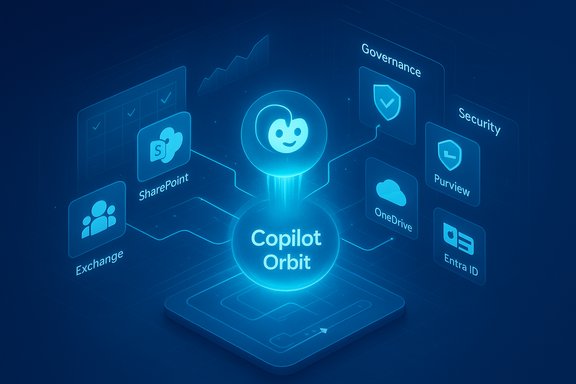
Copilot Orbit positions itself as a channel‑friendly managed offering from ESW (eSoftware Associates) built on the Microsoft Copilot and Power Platform ecosystem. The service claims to deliver four core capabilities for SMBs and mid‑market customers:- Governance, security and permission oversight, including data mapping and alignment with Purview/DLP policies.
- Grounding and integration with business data sources such as SharePoint, Teams, OneDrive, SQL and Exchange so agents act on correct, contextually relevant information.
- Agent and automation development, covering prompt design, Power Automate flows, Teams/SharePoint plugins, and testing.
- A steady cadence of delivery, where new agents or workflows are rolled out monthly rather than as a one‑time “bot build.”
Why this matters now
Microsoft’s Copilot platform and agent paradigm have evolved quickly through 2024–2025, adding tenant‑aware agents, Copilot Studio authoring, and stronger governance integrations (Purview, Entra identities, Defender protections). Microsoft itself launched a Microsoft 365 Copilot Business SKU targeted at organizations with up to 300 seats and priced at USD 21 per user per month, explicitly aimed at lowering the barrier for SMB adoption; that change makes partner managed services more commercially accessible for small and midsize customers. The practical gap for many SMBs is not access to models but operational readiness: designing grounded knowledge indices, mapping sensitive data to labels and DLP rules, building robust connectors and deterministic flows with Power Automate, and putting in place telemetry and FinOps controls so agent consumption does not surprise budgets. Copilot Orbit’s pitch is that a partner‑led, subscription model can deliver that operational muscle without the customer adding a full AI or governance team.What Copilot Orbit promises — a closer look
Governance, data posture and security
ESW lists governance and Purview/DLP alignment as a foundational component. Microsoft’s own documentation and partner guidance emphasize the same elements for safe agent deployment: Entra identities for agents, sensitivity labels and Purview for data governance, and Defender/endpoint controls for runtime protection. Copilot Studio has also tightened DLP defaults in 2025 to reduce inadvertent exposure during agent publishing — an important control for production deployments. Why this matters: agents that can read and act on documents must be constrained by least‑privilege access, auditable identities, and retention/DLP rules. For SMBs without mature security operations, skipping this work invites leakage, regulatory headaches, and costly remediation.Grounding and connector integration
ESW says Copilot Orbit grounds agents against SharePoint, Teams, OneDrive, SQL and Exchange so actions and suggestions are based on the tenant’s authoritative sources. This is standard practice for reliable agent outputs: Microsoft’s recommended architecture for agentic solutions combines Retrieval‑Augmented Generation (RAG) patterns, Dataverse/Graph grounding and Power Platform connectors to avoid hallucination and ensure provenance.Practical implication: Proper grounding requires mapping content locations, indexing metadata, and exposing validated connectors — work that frequently reveals messy content hygiene and permissions issues that must be remediated before automation can be trusted.
Agent and automation engineering
ESW’s service list includes prompt design, Power Automate flows, Teams/SharePoint plugins and testing. This hybrid approach — LLM reasoning for language tasks and Power Automate for deterministic orchestration — follows recommended patterns where agents propose or draft and deterministic flows perform retries, error handling and system write‑backs. Managed testing and a validation station for human review are crucial steps in production rollouts.Continuous delivery model
The commercial differentiator ESW promotes is cadence: delivering monthly agents or workflow upgrades to steadily convert manual processes into automated ones. The subscription cadence aims at predictable value delivery and ongoing tuning rather than “one and done” automations that rot. This approach aligns with the operational reality that agent performance degrades or requires prompt retuning as data and processes change.How this maps to Microsoft’s Copilot platform (validation)
Key platform pieces ESW depends on are real and documented by Microsoft:- Copilot Studio — an authoring and publishing surface for declarative and pro‑code agents. Copilot Studio supports connectors and agent lifecycle controls. Microsoft has published DLP and governance updates for Studio to make tenant publishing safer.
- Microsoft 365 Copilot Business — a lower‑cost SKU tailored to organizations with up to 300 seats, priced at USD 21/user/month, increasing feasibility for SMB deployments and partner bundles that include Purview discounts.
- Identity & governance primitives — Entra agent identities (managed principals), Purview sensitivity/DLP enforcement, and telemetry via the Copilot Control System form the governance fabric partners must leverage. Treat agents as first‑class directory objects for lifecycle and access reviews.
Strengths of the Copilot Orbit approach
- Channel‑ready operational model: Packaging governance, connectors, development, and adoption in a managed subscription reduces the implementation burden for SMBs that lack specialists. This is an effective route to scale AI in organizations that would otherwise stall at pilots.
- Alignment with Microsoft’s ecosystem: By using Copilot Studio, Power Automate, SharePoint and Dataverse patterns, the approach minimizes bespoke engineering and leverages the existing connector ecosystem — a pragmatic way to reduce integration risk.
- Emphasis on governance and observability: The explicit focus on Purview/DLP, Entra identities and telemetry aligns with best practices and is essential for audits, compliance and trust. When done well, this protects both the business and the partner from downstream incidents.
- Repeatable value delivery: A monthly cadence for agent rollouts forces prioritization on measurable use cases and encourages continuous improvement rather than occasional proof‑of‑concept dusting. This model can accelerate cumulative ROI if each deliverable is scoped and measured.
Risks, unknowns and caveats
- Vendor claims vs. customer reality: The headline promise — “agents that automate your company” — is necessarily aspirational. Real‑world automation value depends heavily on data quality, content organization, permissions hygiene, and process clarity. ESW’s offering can reduce lift, but customers must still invest in cleanup and change management. Treat bold outcome claims as conditional on pre‑existing data and process maturity. Flagged as vendor claim — validate in a pilot.
- Model hallucination and decision risk: Even grounded agents make mistakes. The risk is higher when agents are authorized to write back to systems (ERP, financial systems, HR records). The industry pattern is to require human‑in‑the‑loop checkpoints for high‑risk actions and implement deterministic rules and exception handling. Ensure those controls are included in any managed service contract.
- Data residency and third‑party model routing: When Copilot or partners route data to external models or third‑party inference endpoints, procurement and legal teams must assess retention, telemetry, and contractual protections. This is a critical negotiation point for regulated industries. If ESW or a partner routes data to non‑Microsoft models, treat that as a red flag until contractually clarified.
- FinOps and consumption surprises: Agents consume Copilot credits and model inference cycles. Without budgeting and caps, a spike in agent activity can cause unexpected costs. Managed plans must include consumption monitoring and budget guardrails.
- Agent lifecycle and ownership: Agents are operational assets that require naming, ownership, versioning, and retirement playbooks. Smaller organizations often neglect lifecycle governance and then discover shadow agents that cause security or compliance drift. Ensure the managed service agreement defines ownership and handoff processes.
Practical checklist for SMBs evaluating Copilot Orbit or similar managed services
- Clarify scope and measurable outcomes
- Identify 1–3 high‑value pilot workflows (invoice automation, HR onboarding, IT triage).
- Define KPIs (time saved per month, error reduction, headcount equivalence).
- Confirm governance and identity controls
- Require Entra Agent IDs for agents and proof of Purview/DLP alignment during pilot.
- Ask for audit log access and retention policies.
- Validate grounding and connectors
- Request a mapping of data sources the agent will use and evidence of indexing/permissions checks.
- Understand consumption and billing
- Insist on Copilot credit consumption dashboards, monthly caps and FinOps alerts.
- Insist on human‑in‑the‑loop rules for high‑risk actions
- Approve writebacks to finance/HR systems only after staged testing and manual sign‑offs.
- Define ownership and lifecycle
- Name an owner for each agent, an SLA for incidents, and a retirement policy.
- Require a 30/60/90‑day adoption and tuning plan
- Include telemetry reviews, prompt tuning cadence, and user enablement sessions.
- Ask for references and case studies with similar technical stacks
- Prefer customers in your industry or with similar compliance needs.
How partners should price and package managed Copilot services (practical advice)
- Offer a free or low‑cost initial readiness assessment that maps data posture and identifies quick wins.
- Bundle initial governance configuration (Entra + Purview) as a fixed‑price onboarding phase.
- Use tiered recurring plans with clear deliverables per month (e.g., one new low‑risk agent in Plus, two‑three agents in Scale) and explicit success metrics.
- Add optional FinOps and consumption management as a safeguard add‑on.
- Build a standard “validation station” testing playbook so every agent follows a repeatable QA path before receiving writeback privileges.
Verdict — where Copilot Orbit fits in the market
Copilot Orbit is an archetypal channel response to a fast‑moving platform change: Microsoft made agentic Copilot and a lower‑priced SMB Copilot SKU available, and partners are packaging governance, engineering and ongoing operations as recurring services. For SMBs that need hands‑on help to operationalize Copilot agents, a managed, month‑by‑month delivery model is sensible — provided the partner demonstrates strong controls, transparent consumption reporting, and conservative defaults for writebacks and sensitive data access. The offering’s strengths lie in operationalizing platform best practices at scale; its risks are the same as the broader agent era: model error, hidden consumption, and governance gaps if lifecycle controls are not rigorously applied. The most likely successful customers will be those who treat Copilot Orbit as an operational partnership (not a magic switch), commit to data cleanup and labeling, and demand clear KPIs and safety nets.Final recommendations for IT leaders and decision makers
- Treat Copilot Orbit as a vendor‑managed experiment with defined gates: pilot → validate → expand. Do not grant unrestricted writeback privileges during pilot.
- Require a written runbook for every agent covering triggers, data sources, approval points, and incident rollback procedures.
- Negotiate consumption caps and monthly reporting (credits used, run counts, errors, and human interventions).
- Ensure legal and procurement review third‑party routing or model‑choice clauses.
- Start with low‑risk, high‑value use cases (read‑only knowledge agents, ticket triage, document summarization) and only graduate to financial or HR automation after proven accuracy and human oversight are embedded.
Copilot Orbit represents a pragmatic channel play that answers a real market need: converting Copilot pilots into sustainable operational automation for organizations that don’t have large AI teams. The technical plumbing it promises to stitch together — Purview/DLP alignment, Entra identities, Graph/Dataverse grounding, and Power Automate integration — reflects Microsoft’s recommended production patterns. The difference between success and trouble will come down to disciplined governance, realistic expectations, and careful consumption management; done right, the monthly cadence ESW offers can accelerate value, but customers must insist on conservative defaults and transparent controls before letting agents act unmonitored.
Source: GlobeNewswire ESW Introduces Copilot Orbit™, Microsoft AI Automation Services for Small and Mid-Sized Companies
