

Microsoft’s move to fold large language models into the very heart of Windows is the most consequential rethink of the PC in decades — and it arrives as a bundled hardware, software, and cloud strategy that turns the operating system into an active, anticipatory assistant rather than a passive platform.
Background / Overview
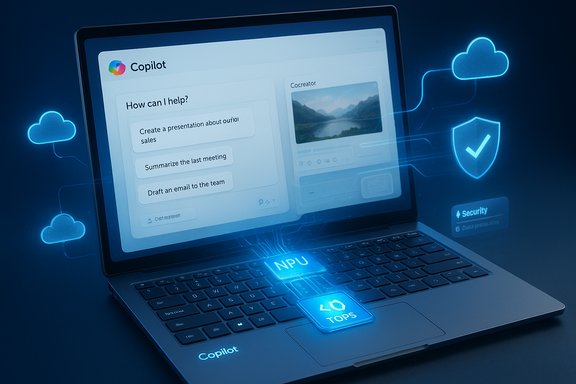
Microsoft introduced the Copilot+ vision — hardware-certified “Copilot+ PCs” paired with deep Windows integration for generative AI — during a major announcement that set out a new product class, new Windows features, and new hardware requirements designed to run AI workloads on-device while remaining connected to cloud models when needed. The company framed Copilot+ as a chip-to-cloud architecture that combines a dedicated Neural Processing Unit (NPU) in new systems with cloud-hosted large language models (LLMs) to deliver features such as Recall (a device timeline and searchable “photographic memory”), Cocreator image and editing tools, live captioning and translation, and system-level agents that can act across apps and files. That platform-level pivot was accompanied by a consumer-facing redesign of Copilot (the assistant previously surfaced in the taskbar), the introduction of a physical Copilot key on new keyboards, and the promise that Copilot would understand context across open apps and files to carry out multi-step, cross-application tasks on command. Microsoft’s messaging emphasized hybrid execution: small, optimized models and runtime processing on the NPU for latency and privacy; heavier reasoning and knowledge tasks in Azure using larger models. The industry reaction was immediate. Analysts, OEMs, and press quickly framed the announcement as the opening of an “AI-PC era” — a shift that could reframe the Windows vs. Mac competition and force new product cycles for chips and devices. At the same time, privacy advocates and security researchers warned that features that read and index local content — even when described as "on-device" — raise complex consent, attack surface, and governance questions.What Microsoft announced, in plain terms
The ingredients of the Copilot+ strategy
- Copilot+ PCs — A certification for devices meeting minimum NPU performance (tens of TOPS), RAM and storage thresholds, and discrete security features. These machines are intended to run small language models (SLMs) locally and call larger cloud models when needed.
- On-device NPU acceleration — Microsoft’s guidance singled out Qualcomm Snapdragon X Elite/X Plus platforms at launch, with Intel and AMD silicon expected to meet certification later. The NPU is positioned as the runtime engine for low-latency, privacy-sensitive tasks.
- Operating-system integration — Copilot is now a first-class, updatable part of the Windows experience with an expanded UI, a dedicated keyboard key/shortcut, and system APIs (the Windows Copilot Runtime and developer imaging APIs) so apps and services can use system-level AI primitives.
- Hybrid model stack — Local SLMs for quick inference plus cloud LLMs for heavy reasoning or access to fresh web knowledge; Microsoft explicitly described the model pairing as chip-to-cloud working in concert.
The headline user experiences promised
- Recall: semantic search of “everything you’ve seen or done” on the PC (opt-in and with controls), enabling retrieval of past screens, documents, and interactions. Microsoft later changed Recall’s default to off and added privacy protections after security scrutiny.
- Click-to-Do / Agents: contextual overlays and small agents that can act across apps (e.g., find last week’s budget spreadsheet, summarize changes, and draft an email). This is the cross-application “agentic” capability Microsoft demoed as a core differentiator.
- Cocreator and image editing: on-device image generation and editing using the NPU for near-real-time results.
How this differs from “running ChatGPT in a browser”
- System-level permissions and context: Copilot+ is designed to access local files, settings, and cross-app context directly (with controls), enabling end-to-end actions that a browser-based chatbot cannot perform without explicit file uploads or third-party integrations.
- On-device inference: The presence of an NPU means some inference can happen locally, reducing latency and keeping data off the network for certain tasks — a capability absent when using a cloud-only chatbot.
- Tighter UI and OS hooks: The Copilot key and system APIs let the assistant be invoked and embedded more naturally than a web chat, with deeper hooks into the Windows shell and application surfaces.
Technical specifications and hardware requirements — verified
Microsoft’s Copilot+ documents and product pages provide concrete spec guidance for the initial Copilot+ wave:- NPU: devices launch with NPUs capable of roughly 40 TOPS (trillion operations per second) in the Snapdragon X Elite/X Plus family; Microsoft requires an NPU threshold to run Copilot+ features locally.
- Memory & storage: Microsoft recommends 16 GB RAM and 256 GB storage as a baseline for Copilot+ experiences because local model storage and runtime require disk and memory headroom.
- Pricing and availability: first Copilot+ PCs were priced from $999 and began shipping in the summer following the announcement window; OEMs named at launch included Surface, Acer, ASUS, Dell, HP, Lenovo and Samsung.
Strengths: why this is powerful for Windows users and enterprises
- A genuine productivity bet: Copilot+ converts natural language into orchestrated, multi-step actions across the OS. If the assistant reliably finds the correct files, extracts context, and executes, that replaces many manual workflows and can save hours each week for knowledge workers. Microsoft’s demos highlight non-trivial use cases: summarizing spreadsheets, compiling CVs from scattered documents, and reorganizing desktops.
- Lower latency and greater responsiveness: On-device SLMs running on an NPU can deliver near-instant responses for many tasks without cloud round-trips, which matters for both productivity and perceived usefulness. That change addresses one of the core friction points for generative AI in daily workflows.
- OEM and developer ecosystem alignment: Microsoft shipped APIs and runtime components (Windows Copilot Runtime, imaging APIs, and dev tooling) so ISVs and independent developers can tap the system-level AI primitives and create richer, integrated apps — a big advantage over treating AI as an incidental cloud service.
- Security-first posture in messaging: Microsoft responded to early privacy scrutiny (notably around Recall) by making such features opt-in, adding exclusion controls, and promising local processing where possible. For enterprise customers, Microsoft emphasized governance, tenant controls, and compliance tooling. Those are essential for adoption in regulated industries.
Risks, unknowns, and the question marks enterprises must weigh
- Depth of system access = attack surface: The same capabilities that let Copilot read and cross-reference local documents and app state also expand the attack surface. If the assistant or its index is compromised, attackers could gain a shortcut to sensitive data. Microsoft’s opt-in defaults and Windows Pluton/secure runtime are protective steps, but they do not eliminate risk. Security teams will need to evaluate data flows, local indexes, permission boundaries, and incident response plans.
- Privacy and telemetry ambiguity: Microsoft’s hybrid model claims some processing stays on-device while other heavier tasks use Azure LLMs. Precisely which prompts, snippets, or metadata leave the device in practice — and under what legal and contractual guarantees — must be made explicit for enterprises handling regulated or confidential data. Public statements stress “user control,” but details and independent audits are necessary.
- Vendor lock-in and model sourcing: Microsoft has publicly indicated it will use a mix of OpenAI models, Microsoft’s internal models, and third-party models for different Copilot experiences. This diversity reduces single-vendor dependency but complicates enterprise assurance (who trains the model, what data is retained, and what red-team testing was done?. Reports also indicate Microsoft is actively working to diversify model sources for cost and performance reasons — a practical tug-of-war that could change capabilities and pricing over time.
- Hardware fragmentation and upgrade pressure: The Copilot+ certification means many recently sold “AI-branded” laptops (or even mainstream laptops with modest NPUs) won’t get the full feature set. That leaves consumers and enterprises facing a replacement cycle: buy a new Copilot+ certified device or accept reduced functionality. The requirement for specific NPU performance levels effectively creates a hardware moat in the short term.
- Cost model and long-term economics: Microsoft has historically used a freemium or subscription model for Copilot-related features (Copilot Pro, Microsoft 365 Copilot). While baseline Copilot features may remain free or included with Windows, advanced, cloud-intensive, or enterprise-grade capabilities are likely to be monetized. That complicates TCO calculations: hardware premiums for Copilot+ devices plus recurring service fees for cloud-model usage can add up.
How privacy, security, and governance look in practice (what’s been confirmed)
- Recall will be off by default and excludes sensitive categories unless the user opts in; Microsoft added controls to exclude apps and websites from indexing. This came after public scrutiny and showed Microsoft will iterate features based on security feedback.
- Enterprise controls: Microsoft positioned Copilot features for business deployment with admin controls for managing Copilot, agent behavior, and data access; it also says tenant-bound processing and non-retention options are available for certain commercial services. Organizations should map those settings against their compliance needs and audit requirements.
- Hardware security: Copilot+ PCs were announced with the Microsoft Pluton security processor enabled and additional defaults to reduce the risk of firmware and local attack vectors — a necessary but not sufficient component of a broader security posture.
What this means for competitors and the broader OS landscape
Microsoft’s architecture-level integration of AI into Windows is a clear strategic bet: make the OS itself the session manager and memory layer for an AI assistant that can act on behalf of the user. The immediate consequence is competitive pressure on Apple and Google to answer with comparable, system-level assistants that can act across apps and devices with the same fluidity. The result could be an OS-level arms race over NPUs, efficient on-device models, and new privacy/consent standards. Early responses from hardware and OEM partners show they’ll race to produce Copilot+ certified machines and compatible silicon.Practical guidance: what IT teams should do now (a short checklist)
- Inventory: map sensitive data flows and the apps that Copilot would potentially index or interact with.
- Pilot: enroll a small set of users in early Copilot+ or Copilot experiences to measure benefit and surface privacy issues.
- Policy: define explicit governance for AI features — opt-in for Recall-like features, exclusion lists for apps/sites, and logging/auditing of Copilot actions.
- Procurement: include Copilot+ certification, NPU performance, RAM, and storage minimums in device purchasing specs if you plan to adopt Microsoft’s full stack.
- Cost modeling: estimate cloud model usage and potential subscription costs over a 3–5 year horizon; include device amortization in your analysis.
Independent verification and cross-references
Key claims in this piece have been cross-checked against Microsoft’s official Copilot+/Windows blogs and multiple independent reports:- Microsoft’s Copilot+ blog and Windows Experience posts describe the Copilot+ PC architecture, NPU requirements, and the hybrid model approach.
- Coverage by major outlets (CNBC, The Verge, Windows Central, PCWorld) independently reported the Copilot key, the Copilot+ PC pricing and OEM list, and privacy concerns and follow-ups about Recall. Those stories echoed Microsoft’s technical framing and added context from independent reporters and hardware reviewers.
How accurate was the Zoom Bangla piece you supplied?
The Zoom Bangla report we were asked to assess captures the high-level shape of Microsoft’s announcement: deep Copilot integration in Windows, a dedicated Copilot keyboard button, NPU requirements for Copilot+ PCs, hybrid on-device/cloud processing, and the broad productivity scenarios Microsoft demoed (find, summarize, and act across files). Those core statements align with Microsoft’s official messaging and contemporaneous coverage. Where the article frames the change as “integrating OpenAI’s GPT-4 directly into Windows” we must add nuance: Microsoft’s consumer and commercial Copilot experiences have used a variety of OpenAI-derived models (GPT-4, GPT-4 Turbo at various tiers) and Microsoft has also been explicit about running different model classes locally (small models on NPUs) and invoking larger cloud models for complex tasks. In short, the OS is integrated with a model stack that includes OpenAI models in the cloud in many experiences, but the on-device execution is usually smaller, optimized models — not necessarily a full GPT-4 instance running locally. That distinction matters for claims about where the “brain” lives and how private or self-contained the system is. I also flagged the model- and subscription-related items from the Zoom Bangla article for caution: Microsoft has shifted which tiers get access to which OpenAI models (for example, rolling GPT-4 Turbo into certain Copilot tiers), and it continues to evolve pricing and feature gating. Those business-level details were in flux at announcement and have been adjusted since. Treat claims about final consumer pricing and long-term inclusion of specific models as provisional until Microsoft publishes explicit product-level commitments. Finally, the Zoom Bangla article’s Q&A (about hardware upgrades, subscription likelihood, and file access) is reasonable as a practical summary — but each of those answers depends on device qualification, admin policy, and Microsoft’s future commercial choices. For example, the NPU requirement is a real gating factor for Copilot+ features — but Microsoft also plans expanded Copilot features to work on non-Copilot+ devices in reduced form. (Referenced locally uploaded forum and briefing notes on Windows Intelligence and Copilot rollout also align with this analysis and the timeline of Windows-level AI settings and controls that Microsoft has been building.The bottom line
Microsoft’s Copilot+ strategy is the company’s attempt to put AI at the center of personal computing: a combined hardware requirement, an expanded OS role for the assistant, and a hybrid model infrastructure that fuses local latency/privacy advantages with cloud horsepower. The potential benefits are substantial — faster, more natural productivity workflows and new developer primitives — but they come with concrete risks around privacy, security, procurement cost, and vendor control.For IT leaders and power users the prudent path is staged adoption: pilot to validate real productivity wins, exercise fine-grained governance controls, and require vendor transparency (model provenance, data retention, red-team results) before rolling Copilot features into regulated workflows. Consumers should be clear-eyed about the trade-offs: you may need newer hardware to get the full promise, and some advanced features will likely tie into cloud subscriptions over time.
The promise is transformative: an always-available assistant that can act on your behalf across the OS. The reality will be determined by implementation detail, transparency, and the discipline of organizations and regulators to demand safe defaults, verifiable privacy guarantees, and accountable governance. If Microsoft, its OEM partners, and the security community get those pieces right, Copilot+ could usher in a genuinely new era of PC computing. If not, the feature set could become a vector for new privacy and security headaches that slow adoption.
Source: Zoom Bangla News Windows Gets a Brain: Microsoft Integrates GPT-4 Directly into Operating System
