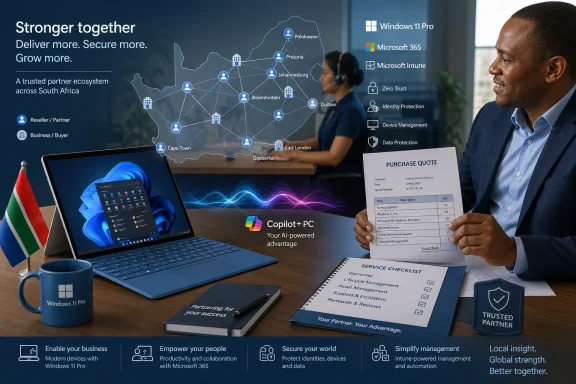
Microsoft Surface’s South African channel story shifted on July 1, 2026, as Business Day Spotlight highlighted Core Group’s expanding reseller programme for Surface for Business devices across a market where Microsoft’s hardware reach depends heavily on distributors and downstream partners. The news is not merely that another vendor programme exists. It is that Microsoft’s most emblematic Windows hardware is being pushed through the same messy, relationship-driven channel that actually buys, deploys, services, and renews PCs for much of the region. For Windows users and IT shops, that makes the reseller programme less a sales footnote than a test of whether premium, AI-branded Windows PCs can move beyond glossy launch events and into ordinary business refresh cycles.
Surface has always carried a strange burden inside the Windows ecosystem. Microsoft built it as a reference device, a way to show OEMs and customers what Windows hardware could look like when the software company controlled the whole stack. That made sense in New York launch rooms and Microsoft Store demos, but it was always a more awkward proposition in regions where business PCs are bought through account managers, tender processes, warranty expectations, and reseller credit lines.
Core Group’s programme matters because it turns Surface into something more operational. According to the Business Day discussion, the initiative is aimed at helping small and mid-sized resellers grow by giving them access to Surface for Business devices. That is a quiet but important distinction: Microsoft is not simply trying to sell another laptop to a well-funded enterprise buyer; it is trying to broaden the base of businesses that can quote, configure, and support Surface as part of a broader Microsoft stack.
That also explains why the programme does not appear to be built around a forbidding certification maze. John Press, Core Group’s Surface Business Unit head, reportedly frames entry in terms of basic technological capability, business compliance, and a defined target market. In channel terms, that is a deliberate lowering of friction. Microsoft and Core need resellers who can reach customers, not only those already polished enough to sit in the top tier of enterprise procurement.
There is a gamble here. Premium hardware does not become mainstream in business merely because more companies can resell it. It becomes mainstream when the economics, availability, after-sales support, and procurement paperwork line up well enough that a reseller can recommend it without risking the customer relationship. Core’s programme is therefore best understood as a distribution bet, not a marketing campaign.
A laptop is not a SaaS license. It has to be imported, stocked, financed, insured, shipped, imaged, repaired, replaced, and eventually retired. The more fragmented the customer base, the more useful the reseller becomes. A small accounting firm, a regional logistics operator, or a school group may not want a direct relationship with Microsoft hardware sales; it wants a local partner that can bundle devices with Microsoft 365, endpoint management, security, accessories, and support.
That is especially true in South Africa and the broader Sub-Saharan African market, where currency volatility, logistics constraints, public-sector procurement rules, and uneven enterprise maturity all shape how technology is bought. The clean global story of “AI PCs are arriving” collides with local questions: Who has stock? Who can extend payment terms? Who handles warranty swaps? Who knows whether a customer actually needs a premium 2-in-1, or whether a cheaper business notebook will do?
Core Group already operates in this world. Its distribution portfolio includes premium consumer and business technology brands, including Apple, Nintendo, and Microsoft. That matters because Surface is not entering a blank market; it is entering a channel where Core has experience turning desirable global brands into locally purchasable products. The challenge is that Surface for Business is neither a pure consumer status device nor a commodity corporate laptop. It sits in the middle, where channel education and positioning matter.
That makes the reported reliance on the reseller network in the region especially important. Unlike manufacturers that sell directly to large enterprises, the Surface business described by Press depends on the reseller network, which spans thousands of software and hardware channel partners. The practical consequence is that Microsoft’s local Surface ambitions are limited by how many partners understand the product, can source it reliably, and are willing to pitch it against entrenched alternatives from Lenovo, HP, Dell, and Apple.
This is not necessarily a weakness. The reseller channel is often where Microsoft’s software story becomes a business outcome. A partner can walk into a customer conversation about device replacement and turn it into a discussion about Windows 11 readiness, endpoint security, Teams rooms, identity, compliance, and AI features. Surface gives that partner a Microsoft-branded hardware anchor for the rest of the stack.
But the arrangement also limits Microsoft’s control. Every layer in the channel adds interpretation. A reseller may lead with price, a distributor may lead with inventory, and a customer may lead with serviceability. If Surface is to win, it must survive that translation. The device cannot rely on Microsoft’s brand aura alone.
The risk is that AI PC becomes another vendor phrase that sounds impressive in a launch deck and vague in a purchasing meeting. For many SMB customers, the immediate questions are not philosophical. They want to know whether AI-capable devices will last longer, whether they justify a higher upfront price, whether they support existing applications, whether they simplify administration, and whether they introduce new privacy or compliance concerns.
That is where a reseller programme becomes strategically useful. Microsoft can announce AI features; resellers must explain them. A local partner can tell a customer whether a Surface Laptop for Business is a sensible choice for executives, mobile workers, designers, field staff, or general office users. It can also say when Surface is not the right fit, which is the kind of credibility vendors rarely get from their own marketing.
There is another practical angle. AI features are increasingly tied to Windows versioning, silicon capabilities, cloud subscriptions, and management policies. A business may buy a new device expecting a Copilot-centered experience, only to discover that licensing, region availability, data policies, or hardware eligibility complicate the story. A competent reseller can prevent those gaps from turning into resentment.
The attraction is not only that the hardware runs Windows well. It is that Microsoft can present Surface, Windows 11, Microsoft 365, Intune, Defender, Entra ID, and Copilot as parts of a single operational story. That story appeals to IT teams that want fewer variables and cleaner accountability. If the device, operating system, productivity suite, management layer, and security tooling all come from the same vendor ecosystem, troubleshooting and policy design can feel less fragmented.
Of course, the Windows ecosystem has historically thrived precisely because it is not vertically locked down. Enterprises have long mixed Dell desktops, Lenovo ThinkPads, HP workstations, custom images, third-party management tools, and Microsoft software. Surface does not replace that model. It offers Microsoft’s preferred version of it.
For resellers, that creates an upsell path. A Surface sale can lead to accessory revenue, warranty revenue, deployment services, device management work, security assessments, and recurring cloud licensing. The programme’s value to small and mid-sized resellers is not just access to premium devices; it is access to a broader conversation about workplace modernization.
Microsoft’s answer is usually total value rather than sticker price. Premium build quality, security features, manageability, Windows integration, and longer device relevance are meant to justify the investment. That argument can work, particularly for mobile staff, executives, hybrid workers, and customers standardizing on Microsoft management tools. It is less persuasive when the buyer needs fifty durable laptops for basic office work and has a fixed budget.
This is where the reseller’s incentives matter. If Core and Microsoft provide strong pricing, training, after-sales support, and deal protection, partners may be willing to introduce Surface into accounts where it previously seemed too niche. If margins are thin, stock is inconsistent, or support is cumbersome, resellers will default to products they already know how to sell profitably.
The programme’s success will therefore depend on ordinary channel mechanics. Are quotes fast? Are warranties clear? Are demo units available? Can resellers get training without sacrificing billable time? Can they compete against larger partners without being crushed on price? These details are less glamorous than AI, but they decide whether a device becomes a business line or a brochure.
That involves more than product sheets. A good distributor helps partners understand which SKUs to lead with, how to attach warranties and accessories, how to position devices against competitive offerings, and how to avoid promising features that a customer cannot use. For an AI-era Surface push, that education becomes even more important because the feature matrix is changing quickly.
The distributor also provides confidence. Smaller resellers may not have the balance sheet or vendor relationships to carry premium hardware risk on their own. A programme that gives them access, enablement, and support can let them participate in deals that would otherwise flow to larger channel players. That broadening effect appears to be the explicit promise of Core’s initiative.
Still, broadening the channel can create tension. Larger resellers may worry about margin erosion. Smaller partners may worry that they are being invited into a programme without enough practical support to win. Customers may see more Surface quotes but not necessarily better Surface expertise. The difference between expansion and dilution will come down to enablement quality.
That context helps explain why Core’s more accessible reseller programme is significant. There is a ladder here. A smaller reseller may begin with basic access to Surface for Business devices, build competence, attach services, and eventually become a more meaningful Microsoft hardware partner. The programme is not only about today’s sales; it is about feeding the partner ecosystem that Microsoft will need if Surface is to be more than a premium niche.
The revenue-tier model also shows the dual nature of Microsoft’s channel strategy. On one hand, the company wants breadth. On the other, it rewards partners that produce measurable volume. That is standard channel economics, but it can shape behavior in subtle ways. Partners may focus on higher-margin customers, device refresh campaigns, or bundled projects that count toward meaningful revenue movement.
For IT buyers, the existence of partner tiers can be both useful and opaque. A more advanced Surface partner may have better incentives, deeper reporting, and more experience. But a smaller local reseller may understand the customer’s environment better. Microsoft and Core will need both kinds of partners if Surface is to expand without becoming disconnected from real customer needs.
The end of Windows 10 support in 2025 forced many organizations to confront device eligibility and refresh planning. Even after that deadline, the aftershocks continue, especially among smaller businesses that delayed upgrades, used extended support options, or discovered that their fleets were less ready for Windows 11 than expected. Surface for Business gives Microsoft and its partners a clean answer to that mess: buy hardware designed for the current Windows roadmap.
But that answer is not automatically economical. Many businesses still stretch hardware lifecycles as long as possible. Others are skeptical of first-generation AI messaging after years of productivity promises that required cloud subscriptions, policy tuning, and user training to matter. Resellers sit in the middle of that skepticism. They are the ones who must turn vendor urgency into customer timing.
This is why the Core programme is more interesting than a typical channel announcement. It is not just about adding more names to a reseller list. It is about creating more points of persuasion at a moment when the Windows PC is being redefined but not yet universally understood.
The region also exposes the limits of global uniformity. A device strategy that works in the United States or the United Kingdom cannot simply be copied into South Africa. Pricing, support expectations, currency exposure, import dynamics, and reseller economics all shift the calculation. Microsoft’s Surface business has to prove that it can be locally viable, not merely globally prestigious.
Core’s portfolio gives it a useful comparative advantage. Having handled premium brands, it understands that availability and aspiration must move together. Apple’s channel, for example, has long depended on making premium hardware feel accessible through retail, enterprise resellers, financing, and service networks. Surface has a different identity, but it faces a similar distribution challenge.
There is also a Windows-specific opportunity. Unlike Apple, Microsoft can lean on the installed base of Windows software, Microsoft 365 tenants, and Active Directory or Entra-connected environments. Surface does not have to persuade customers to switch ecosystems. It has to persuade them that Microsoft’s own hardware is the best expression of the ecosystem they already use.
A reseller-led Surface push gives Microsoft a way to make that conversation more concrete. Instead of presenting AI PCs as an abstract platform transition, partners can attach them to everyday business scenarios: faster video workflows, better hybrid meetings, local AI features, stronger security baselines, and longer useful life. Some of those claims will prove more valuable than others, and good partners will learn which ones resonate.
There is a danger, however, in overselling the AI angle. If customers buy premium devices expecting immediate transformation, disappointment will follow. The more durable pitch is that modern business PCs are becoming security, identity, management, and AI endpoints at once. Surface is Microsoft’s attempt to package that convergence cleanly.
That is why Core’s reseller programme is a practical hinge for a strategic story. Microsoft can design the hardware and the software, but the channel has to normalize the purchase. Once a reseller can say, without drama, “This is the right Surface configuration for your next three-year cycle,” the AI PC stops being a slogan and becomes a line item.
The reported low barrier to entry is sensible, but it must be matched by rising competence. A reseller does not need an intimidating certification chain to begin, but customers still need confidence that the person quoting the device understands business deployment. Surface for Business is not just a nicer consumer laptop with a different label. It involves business SKUs, manageability expectations, warranty choices, and lifecycle planning.
Core and Microsoft should therefore be judged on enablement, not announcements. Training, demo access, competitive battle cards, warranty clarity, financing options, and escalation paths will decide the quality of the channel. A thousand nominal resellers are less valuable than a few hundred who can sell responsibly and support what they sell.
The programme also needs feedback loops. Resellers will know quickly where Surface struggles: price objections, missing configurations, accessory availability, repair turnaround, customer confusion about AI features, or competitive discounting. If Core can relay that intelligence back into stocking, pricing, and messaging, the programme can improve. If not, it risks becoming another vendor initiative that sounded compelling at launch and faded into the partner portal.
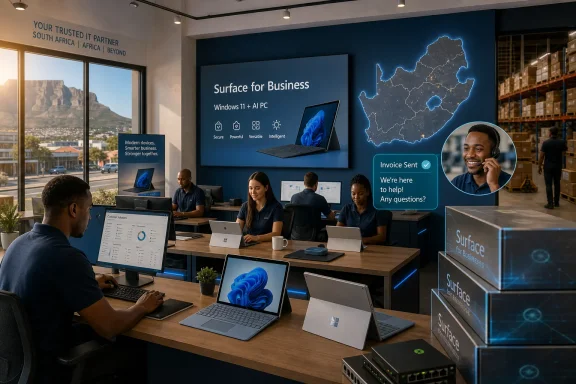 Surface Stops Being a Showpiece and Starts Acting Like a Channel Product
Surface has always carried a strange burden inside the Windows ecosystem. Microsoft built it as a reference device, a way to show OEMs and customers what Windows hardware could look like when the software company controlled the whole stack. That made sense in New York launch rooms and Microsoft Store demos, but it was always a more awkward proposition in regions where business PCs are bought through account managers, tender processes, warranty expectations, and reseller credit lines.Core Group’s programme matters because it turns Surface into something more operational. According to the Business Day discussion, the initiative is aimed at helping small and mid-sized resellers grow by giving them access to Surface for Business devices. That is a quiet but important distinction: Microsoft is not simply trying to sell another laptop to a well-funded enterprise buyer; it is trying to broaden the base of businesses that can quote, configure, and support Surface as part of a broader Microsoft stack.
That also explains why the programme does not appear to be built around a forbidding certification maze. John Press, Core Group’s Surface Business Unit head, reportedly frames entry in terms of basic technological capability, business compliance, and a defined target market. In channel terms, that is a deliberate lowering of friction. Microsoft and Core need resellers who can reach customers, not only those already polished enough to sit in the top tier of enterprise procurement.
There is a gamble here. Premium hardware does not become mainstream in business merely because more companies can resell it. It becomes mainstream when the economics, availability, after-sales support, and procurement paperwork line up well enough that a reseller can recommend it without risking the customer relationship. Core’s programme is therefore best understood as a distribution bet, not a marketing campaign.
The Old Supply Chain Still Runs the New Windows PC
The most revealing part of the Business Day framing is its acknowledgement that the hardware ecosystem still runs on a legacy supply chain model. Appointed distributors serve downstream partners, who then serve end customers. That can sound outdated in an era of direct cloud marketplaces and self-service portals, but for physical devices it remains stubbornly relevant.A laptop is not a SaaS license. It has to be imported, stocked, financed, insured, shipped, imaged, repaired, replaced, and eventually retired. The more fragmented the customer base, the more useful the reseller becomes. A small accounting firm, a regional logistics operator, or a school group may not want a direct relationship with Microsoft hardware sales; it wants a local partner that can bundle devices with Microsoft 365, endpoint management, security, accessories, and support.
That is especially true in South Africa and the broader Sub-Saharan African market, where currency volatility, logistics constraints, public-sector procurement rules, and uneven enterprise maturity all shape how technology is bought. The clean global story of “AI PCs are arriving” collides with local questions: Who has stock? Who can extend payment terms? Who handles warranty swaps? Who knows whether a customer actually needs a premium 2-in-1, or whether a cheaper business notebook will do?
Core Group already operates in this world. Its distribution portfolio includes premium consumer and business technology brands, including Apple, Nintendo, and Microsoft. That matters because Surface is not entering a blank market; it is entering a channel where Core has experience turning desirable global brands into locally purchasable products. The challenge is that Surface for Business is neither a pure consumer status device nor a commodity corporate laptop. It sits in the middle, where channel education and positioning matter.
Microsoft’s Direct-Sales Muscle Has Limits
Microsoft can sell software globally with extraordinary efficiency, but Surface is a reminder that the company’s power is unevenly distributed. Windows, Microsoft 365, Azure, Defender, Intune, and Copilot can all be attached to digital procurement workflows. Surface devices still need physical channel density. In many markets, the route to business buyers is not a Microsoft checkout page; it is a reseller’s quote.That makes the reported reliance on the reseller network in the region especially important. Unlike manufacturers that sell directly to large enterprises, the Surface business described by Press depends on the reseller network, which spans thousands of software and hardware channel partners. The practical consequence is that Microsoft’s local Surface ambitions are limited by how many partners understand the product, can source it reliably, and are willing to pitch it against entrenched alternatives from Lenovo, HP, Dell, and Apple.
This is not necessarily a weakness. The reseller channel is often where Microsoft’s software story becomes a business outcome. A partner can walk into a customer conversation about device replacement and turn it into a discussion about Windows 11 readiness, endpoint security, Teams rooms, identity, compliance, and AI features. Surface gives that partner a Microsoft-branded hardware anchor for the rest of the stack.
But the arrangement also limits Microsoft’s control. Every layer in the channel adds interpretation. A reseller may lead with price, a distributor may lead with inventory, and a customer may lead with serviceability. If Surface is to win, it must survive that translation. The device cannot rely on Microsoft’s brand aura alone.
The AI PC Pitch Needs Feet on the Ground
The Business Day discussion reportedly turns to emerging technologies such as AI and how they are shaping the personal computer market. That is inevitable in 2026. Microsoft has spent the past two years repositioning Windows PCs around local AI acceleration, Copilot experiences, neural processing units, and a new hardware baseline for what a modern business computer should be.The risk is that AI PC becomes another vendor phrase that sounds impressive in a launch deck and vague in a purchasing meeting. For many SMB customers, the immediate questions are not philosophical. They want to know whether AI-capable devices will last longer, whether they justify a higher upfront price, whether they support existing applications, whether they simplify administration, and whether they introduce new privacy or compliance concerns.
That is where a reseller programme becomes strategically useful. Microsoft can announce AI features; resellers must explain them. A local partner can tell a customer whether a Surface Laptop for Business is a sensible choice for executives, mobile workers, designers, field staff, or general office users. It can also say when Surface is not the right fit, which is the kind of credibility vendors rarely get from their own marketing.
There is another practical angle. AI features are increasingly tied to Windows versioning, silicon capabilities, cloud subscriptions, and management policies. A business may buy a new device expecting a Copilot-centered experience, only to discover that licensing, region availability, data policies, or hardware eligibility complicate the story. A competent reseller can prevent those gaps from turning into resentment.
Surface for Business Is Really a Microsoft Stack Delivery Vehicle
Surface devices are often judged like ordinary laptops: screen, keyboard, ports, battery, performance, price. That is fair for consumers, but incomplete for business. Surface for Business is more accurately a delivery vehicle for a managed Microsoft environment.The attraction is not only that the hardware runs Windows well. It is that Microsoft can present Surface, Windows 11, Microsoft 365, Intune, Defender, Entra ID, and Copilot as parts of a single operational story. That story appeals to IT teams that want fewer variables and cleaner accountability. If the device, operating system, productivity suite, management layer, and security tooling all come from the same vendor ecosystem, troubleshooting and policy design can feel less fragmented.
Of course, the Windows ecosystem has historically thrived precisely because it is not vertically locked down. Enterprises have long mixed Dell desktops, Lenovo ThinkPads, HP workstations, custom images, third-party management tools, and Microsoft software. Surface does not replace that model. It offers Microsoft’s preferred version of it.
For resellers, that creates an upsell path. A Surface sale can lead to accessory revenue, warranty revenue, deployment services, device management work, security assessments, and recurring cloud licensing. The programme’s value to small and mid-sized resellers is not just access to premium devices; it is access to a broader conversation about workplace modernization.
The Premium Device Problem Does Not Disappear
The hard question is whether Surface’s price and positioning match the needs of the customers the programme hopes to reach. Small and mid-sized resellers serve a broad market, and much of that market is cost-sensitive. A well-built Surface device may be attractive, but it competes against business laptops that are cheaper, familiar, easier to repair, or already approved by procurement departments.Microsoft’s answer is usually total value rather than sticker price. Premium build quality, security features, manageability, Windows integration, and longer device relevance are meant to justify the investment. That argument can work, particularly for mobile staff, executives, hybrid workers, and customers standardizing on Microsoft management tools. It is less persuasive when the buyer needs fifty durable laptops for basic office work and has a fixed budget.
This is where the reseller’s incentives matter. If Core and Microsoft provide strong pricing, training, after-sales support, and deal protection, partners may be willing to introduce Surface into accounts where it previously seemed too niche. If margins are thin, stock is inconsistent, or support is cumbersome, resellers will default to products they already know how to sell profitably.
The programme’s success will therefore depend on ordinary channel mechanics. Are quotes fast? Are warranties clear? Are demo units available? Can resellers get training without sacrificing billable time? Can they compete against larger partners without being crushed on price? These details are less glamorous than AI, but they decide whether a device becomes a business line or a brochure.
Core Group Becomes the Interpreter Between Redmond and the Region
Core Group’s role is not simply to move boxes. In a market like South Africa, the distributor is also a translator of global vendor strategy into local commercial reality. Microsoft may define the Surface portfolio; Core has to make it legible to the resellers who will actually sell it.That involves more than product sheets. A good distributor helps partners understand which SKUs to lead with, how to attach warranties and accessories, how to position devices against competitive offerings, and how to avoid promising features that a customer cannot use. For an AI-era Surface push, that education becomes even more important because the feature matrix is changing quickly.
The distributor also provides confidence. Smaller resellers may not have the balance sheet or vendor relationships to carry premium hardware risk on their own. A programme that gives them access, enablement, and support can let them participate in deals that would otherwise flow to larger channel players. That broadening effect appears to be the explicit promise of Core’s initiative.
Still, broadening the channel can create tension. Larger resellers may worry about margin erosion. Smaller partners may worry that they are being invited into a programme without enough practical support to win. Customers may see more Surface quotes but not necessarily better Surface expertise. The difference between expansion and dilution will come down to enablement quality.
Microsoft’s Partner Tiers Reveal the Bigger Channel Logic
Microsoft’s broader Surface Reseller Alliance structure shows how formal the business becomes once partners scale. The programme recognizes different partner types and tiers, with revenue-based thresholds and Partner Center reporting used to track status, incentives, and performance. South Africa is included in Microsoft’s published market category structure for Surface partner thresholds, which places the country inside a global incentive framework rather than treating it as an afterthought.That context helps explain why Core’s more accessible reseller programme is significant. There is a ladder here. A smaller reseller may begin with basic access to Surface for Business devices, build competence, attach services, and eventually become a more meaningful Microsoft hardware partner. The programme is not only about today’s sales; it is about feeding the partner ecosystem that Microsoft will need if Surface is to be more than a premium niche.
The revenue-tier model also shows the dual nature of Microsoft’s channel strategy. On one hand, the company wants breadth. On the other, it rewards partners that produce measurable volume. That is standard channel economics, but it can shape behavior in subtle ways. Partners may focus on higher-margin customers, device refresh campaigns, or bundled projects that count toward meaningful revenue movement.
For IT buyers, the existence of partner tiers can be both useful and opaque. A more advanced Surface partner may have better incentives, deeper reporting, and more experience. But a smaller local reseller may understand the customer’s environment better. Microsoft and Core will need both kinds of partners if Surface is to expand without becoming disconnected from real customer needs.
The Reseller Revival Is Also a Response to Fragmentation
The timing of this push is not accidental. The PC market is fragmenting along several lines at once: Intel versus Arm, cloud AI versus local AI, consumer Copilot features versus business controls, Windows 10 retirement pressure versus Windows 11 modernization, and premium device aspirations versus constrained budgets. Customers need interpretation, not just inventory.The end of Windows 10 support in 2025 forced many organizations to confront device eligibility and refresh planning. Even after that deadline, the aftershocks continue, especially among smaller businesses that delayed upgrades, used extended support options, or discovered that their fleets were less ready for Windows 11 than expected. Surface for Business gives Microsoft and its partners a clean answer to that mess: buy hardware designed for the current Windows roadmap.
But that answer is not automatically economical. Many businesses still stretch hardware lifecycles as long as possible. Others are skeptical of first-generation AI messaging after years of productivity promises that required cloud subscriptions, policy tuning, and user training to matter. Resellers sit in the middle of that skepticism. They are the ones who must turn vendor urgency into customer timing.
This is why the Core programme is more interesting than a typical channel announcement. It is not just about adding more names to a reseller list. It is about creating more points of persuasion at a moment when the Windows PC is being redefined but not yet universally understood.
South Africa Is a Useful Test Case for Microsoft’s Hardware Ambitions
South Africa is large enough to matter and complex enough to be revealing. It has sophisticated enterprise buyers, a mature channel ecosystem, a strong Microsoft partner community, and plenty of small and mid-sized organizations that rely heavily on trusted IT providers. If Surface can expand there through a distributor-led reseller model, the lessons may apply elsewhere in emerging and middle-income markets.The region also exposes the limits of global uniformity. A device strategy that works in the United States or the United Kingdom cannot simply be copied into South Africa. Pricing, support expectations, currency exposure, import dynamics, and reseller economics all shift the calculation. Microsoft’s Surface business has to prove that it can be locally viable, not merely globally prestigious.
Core’s portfolio gives it a useful comparative advantage. Having handled premium brands, it understands that availability and aspiration must move together. Apple’s channel, for example, has long depended on making premium hardware feel accessible through retail, enterprise resellers, financing, and service networks. Surface has a different identity, but it faces a similar distribution challenge.
There is also a Windows-specific opportunity. Unlike Apple, Microsoft can lean on the installed base of Windows software, Microsoft 365 tenants, and Active Directory or Entra-connected environments. Surface does not have to persuade customers to switch ecosystems. It has to persuade them that Microsoft’s own hardware is the best expression of the ecosystem they already use.
The Channel Will Decide Whether Copilot PCs Become Ordinary
Microsoft’s AI PC campaign has mostly been told from the top down. The company announces devices, silicon partnerships, Windows features, and Copilot experiences, then waits for OEMs and developers to fill in the rest. But adoption will be decided from the bottom up, in procurement meetings and renewal conversations where buyers ask whether the new class of PC solves a real problem.A reseller-led Surface push gives Microsoft a way to make that conversation more concrete. Instead of presenting AI PCs as an abstract platform transition, partners can attach them to everyday business scenarios: faster video workflows, better hybrid meetings, local AI features, stronger security baselines, and longer useful life. Some of those claims will prove more valuable than others, and good partners will learn which ones resonate.
There is a danger, however, in overselling the AI angle. If customers buy premium devices expecting immediate transformation, disappointment will follow. The more durable pitch is that modern business PCs are becoming security, identity, management, and AI endpoints at once. Surface is Microsoft’s attempt to package that convergence cleanly.
That is why Core’s reseller programme is a practical hinge for a strategic story. Microsoft can design the hardware and the software, but the channel has to normalize the purchase. Once a reseller can say, without drama, “This is the right Surface configuration for your next three-year cycle,” the AI PC stops being a slogan and becomes a line item.
The Real Test Comes After the First Wave of Sign-Ups
Launching or expanding a reseller programme is the easy part. The harder part comes six months later, when partners know whether the portal is useful, whether leads convert, whether support responds, and whether Surface earns repeat business. Channel enthusiasm is perishable. If early deals are painful, partners remember.The reported low barrier to entry is sensible, but it must be matched by rising competence. A reseller does not need an intimidating certification chain to begin, but customers still need confidence that the person quoting the device understands business deployment. Surface for Business is not just a nicer consumer laptop with a different label. It involves business SKUs, manageability expectations, warranty choices, and lifecycle planning.
Core and Microsoft should therefore be judged on enablement, not announcements. Training, demo access, competitive battle cards, warranty clarity, financing options, and escalation paths will decide the quality of the channel. A thousand nominal resellers are less valuable than a few hundred who can sell responsibly and support what they sell.
The programme also needs feedback loops. Resellers will know quickly where Surface struggles: price objections, missing configurations, accessory availability, repair turnaround, customer confusion about AI features, or competitive discounting. If Core can relay that intelligence back into stocking, pricing, and messaging, the programme can improve. If not, it risks becoming another vendor initiative that sounded compelling at launch and faded into the partner portal.
The Surface Bet Now Runs Through the People Who Answer the Phone
Core Group’s expansion of the Microsoft Surface reseller programme leaves several concrete signals for Windows buyers and partners watching the region:- Microsoft’s Surface for Business growth in South Africa depends on the reseller channel rather than a primarily direct-sales hardware model.
- Core Group is positioning the programme as an entry point for small and mid-sized resellers that can meet basic business and technical expectations.
- The AI PC pitch will need local partner translation because customers care less about branding than about lifecycle, support, security, and usable productivity gains.
- Surface’s premium pricing will remain a hurdle unless resellers can attach clear business value through management, warranties, accessories, and services.
- The programme’s real success will be measured by repeatable reseller economics, not by the number of partners initially invited into the ecosystem.
- For IT buyers, the practical advantage is more local access to Microsoft’s business hardware, but the quality of advice will vary by partner maturity.
References
- Primary source: Business Day
Published: Wed, 01 Jul 2026 16:41:12 GMT
PODCAST | Core Group expands Microsoft Surface reseller programme
John Press chats to Business Day Spotlight host Mudiwa Gavazawww.businessday.co.za
- Official source: microsoft.com
Your request has been blocked. This could be due to several reasons.
www.microsoft.com
- Related coverage: core.co.za
MS Surface - The Core Group
 core.co.za
- Related coverage: bizcommunity.com
Core launches Microsoft Surface reseller programme for SA SMEs
Core has launched a Microsoft Surface Reseller Programme aimed at expanding opportunities for small and mid-sized IT resellers in SA...www.bizcommunity.com - Official source: learn.microsoft.com
Surface Reseller Alliance program - Partner Center | Microsoft Learn
Understand the Surface Reseller Alliance Program Membership and Insights.learn.microsoft.com - Related coverage: itweb.co.za
Become a Surface Reseller with Core | ITWeb
Core is inviting IT resellers to grow their businesses by joining the Microsoft Surface Reseller Program. www.itweb.co.za
- Related coverage: twfld.com
Core Launches Microsoft Surface Reseller Program For South African Partners – TWFLD
Core, one of South Africa's leading technology distributors, has launched the Microsoft Surface Reseller Program, an initiative designed to support South African resellers in delivering Microsoft Surface hardware, accessories, and warranties to businesses across thetwfld.com
- Related coverage: lifestyleandtech.co.za
Join the Exclusive Surface Reseller Partner Community - Lifestyle & Tech
The Core Group is inviting local IT resellers to join its exclusive Surface Reseller Program, which offers members targeted traininglifestyleandtech.co.za - Official source: blogs.windows.com
Introducing new Surface devices built for business and AI acceleration
Every IT leader and partner we work with is navigating the same challenges: AI is changing the demands of how teams work, security threats are growing more sophisticated and agents are changing investment decisions for the future. All under greater sblogs.windows.com - Official source: news.microsoft.com
Surface as a Service Fact Sheet_FINAL
</rdf:Alt> </dc:description> <dc:creator> <rdf:Seq> <rdf:li>Jessica Dashnews.microsoft.com
- Related coverage: na.ingrammicro.com
- Official source: cdn.techcommunity.microsoft.com
Surface Surface devices solution guide solutionguide 110321
PDF documentcdn.techcommunity.microsoft.com
- Related coverage: synnexcorp.com
TD SYNNEX Canada
Partner With UsBecome a CustomerBecome a Vendor Take a TourExplore TD SYNNEXDiscover Our Sustainable Future Empowering Technology Partners Technology moves fast. We partner with the entire technology ecosystem to manage relentless transformation, execute confidently, and evolve to capture...www.synnexcorp.com