

Most South African organisations that already use Microsoft Teams can now collapse meetings, chat and external business calling into the same daily workspace by using Microsoft Teams Phone with an Operator Connect provider such as FirstNet, the First Technology Group telecommunications operator. That is the practical answer behind the MyBroadband industry piece: this is not merely a telephony upgrade, but a consolidation play. CIOs are being asked to remove one more ageing island from the IT estate. The real question is whether the phone system has finally become just another Microsoft 365 workload.
For years, the business phone system occupied a strange place in enterprise IT. It was mission-critical, but often treated as separate from the rest of the digital workplace: different vendor, different contract, different support desk, different reporting tools, and often a different vocabulary altogether.
That separation made sense when collaboration meant email, a desk phone, and a meeting room bridge. It makes far less sense in a workplace where the same employee may join a Teams meeting from home, message a colleague from a mobile device, and then dial a customer using a legacy PBX that IT still has to nurse through upgrades and outages.
The MyBroadband article frames South Africa’s Teams Calling push as a simplification story, and that is the right lens. The important movement here is not that Teams can make calls. The important movement is that CIOs increasingly see standalone voice infrastructure as the kind of duplication they have spent the past decade trying to eliminate elsewhere.
Cloud infrastructure reduced the number of physical systems IT teams had to own. SaaS reduced the number of applications they had to patch. Security consolidation is reducing the sprawl of point products. Communications is now undergoing the same rationalisation, with Teams sitting at the centre because it is already where many users spend their working day.
That matters because user behaviour is stubborn. Employees rarely care which infrastructure layer carries a call. They care whether they can reach a colleague, customer, supplier, or support desk without switching tools or remembering which communication channel belongs to which scenario.
This is where Teams has leverage that older unified communications products struggled to build. It is not trying to persuade users to adopt a new communications client from scratch. In many organisations, Teams is already the default interface for meetings, chat, presence, file sharing, and internal collaboration. Adding external calling is less a new habit than an extension of an existing one.
For Microsoft, that makes Teams Phone part of a broader Microsoft 365 retention machine. For CIOs, it creates a more uncomfortable but potentially useful question: if the organisation already pays for the Microsoft workplace stack, why is voice still sitting somewhere else?
In other words, Teams does not magically dissolve the telecom world. It gives enterprises a cleaner way to connect that world to Microsoft 365.
Operator Connect is designed for organisations that want Teams calling without building and maintaining the Session Border Controller infrastructure associated with Direct Routing. The operator handles much of the PSTN connectivity and related voice service layer, while administrators work through the Teams admin centre to connect operators and assign numbers.
That distinction matters for resource-constrained IT departments. Direct Routing can be powerful, especially for complex environments with bespoke routing, legacy integrations, or multinational architectures. But it also asks the customer or a managed partner to take on more design and operational responsibility. Operator Connect is Microsoft’s cleaner, more standardised path for organisations that want Teams voice without becoming voice infrastructure specialists.
That is the role FirstNet wants to occupy. As the telecommunications operator within First Technology Group, it is positioning itself as the local bridge between Microsoft’s global collaboration platform and South Africa’s voice requirements.
The phrase “local partner” can sound like procurement boilerplate, but in telephony it still has substance. Phone numbers are not abstract cloud identities. They are regulated assets attached to national numbering plans, porting processes, call routing, and service expectations that become painfully visible when something breaks.
For CIOs, this is why the operator does not disappear. The better version of Teams Calling is not a world in which Microsoft replaces every telecoms relationship. It is a world in which the telecoms relationship becomes more tightly integrated into the collaboration platform employees already use.
A typical mid-sized or large organisation may have Microsoft Teams for collaboration, a PBX or hosted voice provider for external calling, mobile contracts for field staff, a contact centre platform for customer-facing teams, and separate support arrangements for each layer. None of these systems is necessarily broken on its own. The problem is that they create an operational maze when viewed together.
Troubleshooting illustrates the issue. If an employee cannot place a customer call, the fault may sit with the endpoint, the network, the user’s licence, the phone number assignment, the PBX, the operator, the SIP trunk, or the Teams tenant configuration. The more fragmented the environment, the more likely support becomes a circular handoff between vendors.
The promise of Teams Calling through Operator Connect is not that voice suddenly becomes effortless. It is that accountability becomes clearer. The user works in Teams. The Teams administrator manages numbers and policies through Microsoft’s tooling. The operator provides PSTN connectivity and support for the voice service. That is still a multi-party model, but it is less chaotic than the patchwork it replaces.
Teams Calling fits the newer pattern because it attaches calling more closely to identity and presence than to a physical handset. Users can place and receive business calls from the Teams client on a laptop or mobile device, while IT can retain centralised control over numbers, policies, call queues, voicemail, and compliance settings.
That is not just convenience. It changes expectations. A colleague’s availability, chat history, meeting context, and calling capability sit in one interface. The user does not have to decide whether communication belongs to “telephony” or “collaboration.” They just communicate.
There are limits. Some roles still need desk phones, analogue devices, paging systems, reception consoles, contact-centre features, or specialised recording and compliance workflows. Teams Phone can support many standard enterprise calling scenarios, but it is not a universal replacement for every voice-adjacent system in every organisation. The CIO’s job is to identify where consolidation reduces friction and where it would merely hide complexity somewhere more expensive.
Organisations need the appropriate Teams Phone licensing, a PSTN connectivity option, and an operator voice plan or equivalent service. Depending on existing Microsoft agreements, the marginal cost may look attractive or less attractive than expected. The phone system may also have hidden legacy costs that only become visible during migration: old contracts, hardware depreciation, support retainers, and site-specific voice dependencies.
This is why the business case should not be reduced to “Teams is already deployed, so calling is easy.” Teams being deployed lowers the adoption barrier, but voice migration remains a business-critical change. Numbers must be ported or provisioned. Call flows must be mapped. Reception and hunt group scenarios must be tested. Emergency calling and regulatory obligations must be understood. Support teams must know where Microsoft ends and the operator begins.
The organisations that succeed will be the ones that treat Teams Calling as a communications redesign, not as a checkbox in the admin centre. The technology may be cloud-based, but the business process still touches customers, suppliers, executives, service desks, and frontline users.
That makes the FirstNet angle commercially sensible. A licensed local operator can argue that it offers something Microsoft alone cannot: South African telecoms execution wrapped around Microsoft’s collaboration platform. For organisations already using First Technology Group for cloud, networking, cybersecurity, or managed services, the pitch becomes broader still — consolidate not only the tool, but also the supplier relationship.
There is an obvious vendor benefit in that framing. Providers love consolidation when they are the consolidator. But CIOs also have legitimate reasons to prefer fewer accountable partners over a long tail of niche contracts. Complexity is not neutral; it consumes engineering time, procurement attention, security review capacity, and executive patience.
The best CIO argument for Teams Calling is therefore not “one platform for everything” in a simplistic sense. It is “fewer seams in the places where users and IT teams feel the pain most.”
Reception desks, branch offices, warehouses, clinics, retail sites, security desks, and contact centres often have requirements that do not fit neatly into a standard softphone model. They may rely on shared devices, overhead paging, analogue lines, call recording rules, wallboards, CRM integrations, after-hours routing, or industry-specific compliance features.
This is where Teams Calling projects can become politically sensitive. A CIO may see an elegant consolidation opportunity, while a frontline manager sees a risk to the workflow that keeps customers moving. Both can be right.
The smarter approach is phased. Start with user groups whose voice needs align well with Teams Phone. Prove call quality, number management, support escalation, and user training. Then tackle more complex scenarios with deliberate design rather than assuming the Microsoft platform should automatically swallow every voice function.
In some enterprises, Teams Phone will become the main calling platform while specialised systems remain for contact centres or operational voice. That is not failure. It is the difference between consolidation and overreach.
Moving calling into Teams can bring voice closer to the identity, policy, auditing, and administrative controls organisations already apply across Microsoft 365. Conditional access, centralised identity management, role-based administration, and consistent user lifecycle processes can all make the environment easier to govern than a disconnected PBX.
But this advantage is not automatic. A poorly governed Teams tenant with weak role management and inconsistent policies can simply become a larger blast radius. Voice consolidation raises the stakes for Microsoft 365 administration because Teams is no longer just where people chat and meet; it becomes where the organisation’s phone presence lives.
That is why security-minded CIOs should view Teams Calling as part of a broader governance programme. The migration should include policy review, administrator access controls, call recording requirements, retention expectations, emergency calling configuration, and incident response procedures. Voice may be moving into the cloud, but the accountability remains firmly on the enterprise.
That is consistent with Microsoft’s broader enterprise playbook. The company wins when identity, productivity, collaboration, endpoint management, security, and communications all feel like parts of the same administrative and user experience. Each additional workload makes the next one easier to justify.
For competitors, this is uncomfortable. Standalone voice providers can still beat Teams in specialised features, pricing flexibility, service quality, or vertical-specific capabilities. But they increasingly have to explain why a separate interface and operating model are worth preserving. That is a harder argument when the CIO is under pressure to simplify.
For Microsoft partners such as FirstNet, the opportunity is to profit from the gravity rather than resist it. The provider does not need to replace Teams; it needs to make Teams viable as a business calling platform in the local market. That is a different kind of telecoms business from selling a traditional PBX, and it is where much of the channel is heading.
Employees have deeply ingrained expectations about phone numbers, voicemail, transfer behaviour, reception workflows, and availability. Executives often notice voice problems faster than almost any other IT issue because calls remain tied to customers, revenue, and reputation. A botched phone migration can generate more internal noise than a dozen less visible infrastructure upgrades.
That means communication and training matter. Users need to know what changes, what stays the same, how to make and receive calls, how voicemail works, and where to get support. Service desks need scripts and escalation paths. Network teams need to understand quality-of-service requirements and connectivity dependencies. Procurement needs to understand how legacy contracts unwind.
The irony is that the simpler the end-state appears, the more tempting it is to under-plan the transition. CIOs should resist that temptation. Voice is one of those technologies people ignore only when it works.
But sponsored framing does not make the underlying trend imaginary. Microsoft Teams has become a default collaboration hub for many organisations. Operator Connect is a real Microsoft-supported path for PSTN integration. South African businesses do need local telecommunications providers for numbers, connectivity, compliance, and support. CIOs are indeed under pressure to simplify communications estates that grew through years of incremental procurement.
The article’s most useful contribution is that it captures the shift in how voice is being sold. The pitch is no longer “buy a better phone system.” It is “remove a separate system from your environment.” That is a very different proposition, and it speaks directly to the modern CIO’s fatigue with complexity.
The caution is that platform consolidation should not be confused with magic. Teams Calling can simplify operations, but only if the implementation is aligned with real calling patterns, licensing economics, network readiness, support boundaries, and user expectations. Otherwise, the organisation may simply trade a visible legacy system for a cloud dependency it does not fully understand.
That matters because communications failures often sit at the intersection of disciplines. A bad calling experience may involve endpoint configuration, Wi-Fi quality, WAN performance, Teams policy, number assignment, carrier routing, or user training. A provider with broader cloud, networking, cybersecurity, and managed services capabilities can argue that it sees more of the problem surface than a narrow voice supplier.
This is also where CIOs should test the sales pitch. The right questions are practical. Who owns the incident? How are Microsoft escalations handled? What service levels apply? How are number porting delays managed? What happens during a regional connectivity issue? How are call queues, auto attendants, and emergency calling documented? What reporting is available?
A single accountable provider is valuable only if accountability is real. Otherwise, “managed service” becomes a branding layer over the same old vendor shuffle.
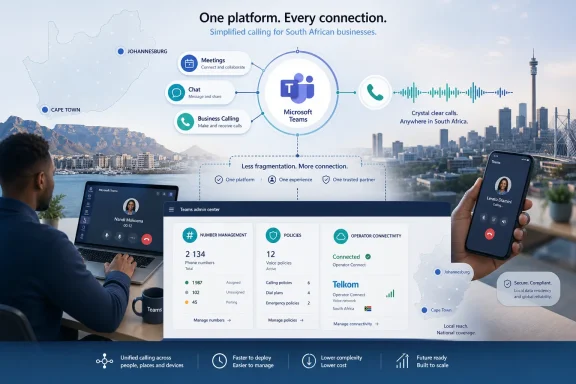 The PBX Is Becoming the Next Server Room
For years, the business phone system occupied a strange place in enterprise IT. It was mission-critical, but often treated as separate from the rest of the digital workplace: different vendor, different contract, different support desk, different reporting tools, and often a different vocabulary altogether.That separation made sense when collaboration meant email, a desk phone, and a meeting room bridge. It makes far less sense in a workplace where the same employee may join a Teams meeting from home, message a colleague from a mobile device, and then dial a customer using a legacy PBX that IT still has to nurse through upgrades and outages.
The MyBroadband article frames South Africa’s Teams Calling push as a simplification story, and that is the right lens. The important movement here is not that Teams can make calls. The important movement is that CIOs increasingly see standalone voice infrastructure as the kind of duplication they have spent the past decade trying to eliminate elsewhere.
Cloud infrastructure reduced the number of physical systems IT teams had to own. SaaS reduced the number of applications they had to patch. Security consolidation is reducing the sprawl of point products. Communications is now undergoing the same rationalisation, with Teams sitting at the centre because it is already where many users spend their working day.
Microsoft Has Turned Teams Into a Communications Gravity Well
Microsoft’s position is simple: if Teams is already the collaboration layer, voice should not live outside it unless there is a strong reason. Teams Phone, Operator Connect, Calling Plans, and Direct Routing are all variants of the same strategic idea — bring PSTN calling into the Teams environment and make the old phone system less visible to the user.That matters because user behaviour is stubborn. Employees rarely care which infrastructure layer carries a call. They care whether they can reach a colleague, customer, supplier, or support desk without switching tools or remembering which communication channel belongs to which scenario.
This is where Teams has leverage that older unified communications products struggled to build. It is not trying to persuade users to adopt a new communications client from scratch. In many organisations, Teams is already the default interface for meetings, chat, presence, file sharing, and internal collaboration. Adding external calling is less a new habit than an extension of an existing one.
For Microsoft, that makes Teams Phone part of a broader Microsoft 365 retention machine. For CIOs, it creates a more uncomfortable but potentially useful question: if the organisation already pays for the Microsoft workplace stack, why is voice still sitting somewhere else?
Operator Connect Is Microsoft’s Compromise With Telecom Reality
The phrase Operator Connect sounds like product-management wallpaper, but it describes an important compromise. Microsoft can provide the Teams platform, call control features, and administrative experience, but public telephone networks still depend on regulated operators, phone numbers, local routing, emergency services obligations, porting processes, and country-specific telecommunications rules.In other words, Teams does not magically dissolve the telecom world. It gives enterprises a cleaner way to connect that world to Microsoft 365.
Operator Connect is designed for organisations that want Teams calling without building and maintaining the Session Border Controller infrastructure associated with Direct Routing. The operator handles much of the PSTN connectivity and related voice service layer, while administrators work through the Teams admin centre to connect operators and assign numbers.
That distinction matters for resource-constrained IT departments. Direct Routing can be powerful, especially for complex environments with bespoke routing, legacy integrations, or multinational architectures. But it also asks the customer or a managed partner to take on more design and operational responsibility. Operator Connect is Microsoft’s cleaner, more standardised path for organisations that want Teams voice without becoming voice infrastructure specialists.
FirstNet’s Pitch Is Local Accountability, Not Just Microsoft Integration
The MyBroadband article is clearly a commercial industry piece for FirstNet, but the underlying argument is not empty. In South Africa, the communications problem is not solved merely by saying “move calling to Teams.” Organisations still need local number provisioning, number porting, regulatory compliance, support escalation, and a telecoms provider that understands South African business conditions.That is the role FirstNet wants to occupy. As the telecommunications operator within First Technology Group, it is positioning itself as the local bridge between Microsoft’s global collaboration platform and South Africa’s voice requirements.
The phrase “local partner” can sound like procurement boilerplate, but in telephony it still has substance. Phone numbers are not abstract cloud identities. They are regulated assets attached to national numbering plans, porting processes, call routing, and service expectations that become painfully visible when something breaks.
For CIOs, this is why the operator does not disappear. The better version of Teams Calling is not a world in which Microsoft replaces every telecoms relationship. It is a world in which the telecoms relationship becomes more tightly integrated into the collaboration platform employees already use.
The Case for Consolidation Is Really a Case Against Fragmentation
The strongest argument for Teams Calling is not novelty. It is the accumulated cost of fragmentation.A typical mid-sized or large organisation may have Microsoft Teams for collaboration, a PBX or hosted voice provider for external calling, mobile contracts for field staff, a contact centre platform for customer-facing teams, and separate support arrangements for each layer. None of these systems is necessarily broken on its own. The problem is that they create an operational maze when viewed together.
Troubleshooting illustrates the issue. If an employee cannot place a customer call, the fault may sit with the endpoint, the network, the user’s licence, the phone number assignment, the PBX, the operator, the SIP trunk, or the Teams tenant configuration. The more fragmented the environment, the more likely support becomes a circular handoff between vendors.
The promise of Teams Calling through Operator Connect is not that voice suddenly becomes effortless. It is that accountability becomes clearer. The user works in Teams. The Teams administrator manages numbers and policies through Microsoft’s tooling. The operator provides PSTN connectivity and support for the voice service. That is still a multi-party model, but it is less chaotic than the patchwork it replaces.
Users Do Not Want a Phone System; They Want Calls to Follow Work
The old enterprise phone model assumed the desk was the centre of work. That assumption has been collapsing for years, but hybrid work finished the job. For many employees, the “office phone” is now conceptually odd: a number attached to a location they may visit only part of the week, if at all.Teams Calling fits the newer pattern because it attaches calling more closely to identity and presence than to a physical handset. Users can place and receive business calls from the Teams client on a laptop or mobile device, while IT can retain centralised control over numbers, policies, call queues, voicemail, and compliance settings.
That is not just convenience. It changes expectations. A colleague’s availability, chat history, meeting context, and calling capability sit in one interface. The user does not have to decide whether communication belongs to “telephony” or “collaboration.” They just communicate.
There are limits. Some roles still need desk phones, analogue devices, paging systems, reception consoles, contact-centre features, or specialised recording and compliance workflows. Teams Phone can support many standard enterprise calling scenarios, but it is not a universal replacement for every voice-adjacent system in every organisation. The CIO’s job is to identify where consolidation reduces friction and where it would merely hide complexity somewhere more expensive.
The Licensing Conversation Is Where the Simplicity Story Gets Complicated
Every cloud consolidation story eventually reaches licensing, and Teams Calling is no exception. Microsoft 365 standardisation can make the user experience simpler while making the commercial model more layered.Organisations need the appropriate Teams Phone licensing, a PSTN connectivity option, and an operator voice plan or equivalent service. Depending on existing Microsoft agreements, the marginal cost may look attractive or less attractive than expected. The phone system may also have hidden legacy costs that only become visible during migration: old contracts, hardware depreciation, support retainers, and site-specific voice dependencies.
This is why the business case should not be reduced to “Teams is already deployed, so calling is easy.” Teams being deployed lowers the adoption barrier, but voice migration remains a business-critical change. Numbers must be ported or provisioned. Call flows must be mapped. Reception and hunt group scenarios must be tested. Emergency calling and regulatory obligations must be understood. Support teams must know where Microsoft ends and the operator begins.
The organisations that succeed will be the ones that treat Teams Calling as a communications redesign, not as a checkbox in the admin centre. The technology may be cloud-based, but the business process still touches customers, suppliers, executives, service desks, and frontline users.
South African CIOs Are Buying Operational Calm
South African IT leaders face the same global pressure as their peers: simplify estates, reduce vendor sprawl, improve security posture, enable hybrid work, and keep budgets defensible. But they also operate in a market where connectivity quality, local support, regulatory requirements, and provider accountability can be decisive.That makes the FirstNet angle commercially sensible. A licensed local operator can argue that it offers something Microsoft alone cannot: South African telecoms execution wrapped around Microsoft’s collaboration platform. For organisations already using First Technology Group for cloud, networking, cybersecurity, or managed services, the pitch becomes broader still — consolidate not only the tool, but also the supplier relationship.
There is an obvious vendor benefit in that framing. Providers love consolidation when they are the consolidator. But CIOs also have legitimate reasons to prefer fewer accountable partners over a long tail of niche contracts. Complexity is not neutral; it consumes engineering time, procurement attention, security review capacity, and executive patience.
The best CIO argument for Teams Calling is therefore not “one platform for everything” in a simplistic sense. It is “fewer seams in the places where users and IT teams feel the pain most.”
The Contact Centre and Frontline Edge Cases Will Decide the Hard Migrations
The easy migrations are knowledge workers with direct-dial numbers, voicemail, call forwarding, and straightforward inbound and outbound calling needs. The hard migrations are the environments where telephony is embedded into operational workflows.Reception desks, branch offices, warehouses, clinics, retail sites, security desks, and contact centres often have requirements that do not fit neatly into a standard softphone model. They may rely on shared devices, overhead paging, analogue lines, call recording rules, wallboards, CRM integrations, after-hours routing, or industry-specific compliance features.
This is where Teams Calling projects can become politically sensitive. A CIO may see an elegant consolidation opportunity, while a frontline manager sees a risk to the workflow that keeps customers moving. Both can be right.
The smarter approach is phased. Start with user groups whose voice needs align well with Teams Phone. Prove call quality, number management, support escalation, and user training. Then tackle more complex scenarios with deliberate design rather than assuming the Microsoft platform should automatically swallow every voice function.
In some enterprises, Teams Phone will become the main calling platform while specialised systems remain for contact centres or operational voice. That is not failure. It is the difference between consolidation and overreach.
The Security and Compliance Argument Is Stronger Than It First Appears
Voice systems are often underexamined in security reviews because they are treated as legacy utilities rather than modern collaboration infrastructure. That is a mistake. Calling touches identity, customer data, recordings, voicemail, call routing, and sometimes authentication workflows.Moving calling into Teams can bring voice closer to the identity, policy, auditing, and administrative controls organisations already apply across Microsoft 365. Conditional access, centralised identity management, role-based administration, and consistent user lifecycle processes can all make the environment easier to govern than a disconnected PBX.
But this advantage is not automatic. A poorly governed Teams tenant with weak role management and inconsistent policies can simply become a larger blast radius. Voice consolidation raises the stakes for Microsoft 365 administration because Teams is no longer just where people chat and meet; it becomes where the organisation’s phone presence lives.
That is why security-minded CIOs should view Teams Calling as part of a broader governance programme. The migration should include policy review, administrator access controls, call recording requirements, retention expectations, emergency calling configuration, and incident response procedures. Voice may be moving into the cloud, but the accountability remains firmly on the enterprise.
Microsoft Wins When the Interface Disappears
The strategic brilliance of Teams Phone is that it makes the phone system less visible. Microsoft does not need users to think about Teams as a PBX replacement. It needs them to stop thinking about the PBX at all.That is consistent with Microsoft’s broader enterprise playbook. The company wins when identity, productivity, collaboration, endpoint management, security, and communications all feel like parts of the same administrative and user experience. Each additional workload makes the next one easier to justify.
For competitors, this is uncomfortable. Standalone voice providers can still beat Teams in specialised features, pricing flexibility, service quality, or vertical-specific capabilities. But they increasingly have to explain why a separate interface and operating model are worth preserving. That is a harder argument when the CIO is under pressure to simplify.
For Microsoft partners such as FirstNet, the opportunity is to profit from the gravity rather than resist it. The provider does not need to replace Teams; it needs to make Teams viable as a business calling platform in the local market. That is a different kind of telecoms business from selling a traditional PBX, and it is where much of the channel is heading.
The Phone System Is Now a Change-Management Project
The technical migration to Teams Calling may be easier than a traditional telephony replacement, especially where Teams is already deployed. But the organisational migration should not be underestimated.Employees have deeply ingrained expectations about phone numbers, voicemail, transfer behaviour, reception workflows, and availability. Executives often notice voice problems faster than almost any other IT issue because calls remain tied to customers, revenue, and reputation. A botched phone migration can generate more internal noise than a dozen less visible infrastructure upgrades.
That means communication and training matter. Users need to know what changes, what stays the same, how to make and receive calls, how voicemail works, and where to get support. Service desks need scripts and escalation paths. Network teams need to understand quality-of-service requirements and connectivity dependencies. Procurement needs to understand how legacy contracts unwind.
The irony is that the simpler the end-state appears, the more tempting it is to under-plan the transition. CIOs should resist that temptation. Voice is one of those technologies people ignore only when it works.
The MyBroadband Piece Is Advertising, but the Trend Is Real
It is worth being direct: the MyBroadband article is an industry-news placement promoting FirstNet’s Managed Microsoft Teams Calling service. Its purpose is to make the case for FirstNet, and it does so in the polished language of partner marketing.But sponsored framing does not make the underlying trend imaginary. Microsoft Teams has become a default collaboration hub for many organisations. Operator Connect is a real Microsoft-supported path for PSTN integration. South African businesses do need local telecommunications providers for numbers, connectivity, compliance, and support. CIOs are indeed under pressure to simplify communications estates that grew through years of incremental procurement.
The article’s most useful contribution is that it captures the shift in how voice is being sold. The pitch is no longer “buy a better phone system.” It is “remove a separate system from your environment.” That is a very different proposition, and it speaks directly to the modern CIO’s fatigue with complexity.
The caution is that platform consolidation should not be confused with magic. Teams Calling can simplify operations, but only if the implementation is aligned with real calling patterns, licensing economics, network readiness, support boundaries, and user expectations. Otherwise, the organisation may simply trade a visible legacy system for a cloud dependency it does not fully understand.
The Real FirstNet Proposition Is Fewer Places to Point the Finger
For South African enterprises, the most persuasive part of the FirstNet proposition is not that it can switch on Teams Calling. Many operators and managed service providers can tell a version of that story. The stronger claim is that FirstNet can combine local telecoms accountability with the broader technology capabilities of First Technology Group.That matters because communications failures often sit at the intersection of disciplines. A bad calling experience may involve endpoint configuration, Wi-Fi quality, WAN performance, Teams policy, number assignment, carrier routing, or user training. A provider with broader cloud, networking, cybersecurity, and managed services capabilities can argue that it sees more of the problem surface than a narrow voice supplier.
This is also where CIOs should test the sales pitch. The right questions are practical. Who owns the incident? How are Microsoft escalations handled? What service levels apply? How are number porting delays managed? What happens during a regional connectivity issue? How are call queues, auto attendants, and emergency calling documented? What reporting is available?
A single accountable provider is valuable only if accountability is real. Otherwise, “managed service” becomes a branding layer over the same old vendor shuffle.
The CIO’s Checklist Is Shorter Than the Migration Plan
A Teams Calling decision should begin with a strategic preference, but it should not end there. The organisations most likely to benefit are those that can connect the consolidation story to concrete operational improvements.- Organisations should identify which users can move cleanly to Teams Phone and which roles still depend on specialised voice workflows.
- IT teams should confirm Teams Phone licensing, Operator Connect availability, number porting requirements, and local regulatory obligations before promising timelines.
- Network teams should validate call quality from offices, homes, branches, and mobile scenarios rather than assuming meetings performance guarantees voice performance.
- Service owners should define escalation boundaries between Microsoft, the operator, internal IT, and any managed service provider before the first production cutover.
- Business leaders should treat the project as a user-experience change, not merely a telecoms procurement exercise.
- CIOs should measure success by reduced operational friction, clearer accountability, and user adoption rather than by platform consolidation alone.
References
- Primary source: MyBroadband
Published: Fri, 05 Jun 2026 06:56:02 GMT
Why South African CIOs are simplifying communications with Microsoft Teams Calling
FirstNet delivers Microsoft Teams Calling through Microsoft’s Operator Connect programme, enabling organisations to make and receive external calls directly within Microsoft Teams. mybroadband.co.za
- Official source: learn.microsoft.com
Get Operator Connect telephone numbers for your organization - Microsoft Teams | Microsoft Learn
Learn about acquiring new telephone numbers for your tenant with Operator Connect partners.learn.microsoft.com - Official source: support.microsoft.com
Getting started with Microsoft Teams Phone Mobile | Microsoft Support
Teams Phone Mobile enables you to stay connected no matter where you are. Your SIM-enabled phone number is also your Teams phone number, allowing you to answer and move calls seamlessly between devices. Learn how to manage, uplift, and transfer your calls on your business-provided phone number.support.microsoft.com - Related coverage: operatorconnect.firsttech.co.za
Benefits of Operator Connect | First Technology OC
www.operatorconnect.firsttech.co.za
- Official source: microsoft.com
Your request has been blocked. This could be due to several reasons.
www.microsoft.com
- Official source: info.microsoft.com
Connectivity Options for Microsoft Teams Phone
Connectivity Options for Microsoft Teams Phoneinfo.microsoft.com
- Official source: adoption.microsoft.com
- Official source: download.microsoft.com
- Related coverage: operatorconnect.teliacompany.com
