

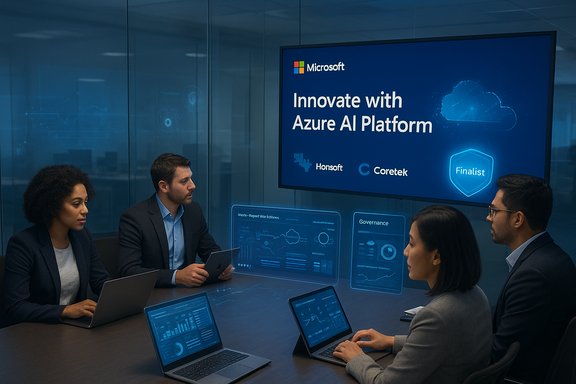
Coretek’s announcement that it has been named a finalist in Microsoft’s 2025 Innovate with Azure AI Platform Partner of the Year program marks a high‑visibility moment for the Michigan‑based cloud, security, and AI engineering firm—and it arrives at a time when Microsoft’s partner awards are acting as a fast track for co‑sell visibility, technical credibility, and marketing momentum in enterprise AI procurement.
Microsoft’s Partner of the Year Awards are an annual, global recognition program that highlights partners who built measurable customer outcomes using Microsoft Cloud and AI technologies. The 2025 awards cycle drew an unusually large field of submissions—Microsoft and partner press note more than 4,600 nominations across 100+ countries—making each category highly competitive and amplifying the commercial value of finalist status. The Innovate with Azure AI Platform category specifically rewards partners that design and deliver production‑grade AI solutions on Microsoft’s Azure AI platform (in 2025 that emphasis heavily centered on Azure AI Foundry, agentic or multi‑agent architectures, model lifecycle management, and governance/observability features). EPAM was named the category winner for 2025 for a production GenAI platform delivered to a large retailer; a set of partners including Coretek were named finalists in the same category. Microsoft will present and amplify these awards in the run‑up to Microsoft Ignite (November 18–21, 2025), an event where partners typically convert award recognition into co‑sell introductions and field‑level momentum.
At the same time, the award cycle’s winner (EPAM) and other finalists reveal Microsoft’s preference for entries that combine platform depth (Azure AI Foundry), governance, and demonstrable customer impact. Organizations should therefore convert recognition into verifiable artifacts before committing to multi‑region or mission‑critical rollouts.
Coretek’s finalist placement is a useful credential that will accelerate shortlisting and Microsoft field visibility; it is not, by itself, a procurement pass. The announcement is best read as an invitation to evaluate Coretek more deeply—with the standard enterprise checklist of telemetry, security attestations, governance proof points, and cost controls—before committing to broad production deployments of agentic AI on Azure AI Foundry.
Additional verification notes and caveats: Coretek’s public release and trade redistributions report its finalist status; Microsoft’s award cycle materials and the EPAM winner announcement corroborate the category’s outcome and the heavy emphasis on Azure AI Foundry for 2025 award selections. Readers seeking the canonical winners and finalists list should verify the Microsoft Partner of the Year winners page and the Microsoft Partner Blog for the official, up‑to‑date roster.
Source: StreetInsider Coretek recognized as a finalist for the 2025 Microsoft Innovate with Azure AI Platform Partner of the Year Award
 Background / Overview
Microsoft’s Partner of the Year Awards are an annual, global recognition program that highlights partners who built measurable customer outcomes using Microsoft Cloud and AI technologies. The 2025 awards cycle drew an unusually large field of submissions—Microsoft and partner press note more than 4,600 nominations across 100+ countries—making each category highly competitive and amplifying the commercial value of finalist status. The Innovate with Azure AI Platform category specifically rewards partners that design and deliver production‑grade AI solutions on Microsoft’s Azure AI platform (in 2025 that emphasis heavily centered on Azure AI Foundry, agentic or multi‑agent architectures, model lifecycle management, and governance/observability features). EPAM was named the category winner for 2025 for a production GenAI platform delivered to a large retailer; a set of partners including Coretek were named finalists in the same category. Microsoft will present and amplify these awards in the run‑up to Microsoft Ignite (November 18–21, 2025), an event where partners typically convert award recognition into co‑sell introductions and field‑level momentum. What Coretek announced — the facts from the release
Coretek issued a public announcement stating it has been named a finalist in the Innovate with Azure AI Platform category of the 2025 Microsoft Partner of the Year Awards. The release highlights three core points:- The recognition is framed as validation of Coretek’s work helping organizations accelerate secure AI adoption and delivering tangible business value from Microsoft AI technologies.
- Coretek quoted its Chief Revenue Officer, Clint Adkins, who said the finalist status is a meaningful milestone for the company and its clients, and emphasized outcomes such as improved collaboration and secure AI‑led transformation.
- The release repeats Microsoft’s program framing (tens of thousands of nominations globally, many award categories) and situates Coretek among a short list of finalists for the Innovate with Azure AI Platform award.
Why this matters: what a finalist badge signals to buyers and partners
Being named a Microsoft Partner of the Year finalist is not merely ceremonial—within the Microsoft ecosystem it carries concrete, near‑term commercial and operational implications:- Field visibility and co‑sell acceleration. Finalists commonly receive amplified promotion through Microsoft field channels and prioritized co‑sell introductions, which can shorten sales cycles for customers already standardized on Azure.
- Marketing and talent signal. Awards strengthen a partner’s go‑to‑market narrative, helping win shortlists and attract engineers and product talent who want to work with recognized Microsoft partners.
- Platform alignment indicator. Finalists in this category typically demonstrate platform‑native engineering using Azure AI Foundry and adjacent services—an important procurement signal for enterprises that prefer vendor‑aligned solutions.
Where the finalist recognition fits into the 2025 awards landscape
EPAM won the Innovate with Azure AI Platform award in 2025 for a GenAI platform implemented with a major retailer; EPAM’s submission emphasized Azure AI Foundry, model lifecycle discipline, and enterprise‑grade governance—traits Microsoft’s judging panel prioritized. The presence of both global systems integrators and regional specialists among finalists shows the award judges reward both scale and focused domain expertise. Microsoft framed the 2025 awards ahead of Microsoft Ignite, and partner blog coverage reinforces that judges were looking for productionized outcomes—repeatable KPIs and governance practices—not just proofs‑of‑concept. That makes finalist slots especially valuable for partners seeking to demonstrate they can move customers from pilots to governed production.Technical context: Azure AI Foundry and what “Innovate with Azure AI Platform” actually evaluates
Understanding the technology stack the awards emphasize is critical to interpreting what Coretek’s nomination likely represents. The Innovate with Azure AI Platform rubric in 2025 focused on platform‑native engineering—especially usage of Azure AI Foundry and its production capabilities:- Azure AI Foundry as the runtime and agent factory. Foundry is positioned as a unified platform for model catalogs, multi‑agent orchestration, retrieval‑augmented generation (RAG), safety filters, and observability. It includes an Agent Service, Observability surface, and connectors to Microsoft Fabric, Azure AI Search, and enterprise data sources.
- Multi‑agent and orchestration features. The Foundry Agent Service manages threads, tool calls, and agent‑to‑agent messaging; it preserves traceability and supports network isolation and managed identities, which are essential for enterprise automation.
- Observability and safety. Continuous evaluation, model leaderboards, content safety tooling, and OpenTelemetry tracing for agent threads are explicit platform features that judges look for when assessing production readiness.
Strengths implied by the finalist notice (what the public record supports)
Based on the release and typical entry patterns for this category, Coretek’s finalist placement implies the company likely demonstrated one or more of the following in its submission:- Platform‑native architecture. Use of Azure‑native primitives (Foundry, Azure OpenAI Service, Microsoft Fabric, Entra/Azure AD) rather than purely bolt‑on integrations.
- Focus on secure adoption. The company’s messaging emphasized “accelerating secure AI adoption,” suggesting the nomination highlighted governance, identity integration, and enterprise safety controls—areas the Foundry stack explicitly supports.
- Domain or operational outcomes. Finalist narratives that win field attention often quantify business outcomes (time‑saved, reduced errors, process speedups). While Coretek’s release framed value in general terms, finalists are usually expected to present measurable business impact to judges.
Gaps and risks — what the finalist badge does not prove
Finalist recognition is persuasive but incomplete evidence of production readiness. Important gaps to close through procurement diligence include:- Sustained production telemetry. Public releases rarely publish long‑running metrics such as monthly active users, P95/P99 latency, or sustained Azure AI consumption that prove production scale.
- Security and compliance attestations. A finalist announcement does not substitute for SOC 2 / ISO reports, recent penetration testing outcomes, or documented incident response playbooks.
- Cost governance and FinOps. Token/GPU consumption for agentic workloads is variable and potentially expensive; award messaging rarely includes tagging, budget cap policies, or expected monthly costs for scale.
- Portability and exit strategy. Awards do not reveal whether customers can export vector indices, model artifacts, or audit logs in a vendor‑agnostic format.
- Named references with traceable KPIs. Judges will have seen customer evidence during submission, but public announcements rarely identify named references with verifiable telemetry—procurement should demand these before contract award.
Due‑diligence checklist for IT leaders evaluating Coretek or other finalists
- Verify finalist/winner status on Microsoft’s official winners and finalists listing and request the nomination reference used in the submission.
- Ask for named operational references and extractable KPIs (monthly active users, task completion rates, latency P95/P99).
- Obtain security artifacts: SOC 2 / ISO attestation, recent pen‑test summaries, and data residency commitments.
- Request Partner Center or Azure billing/consumption snapshots that show sustained usage consistent with production workloads.
- Validate governance and observability: model evaluation reports, drift detection mechanisms, audit logs, and evidence of continuous evaluation.
- Confirm FinOps controls: resource tagging, budget alerts, throttles, and forecasted monthly spend for typical user loads.
- Start with a time‑boxed pilot defined by measurable KPIs and an export/exit clause for portability of indexes and model artifacts.
Practical implications for Windows and Azure administrators
- Identity and access. Agentic workloads should use Entra/Azure AD service identities, least‑privilege roles, and on‑behalf‑of authentication for connectors; require clear role matrices from the partner.
- Observability. Integrate Foundry telemetry into Azure Monitor and Application Insights to capture agent threads, tool invocations, and model evaluation metrics.
- Network controls. Ensure private endpoints or VNet isolation for any connectors that access ERP or sensitive data stores; ask for design docs showing no uncontrolled egress.
- FinOps and cost controls. Put tagging and automated budget alerts in place before pilot scale‑up to avoid surprise invoices from model inference costs.
How to interpret Coretek’s announcement in context
Coretek’s finalist announcement is a clear market signal: it positions the company as an Azure‑aligned engineering firm able to work with enterprise customers on secure AI initiatives and places it within a small group of Microsoft‑validated partners visible to field teams and procurement lists. That positioning is valuable for customers who want Azure‑native partners and for Coretek when pursuing co‑sell and GTM opportunities.At the same time, the award cycle’s winner (EPAM) and other finalists reveal Microsoft’s preference for entries that combine platform depth (Azure AI Foundry), governance, and demonstrable customer impact. Organizations should therefore convert recognition into verifiable artifacts before committing to multi‑region or mission‑critical rollouts.
Final assessment — what IT buyers should take away
- Shortlist value: Use the Microsoft awards list and partner press to build a short list—Coretek’s finalist status meaningfully elevates it in Microsoft‑centric sourcing conversations.
- Don’t skip procurement rigor: Treat finalist status as a starting point. Demand operational telemetry, security attestations, FinOps controls, and named references that prove the partner’s claims at scale.
- Platform matters: If you plan to run agentic or generative workflows at scale, prefer partners who demonstrate Azure AI Foundry usage, clear observability designs, and identity/network isolation strategies—these are the elements judges rewarded in 2025.
- Pilot smart: Start with a narrow, measurable pilot that has concrete acceptance criteria (latency, correctness, cost) and a contractual portability clause to avoid lock‑in surprises.
Coretek’s finalist placement is a useful credential that will accelerate shortlisting and Microsoft field visibility; it is not, by itself, a procurement pass. The announcement is best read as an invitation to evaluate Coretek more deeply—with the standard enterprise checklist of telemetry, security attestations, governance proof points, and cost controls—before committing to broad production deployments of agentic AI on Azure AI Foundry.
Additional verification notes and caveats: Coretek’s public release and trade redistributions report its finalist status; Microsoft’s award cycle materials and the EPAM winner announcement corroborate the category’s outcome and the heavy emphasis on Azure AI Foundry for 2025 award selections. Readers seeking the canonical winners and finalists list should verify the Microsoft Partner of the Year winners page and the Microsoft Partner Blog for the official, up‑to‑date roster.
Source: StreetInsider Coretek recognized as a finalist for the 2025 Microsoft Innovate with Azure AI Platform Partner of the Year Award


