

Microsoft has not announced a Windows 11 sound overhaul, but a May 2026 comment from Windows design leader Marcus Ash says the designer behind the original Windows 11 startup sound has rejoined Microsoft’s Windows and Devices design team. That is not confirmation of a new chime, but it is the kind of personnel breadcrumb Microsoft rarely drops by accident. If the next phase of Windows 11 is about making the operating system feel less mechanical and more crafted, sound is an obvious unfinished frontier.
The reason this matters is not that users are clamoring for a different beep when an error dialog appears. It matters because Windows has spent years trying to look modern while still often feeling like a pile of eras stacked on top of each other. The Start menu can be redesigned, File Explorer can be optimized, and the taskbar can be argued over forever, but the operating system’s sensory language is still full of old muscle memory.
A Windows sound refresh would be easy to dismiss as cosmetic. That would be a mistake. In an operating system used by hundreds of millions of people, sound is one of the few design elements that cuts through the screen, the workflow, and the user’s attention all at once.
The spark here came from a brief exchange on X, where Marcus Ash, now leading Design and Research for Windows and Devices, responded to a discussion about old Windows startup sounds by saying that the sound designer who worked on the Windows 11 startup sound had recently rejoined his team. He added that what the designer could do with sound “blows my mind.” That is a tease, not a roadmap.
Still, the timing is hard to ignore. Microsoft has spent much of the past year trying to convince Windows 11 users that it understands the difference between shipping features and polishing the product. Performance, reliability, File Explorer responsiveness, taskbar behavior, and Windows Update friction have all become part of a broader narrative: Windows 11 has to feel better, not merely accumulate more toggles.
Sound fits neatly into that narrative because it is one of the least ambiguous forms of craft. Users may disagree about whether centered taskbar icons are better than left-aligned ones. They may never notice whether a UI surface is WinUI, XAML, or a legacy shell component. But almost everyone notices when a notification sound is too sharp, when an alert feels ancient, or when a startup chime makes a machine feel like a device rather than an appliance.
The catch is that Microsoft has not said Windows 11 is getting a new sound scheme. There is no Insider build with a documented audio refresh, no support page, no design blog post, and no release note pointing to a new startup sound. The responsible reading is that Microsoft has brought audio talent back into the Windows design orbit, and that makes an audio refresh plausible.
But plausible is enough to ask the larger question: why does Windows 11 still sound less cohesive than it looks?
Its audio language is less settled. Windows 11 restored the startup sound after Microsoft spent years de-emphasizing boot chimes, and the current chime is restrained, airy, and short. It is not trying to be Windows XP’s orchestral arrival or Windows 95’s synthetic sunrise. It sounds like a laptop waking politely in a shared room.
That restraint is the point. Modern devices are no longer beige towers in family rooms. They are work machines, school machines, bedroom machines, meeting-room machines, and late-night machines. A startup sound in 2026 has to be emotionally legible without being obnoxious, and Windows 11’s current chime mostly gets that right.
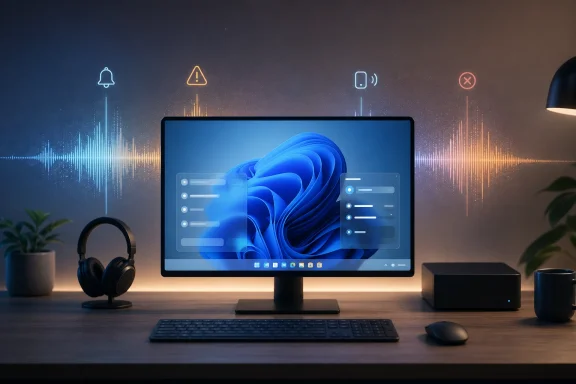
The problem is the rest of the system. Windows is not one sound. It is a cluster of confirmation tones, alert sounds, device connection noises, calendar pings, error cues, accessibility feedback, Teams-adjacent interruptions, and app notifications. Some of those cues still feel like they were designed for an operating system that expected you to sit upright at a desk and wait for modal dialogs to bark at you.
That mismatch is the opportunity. A new startup sound would get the headlines, but a smarter refresh would make everyday system events feel less like archaeological leftovers. The real win would be a soundscape that tells users what happened without punishing them for leaving system audio enabled.
Windows 95 understood this better than almost any version that followed. Microsoft hired Brian Eno to create a tiny piece of music that had to be optimistic, futuristic, emotional, and compressed into a few seconds. The result became one of the most famous sonic logos in technology, partly because it arrived at the moment Windows itself became a mass-market cultural object.
Windows 98’s startup sound leaned into a different late-1990s mood: expansion, gloss, and the fantasy that the desktop was becoming a portal into something larger. Windows XP went warmer and more cinematic, matching the saturated friendliness of Bliss and Luna. Vista, for all its reputation elsewhere, gave Windows a polished, glassy chime that survived into Windows 7 and lingered in the collective memory even as startup sound behavior changed in later releases.
This history matters because Windows sounds are not judged on fidelity alone. They are judged against nostalgia, and nostalgia is unfair. Nobody can compose a new startup sound that competes cleanly with the memory of being twelve years old, getting home from school, and hearing XP announce that the family computer was ready.
That does not mean Microsoft should avoid trying. It means the job is harder than producing a pleasant clip. A Windows sound has to be functional on bad laptop speakers, tolerable in an office, distinctive enough to belong to Windows, and subtle enough not to become a meme for the wrong reasons.
Today, many PCs sleep, hibernate, resume, update, fast-start, or unlock before the user thinks of the experience as a “boot.” A startup chime has less daily exposure than it once did. For many users, the most common Windows sounds are notification pings, USB device cues, meeting alerts, and warning tones.
That shift should change Microsoft’s priorities. The most important Windows sound in 2026 may not be the startup sound at all. It may be the notification sound that fires during a call, the subtle feedback when a device connects, or the alert that tells an admin a process needs attention without making everyone nearby look up.
This is where an audio refresh could become more than nostalgia bait. Windows 11 needs a modern hierarchy of sound: gentle cues for routine events, clear alerts for user action, unmistakable warnings for failures, and accessibility-conscious feedback that works across hardware and hearing contexts. Good sound design is not about making everything prettier. It is about making the system less fatiguing.
Microsoft already knows this in other domains. Windows has spent years adding visual affordances for focus, accessibility, dark mode, touch targets, and reduced motion. Audio deserves the same seriousness. A tone can be as intrusive as a flashing animation, and a badly chosen alert can make a premium laptop feel cheap.
A modern Windows sound scheme should be built around restraint. The best notification sounds are not the ones users can hum; they are the ones users do not immediately disable. The best error sounds are not the loudest; they are the ones that communicate seriousness without sounding like a scolding appliance from 1998.
This is especially important for enterprise environments. A sysadmin does not want a fleet of laptops suddenly becoming more expressive after a feature update. IT departments care about predictability, user complaints, accessibility settings, and whether a change generates tickets. A tasteful refresh should preserve existing controls and respect quiet defaults.
There is also the matter of brand. Microsoft is not Apple, and Windows cannot simply borrow the sparse audio etiquette of macOS without losing something of its own identity. Windows is broader, messier, more hardware-diverse, and more configurable. Its sound design has to scale from $300 classroom laptops to studio workstations to enterprise thin-and-light machines with aggressive power management.
That argues for a family of sounds rather than one heroic chime. The startup sound can remain the postcard, but the everyday cues are the infrastructure. If those are coherent, Windows 11 will feel more deliberate even if most users never consciously notice why.
The audio hint lands in that context. A company obsessed only with AI buttons and subscription hooks does not publicly talk up a returning sound designer. A Windows team trying to rebuild trust around craft might.
That does not mean Microsoft has suddenly become a design purist. Windows remains a commercial platform with ads, prompts, Microsoft account nudges, Edge preference battles, Copilot positioning, and enterprise management priorities. Any romantic reading of the company’s motives should be tempered by the reality of modern Windows.
But craft and commerce are not mutually exclusive. Microsoft needs Windows 11 to feel premium because it wants users to accept a new era of AI PCs, new hardware requirements, and an operating system that is increasingly bound to cloud services. If the OS feels sluggish, inconsistent, or stale, the pitch collapses. If the small details feel cared for, the larger changes meet less resistance.
Sound is one of those small details. It costs little compared with kernel work, app platform rewrites, or security architecture. But it carries an outsized emotional payload. A refined sound scheme will not fix File Explorer, but it can make the system feel less neglected.
Microsoft has used that nostalgia before. Ahead of the Windows 11 reveal in 2021, it published an 11-minute slowed-down remix of classic Windows startup sounds, a move that was both marketing wink and emotional priming. The message was clear: Windows 11 was supposed to be new, but it knew where it came from.
The danger is that nostalgia can flatten judgment. A startup sound is not good simply because it reminds us of childhood, and a new sound is not bad simply because it cannot. If Microsoft tries too hard to recapture XP, it will produce cosplay. If it ignores the emotional history entirely, it will produce sterile UX audio that could belong to any productivity app.
The right answer is continuity without imitation. Windows 11’s current startup sound already points in that direction. It is soft, upward, and brief. It suggests a device opening rather than a computer announcing itself. A refresh should extend that logic across the system instead of throwing it away.
The test is not whether a new sound makes longtime users nostalgic on first listen. The test is whether it still feels appropriate after the thousandth notification.
A modern sound refresh should be paired with clear controls. Users should be able to distinguish between notification categories, mute nonessential sounds, preserve critical alerts, and avoid surprises after updates. Enterprises should be able to manage defaults. Accessibility settings should make the system more legible, not merely louder.
Microsoft has generally improved Windows’ accessibility posture over time, but sound is easy to overlook because it is treated as theming. That is too narrow. A system alert is a user interface component. A notification chime is a behavioral nudge. A device disconnect sound is diagnostic feedback.
If Windows 11 gets new sounds, Microsoft should explain the design philosophy. Are the sounds softer? Are they grouped by urgency? Are they optimized for laptop speakers? Are they tested for neurodivergent users and shared workspaces? Are legacy sounds being retired or remixed?
Those questions may sound excessive for a set of WAV files. They are not. A billion tiny interruptions define how an OS feels.
But Microsoft could also be experimenting internally with no near-term release plan. Personnel movement does not equal product shipment. Designers rejoin teams for many reasons, and sound work could relate to Windows, Surface, accessibility, onboarding, Copilot experiences, or internal prototypes that never reach public builds.
That uncertainty matters. It would be irresponsible to say Windows 11 is definitely getting a new startup sound. The stronger claim is that Microsoft has publicly signaled renewed attention to Windows audio at a moment when the OS is already being tuned for feel, responsiveness, and polish.
For WindowsForum readers, the distinction is useful. If you run Insider builds, keep an eye on sound files and personalization settings. If you manage production machines, do not plan for anything yet. If you care about Windows design, this is one of those small signals that suggests the team’s definition of polish may be widening.
And if you disabled all system sounds years ago, this may be the first time in a while that Microsoft has a chance to persuade you to turn them back on.
Think about where Windows sound actually intersects daily life. A notification arrives while you are writing. A USB device connects. A Bluetooth headset drops. A calendar reminder fires. An error appears while a script is running. A remote desktop session passes through audio from somewhere else. These moments are small, but they are repeated constantly.
If they are too loud, users mute them. If they are too vague, users ignore them. If they are too similar, users cannot tell what happened. If they are too old-fashioned, the whole system feels less modern than its visual shell suggests.
A good refresh would create clearer relationships among sounds. Routine events should feel light. Completion sounds should feel resolved. Warnings should be distinct without being hostile. Critical alerts should cut through, but only when the event deserves it.
That is difficult work. It is also the kind of work that separates an operating system with a theme from an operating system with a personality.
Those debates are valid. Windows remains visually inconsistent in ways that macOS and many Linux desktop environments can avoid because they carry less backward-compatibility baggage. But polish is multisensory. If Microsoft wants Windows 11 to feel coherent, it has to think about animation, latency, haptics, and sound as part of the same system.
That is why the return of a sound designer is symbolically useful even before anything ships. It suggests that Windows design is not just about what a screenshot looks like in a keynote. It is about what happens when a user snaps a window, resizes an app, gets a warning, plugs in a device, or starts the machine in a quiet room.
The risk is that Microsoft treats sound as a marketing flourish. The opportunity is that it treats sound as part of the operating system’s ergonomics. Windows does not need to sing more often. It needs to speak with better judgment.
The old Windows startup sounds became iconic because they arrived at moments when the PC itself felt like it was changing. Windows 11 is in a different kind of transition now: less about discovering the desktop for the first time, more about making a mature, heavily burdened platform feel responsive, humane, and worthy of the hardware it runs on. If Microsoft can use this audio moment to refresh not just the chime but the daily soundscape of Windows, the result may be one of the rare design changes users feel before they can explain.
Source: Windows Latest Windows 11's iconic system sounds may be getting a refresh, Microsoft drops a hint
The reason this matters is not that users are clamoring for a different beep when an error dialog appears. It matters because Windows has spent years trying to look modern while still often feeling like a pile of eras stacked on top of each other. The Start menu can be redesigned, File Explorer can be optimized, and the taskbar can be argued over forever, but the operating system’s sensory language is still full of old muscle memory.
A Windows sound refresh would be easy to dismiss as cosmetic. That would be a mistake. In an operating system used by hundreds of millions of people, sound is one of the few design elements that cuts through the screen, the workflow, and the user’s attention all at once.
 Microsoft’s Smallest Hint Points at a Larger Design Problem
The spark here came from a brief exchange on X, where Marcus Ash, now leading Design and Research for Windows and Devices, responded to a discussion about old Windows startup sounds by saying that the sound designer who worked on the Windows 11 startup sound had recently rejoined his team. He added that what the designer could do with sound “blows my mind.” That is a tease, not a roadmap.Still, the timing is hard to ignore. Microsoft has spent much of the past year trying to convince Windows 11 users that it understands the difference between shipping features and polishing the product. Performance, reliability, File Explorer responsiveness, taskbar behavior, and Windows Update friction have all become part of a broader narrative: Windows 11 has to feel better, not merely accumulate more toggles.
Sound fits neatly into that narrative because it is one of the least ambiguous forms of craft. Users may disagree about whether centered taskbar icons are better than left-aligned ones. They may never notice whether a UI surface is WinUI, XAML, or a legacy shell component. But almost everyone notices when a notification sound is too sharp, when an alert feels ancient, or when a startup chime makes a machine feel like a device rather than an appliance.
The catch is that Microsoft has not said Windows 11 is getting a new sound scheme. There is no Insider build with a documented audio refresh, no support page, no design blog post, and no release note pointing to a new startup sound. The responsible reading is that Microsoft has brought audio talent back into the Windows design orbit, and that makes an audio refresh plausible.
But plausible is enough to ask the larger question: why does Windows 11 still sound less cohesive than it looks?
Windows 11 Looks Like 2026 and Sometimes Sounds Like a Museum
Windows 11’s visual identity is no longer new. Rounded corners, Mica, centered taskbar icons, softened iconography, and redesigned settings pages have been with us long enough to stop feeling like a launch-day novelty. The system has its own visual language, even if it still trips over legacy surfaces.Its audio language is less settled. Windows 11 restored the startup sound after Microsoft spent years de-emphasizing boot chimes, and the current chime is restrained, airy, and short. It is not trying to be Windows XP’s orchestral arrival or Windows 95’s synthetic sunrise. It sounds like a laptop waking politely in a shared room.
That restraint is the point. Modern devices are no longer beige towers in family rooms. They are work machines, school machines, bedroom machines, meeting-room machines, and late-night machines. A startup sound in 2026 has to be emotionally legible without being obnoxious, and Windows 11’s current chime mostly gets that right.
The problem is the rest of the system. Windows is not one sound. It is a cluster of confirmation tones, alert sounds, device connection noises, calendar pings, error cues, accessibility feedback, Teams-adjacent interruptions, and app notifications. Some of those cues still feel like they were designed for an operating system that expected you to sit upright at a desk and wait for modal dialogs to bark at you.
That mismatch is the opportunity. A new startup sound would get the headlines, but a smarter refresh would make everyday system events feel less like archaeological leftovers. The real win would be a soundscape that tells users what happened without punishing them for leaving system audio enabled.
Startup Sounds Became Windows’ Accidental Emotional API
The Windows startup sound was never merely decoration. It was a signal that the machine had survived the ritual: BIOS handoff, drive spin-up, splash screen, login, shell. For generations of PC users, it marked the moment when the computer crossed from hardware into personality.Windows 95 understood this better than almost any version that followed. Microsoft hired Brian Eno to create a tiny piece of music that had to be optimistic, futuristic, emotional, and compressed into a few seconds. The result became one of the most famous sonic logos in technology, partly because it arrived at the moment Windows itself became a mass-market cultural object.
Windows 98’s startup sound leaned into a different late-1990s mood: expansion, gloss, and the fantasy that the desktop was becoming a portal into something larger. Windows XP went warmer and more cinematic, matching the saturated friendliness of Bliss and Luna. Vista, for all its reputation elsewhere, gave Windows a polished, glassy chime that survived into Windows 7 and lingered in the collective memory even as startup sound behavior changed in later releases.
This history matters because Windows sounds are not judged on fidelity alone. They are judged against nostalgia, and nostalgia is unfair. Nobody can compose a new startup sound that competes cleanly with the memory of being twelve years old, getting home from school, and hearing XP announce that the family computer was ready.
That does not mean Microsoft should avoid trying. It means the job is harder than producing a pleasant clip. A Windows sound has to be functional on bad laptop speakers, tolerable in an office, distinctive enough to belong to Windows, and subtle enough not to become a meme for the wrong reasons.
The Modern PC No Longer Boots Like the Old PC
Part of the challenge is that startup sounds no longer occupy the same place in daily computing. In the 1990s and early 2000s, users commonly shut down PCs, powered them on, and waited. The startup sound was part of a predictable ceremony.Today, many PCs sleep, hibernate, resume, update, fast-start, or unlock before the user thinks of the experience as a “boot.” A startup chime has less daily exposure than it once did. For many users, the most common Windows sounds are notification pings, USB device cues, meeting alerts, and warning tones.
That shift should change Microsoft’s priorities. The most important Windows sound in 2026 may not be the startup sound at all. It may be the notification sound that fires during a call, the subtle feedback when a device connects, or the alert that tells an admin a process needs attention without making everyone nearby look up.
This is where an audio refresh could become more than nostalgia bait. Windows 11 needs a modern hierarchy of sound: gentle cues for routine events, clear alerts for user action, unmistakable warnings for failures, and accessibility-conscious feedback that works across hardware and hearing contexts. Good sound design is not about making everything prettier. It is about making the system less fatiguing.
Microsoft already knows this in other domains. Windows has spent years adding visual affordances for focus, accessibility, dark mode, touch targets, and reduced motion. Audio deserves the same seriousness. A tone can be as intrusive as a flashing animation, and a badly chosen alert can make a premium laptop feel cheap.
The Best Refresh Would Be Boring in Exactly the Right Ways
If Microsoft is working on new Windows 11 sounds, the temptation will be to make them noticeable. That is how companies market design refreshes. The better approach would be to make them noticeable only when they need to be.A modern Windows sound scheme should be built around restraint. The best notification sounds are not the ones users can hum; they are the ones users do not immediately disable. The best error sounds are not the loudest; they are the ones that communicate seriousness without sounding like a scolding appliance from 1998.
This is especially important for enterprise environments. A sysadmin does not want a fleet of laptops suddenly becoming more expressive after a feature update. IT departments care about predictability, user complaints, accessibility settings, and whether a change generates tickets. A tasteful refresh should preserve existing controls and respect quiet defaults.
There is also the matter of brand. Microsoft is not Apple, and Windows cannot simply borrow the sparse audio etiquette of macOS without losing something of its own identity. Windows is broader, messier, more hardware-diverse, and more configurable. Its sound design has to scale from $300 classroom laptops to studio workstations to enterprise thin-and-light machines with aggressive power management.
That argues for a family of sounds rather than one heroic chime. The startup sound can remain the postcard, but the everyday cues are the infrastructure. If those are coherent, Windows 11 will feel more deliberate even if most users never consciously notice why.
A Sound Refresh Would Fit Microsoft’s New “Craft” Pitch
Microsoft’s recent Windows messaging has leaned heavily on the idea that the company is paying attention to fundamentals. Some of that is performance work. Some of it is UI cleanup. Some of it is the slow correction of Windows 11 launch decisions that annoyed users, such as taskbar limitations and inconsistent shell behavior.The audio hint lands in that context. A company obsessed only with AI buttons and subscription hooks does not publicly talk up a returning sound designer. A Windows team trying to rebuild trust around craft might.
That does not mean Microsoft has suddenly become a design purist. Windows remains a commercial platform with ads, prompts, Microsoft account nudges, Edge preference battles, Copilot positioning, and enterprise management priorities. Any romantic reading of the company’s motives should be tempered by the reality of modern Windows.
But craft and commerce are not mutually exclusive. Microsoft needs Windows 11 to feel premium because it wants users to accept a new era of AI PCs, new hardware requirements, and an operating system that is increasingly bound to cloud services. If the OS feels sluggish, inconsistent, or stale, the pitch collapses. If the small details feel cared for, the larger changes meet less resistance.
Sound is one of those small details. It costs little compared with kernel work, app platform rewrites, or security architecture. But it carries an outsized emotional payload. A refined sound scheme will not fix File Explorer, but it can make the system feel less neglected.
Nostalgia Is Useful, but It Is Also a Trap
The Windows community loves old startup sounds because they function as compressed time machines. Windows XP’s chime evokes home PCs, CRTs, early broadband, MSN Messenger, and the feeling that the web was still young enough to explore. Windows 95’s sound evokes a different mythology: the PC entering the mainstream as a household object.Microsoft has used that nostalgia before. Ahead of the Windows 11 reveal in 2021, it published an 11-minute slowed-down remix of classic Windows startup sounds, a move that was both marketing wink and emotional priming. The message was clear: Windows 11 was supposed to be new, but it knew where it came from.
The danger is that nostalgia can flatten judgment. A startup sound is not good simply because it reminds us of childhood, and a new sound is not bad simply because it cannot. If Microsoft tries too hard to recapture XP, it will produce cosplay. If it ignores the emotional history entirely, it will produce sterile UX audio that could belong to any productivity app.
The right answer is continuity without imitation. Windows 11’s current startup sound already points in that direction. It is soft, upward, and brief. It suggests a device opening rather than a computer announcing itself. A refresh should extend that logic across the system instead of throwing it away.
The test is not whether a new sound makes longtime users nostalgic on first listen. The test is whether it still feels appropriate after the thousandth notification.
Accessibility Should Shape the Soundscape, Not Follow It
There is another reason Microsoft should treat audio as more than decoration: accessibility. System sounds are part of how users understand state, urgency, and completion. For users with visual impairments, cognitive load concerns, or attention differences, sound can be a useful signal. For users with hearing sensitivity or shared environments, it can be a burden.A modern sound refresh should be paired with clear controls. Users should be able to distinguish between notification categories, mute nonessential sounds, preserve critical alerts, and avoid surprises after updates. Enterprises should be able to manage defaults. Accessibility settings should make the system more legible, not merely louder.
Microsoft has generally improved Windows’ accessibility posture over time, but sound is easy to overlook because it is treated as theming. That is too narrow. A system alert is a user interface component. A notification chime is a behavioral nudge. A device disconnect sound is diagnostic feedback.
If Windows 11 gets new sounds, Microsoft should explain the design philosophy. Are the sounds softer? Are they grouped by urgency? Are they optimized for laptop speakers? Are they tested for neurodivergent users and shared workspaces? Are legacy sounds being retired or remixed?
Those questions may sound excessive for a set of WAV files. They are not. A billion tiny interruptions define how an OS feels.
The Insider Canary Will Tell Us More Than the Tweet
The practical next step is obvious: watch Windows Insider builds. If Microsoft is preparing a sound refresh, it may show up first as new media files, altered system schemes, changed defaults, or hidden assets tucked into preview builds. Windows enthusiasts will find those quickly.But Microsoft could also be experimenting internally with no near-term release plan. Personnel movement does not equal product shipment. Designers rejoin teams for many reasons, and sound work could relate to Windows, Surface, accessibility, onboarding, Copilot experiences, or internal prototypes that never reach public builds.
That uncertainty matters. It would be irresponsible to say Windows 11 is definitely getting a new startup sound. The stronger claim is that Microsoft has publicly signaled renewed attention to Windows audio at a moment when the OS is already being tuned for feel, responsiveness, and polish.
For WindowsForum readers, the distinction is useful. If you run Insider builds, keep an eye on sound files and personalization settings. If you manage production machines, do not plan for anything yet. If you care about Windows design, this is one of those small signals that suggests the team’s definition of polish may be widening.
And if you disabled all system sounds years ago, this may be the first time in a while that Microsoft has a chance to persuade you to turn them back on.
The Chime Is the Headline, but the Daily Beeps Are the Story
A new startup sound would dominate coverage because startup sounds are culturally legible. Everyone understands the symbolism of a PC waking up with a new voice. But the more consequential change would be a broader system sound refresh.Think about where Windows sound actually intersects daily life. A notification arrives while you are writing. A USB device connects. A Bluetooth headset drops. A calendar reminder fires. An error appears while a script is running. A remote desktop session passes through audio from somewhere else. These moments are small, but they are repeated constantly.
If they are too loud, users mute them. If they are too vague, users ignore them. If they are too similar, users cannot tell what happened. If they are too old-fashioned, the whole system feels less modern than its visual shell suggests.
A good refresh would create clearer relationships among sounds. Routine events should feel light. Completion sounds should feel resolved. Warnings should be distinct without being hostile. Critical alerts should cut through, but only when the event deserves it.
That is difficult work. It is also the kind of work that separates an operating system with a theme from an operating system with a personality.
The Next Windows Polish Pass May Be Heard Before It Is Seen
The most interesting part of this hint is that it points beyond the screen. For most of Windows 11’s life, debates about polish have been visual: dark mode inconsistencies, Control Panel leftovers, context menus, taskbar constraints, Start menu recommendations, File Explorer performance, and rounded corners that stop at the edge of some ancient dialog.Those debates are valid. Windows remains visually inconsistent in ways that macOS and many Linux desktop environments can avoid because they carry less backward-compatibility baggage. But polish is multisensory. If Microsoft wants Windows 11 to feel coherent, it has to think about animation, latency, haptics, and sound as part of the same system.
That is why the return of a sound designer is symbolically useful even before anything ships. It suggests that Windows design is not just about what a screenshot looks like in a keynote. It is about what happens when a user snaps a window, resizes an app, gets a warning, plugs in a device, or starts the machine in a quiet room.
The risk is that Microsoft treats sound as a marketing flourish. The opportunity is that it treats sound as part of the operating system’s ergonomics. Windows does not need to sing more often. It needs to speak with better judgment.
The Sound Designer’s Return Gives Windows a Rare Chance to Fix a Feeling
The concrete facts are modest, but the implications are worth tracking. Microsoft has not shipped a new Windows 11 audio scheme, yet the public hint points toward a neglected part of the operating system’s identity.- Microsoft has only hinted at renewed Windows audio work; it has not announced a new startup sound or system sound package.
- The most credible near-term evidence would be new or changed audio assets appearing in Windows Insider builds.
- A useful refresh would focus less on nostalgia and more on reducing fatigue from everyday alerts and notifications.
- Enterprise users will care less about the chime and more about predictable defaults, manageability, and avoiding disruptive changes.
- The best outcome would be a coherent sound family that makes Windows 11 feel calmer, newer, and more intentional without demanding attention.
The old Windows startup sounds became iconic because they arrived at moments when the PC itself felt like it was changing. Windows 11 is in a different kind of transition now: less about discovering the desktop for the first time, more about making a mature, heavily burdened platform feel responsive, humane, and worthy of the hardware it runs on. If Microsoft can use this audio moment to refresh not just the chime but the daily soundscape of Windows, the result may be one of the rare design changes users feel before they can explain.
Source: Windows Latest Windows 11's iconic system sounds may be getting a refresh, Microsoft drops a hint
