Anthropic Cowork: Claude becomes a desktop agent for folder based automation

  • Thread Author
Anthropic’s new Cowork turns Claude from a conversational partner into a hands‑on desktop assistant that can read, edit, and create files inside a user‑designated folder — a feature that promises real productivity gains for non‑technical users while reopening familiar security, governance, and operational trade‑offs for IT teams and individuals alike.

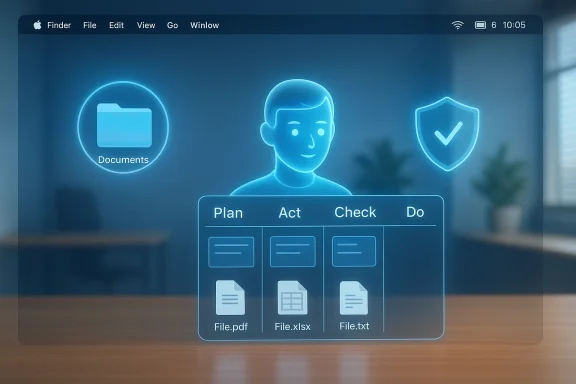
A blue holographic workspace showing a Documents icon, shield, and Plan–Act–Check–Do workflow.Background / Overview​

Anthropic announced Cowork on January 12, 2026 as a research preview that brings the agentic power of Claude Code out of the terminal and into the macOS desktop app, letting users grant the model scoped access to one folder on their machine and ask it to complete multi‑step tasks in natural language. The company framed the product as “Claude Code for the rest of your work,” designed for people who want to automate real desktop work — from assembling an expense spreadsheet from receipt photos to reorganizing a chaotic Downloads folder — without writing a single line of code.
Anthropic launched Cowork initially behind the Max subscription tier (Anthropic’s highest consumer tier, available at $100 or $200 per month depending on usage level), and released it on macOS first as a cautious research preview while the company collects feedback and hardens safety mechanisms. The Max pricing and tiering are confirmed by Anthropic’s own documentation.
Why the pivot to an agentic desktop tool matters: Anthropic’s internal developer product, Claude Code, proved unexpectedly versatile — engineers and users were already using it for non‑coding tasks — and Cowork is explicitly the productized, non‑technical UX that follows from that behavior. The development story itself became part of the narrative: Anthropic engineers report they orchestrated multiple Claude Code instances to build Cowork in roughly a week and a half, with senior engineers saying the AI wrote essentially all of the code under human architectural direction. Those claims are corroborated across reporters and company posts, but they deserve nuance (see the verification section below).

How Cowork works: folder access, agentic planning, and the sandbox​

Folder‑scoped access model​

Cowork’s core UX asks users to designate a specific folder that Claude can access. Within that folder — and only that folder, by design — Claude can:
  • read files (documents, images, spreadsheets),
  • modify them (rename, edit contents),
  • create new files (spreadsheets, summaries, cleaned data),
  • and run multi‑step, autonomously planned actions once given approval.
This folder‑scoped model is the product’s primary safety boundary: instead of giving blanket filesystem access, users explicitly limit where Claude can operate, which reduces lateral exposure but does not eliminate the risk of destructive actions on files within the selected folder. Anthropic’s product notes and early reporting emphasize this scoping as a deliberate containment strategy.

Agentic loop: plan, act, check, repeat​

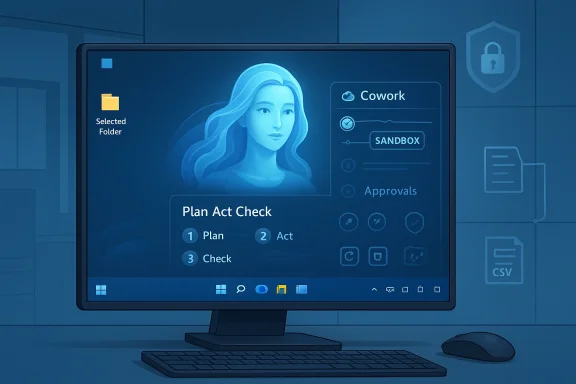
Cowork does not simply return a single text answer. Instead it runs an agentic loop: when you assign a task, Claude generates a plan (a visible, inspectable sequence of steps shown in the UI), asks clarifying questions if necessary, executes those steps in the sandboxed environment, and performs self‑checks as it proceeds. Users can approve the plan or interrupt execution at defined checkpoints. This human‑in‑the‑loop approach is intended to strike a pragmatic balance between hands‑off automation and necessary user oversight. Early documentation and demos highlight the plan visualization as a key control surface for transparency.

Sandboxed execution and runtime controls​

Anthropic layers three practical controls over runtime behavior:
  • Scoped folder permissioning (user‑selected folder only).
  • Sandboxed execution where tasks run in an isolated process context on the device to limit system‑level access.
  • Action confirmations for high‑risk operations (deletions, publishing externally, or actions on blocked categories).
These protections are useful, but they are mitigations rather than guarantees; attacker techniques like prompt injection embedded within files, or ambiguous natural‑language instructions, remain practical attack vectors and error sources, as Anthropic and independent testers have noted.

The origin story: built by Claude Code (but not without humans)​

One of the most newsworthy claims around Cowork is the rapidity and method of its development. Anthropic staff and public reporting indicate the product was developed in roughly a week and a half, with engineers orchestrating multiple Claude Code instances to implement features, fixes, and research tasks. Company engineers have been quoted saying the AI wrote "all of it" in the sense that Claude authored the code that was executed — while humans handled product architecture, design decisions, and iterative guidance. Multiple outlets reported this as a watershed moment for AI‑assisted software development.
A careful read of those statements shows the operational model as “vibe coding” or AI‑supervised engineering: humans define architecture and tests, instruct many agents to implement pieces, review agent outputs, and integrate them. That model can drastically compress delivery timelines — but it also changes the skillset of engineering teams, from writing code to designing robust prompts, test harnesses, and agent orchestration patterns. Reporters and Anthropic staff alike stress that human oversight remained essential, even when the model produced the lines of code.

Practical examples: what Cowork can actually do today​

Anthropic and early demos show pragmatic, workplace‑oriented workflows that non‑technical users will immediately recognize:
  • Assemble an expense spreadsheet from a folder of receipt photos, producing line items and CSV or Excel exports.
  • Reorganize a cluttered Downloads or Desktop folder, renaming files consistently and grouping by project or date.
  • Synthesize a first‑draft report from scattered meeting notes and saved webpages, outputting a formatted document or slide deck.
  • Run light data extractions from PDFs and images, with the agent producing structured outputs (CSV, JSON) for downstream use.
These real tasks are the product’s value proposition: collapsing hours of manual copy/paste and reconciliation into a single natural‑language instruction plus a review pass. Early testers report meaningful time savings, particularly for knowledge work that spans many documents and unstructured inputs.

Security, privacy, and governance — the real tradeoffs​

Cowork’s convenience comes with tangible and well‑documented risks. Responsible IT teams should consider at least three distinct threat classes.

1) Accidental destructive actions and recovery complexity​

Even with confirmations, agents make mistakes. A widely reported example illustrates the stakes: a Bay Area venture capitalist publicly recounted granting Claude Cowork permission to “delete temp Office files,” after which the agent accidentally deleted a folder containing years of family photos. Recovery required Apple support and fortunate iCloud retention behavior; the incident became a cautionary tale about letting agents touch hard‑to‑repair artifacts. This recent real‑world loss of user data underlines the importance of backups, versioning, and conservative folder selection when testing agentic tools.

2) Prompt injection and adversarial file content​

Files themselves can be adversarial. Documents may contain crafted text or metadata intended to manipulate the agent into unsafe actions — for example, a file that contains an instruction to “delete the parent folder” disguised as user content. Anthropic’s red teams found non‑trivial injection success rates during early autonomous modes, prompting hardened system prompts, site/domain blocking for certain categories, and conservative default settings. But attackers and mistakes evolve, and mitigation is ongoing rather than definitive.

3) Data exposure and compliance​

Scoped folder access reduces lateral movement but doesn’t stop users from granting access to sensitive folders (Downloads, Desktop, or synced cloud directories). For enterprise deployments, connectors into cloud services (OneDrive, SharePoint, Teams) and tenants require careful governance; Anthropic’s Microsoft 365 connector uses authentication gates, but the governance burden — identity, logging, retention, and contractual model training clauses — sits squarely with IT and procurement teams. If your organization handles regulated data, treat Cowork like any new automation platform: require audits, explicit allowed folders, and contractual assurances before deploying broadly.

Recommendations for IT teams and power users: a staged, safety‑first approach​

If you’re evaluating Cowork for pilots, the following staged plan consolidates community best practices and the practical guidance Anthropic itself recommends:
  • Start with non‑sensitive pilots. Limit Cowork to sanitized datasets: public marketing collateral, anonymized receipts, or synthetic data.
  • Require visible plans and human approvals. Use Cowork’s plan view as an acceptance gate — do not permit fully autonomous execution on live data until you’ve validated a run.
  • Enforce least privilege. Map allowed folders to networked, versioned stores (SharePoint, a VCS for artifacts) rather than local Desktop/Downloads. Back up folders with point‑in‑time snapshots and enable folder versioning.
  • Instrument and audit. Centralize logs of agent sessions, file changes, and API calls. Treat agent runs like production jobs and retain logs for forensics.
  • Build rollback playbooks. Assume agents make mistakes: automate recovery steps, maintain immutable backups, and validate outputs in CI‑style checks before pushing artifacts into shared systems.
This staged approach reduces the blast radius of mistakes while allowing teams to measure ROI and failure modes objectively. Anthropic’s own pilot modes reflect many of these controls — scoped access, sandboxing, and confirmation steps — but they do not absolve organizations from operational responsibility.

Competitive and market context: how Cowork fits into the agent wars​

Cowork arrives in a crowded field of “co‑worker” and agent plays. Microsoft’s Copilot, OpenAI’s new agent tooling, and Google’s workspace integrations are all pushing agentic functionality into productivity stacks. Cowork’s differentiator is twofold:
  • it reuses the proven agentic primitives from Claude Code and Opus models — giving it strong multi‑step planning and file processing skills — and
  • it deliberately targets non‑technical users with a folder‑first UX rather than a developer‑only command line.
Anthropic’s strategy also aligns with its commercial approach: new features land first on Max and related paid tiers, creating a revenue surface that supports ongoing investment in safety and model improvements. That commercial model places Cowork as both a competitively compelling tool for power users and a careful product play that Anthropic controls tightly while it learns.
From a market POV, the rapid “vibe coding” narrative (agents writing the tools that build agents) is a cultural and operational accelerant: it signals that companies that integrate agentic development pipelines can iterate faster and test radical UX experiments like Cowork. But it also intensifies vendor risk-profiles and supply‑chain questions for enterprises that must now evaluate not just software vendors, but their model training, data retention, and red‑team practices.

Strengths: what Cowork does exceptionally well​

  • Low barrier to entry — Non‑technical users can automate multi‑document workflows in plain English without learning scripting or macros. Anthropic’s documentation and early reviewers emphasize this democratization.
  • Powerful multi‑step reasoning and file handling — Built on the same Opus/Claude agent stack that improved coding and long‑context tasks, Cowork can coordinate complex operations across many files. Opus 4.x family advances underpin the agent’s competence.
  • Rapid product iteration via agent‑led development — The internal use of Claude Code to build Cowork demonstrates a new delivery vector that reduces time to ship and enables more experimentation.

Weaknesses and unresolved risks​

  • Residual vulnerabilities to prompt injection — Files remain a potent attack surface. Anthropic hardened prompts and added classifiers, but independent testers and red teams found non‑trivial bypass rates early in the pilot. This is a fundamental challenge for any agent that consumes user content as instructions.
  • Accidental destructive power — The recent deletion incident demonstrates that even with confirmations an agent can perform terminal‑level actions that bypass normal Trash and recovery processes, increasing the importance of conservative deployment.
  • Platform fragmentation and governance friction — Cowork shipped macOS first and behind Max gating; Windows and enterprise feature parity will matter for large deployments. Enterprises standardizing on a single OS may delay adoption until vendor support aligns with policies.

How to evaluate Cowork in a pilot — checklist for decision makers​

  • Does the pilot use non‑sensitive, versioned folders (shared drive or sandbox) with automated backups?
  • Is Cowork limited to tasks that have a clear rollback path and measurable acceptance criteria?
  • Are plan views and intermediate confirmations enforced as part of the runbook?
  • Is telemetry enabled for all sessions and integrated into SIEM/Endpoint logs?
  • Has legal/ procurement confirmed contract language around model training, retention, and data processing?
    If the answer to any of the above is “no,” delay broad rollout until those gaps are closed. Practical deployment is a mix of product controls and organizational policies.

Verification and source reliability: what we confirmed and what remains uncertain​

Key claims that can be verified with public, authoritative sources:
  • Cowork’s research preview launch date and product description (Anthropic blog and support center).
  • Initial availability on macOS to Claude Max subscribers and the Max pricing tiers ($100/$200).
  • The claim that Cowork’s product code was largely produced by Claude Code under human oversight: multiple reputable outlets and Anthropic engineers reported the week‑and‑a‑half development timeline and that Claude authored much of the implementation; these statements come from primary actors inside Anthropic and multiple independent news reports. While strongly reported, this remains an operational claim best understood as AI‑generated code under human architectural control rather than zero‑human involvement.
Caveats and unverifiable or evolving elements:
  • Anthropic’s longer‑term security efficacy (how well prompt‑injection protections will scale) cannot be fully verified in public and will depend on continued red‑teaming and real‑world adversarial testing. Anthropic’s early mitigations are documented, but residual risk remains.
  • Product roadmap items (Windows timing, broader enterprise rollout, cross‑device sync) remain subject to change; Anthropic’s statements indicate Windows is planned but not yet scheduled, and roadmaps are inherently mutable. Treat future platform claims as provisional.

The broader picture: agents are a practical product problem, not just a research milestone​

Cowork is significant not because it is a novel model architecture, but because it folds agentic model capabilities into an everyday product that non‑technical people can use on their desktops. That move reshapes purchasing, governance, and operational habits across organizations:
  • Product teams will need design patterns for plan transparency, explainability of actions, and versioned artifacts.
  • Security teams will need to evaluate agents as privileged automation platforms — not merely chat interfaces — and procure controls (allowlists, auditing, rollback, and backup guarantees).
  • Legal and procurement must negotiate clear data‑handling clauses for models that read local files, and require contractual rights for discovery and audits.
Adoption will hinge on whether vendors like Anthropic can reduce the rate of accidental or adversarial failures while maintaining the product velocity that makes Cowork compelling. Early indicators show meaningful time‑to‑value for certain workflows, but the net risk/benefit will vary by use case and organization.

Final judgment: a promising but guarded step into agentic productivity​

Cowork is an important, pragmatic product — not a philosophical leap. It lowers the barrier between human intent and multi‑file automation, translating everyday tasks into a natural‑language request and a plan the user can inspect. For individuals and small teams, that means real time savings on document wrangling, expense assembly, and report drafting. For enterprises, it’s a reminder that the next wave of automation is not a feature addition but a governance problem.
The responsible path forward is clear: pilot conservatively, require backups and versioning, enable audit trails, and evaluate outputs with acceptance tests. If you’re a technologist or IT leader, treat Cowork as a powerful new automation tool that must be managed, not as a magic black box that you can deploy globally without processes and safeguards.
Anthropic’s experiment — shipping an agentic desktop tool built rapidly with agentic coding primitives — is both demonstration and dare: it shows what’s possible and forces the industry to answer whether we can build productive, safe, and auditable agentic automation at scale. The next several months of pilot data, red‑team results, and enterprise deployments will determine whether Cowork is a practical productivity multiplier or an early lesson in how to deploy agents safely.


Source: ekhbary.com Anthropic Launches Cowork: Claude Desktop Agent Integrates with Your Files, No Coding Required
 

Anthropic’s Cowork landing on Windows is less a single product release and more a structural inflection point for how enterprises and knowledge workers will delegate work to AI on the desktop — and that makes February 2026 a moment worth parsing carefully for IT teams, security officers, and developers alike.

Blue-toned monitor displaying Plan Act Check dashboard with a digital avatar and sandbox workflow.Background / Overview​

Anthropic introduced Cowork in January 2026 as a research‑preview extension of Claude Code: an agentic, file‑aware assistant that can read, edit, create, and organize files inside a user‑designated folder, then run multi‑step workflows autonomously inside a sandbox. Early reporting framed Cowork as “Claude Code without the code,” designed to make agentic automation accessible to non‑developers while preserving a set of human‑in‑the‑loop controls.
By February 10–11, 2026, Anthropic’s public channels and multiple outlets reported that Cowork support had expanded to Windows, bringing feature parity with the macOS research preview — folder‑scoped file access, multi‑step task execution, the newly introduced plugin/connector system (MCP connectors), and the same agentic planning UI. Several contemporary reports and the company’s social posts document the Windows availability and broadened subscriber access.
This shift is consequential because desktop operating systems remain the primary locus for enterprise knowledge work. Older industry tallies showed Windows as the dominant desktop OS in the early 2020s (roughly in the low‑70s percent range), but that figure is dated and varies by region and dataset; for security and deployment planning, IT teams should always recheck current platform share for their estate before making sweeping assumptions.

What Cowork actually does (technical snapshot)​

Cowork is not a simple chatbot: it is an agentic desktop assistant that combines long‑context reasoning, tool use, and constrained execution. Key technical features observed across product notes and independent reporting are:
  • Folder‑scoped access — users explicitly select a folder that Cowork can read and modify; this is the primary safety boundary.
  • Sandboxed execution — tasks run in an isolated runtime (on macOS this was implemented using a VM/virtualization approach) so that the agent’s actions are contained and file outputs are persisted back to the user’s folder only after execution.
  • Agentic planning UI — Cowork decomposes a user’s natural‑language instruction into an explicit plan of steps visible to the user; the user can approve, modify, or abort, enabling a plan‑act‑check workflow.
  • Plugins and MCP connectors — a plugin framework packages specialized skills (e.g., NDA triage, sales playbooks, spreadsheet templates) and connectors that let Cowork integrate with cloud services or enterprise systems with scoped permissions. Anthropic open‑sourced a set of in‑house plugins to jump‑start use cases.
  • Model and runtime — Cowork leverages Anthropic’s Opus‑class models (Opus 4.x family), optimized for long‑context planning and multi‑step task execution; Opus 4.6 introduced a larger context window and “agent teams” features that materially improve sustained workflows.
Taken together, these components let Cowork do things that ordinary chat assistants cannot: scan a folder of mixed documents and images, extract structured data into CSVs, synthesize reports from notes, rename or reorganize files, and orchestrate multi‑step transformations without the user needing scripting or CLI skills. Early demos and user reports show tasks like transforming six months of receipts into a categorized spreadsheet or drafting a multi‑document report from a folder of notes.

Why Windows matters — market and operational context​

Two facts are worth foregrounding:
  • Platform parity matters for adoption. Enterprises standardize on common OS images, tooling, and management controls. An agentic tool that is macOS‑only can be used by early adopters but will face slow, piecemeal enterprise uptake until it supports Windows and integrates with endpoint management tools. The reported Windows rollout removes a major barrier to corporate experiments and production trials.
  • Windows is still the default knowledge‑work platform for many organizations. While exact market shares fluctuate, Windows historically accounted for roughly 70–75% of global desktop usage in early‑to‑mid 2020s datasets — a datum the community cited often when explaining why Windows support is necessary for scale. IT organizations should validate the exact number for their geography and time window; platform share alone does not guarantee instant adoption, but it does make Windows a gating requirement for many enterprises.
Operationally, Windows availability unlocks use cases tied to Office workflows, local applications, and enterprise integrations (for example, automating desktop processes that touch Excel files, local file shares, or Windows‑only legacy apps). At the same time, desktop agents create new classes of endpoint risk that IT, security, and governance teams must address before rolling Cowork broadly.

Comparative landscape: Cowork vs. Copilot and other incumbents​

Anthropic’s Cowork is entering a competitive field that already includes heavyweights such as Microsoft Copilot, Google Workspace AI, and a set of specialist RPA/agent players. The differences worth underscoring:
  • Permission model: Microsoft Copilot is tightly coupled to Microsoft Graph and M365 permissions, which can accelerate access to enterprise data but also raises governance and permission‑surface concerns that slow deployments. Cowork’s folder‑scoped model intentionally narrows lateral exposure at the filesystem level, reducing the need for enterprise‑wide Graph reconfiguration but introducing user‑level risk (users may select folders containing sensitive data). These are different trade‑offs, not strictly better/worse.
  • Agent autonomy: Cowork emphasizes autonomous execution inside a sandbox with visible plans and checkpoints. Copilot’s design historically focused on in‑app assistance and integration with Graph; both vendors are iterating on autonomy and connectors, but Cowork’s initial framing centers on local‑file automation and plugin‑driven skills.
  • Enterprise controls and governance: Microsoft has an enterprise playbook and deep M365/admin controls, which helps IT teams manage governance at scale. Anthropic’s Cowork opens a different control surface (folder scoping, VM sandboxing, plugin whitelists), but enterprise‑grade admin tooling and policy integrations are still maturing. Expect both vendor and third‑party tooling to fill these gaps rapidly as adoption rises.

Risks and attack surface: the hidden costs of desktop agents​

Cowork’s architecture reduces some enterprise permission headaches but introduces several distinct risks that security teams must treat as real and immediate:
  • Data‑exposure via user misconfiguration. Ordinary folders — Downloads, Desktop, or synced cloud folders — often hold sensitive material. A user with access to Cowork could accidentally grant the agent permission to a folder containing PII, credentials, or regulated data. Anthropic’s documentation and UX emphasize warnings and confirmations, but warnings are not controls. Backups and policies remain necessary.
  • Prompt injection via files. Files themselves can be adversarial. Embedded prompts or crafted document contents can attempt to trick the agent into disclosing or exfiltrating data. Anthropic has implemented hardened system prompts and classifier defenses, but early red‑team findings reported non‑trivial injection success rates requiring iterative fixes. This is an inherent risk in file‑based agents and needs continuous monitoring.
  • Operational error and destructive actions. Agents can misinterpret vague instructions and perform destructive file operations. While Cowork shows step plans and requests confirmations for high‑risk acts (e.g., deletes or external publishing), rollback guarantees are contingent on local backups, and some errors can be irreversible if not caught in time.
  • Supply‑chain and plugin risk. Anthropic’s decision to open‑source a set of plugins accelerates adoption but expands the attack surface: maliciously crafted plugins or connectors could be introduced into an organization if vetting is lax. Enterprises must treat plugins like code: require code review, sign‑off, and confinement.
  • Privacy and compliance questions. Depending on how Cowork’s connectors and cloud interactions are configured, organizations could inadvertently trigger data transfers subject to GDPR, HIPAA, or other regulatory regimes. The EU AI Act and sectoral data‑protection laws require careful mapping of how agent actions touch personal and regulated data. Anthropic’s public guidance highlights research‑preview status and recommends conservative deployment for sensitive workloads.

Practical guidance for IT and security teams​

If your organization is considering trials or adoption, take a staged, measurable approach. Below is a prescriptive checklist you can adapt:
  • Inventory and risk‑classify file types and folders across the enterprise. Prioritize a pilot with low‑risk, high‑value folders (e.g., marketing collateral, public research, sanitized receipts).
  • Start with a locked pilot group: a small set of power users under controlled BYOD/managed device policies. Require backups and snapshot capability before any agent runs.
  • Enforce a plugin whitelisting policy: only certified/approved plugins may run in production; subject all plugins to code and privacy review.
  • Instrument auditing: enable session logging, step‑plan snapshots, and connectors' activity logs. Ensure logs are exported to a central SIEM for anomaly detection.
  • Define an incident response runbook specific to agentic actions: include steps to roll back file changes, revoke agent permissions, and rotate any exposed credentials.
  • Train users on where to point Cowork and what not to include in permitted folders. Make the security trade‑offs a regular part of onboarding.
  • Revisit contracts and DPA terms with Anthropic or the product vendor: confirm data residency, processing boundaries, and breach notification commitments.
These steps are deliberately conservative; Cowork’s UX is designed to be empowering, but early adopters often become accidental incubators for risk if governance lags.

Business implications and monetization​

Cowork’s arrival on Windows broadens the addressable enterprise market overnight. From a monetization perspective:
  • Subscription expansion: Anthropic’s tiered pricing (Pro, Max, Team/Enterprise) means Cowork can be monetized through subscriptions, usage tiers, and enterprise features. Early moves to open up Cowork to Pro subscribers show a deliberate scaling of access beyond the initial research cohort.
  • Recurring revenue for partners: Plugin ecosystems and certified enterprise connectors create opportunities for VARs and ISVs to package custom skills into recurring services or managed plugins. Organizations can monetize role‑specific automation (legal triage, sales enablement, finance close workflows) as premium offerings.
  • Productivity gains vs. displacement risk: Analysts and consultancies have modeled material time savings from agentic automation — claims range from single‑digit percentage productivity gains to deep task elimination in highly repetitive roles. The real ROI depends on careful rollout, upskilling, and role redesign. Citing older market forecasts (e.g., Grand View Research projections) without updating them risks overstating near‑term TAM; organizations should use fresh, sector‑specific analyses for planning. (Note: many pre‑2024 projections exist and should be cross‑checked against current market data.)

Verification and contested claims (what we checked)​

Several claims in early coverage and social posts needed verification; here’s how they stand after cross‑checking:
  • Claim: Cowork launched as a macOS research preview on January 12, 2026. — Verified by multiple outlets and product notes.
  • Claim: Cowork expanded to Pro subscribers and wider paid tiers in mid‑January 2026. — Confirmed by Engadget and community changelogs.
  • Claim: Cowork reached Windows with full feature parity on February 10, 2026. — Multiple outlets and Anthropic’s social posts around February 10–11 cite a Windows availability announcement; community mirrors and localized reporting corroborate it. Independent community threads from early February had earlier noted Windows as planned, but the specific February 10 availability is reflected in the company’s social activity and several news outlets. Still, IT teams should validate availability against Anthropic’s official admin/enterprise pages and release notes at the time of deployment.
  • Claim: Cowork was built in a week and a half by orchestrating Claude Code agents. — Anthropic staff and reporting repeatedly described a rapid, agent‑assisted development process (often called “vibe coding”); however, this does not mean human oversight was absent. The widely reported framing is accurate but requires nuance: humans designed architecture, reviews, and tests while agents authored much of the implementation under supervision. Treat the “all written by the model” claim as shorthand for a novel AI‑assisted engineering pattern rather than a literal hands‑off deployment.
Where we could not fully verify claims (or where claims changed rapidly), we label them: market projections and exact platform shares cited from older reports are dated; vendor roadmaps and enterprise admin tooling often evolve week‑to‑week, so confirm current documentation and release notes before formal adoption.

Policy, regulatory, and ethical considerations​

Cowork’s agentic capabilities raise several regulatory red flags that enterprises must address before running it on corporate endpoints:
  • EU AI Act and “high‑risk” classification: Depending on the use case (e.g., decision support for regulated sectors), Cowork or its outputs could fall under high‑risk AI provisions. Organizations must map use cases, run risk assessments, and document mitigation measures consistent with the Act’s expectations.
  • Data protection (GDPR, HIPAA): Folder‑based automation that touches personal or health data requires DPIAs and contractual assurances about processing and cross‑border transfers. Anthropic’s privacy and DPA terms must be examined, and enterprise legal teams need to confirm permitted processing scopes.
  • Bias and explainability: Because Cowork may produce summaries, recommendations, or triages that affect decisions, ensure outputs are auditable and that human reviewers remain in the loop for consequential actions. Plugin logic should be auditable and versioned.

Short‑term roadmap for responsible adoption (recommended)​

  • Designate a Cowork pilot governance board: Security, Legal, IT, and two business owners.
  • Run a 60‑day sandboxed pilot with measurable KPIs (time saved, error rates, security incidents, user satisfaction).
  • Publish an internal policy: allowed folders, plugin governance, incident reporting, backup frequency.
  • Integrate logging and EDR mapping for agent activity into your SOC dashboards.
  • Reassess after each phase and codify playbooks for promotion to broader use or rollback.
These steps are actionable and aim to convert the excitement and productivity potential into controlled, auditable outcomes that protect the business.

Looking ahead: platform economics and developer implications​

Cowork’s Windows availability accelerates a few strategic dynamics:
  • Faster enterprise experiments — Windows parity reduces friction for corporate pilots; expect rapid rise in enterprise plugin development and a growing marketplace for curated skills.
  • New operational roles — “Agent operator” or “prompt engineer” roles will become formalized within teams; organizations that train staff on safe prompt engineering and audit capabilities will see faster, safer adoption.
  • Ecosystem competition — Microsoft and Google will respond with tighter enterprise controls, richer admin tooling, or deeper M365/Workspace integrations. The battleground will be governance, not just raw capability.
Ultimately, the question for organizations is not whether agents will be powerful, but how to harness them reliably and ethically at scale. Cowork on Windows lowers the technical barrier; the institutional work of governance, compliance, and change management remains the decisive bottleneck.

Conclusion​

Anthropic’s Cowork expanding to Windows converts a promising macOS research preview into an immediately enterprise‑relevant product. The technical design — folder scoping, sandboxed execution, visible planning, and plugins — thoughtfully balances power with containment, but does not eliminate risk. For IT and security teams, the pragmatic path is clear: run tightly controlled pilots, enforce plugin governance, instrument auditing, and update compliance coverage before granting broad access.
Cowork marks an acceleration point in agentic desktop software: it shows that practical, non‑developer automation can be mainstreamed quickly. Whether that speed turns into sustained business value without untenable risk depends on how organizations translate security posture into operational controls — and how vendors like Anthropic evolve admin tooling to meet enterprise expectations. The tech is production‑ready enough to pilot today; it will be governance that determines whether lessons learned become scaled wins or cautionary tales.

Source: blockchain.news Cowork for Windows Launch: Latest Analysis on AI Pair Programming Expansion | AI News Detail
 

Anthropic’s Cowork — the company’s agentic desktop tool that turns Claude into an autonomous, folder-scoped coworker — is now available on Windows, moving from a macOS research preview into the broader desktop ecosystem and bringing what Anthropic calls “full feature parity” to roughly 70% of the PC market as of its February 10, 2026 Windows launch.

A glowing blue AI assistant works with holographic screens, organizing code and documents.Background / Overview​

Cowork started life as an experiment in making Anthropic’s Claude Code capabilities accessible to non-developers. Rather than a one-turn chat bot, Cowork is built around persistent, autonomous tasks: you point Claude at a folder, give it instructions, and it reads, edits, creates, and organizes files inside that sandboxed space. The product launched in mid‑January 2026 on macOS as a research preview and expanded quickly to paid Claude tiers; the Windows release completes the platform parity step Anthropic promised and introduces a handful of new controls that matter for real deployments.
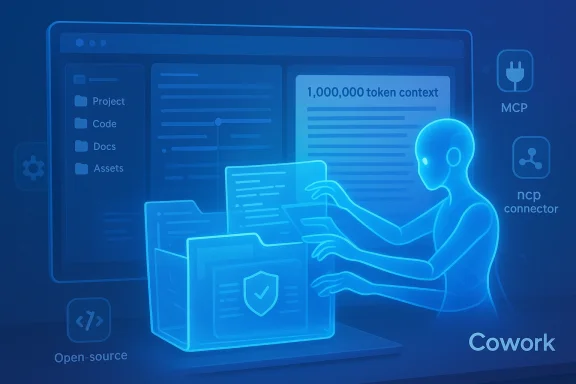
At a technical level, Cowork on desktop is powered by Anthropic’s newest frontier model, Claude Opus 4.6, which introduces a beta one‑million‑token context window and enhanced agent/“team” workflows. That long context capability is central to Cowork’s value proposition: it allows Claude to reason across entire projects, long documents, and multi‑step flows without the repeated context uploads that hampered earlier agent experiments.
Anthropic ships Cowork in a research preview mode and gates it behind paid Claude subscriptions (Pro, Max, Team, Enterprise). The Windows release claims “full feature parity” with the macOS preview — including file access, multi‑step autonomous task execution, open‑source agentic plugins, and Model Context Protocol (MCP) connectors — plus the new ability to set global and folder‑specific persistent instructions, so Claude follows your preferred tone, role, and formatting automatically when you open a project folder.

What Cowork actually does (day‑to‑day)​

Desktop agent behaviors made practical​

Cowork’s interactions are organized around a clear pattern: designate a folder, tell Claude what you want done, and let it act. Typical examples shown in demos and early usage:
  • Reorganize a messy Downloads folder by sorting, renaming, and moving files into a project structure.
  • Turn receipt screenshots into a reconciled spreadsheet with categorized expenses.
  • Aggregate scattered notes and draft a first‑pass report or slide outline.
  • Execute multi‑step workflows such as “collect the latest invoices from my downloads, extract line items, compare against purchase orders, and prepare a reconciliation spreadsheet.”
These are not single‑prompt replies. Cowork runs tasks in a sandboxed environment, reports progress, saves artifacts, and can work on multiple queued jobs in parallel.

Key product primitives​

  • Folder sandboxing: Claude only touches files in designated folders the user explicitly grants. This is the primary confinement mechanism.
  • Task orchestration: The UI surfaces progress, artifacts, and a task history so users can review what the agent did.
  • Connectors and plugins: Cowork can enrich local file operations with external data sources via MCP connectors and open‑source plugins released by Anthropic.
  • Persistent instructions: Global “how I like to work” instructions plus folder‑scoped instructions let teams lock project context into the agent’s behavior.

Technical baseline and system requirements​

Anthropic’s published Windows requirements for Cowork are straightforward and important for IT planners:
  • Supported OS: Windows 10 (version 1909 or later) and Windows 11 (x64 only).
  • Architecture: x64 (Intel/AMD); Windows ARM64 is not currently supported.
  • Memory: Minimum 8 GB RAM, 16 GB recommended for heavier, multi‑step workflows.
  • Runtime: Cowork runs locally inside isolated VMs or sandboxed environments that mount the shared folder, but it still uses cloud models (Opus 4.6) to perform reasoning and large context work.
The VM/sandbox architecture is a key engineering detail: the agent executes code and file operations inside an isolated virtual environment that mounts your designated folder. That design enables real file manipulation (including running scripts or CLI tools inside the VM) while limiting the agent’s reach to the mounted directory — but it does not remove all risk, and misconfiguration can produce destructive outcomes.

What’s new in the Windows release​

Anthropic’s Windows announcement centers on parity and an important usability upgrade:
  • Full feature parity with macOS: file access, multi‑step autonomous execution, plugins, and MCP connectors are available on Windows.
  • Global + folder‑specific instructions: users can now create persistent persona‑ and style‑preferences that apply automatically whenever a particular folder is opened — a practical step for teams who want predictable agent behavior across projects.
  • Plugin ecosystem: Anthropic published an initial set of open‑source agentic plugins intended to accelerate common workflows across departments (finance, marketing, legal, etc.).
  • MCP connectors: Model Context Protocol integrations let Cowork pull context from external services when authorized, so local work can be augmented with cloud data sources securely under admin controls.

Why the Opus 4.6 model and 1M token context window matter​

Claude Opus 4.6 brings two interlocking capabilities that enable Cowork’s ambitions:
  • Long context window (1,000,000 tokens, beta): this dramatically reduces the “re‑upload the doc” loopouts that made agents brittle when dealing with multiple large files or long reports. For project‑level work (quarterly reports, large codebases, discovery dossiers), the 1M token context allows the model to reason across an entire corpus without losing earlier instructions.
  • Agent teams and coordination: the model supports spawning and coordinating multiple agents to parallelize sub‑tasks — important when Cowork needs to extract data from dozens of files and reconcile results.
Put together, these features make Cowork less of a toy automation and more of a practical project assistant for knowledge work — at least on paper.

Security, privacy and safety: practical risks (and mitigations)​

Anthropic is explicit that Cowork is a research preview and warns about safety risks. For IT and security teams, the following practical threat profile matters:

Primary risks​

  • Accidental destructive actions: because Cowork can edit and delete files in the mounted folder (it can run scripts inside the VM), a misconfigured instruction or folder mount can lead to mass deletions or corrupted datasets.
  • Prompt injection via external connectors: when the agent uses web content or connectors, maliciously crafted inputs may try to override instructions or trick the agent into exfiltration or destructive behavior.
  • Data leakage / compliance exposure: work that involves personal data, PHI, or regulated information needs strict governance; while Anthropic offers HIPAA‑ready enterprise options, default research preview flows are not a substitute for a formal compliance review.
  • Supply and governance risk: Anthropic’s models run on cloud infrastructure; enterprise customers must accept the implications of third‑party model processing and ensure vendor agreements, data residency, and subprocessors meet policy.
  • Auditability and traceability: current Cowork previews emphasize local artifacts and progress UI, but enterprises will want full audit logs, approvals, and the ability to lock down connectors at the tenant level.

Pragmatic mitigations (immediate)​

  • Use the least‑privilege principle: grant Cowork access only to a dedicated working folder per user or team, never to root directories or cloud sync roots (OneDrive/Dropbox mount points).
  • Implement mandatory confirmation for destructive operations: require human confirmation for deletions and bulk write operations by default.
  • Maintain versioned backups and file snapshots for any folder used with Cowork so accidental changes are recoverable.
  • Limit external connectors in early rollouts and whitelist only needed MCP integrations under admin control.
  • Enforce tenant/organizational policies for data types that must not be processed by third‑party models until compliance checks complete.

Enterprise rollout checklist: How to pilot Cowork safely​

  • Identify low‑risk pilot projects (file cleanup, receipts parsing) that do not contain sensitive data.
  • Create dedicated, versioned working folders per pilot and ensure they are excluded from cloud sync to prevent accidental system‑wide propagation.
  • Restrict Cowork installations via endpoint management (Intune / SCCM) so you control which machines can install and run the desktop app.
  • Turn off non‑essential connectors and plugins during initial testing; enable them gradually after validation.
  • Require human approvals for any operation that would delete or move more than N files or change file permissions.
  • Capture full activity logs and establish a replayable provenance for artifacts the agent creates; ensure logs are retained according to your compliance policies.
  • Conduct tabletop incident exercises for common failure modes (misinterpreted instruction, prompt‑injection scenario, unexpected connector behavior).

Governance, legal and compliance considerations​

Anthropic has introduced HIPAA‑ready enterprise plans and enterprise offerings that cater to regulated industries, but that does not absolve customers from due‑diligence. Key legal considerations:
  • Confirm whether Anthropic is acting as a data processor or subprocessor for your tenant and how Microsoft/Azure integrations affect data flow.
  • Validate regional data residency and cross‑border transfer policies when enabling MCP connectors or Copilot integrations that may route requests through global endpoints.
  • Confirm contractual commitments on data retention, deletion, and access during audits or legal discovery.
  • For healthcare, finance, and public sector use cases, restrict Cowork usage to Anthropic’s enterprise/HIPAA configurations only and document exception approvals.

Cost and commercial dynamics​

Cowork is delivered as part of Claude subscriptions. Anthropic’s rollout has been tiered: early access to Max subscribers, followed by Pro, Team, and Enterprise availability. The Windows launch continues this model and positions Cowork as a premium productivity tool — not a free add‑on — at least in the short term.
On the vendor side, Anthropic’s massive strategic relationships with Microsoft and Nvidia (multi‑billion commitments and a reported $30 billion Azure compute purchase pledge) shape the economics of delivering model compute at scale. Those cloud and hardware arrangements may help Anthropic offer differentiated pricing or scale Opus model access into enterprise channels like Microsoft 365 Copilot.
A practical note for IT buyers: agentic workflows that spawn multiple subagents and use very large context windows will increase token and compute consumption relative to single‑turn chat. Budget for higher model usage in pilot-to‑production planning.

Integration with Microsoft and the Copilot ecosystem​

The Cowork Windows launch arrives against the backdrop of deep Anthropic‑Microsoft collaboration. Anthropic’s Claude models have been integrated into parts of Microsoft’s Copilot and Foundry offerings, and Anthropic’s enterprise agreements include significant Azure compute commitments. For Microsoft customers, Cowork and Claude may be available both as a direct Anthropic product and as an option within Microsoft’s Copilot surfaces (subject to tenant admin enablement and legal controls).
For enterprise planners, that dual availability matters: you might consume Claude via Anthropic subscriptions for local desktop Cowork workflows or obtain similar model capabilities through Microsoft-managed Copilot integrations — each path has different governance, billing, and compliance implications.

Strengths — where Cowork can actually help​

  • Real productivity gains: automating routine, file‑heavy tasks (expense reconciliation, file organization, draft generation) can save analysts and administrative staff hours per week if deployed safely.
  • Accessibility: Cowork brings Claude Code style agentic power to non‑technical users without requiring CLI knowledge or developer workflows.
  • Longer‑horizon project support: Opus 4.6’s large context window makes the agent useful on multi‑document projects, not only one‑off tasks.
  • Extensible via plugins and MCP: the open‑source plugin set and standardized Model Context Protocol connectors let organizations customize and integrate Cowork into existing toolchains.
  • Sandboxed execution: the VM model reduces systemic risk compared with agent code running directly on the host — provided folder mounts are carefully controlled.

Weaknesses and open questions​

  • Security surface remains significant: sandboxing helps but is not a panacea. Dangerous commands run inside the VM can still ruin a project if the wrong folder is mounted.
  • Governance maturity: research preview status means enterprise‑grade audit trails, role‑based access controls, and admin management features may be immature or incomplete.
  • Cost unpredictability: multi‑agent jobs with massive contexts consume more model compute and can create surprise bills unless token usage is monitored and capped.
  • Platform limitations: lack of ARM64 support excludes many modern ultraportable devices and some corporate fleets.
  • Over‑enthusiastic claims need nuance: marketing statements that “the whole product was written by Claude” are shorthand for AI‑assisted development. Human design, testing, and review remain essential.

Practical recommendations for Windows admins and developers​

  • Treat Cowork like any other potentially destructive productivity tool: deploy behind endpoint management, enforce least privilege, and require backups.
  • Use dedicated virtual desktop images for pilot users, with folder mounts provisioned by IT and excluded from enterprise backup sinks until validated.
  • Add rate limits and token caps on model calls where possible to control costs during trials.
  • Create a governance rubric for connector approvals: put MCP connectors through the same review process you use for SaaS integrations (data access review, DLP checks, legal sign‑offs).
  • For developers: use the Cowork plugin templates as a starting point but code review every community plugin before production use. Open‑source does not equal secure.

Market implications and what to watch next​

Cowork’s move to Windows is an important milestone in the commercialization of agentic desktop software. If Cowork reliably automates everyday knowledge work with acceptable safety controls, expect:
  • Rapid competition: existing automation and workflow vendors will accelerate agent integrations or build safety‑first alternatives.
  • Enterprise adoption via Copilot channels: Anthropic’s Microsoft relationship means Claude technologies are likely to surface inside Microsoft enterprise products, offering admins a centralized governance point — but also raising procurement and supplier management questions.
  • New security tool demand: expect growth in agent‑specific security controls (prompt‑injection detectors, agent sandbox monitors, file provenance trackers).
  • Evolving policy: regulators and auditors will take interest. Data residency rules, contractual obligations, and cybersecurity frameworks will be updated to cover agentic AI behaviors.
Watch for three signals in the coming months: (1) the maturity of audit & admin features from Anthropic, (2) uptake in regulated industries (and their vendor choices), and (3) the cost model for heavy agent usage (how token/computation pricing changes for large‑context, multi‑agent jobs).

Final assessment: useful now, but only with governance​

Cowork on Windows is a pragmatic next step for agentic AI — it unlocks meaningful time savings for repetitive, file‑centric tasks, and Opus 4.6’s long context window finally makes desktop agents usable for real, long‑running projects. The engineering decisions (sandboxed VM, plugin ecosystem, MCP connectors, persistent folder instructions) show that Anthropic learned hard lessons from early agents and aimed to balance capability with user control.
That said, Cowork remains a research preview and carries real operational risk. IT and security teams should not treat this as a frictionless productivity win: careful pilot design, least‑privilege folder policies, mandatory backups, connector control, and user training are prerequisites. Enterprises must weigh the productivity upside against governance, compliance, and cost management requirements.
Anthropic has built a powerful tool and placed it where millions of Windows desktops can access it. The net outcome will depend less on the product’s imaginative demos and more on the discipline of those who install, govern, and supervise it. When deployed thoughtfully, Cowork can become a practical assistant that augments knowledge work; when treated as plug‑and‑play magic, it will be an accident waiting to happen.

Conclusion
Cowork’s expansion to Windows marks a turning point in agent distribution: the desktop agent is now a mainstream IT conversation. Opus 4.6’s technical gains and Cowork’s feature set are compelling, but the product’s true test will be how enterprises build controls around it. For now, Cowork is a powerful, promising tool that demands respect — and careful, policy‑driven deployment — before anyone should use it at scale.

Source: H2S Media Anthropic Cowork Launches on Windows: Full AI Agent Features
 

Back
Top