

A subtle validation gap in Linux's ethtool handling of Receive-Side Scaling (RSS) indirection tables can be weaponized to trigger kernel crashes and full host outages — the defect tracked as CVE-2024-46834 forces ethtool to “fail closed” when the kernel cannot reliably determine the highest channel index used in indirection tables, preventing unsafe channel reconfiguration but creating a practical denial‑of‑service (DoS) risk for systems that expose XDP, RSS, or dynamic ethtool reconfiguration workflows.
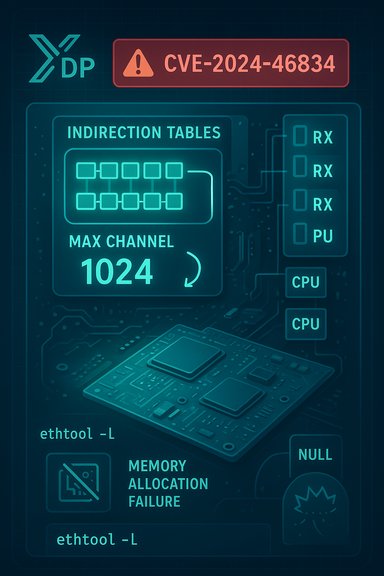
CVE-2024-46834 stems from an interaction between the kernel core’s ethtool channel-change path and driver-supplied indirection tables used by RSS. When the kernel or a driver cannot fetch an interface’s indirection table — or when memory allocation fails while fetching it — the earlier logic skipped a critical check for the maximum channel index present in that table. If the indirection table contains channel IDs that are out-of-bounds for the device, the kernel could proceed with a channel change that produces NULL-dereferences or other unsafe accesses in driver code, leading to kernel oops/panic and broad loss of availability. The upstream response was to make the ethtool change fail closed — refuse the channel-change operation when the kernel cannot safely obtain or validate the maximum channel used by the indirection table. Linux distributors and trackers have broadly classified the vulnerability as availability-first (medium severity; typical CVSS v3.1 = 5.5) because the practical consequence is host crash or persistent service outage rather than confidentiality or integrity compromise. Attack complexity is generally low when an attacker already has local or tenant-adjacent privileges that permit XDP/ethtool operations, which makes multi‑tenant cloud hosts and shared CI/test runners particularly relevant high-risk targets.
The bug arose because that max-channel verification was skipped under two rare but real conditions:
Immediate remediation checklist (recommended):
Key artifacts to capture and monitor:
Actionable conclusion:
Every paragraph above is intended to provide practical, verifiable guidance to systems and security operators facing CVE-2024-46834: inventory, patch, reboot, validate, and monitor — with special emphasis on multi‑tenant and cloud hosts where the local attack model is most meaningful.
Source: MSRC Security Update Guide - Microsoft Security Response Center
 Background / Overview
CVE-2024-46834 stems from an interaction between the kernel core’s ethtool channel-change path and driver-supplied indirection tables used by RSS. When the kernel or a driver cannot fetch an interface’s indirection table — or when memory allocation fails while fetching it — the earlier logic skipped a critical check for the maximum channel index present in that table. If the indirection table contains channel IDs that are out-of-bounds for the device, the kernel could proceed with a channel change that produces NULL-dereferences or other unsafe accesses in driver code, leading to kernel oops/panic and broad loss of availability. The upstream response was to make the ethtool change fail closed — refuse the channel-change operation when the kernel cannot safely obtain or validate the maximum channel used by the indirection table. Linux distributors and trackers have broadly classified the vulnerability as availability-first (medium severity; typical CVSS v3.1 = 5.5) because the practical consequence is host crash or persistent service outage rather than confidentiality or integrity compromise. Attack complexity is generally low when an attacker already has local or tenant-adjacent privileges that permit XDP/ethtool operations, which makes multi‑tenant cloud hosts and shared CI/test runners particularly relevant high-risk targets. What exactly is broken — technical root cause
RSS indirection tables and the max‑channel invariant
RSS works by mapping incoming packet hashes into an indirection table of channel indices; each channel maps to an RX ring and CPU. The kernel core contains logic that validates the indirection table and determines the highest channel index used so that ring allocations and driver checks stay within bounds.The bug arose because that max-channel verification was skipped under two rare but real conditions:
- the driver failed to return an indirection table (e.g., driver query returned error), or
- the kernel failed to allocate memory while attempting to fetch the table.
Why “fail closed” is the correct defensive posture
The upstream fix converts a permissive, optimistic behavior into a conservative one: if the kernel cannot reliably determine the max channel used by the indirection table, the channel-change request is refused. This prevents the kernel or driver from acting on incomplete/uncertain state and avoids dereferencing potentially freed or NULL ring pointers. The change is intentionally small and surgical — it does not re-architect RSS or driver models; it simply enforces a safety invariant before proceeding with reconfiguration. Multiple distro trackers and stable-tree commits have accepted this approach as the lowest-risk correction.Evidence, reproducible pattern, and crash signature
Security advisories and reproduction notes collected from maintainers and operators describe a typical failure sequence observed in the wild and in testbeds:- attach an XDP program to a bnxt-backed interface;
- detach the XDP program;
- immediately request a reduction or change in ethtool channels (for example with
ethtool -L dev combined).
__bnxt_hwrm_vnic_set_rss or related bnxt setup functions. The documented OOPS stack trace typically contains bnxt_get_max_rss_ctx_ring, __bnxt_hwrm_vnic_set_rss, and ethtool_set_channels frames. These traces are consistent across multiple advisories and vendor trackers. Key operational takeaways from reproductions:- this is not a network‑remote wormable RCE bug — exploitation is local/tenant-adjacent (CAP_NET_ADMIN-like operations will often suffice);
- the most realistic real-world impact is host‑level DoS (kernel oops/panic) that takes down services or hypervisors, with cascading consequences in multi‑tenant or automated orchestration environments;
- because the failure manifests as kernel oops/panic, evidence may be transient (logs lost after reboot), so proactive log capture is essential for forensic analysis.
Affected systems and version mapping
- The vulnerability is a Linux kernel issue and affects kernel trees that contain the vulnerable ethtool/core handling behavior and bnxt driver paths described in the upstream commits. NVD and distribution trackers list affected kernel versions up to (but excluding) kernel releases that incorporate the upstream stable fixes (NVD notes affected ranges list kernels before 6.10.10 in some trackers).
- Practically, systems to prioritize for remediation:
- hosts with Broadcom NetXtreme (bnxt) NICs that enable XDP/RSS features;
- multi‑tenant hypervisors, cloud node images, and CI runners where untrusted guests or containers might execute ethtool/XDP commands;
- network appliances and software dataplanes that regularly reconfigure channels or use dynamic RSS contexts.
- Windows operating systems are not affected by Linux kernel driver bugs, but environments that bridge Windows infrastructure with Linux guests, WSL instances, or Azure Linux images should treat Linux guests independently and patch their kernels — Microsoft’s Azure Linux attestation mechanism highlights which Microsoft‑maintained Linux SKUs were inventoried, but absence of an attestation for a particular Microsoft product is not proof of absence. Always validate the specific kernel artifact used by your environment.
Mitigation and remediation — what operations teams must do now
The single authoritative remediation is to run a kernel that contains the upstream fix (or a vendor backport) and reboot into it. Kernel changes take effect only after restart, so package updates alone without reboot will not remove exposure.Immediate remediation checklist (recommended):
- Inventory: identify hosts with bnxt driver present and kernels that may be vulnerable.
ethtool -i <interface>to see driver name and version; checkmodinfo bnxt_enorlsmod | grep bnxt.- capture
uname -rand kernel package metadata to map to vendor advisories. - Patch: apply vendor or distribution kernel updates that explicitly reference CVE-2024-46834 or the upstream stable commit IDs. Confirm package changelogs list the fix. Prioritize multi‑tenant and production hosts.
- Reboot: reboot hosts into the patched kernel during a maintenance window. Kernel-level patches require this to be effective.
- Validate:
- monitor kernel logs (
dmesg,journalctl -k) for the crash signatures (NULL-dereference in bnxt RSS/ethtool frames); - conduct safe, staged reconfiguration tests (re-attach XDP and run
ethtool -Lsequences in a controlled lab environment) to confirm the oops no longer reproduces.
- restrict who can perform XDP/ethtool operations: restrict CAP_NET_ADMIN and limit container capabilities that permit ethtool or XDP manipulations;
- avoid rapid scripted toggles that detach XDP and immediately reconfigure RX rings on affected bnxt interfaces;
- where practical, detach XDP from bnxt interfaces on production hosts and reduce reliance on dynamic channel reconfiguration until patched; these are operational compromises and may reduce performance or functionality.
Detection and hunting guidance
Because the vulnerability’s primary symptom is availability loss, detection focuses on kernel telemetry and incident correlation rather than a network I/O signature.Key artifacts to capture and monitor:
- kernel OOPS/panic entries mentioning bnxt stack frames such as:
bnxt_get_max_rss_ctx_ring,__bnxt_hwrm_vnic_set_rss,bnxt_setup_vnic_p5,bnxt_init_nic,ethtool_set_channels. These frames are repeatedly referenced in public advisories as the canonical crash signature.- orchestration/automation logs showing rapid XDP attach/detach and immediate
ethtool -Loperations around crash windows; correlate user/tenant activity with host crash times. - preserved vmcore or kdump captures when possible — kernel oops traces are lost on reboot if you haven’t enabled crashcapture. Preserve
dmesgoutputs and centralized logs so triage remains possible after reboots.
uname -ato map kernel;ethtool -i <dev>to see driver;journalctl -k --since "YYYY-MM-DD HH:MM" | egrep -i 'bnxt|ethtool|xdp|BUG: kernel NULL pointer dereference';- collect
modinfo bnxt_en/lsmod | grep bnxt.
Vendor and distribution response — what’s already landed
Upstream kernel maintainers merged focused stable-tree commits that enforce the fail‑closed behavior and, more generally, harden the bnxt ethtool/RSS interactions to avoid dereferencing freed or missing ring pointers. Canonical distribution advisories (Ubuntu, SUSE, Debian tracking pages) list fixes and map the CVE to kernel package updates and specific kernels for their images. Ubuntu, for example, lists this CVE with Medium priority and a CVSS v3.1 score of 5.5 (distribution advisory pages include package-level fix lists). SUSE and other vendors have similarly marked the issue resolved in fixed kernels. Operational nuance for cloud providers and Microsoft customers: Microsoft’s published attestation model (MSRC/CSAF) often begins with Azure Linux inventory mappings; an attestation that a given Microsoft-managed Linux image contains the upstream code does not imply exhaustive inventory of all Microsoft products. Operators must verify patching status for the specific kernel artifact their environment runs (Azure images, WSL kernels, vendor-supplied appliance kernels are all separate artifacts).Risk analysis: strengths of the fix — and residual threats
Strengths- The upstream fix is narrow and defensive: it enforces a clear invariant (don’t proceed if you cannot validate the max channel), which is low-risk and easy to backport into distribution stable kernels. That allows vendors to push packages quickly with minimal regression risk.
- The vulnerability’s exploitation model is local/tenant-adjacent; it’s not a remote-wormable RCE in isolation, which reduces the immediate threat to internet-exposed single hosts that do not permit local guest/tenant operations.
- Multi‑tenant or shared-host environments make “local” access effectively reachable for attackers (guest-to-host or container-to-host actions). In those settings, the low privilege barriers make exploitation realistic for disruption campaigns.
- Vendor-supplied out-of-tree drivers or appliance kernels can lag upstream fixes. Operators who rely on vendor images or OEM kernel modules must insist on vendor-supplied backports or replace images with distributions that provide timely patches.
- The absence of a public RCE proof‑of‑concept should not be conflated with the absence of risk. Kernel availability faults are high‑value primitives and sometimes enable complex chains when combined with other vulnerabilities. Treat availability CVEs as operationally important.
Practical playbook for IT teams (concise, prioritized)
- Immediate triage (within 24 hours)
- Identify hosts with bnxt modules:
lsmod | grep bnxt,ethtool -i <iface>. - If feasible, temporarily restrict CAP_NET_ADMIN for untrusted tenants and avoid scripted XDP/ethtool workflows.
- Patch and reboot (next maintenance window)
- Apply vendor/distro kernel package that lists the CVE or upstream commit.
- Reboot hosts; verify kernel version and absence of OOPS traces.
- Validate (post-deployment)
- Re-run controlled XDP attach/detach and
ethtool -Ltests in a lab to confirm absence of the prior crash signature. - Detection hardening (ongoing)
- Add SIEM rules to capture kernel OOPS frames referencing bnxt/ethtool and alert immediately.
- Enable kdump/vmcore capture for critical hosts and preserve pre‑reboot logs for forensic analysis.
- Vendor coordination
- If using OEM kernels or third‑party kmods, request an explicit patch or replacement image from the vendor; do not assume upstream fixes are present in vendor packages until the vendor confirms.
Why operators should care — executive summary for stakeholders
- Impact: a local misconfiguration, tenant action, or scripted admin workflow can cause a kernel oops/panic that takes down a host and possibly multiple services or tenants. This is an availability-first vulnerability with real operational consequences for high‑availability or multi‑tenant environments.
- Remediation: the fix is available and low-risk; the immediate operational burden is to identify affected hosts, apply kernel updates, and schedule reboots. Because the remediation is kernel-level, the task is straightforward but must be executed fleet-wide where exposure exists.
- Priority: prioritize hosts where a kernel crash would be service-disruptive (hypervisors, stateful application nodes, NFV dataplanes). Lesser-priority hosts (lab/dev) can be scheduled with less urgency but should be patched in short order to avoid surprise outages.
Final analysis and closing recommendations
CVE-2024-46834 is a clear example of how a small validation gap in network configuration paths can translate into outsized operational risk. The fail-closed remediation is the correct conservative response — refuse a potentially unsafe channel reconfiguration when the authoritative maximum channel index cannot be determined — and it is small enough to be rolled into stable kernels and vendor backports without sweeping changes.Actionable conclusion:
- Treat this as an operational availability priority rather than a remote-code-execution emergency: inventory bnxt/NICs, apply vendor kernel updates that reference the CVE (or the upstream commit), reboot, and validate with controlled reconfiguration tests. Add kernel OOPS monitoring and preserve crash artifacts for triage. In multi‑tenant and cloud contexts, accelerate patching cadence because the local attack vector is realistic and the consequences (host outage, failed orchestration) are severe.
Every paragraph above is intended to provide practical, verifiable guidance to systems and security operators facing CVE-2024-46834: inventory, patch, reboot, validate, and monitor — with special emphasis on multi‑tenant and cloud hosts where the local attack model is most meaningful.
Source: MSRC Security Update Guide - Microsoft Security Response Center
