

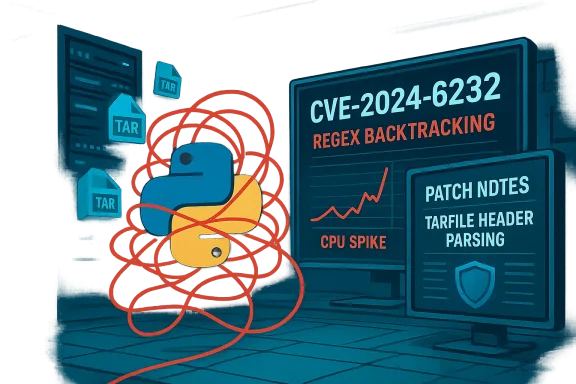
The CPython tarfile module was assigned CVE‑2024‑6232 after researchers discovered that the regular expressions used to parse TarFile headers could exhibit excessive backtracking, allowing specially crafted tar archives to trigger a Regular‑expression Denial‑of‑Service (ReDoS) and drive CPU usage to exhaustion. Microsoft’s Security Response Center (MSRC) has published a short product mapping that reads, in effect, “Azure Linux includes this open‑source library and is therefore potentially affected,” which prompted immediate questions from customers: is Azure Linux the only Microsoft product potentially at risk? The straightforward, evidence‑backed answer is: no — Azure Linux is the only Microsoft product Microsoft has publicly attested so far to include the implicated CPython component, but that attestation is product‑scoped and not an exclusivity guarantee; other Microsoft artifacts may still ship the same vulnerable library and should be inventoried and scanned.
Key technical facts to keep front of mind:
Two additional points in Microsoft’s public messaging are relevant:
Key risks to call out:
The operational imperative is straightforward: act on the MSRC signal for Azure Linux now, but do not stop there — scan, patch, and monitor the rest of your Microsoft‑supplied artifact inventory until you can prove the vulnerable CPython implementation is absent or patched everywhere you run it.
Source: MSRC Security Update Guide - Microsoft Security Response Center
 Background / Overview
What CVE‑2024‑6232 is, technically
CVE‑2024‑6232 is a ReDoS vulnerability in CPython’s standard library — specifically the tarfile.TarFile header parsing logic — that arises from regular expressions which can backtrack excessively when fed adversarial header strings. The practical effect is an availability problem: a process that parses a malicious tar archive can be forced to consume large amounts of CPU and become unresponsive, leading to denial of service. The Python Security Team published the advisory and linked code changes that remove the pathological backtracking by switching to parsing approaches that avoid deep regex backtracking.Key technical facts to keep front of mind:
- The vulnerability is an availability (DoS) issue, not a code‑execution flaw — attackers aiming to exploit it seek to cause high CPU consumption, not remote code execution.
- The upstream fixes were merged into CPython via a targeted pull request and associated commits that replace or refactor the regex‑driven parsing to a single‑pass parser. Operators should prefer patched CPython releases rather than workarounds.
- Multiple downstream distributions (Ubuntu, Oracle/Red Hat family, Amazon Linux, and others) tracked the issue and published distribution‑level advisories and package updates. Distributors list patched package versions for their supported Python builds.
Affected versions (practical guidance)
Upstream advisories and vulnerability trackers list the affected CPython ranges and the release branches that received fixes. Downstream vendors applied their own package updates at different times, so the most reliable way to determine exposure is to query the Python interpreter version and the distribution’s package metadata on each host or image you operate. Public trackers and the upstream PSF advisory should be treated as canonical for version ranges and the commits that fixed the problem.How to read Microsoft’s short MSRC attestation
What Microsoft actually said — and why wording matters
Microsoft’s short CVE mapping language that “Azure Linux includes this open‑source library and is therefore potentially affected” is a product‑level inventory attestation: Microsoft inspected the Azure Linux builds and confirmed the presence of the upstream component mapped to this CVE. That attestation is authoritative for Azure Linux customers and is intended to give them a clear, immediate remediation signal. However, that phrasing does not assert that Azure Linux is the only Microsoft product that could ship the vulnerable CPython tarfile component. In several public analyses and community posts, experts emphasize that an MSRC attestation is product‑scoped and not an exclusivity guarantee.Two additional points in Microsoft’s public messaging are relevant:
- Microsoft started publishing machine‑readable VEX/CSAF attestations to improve transparency and automation; the initial rollout centered on Azure Linux, with Microsoft committing to update mappings as it inventories more product families. That process explains why Azure Linux may appear first in a CVE mapping even when other Microsoft artifacts could also carry the component.
- Microsoft explicitly stated in similar CVE mappings that it will update the CVE/VEX records if additional Microsoft products are identified as shipping the same upstream component. In short, presence of an attestation for Azure Linux is an authoritative “yes” for that product but is not a conclusive “no” for every other Microsoft product.
Is Azure Linux the only Microsoft product that includes the vulnerable library?
Short answer (again): No — not necessarily
From the public materials: Microsoft has attested Azure Linux as including the implicated CPython component for CVE‑2024‑6232. But that attestation is a snapshot of the inventory Microsoft completed for Azure Linux at the time of publication, not a global inventory of every Microsoft product or artifact. Therefore, Azure Linux is the only Microsoft product Microsoft has publicly declared (so far) to include the component — but other Microsoft‑supplied images, SDKs, agents, Marketplace appliances, or managed service components may still include CPython and therefore might be affected until they are confirmed Not Affected or patched. Treat the MSRC statement as a clear remediation signal for Azure Linux, and treat other Microsoft artifacts as unverified until you or Microsoft confirm otherwise.Why this distinction matters operationally
Large vendors (including Microsoft) ship a very large and heterogeneous set of artifacts: cloud VM images, container base images, management agents, SDKs, serverless runtimes, on‑prem appliances, and developer tools. Many of these artifacts can carry embedded copies of third‑party libraries or language runtimes like CPython. A product‑level attestation only covers the artifacts the vendor has inspected and mapped. Security teams that assume the attestation is exhaustive risk leaving blind spots where the vulnerable component persists inside a different product line, private image or SDK package. This is not a Microsoft‑specific observation — it is the practical reality of supply‑chain and artifact diversity.Practical detection and triage checklist
If you operate systems or run Microsoft‑published artifacts, apply the following prioritized steps immediately.1. Prioritize Azure Linux updates (authoritative signal)
- If you run Azure Linux images as provided by Microsoft, treat the MSRC attestation as an authoritative instruction to apply updates for the distribution packages that ship CPython. Microsoft’s VEX/CSAF attestation and the Azure update channels should be the fastest path to a fixed package for those images.
2. Inventory every artifact that could include Python
- Search for Python interpreters, embedded runtimes, and tarfile usage across:
- VM images and base images in your registries
- Containers (scan image layers for /usr/lib/python or /usr/local/lib/python)
- Management and monitoring agents
- SDKs, CLI tools, application runtimes, and CI/CD build images
- Marketplace appliances and vendor images you deploy
- Use SBOMs, package manager outputs (dpkg, rpm, pip freeze inside images), and image scanning tools to locate CPython versions and tarfile usage. Where SBOMs or VEX attestations are available, automate checking for CPython package versions.
3. Confirm affected Python versions and apply upstream or distribution fixes
- Cross‑reference the Python Security Team advisory and your distribution vendor advisories to identify patched versions or patched packages. Upstream commits and PSF advisory metadata indicate fixed lines; downstream vendors list distribution package updates and advisories. Prefer vendor‑supplied fixed packages when they are available for your OS.
4. Apply containment mitigations for unpatched hosts
- If you cannot immediately patch, reduce exposure by:
- Blocking or filtering ingestion of untrusted tar archives at network boundaries and in application logic.
- Running processes that parse untrusted archives inside short‑lived, resource‑constrained sandboxes or containers with CPU and time limits enforced (cgroups, container runtime limits).
- Adding timeouts around archive parsing operations in your application code where feasible.
- Note: these are compensating controls, not substitutes for applying the upstream fix.
5. Monitor and detect attempted ReDoS exploitation
- Look for unusual, sustained spikes in CPU for processes that handle archive parsing (web servers, upload handlers, ingestion workers).
- Add application‑level logging and telemetry on archive sizes, parsing durations, and error rates to speed triage.
- Use existing WAF or application telemetry to look for repeated uploads of oddly structured tar files from the same origin.
Specific guidance for Microsoft environments (Azure Linux, WSL, and Microsoft images)
Azure Linux customers
- Apply Microsoft’s published package updates for Azure Linux as soon as they are available for the Python packages that ship with the distribution. Use your standard image update and patch management processes to replace affected images and containers. Microsoft’s product attestation is intended to ensure Azure Linux customers have a clear remediation target; follow it.
WSL2, Marketplace images, and Azure VM images
- Do not assume a “not listed” status equals “not affected.” WSL2 kernels, Marketplace images and other Azure VM images may include CPython in different places (userland images, cloud‑init helpers, management agents). Treat these artifacts as needing separate inventory and verification. If you use Microsoft‑published Marketplace images, consult vendor documentation and image SBOMs (if provided) and scan the images before deployment.
Azure PaaS (App Service, Functions) and managed runtimes
- For managed runtime offerings where Microsoft controls the runtime stacks, consult the product‑specific advisory pages or the service health dashboard and consume any Microsoft VEX/CSAF attestations relevant to that service. If your workloads provide their own language runtime in containers, the responsibility for patching those images rests with you.
Why Microsoft’s VEX/CSAF rollout matters — strengths and limits
Strengths (what Microsoft gets right)
- Publishing machine‑readable VEX/CSAF attestations materially helps automation: defenders can ingest a VEX feed and immediately mark Azure Linux images in their fleets as “Known Affected” and trigger patching workflows. This reduces time‑to‑remediation for customers running those specific SKUs. Microsoft’s public commitment to expand attestations is a positive transparency step.
Limits and risks (what defenders must still do)
- The phased rollout and product‑scoped attestations create temporal blind spots. A product like Azure Linux may get inventoried and listed quickly while thousands of other Microsoft artifacts remain uninspected for weeks or months. Customers who rely solely on vendor attestation lists without additional artifact verification can have unpatched copies of the same vulnerable library lurking in other images or toolchains. Several community analyses emphasize that an MSRC “Azure Linux includes…” line is therefore actionable for Azure Linux but not exhaustive across Microsoft’s product estate.
Critical analysis — balancing vendor transparency with operational reality
Microsoft’s choice to publish explicit, machine‑readable attestations for Azure Linux is a clear improvement in vendor transparency and should be encouraged. VEX/CSAF gives defenders the ability to automate triage and reduce false positives. At the same time, supply‑chain reality is messy: vendors ship hundreds of different SKUs, images and SDK builds, and a phased attestation program necessarily lags the full scope of potential exposures.Key risks to call out:
- Blind spots in enterprise fleets: organizations that pull Microsoft‑published images from diverse catalogs and reuse vendor images as build inputs will need to actively scan those images — an MSRC attestation alone will not find embedded vulnerable libraries in customer‑specific derived images.
- Patch coordination complexity: downstream distributions and packaging systems apply fixes at different cadences. Even when upstream CPython has a fix merged, distribution packages must be rebuilt, tested, and staged — so timelines vary across Ubuntu, RHEL/Oracle, Amazon Linux, Microsoft distributions and container image maintainers. Rely on vendor security advisories for the timing of vendor packages and prefer those over attempting to “hot patch” shared system Python interpreters in production without coordination.
- Detection difficulty for ReDoS: ReDoS is intrinsically noisy and often only visible as CPU spikes; distinguishing an exploit attempt from benign heavy workloads requires good telemetry and contextual thresholds. Logging and CPU/e2e tracing are therefore essential.
Recommended action plan (prioritized, actionable)
- For every Azure Linux image you run: ingest Microsoft’s VEX/CSAF attestation, apply the vendor package updates for Python, and redeploy images. Treat Azure Linux attestation as high‑priority, authoritative guidance.
- Inventory all other Microsoft‑published artifacts you consume (Marketplace images, SDKs, tools). Use SBOMs, image scanning, and package manager queries to locate CPython interpreters and tarfile module usage. Automate this where possible.
- Patch or rebuild any images or containers that include the affected CPython versions. Prefer vendor‑provided patched packages when operating system packages are used; otherwise, update to patched CPython builds upstream where distribution packages are not available.
- If immediate patching is impossible, apply compensating controls: sandbox parsing, CPU/time limits, and input filtering for untrusted uploads. Monitor CPU and parsing durations and set alerting thresholds to detect potential ReDoS activity.
- Subscribe to vendor advisories (MSRC VEX feed, NVD, distro advisories) and automate ingestion of VEX/CSAF where available. Expect Microsoft to expand attestations; design automation so newly published attestations are automatically processed and mapped to your asset inventory.
Conclusion
CVE‑2024‑6232 is a textbook ReDoS issue in the CPython tarfile header parser: the upstream fix is precise and available, and most major distributions have published package updates. Microsoft’s MSRC attestation that “Azure Linux includes this open‑source library and is therefore potentially affected” is an authoritative and actionable signal for Azure Linux customers, but it should not be read as an all‑encompassing statement about Microsoft’s entire product portfolio. Azure Linux is the only Microsoft product publicly attested so far to include the affected CPython component; that is an important remediation trigger — but it is not proof that no other Microsoft image, SDK, or appliance ships the same vulnerable code. Defenders must therefore combine vendor attestations with active artifact inventory (SBOMs and image scans), prioritize Azure Linux updates immediately, and hunt for the vulnerable tarfile implementation across all images and runtimes they operate.The operational imperative is straightforward: act on the MSRC signal for Azure Linux now, but do not stop there — scan, patch, and monitor the rest of your Microsoft‑supplied artifact inventory until you can prove the vulnerable CPython implementation is absent or patched everywhere you run it.
Source: MSRC Security Update Guide - Microsoft Security Response Center
