

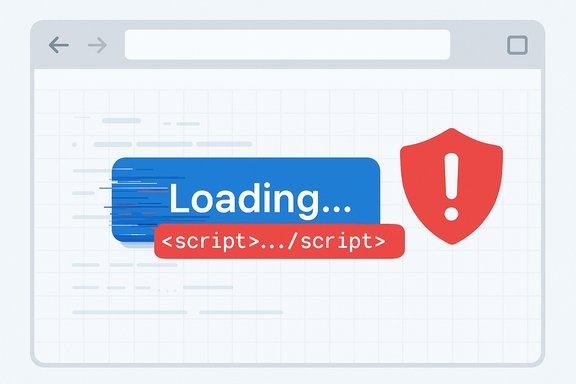
A critical Cross‑Site Scripting (XSS) flaw was assigned CVE‑2024‑6485 after researchers discovered that Bootstrap’s legacy Button plugin improperly handles the data-loading-text / data-*-text attributes, allowing attacker‑controlled HTML (including script) to be rendered when a button enters its “loading” state — a condition that can be weaponized to execute arbitrary JavaScript in a victim’s browser.
Bootstrap remains one of the most widely used front‑end frameworks on the web, with countless legacy applications still running Bootstrap 3.x. The vulnerability tracked as CVE‑2024‑6485 targets the Button component in the older Bootstrap line where state‑text attributes (commonly written as data-loading-text, data-complete-text, etc. are injected into a button’s DOM without sufficient sanitization. Multiple vulnerability trackers and advisories published in mid‑2024 catalog this as an XSS issue (CWE‑79) with a CVSS v3.1 base score in the mid‑6 range (Medium). Why this matters: web UIs that accept or reflect attacker‑supplied content into attribute values — or into templates that later become button text — can be turned into an XSS vector. An attacker who can cause a controlled value to be stored or reflected into a page and then get a victim to trigger the button’s loading state can execute arbitrary script in the victim’s authenticated session, opening paths to session theft, UI spoofing, forced actions, or automated flow manipulation. This class of risk is well understood in the context of stored and reflected XSS.
The vulnerability’s conditional exploitability (needing injection plus victim action) reduces the probability of effortless mass exploitation, but it amplifies the value of targeted attacks against administrative panels, automation systems, and multi‑tenant dashboards. Organizations that host web UIs with user‑generated content should therefore treat CVE‑2024‑6485 as an actionable priority and verify remediation across both upstream and packaged/downstream installations.
Acknowledgement: public advisories and distribution notices (GitHub advisory, NVD/NIST mirrors, Ubuntu USN and related vendor trackers) were used to verify version ranges, impact scoring, and the distribution of fixes; defenders should consult their vendor advisories and package metadata for precise KB/package mappings before declaring hosts remediated.
Source: MSRC Security Update Guide - Microsoft Security Response Center
 Background
Bootstrap remains one of the most widely used front‑end frameworks on the web, with countless legacy applications still running Bootstrap 3.x. The vulnerability tracked as CVE‑2024‑6485 targets the Button component in the older Bootstrap line where state‑text attributes (commonly written as data-loading-text, data-complete-text, etc. are injected into a button’s DOM without sufficient sanitization. Multiple vulnerability trackers and advisories published in mid‑2024 catalog this as an XSS issue (CWE‑79) with a CVSS v3.1 base score in the mid‑6 range (Medium). Why this matters: web UIs that accept or reflect attacker‑supplied content into attribute values — or into templates that later become button text — can be turned into an XSS vector. An attacker who can cause a controlled value to be stored or reflected into a page and then get a victim to trigger the button’s loading state can execute arbitrary script in the victim’s authenticated session, opening paths to session theft, UI spoofing, forced actions, or automated flow manipulation. This class of risk is well understood in the context of stored and reflected XSS. Technical overview
The vulnerable surface
- The root of CVE‑2024‑6485 is the Button plugin in Bootstrap 3.x where *data--text** attributes are used to set alternate button text for different states (e.g., loading, complete).
- The plugin copies attribute values into the button element as HTML/text when the state is switched, without reliably neutralizing embedded markup or script. That insufficient sanitization is what enables script execution.
Affected versions and patching status
- Public advisories list the affected package ranges as bootstrap >= 1.4.0 and <= 3.4.1 (the practical risk concerns Bootstrap 3.x deployments). The official GitHub advisory indicates no upstream patched version available at the time of advisory publication; many downstream vendors and Linux distributions, however, have produced patched packages or backports.
- Some distributions — notably Ubuntu — published security notices that bundle fixes or backports for their packaged bootstrap artifacts; those distro updates are the practical remediation path for many deployments.
Exploit mechanics and preconditions
- Exploitation requires two conditions: an attacker must be able to inject attacker‑controlled content into a location that later becomes the target button’s data‑text value, and a victim must trigger the button into its loading state (which renders the injected content). This is why most public scoring reflects User Interaction: Required and Attack Complexity: High / Medium.
- In many real‑world scenarios the injection step is the difficult part — it might require chaining another vulnerability (for example, a form input that stores unsafe content, a misconfigured CMS, or an open upload endpoint). This conditional nature matches the Microsoft Security Response Center wording that “a successful attack depends on conditions beyond the attacker’s control.”
Impact and exploitability — practical analysis
What a successful exploit can do
- Execute JavaScript in the context of the victim’s origin (same‑origin execution), permitting:
- Session token or cookie theft (if cookies are not HttpOnly),
- DOM manipulation to present spoofed UI and social‑engineer administrative actions,
- Forced clicks and automated actions (including invoking other UI workflows),
- Exfiltration of displayed data or automated submission of sensitive content to attacker endpoints.
How easy is exploitation in practice?
- From a pure technical standpoint, the vulnerable code is straightforward to abuse once an injection vector exists — XSS payloads are low‑complexity. But the real challenge is positioning payloads so they end up in the data‑text attribute of a button that a victim will activate.
- Many public trackers therefore score the vector as network, user interaction required, and attack complexity medium/high. That means opportunistic mass exploitation is less likely than targeted attacks against web apps that accept user HTML or uncontrolled inputs.
Stored vs reflected risk
- If an application stores unsanitized input (for example, a comment, profile field, or item name) that later appears directly in a button’s attribute, the vulnerability becomes a stored XSS with high leverage — a single injected record can reach many victims over time.
- If the injection is temporary or crafted in a URL, the issue is reflected XSS and typically requires one‑off social engineering to lure a user to a malicious link. Stored XSS in admin consoles or multi‑tenant services is the scarier variant. Independent analyses stress the amplified risk when admin or automation workflows can be targeted.
Who is affected and remediation status
Affected ecosystems
- Any web application still using the vulnerable Bootstrap 3.x (or other listed vulnerable versions) Button plugin and which exposes untrusted input into button state attributes is in scope.
- Many Linux distributions and packagers ship libraries named libjs‑bootstrap, twitter‑bootstrap3, or bootstrap‑sass. Those packaged variants received vendor‑specific advisories and fixes (or backports) even when upstream did not ship a new bootstrap release.
Upstream vs downstream posture
- Upstream Bootstrap (the twbs project) did not publish a new patch release for the affected 3.x line at the time the advisory was published; the GitHub advisory explicitly lists no patched versions. That left downstream packagers and third‑party maintainers to provide mitigations or backports.
- Distributions like Ubuntu produced security notices (USN‑7556‑1) and updated their packaged bootstrap files so administrators who update packages get a fixed artifact. This is a common and effective pattern for legacy library fixes.
Verified facts and cross‑references
The following points are cross‑checked across multiple independent sources to ensure accuracy:- The vulnerability is an XSS issue in the Bootstrap Button plugin connected to data‑*‑text attributes. This description appears in the GitHub advisory and NVD entries.
- CVSS v3.1 scoring reported by public trackers places the base score in the 6.4 (Medium) range with the vector CVSS:3.1/AV:N/AC:H/PR:N/UI:R/S:U/C:H/I:L/A:L. Multiple vendors and trackers (NVD mirrors, Snyk, Tenable) show consistent scoring.
- Upstream Bootstrap did not publish a patched release for the vulnerable 3.x line (GitHub advisory shows no patched version). Distributions (for example, Ubuntu) provided updated package versions to remediate the packaged artifacts.
- Exploitation requires conditions external to a single HTTP request in many realistic deployments (injection + victim interaction). This conditional exploitation is consistent with the MSRC guidance phrase the user passed along: “A successful attack depends on conditions beyond the attacker’s control.”
Mitigation and incident response — prioritized steps
Below is an action plan for developers, site owners, and security teams to reduce risk quickly and sustainably.Immediate (hours)
- Inventory: find every instance of Bootstrap 3.x and any usage of the Button plugin across your web apps, admin consoles, and packaged server apps. Search for literal attributes such as
data-loading-text,data-complete-text, or otherdata-*-textstrings in HTML/templates. - Apply distro patches: if your app relies on packaged system libraries (libjs-bootstrap, twitter-bootstrap3), install the vendor security updates (for example, Ubuntu’s USN updates). Distro patches often include backported sanitization fixes.
- Temporary remove/disable: where feasible, remove or neutralize usage of the data‑text attributes (render simple, vetted plain text strings instead) until a permanent fix is in place.
Short term (days)
- Add or tighten Content Security Policy (CSP) to block inline script execution and reduce XSS impact. A good CSP can greatly limit what an injected script can do even if it executes.
- Sanitize server outputs: ensure all untrusted values written into attributes or HTML are HTML‑escaped on output. Prefer known safe rendering helpers from your framework rather than string concatenation.
- Harden input entry points: restrict who can submit free HTML, require allowed HTML whitelists, and validate uploads and fields that can be rendered into UI attributes.
Medium term (weeks)
- Replace or upgrade: plan migration away from Bootstrap 3 to a supported release (Bootstrap 4 or 5), or move to a forked maintenance line that explicitly patches 3.x if migration is not immediately possible. Many modern Bootstrap versions no longer use the same legacy plugin patterns and have different component APIs that are safer by default.
- WAF and detection: deploy WAF rules to detect attempts to submit script fragments into fields that later render into attributes; tune rules to your app’s normal traffic. Enable monitoring for unusual outgoing HTTP POSTs from browsers or suspicious console events.
Forensic and investigation steps (if exploitation suspected)
- Rotate any session tokens, API credentials, or OAuth secrets that may have been exposed.
- Review server logs and application change history for evidence of malicious content insertion (search for script tags or suspicious
data-*attribute contents). - Capture and preserve forensic evidence (database snapshots, logs, and relevant webserver payloads) prior to remediation for incident response.
Detection guidance — what to hunt for
- Search code and templates for uses of
data-loading-textand otherdata-*-textattributes. Any occurrence that uses unescaped user content is suspect. - Scan persisted content stores (databases, object stores, blob metadata) for
<scripttokens or common XSS payload markers in fields that might feed UI elements. - Monitor CSP violation reports and web application logs for blocked inline script runs or unexpected resource fetches from attacker domains.
- Run dependency scanners (SCA tools) across repositories and packaged images so you can rapidly identify where outdated bootstrap artifacts are present. Many commercial scanners have entries for CVE‑2024‑6485 and will flag affected packages.
Risk assessment — strengths and weaknesses of the current state
Notable strengths
- The issue is well cataloged across multiple public vulnerability trackers and Linux vendor advisories, which means defenders can map CVE → package → patch. The consistency across GitHub advisory, NVD mirrors and distribution advisories increases confidence in the technical facts.
- Remediation options exist in practice: distro backports and package updates reduce the operational burden for many teams because they can install vendor updates rather than patch upstream library code themselves.
Key risks and operational headaches
- Bootstrap 3 is widely embedded in legacy applications, static sites, templates, and vendor appliances. Many of these are hard to upgrade or patch centrally, which creates a long tail of exposure.
- Upstream absence of an official patch increases the patch management complexity; downstream maintainers may backport fixes differently, producing heterogeneous package versions across environments. Administrators must therefore verify the exact package versions (CPE/KGs) patched in their platform.
- The practical exploitability of the vulnerability depends on application logic (injection point + victim triggering). That conditionality reduces trivial mass exploitation but raises the chance of targeted attacks against high‑value targets (admin consoles, SaaS tenant UIs, or integrated automation flows).
Concrete remediation checklist (for operations teams)
- Inventory all places that serve Bootstrap assets (CDN links, vendor bundles, node_modules, libjs packages). Prioritize hosts that handle user‑generated content or administrative functionality.
- Apply vendor/distro security updates immediately where available (for packaged artifacts such as libjs‑bootstrap). Confirm fixed package version numbers via your platform’s advisory (Ubuntu USN, Debian LTS, etc..
- If you cannot patch immediately:
- Remove or neutralize
data-*-textusage (replace with server‑rendered text), - Enforce a strict CSP that denies inline scripts and restricts script sources,
- Limit who can publish content that might make it into UI attributes.
- Plan and test an upgrade path to a maintained Bootstrap release or a maintained fork that addresses the issue in a controlled way.
Final assessment and conclusions
CVE‑2024‑6485 is a classic web UI sanitization failure with real operational consequences for applications that still rely on Bootstrap’s legacy Button plugin and accept untrusted content into attribute values. The technical facts are consistent across vendor advisories (GitHub Advisory, NVD mirrors) and distribution security notices; however, upstream Bootstrap 3 had no official patched release at the time public advisories were written, so remediation has been handled largely by downstream packagers and distributors. For defenders the threat is straightforward: locate every place where untrusted strings could end up indata-*-text, apply package updates where available, and eliminate unescaped insertion patterns. Where upgrades are impractical, adopt compensating controls — CSP, input validation/escaping, WAF rules, and least‑privilege publishing workflows — to dramatically reduce exposure while migration plans are executed.The vulnerability’s conditional exploitability (needing injection plus victim action) reduces the probability of effortless mass exploitation, but it amplifies the value of targeted attacks against administrative panels, automation systems, and multi‑tenant dashboards. Organizations that host web UIs with user‑generated content should therefore treat CVE‑2024‑6485 as an actionable priority and verify remediation across both upstream and packaged/downstream installations.
Acknowledgement: public advisories and distribution notices (GitHub advisory, NVD/NIST mirrors, Ubuntu USN and related vendor trackers) were used to verify version ranges, impact scoring, and the distribution of fixes; defenders should consult their vendor advisories and package metadata for precise KB/package mappings before declaring hosts remediated.
Source: MSRC Security Update Guide - Microsoft Security Response Center
