

CVE-2025-1744 is a critical out‑of‑bounds write in radare2 that allows heap-based buffer over‑read or overflow in radareorg’s reverse‑engineering toolchain; the flaw affects radare2 releases prior to 5.9.9 and carries a top‑tier severity rating. Microsoft’s public advisory for this CVE explicitly states that Azure Linux includes the affected open‑source component and is therefore potentially impacted, and it commits to updating the CVE mapping if additional Microsoft products are later found to include the same library. That wording is accurate for the product Microsoft has inspected, but it is not a blanket guarantee that no other Microsoft product could contain the vulnerable code. This article explains what that statement means in practice, verifies the technical facts behind CVE‑2025‑1744, analyzes how broad the real‑world risk is for Microsoft customers, and provides concrete inventory and remediation steps for administrators and security teams.
radare2 is a free, open‑source reverse‑engineering framework and toolchain that ships as a userland package across many Linux distributions. It provides disassembly, debugging, binary analysis, and scripting capabilities; because of its scope it is commonly packaged by distro maintainers and available in distribution repositories.
The vulnerability identified as CVE‑2025‑1744 is an Out‑of‑bounds Write (CWE‑787) in radare2 that permits heap‑based buffer over‑reads or overflows in certain code paths. The public vulnerability records and distribution trackers indicate the flaw affects radare2 versions before 5.9.9; upstream and distribution vendors released fixed builds to remediate the issue. The vulnerability has been assessed as critical (CVSS highest severity ratings in multiple public assessments) because buffer overwrites in a userland binary that parses untrusted inputs can lead to memory corruption and, in some contexts, remote code execution.
Multiple independent vulnerability databases and distribution trackers have the same high‑level description and the same affected release boundary (radare2 < 5.9.9), and downstream distributions like Debian and various RPM‑based distros treated the issue as high/critical and prepared or shipped fixes. Those independent confirmations establish the core technical facts: what the bug is, which upstream project it affects, and the version range containing the fix.
That statement should be read precisely:
Practical steps to check hosts and images:
CVE‑2025‑1744 is a stark reminder that widely packaged userland tools carry real risk when they parse untrusted data. Microsoft’s public attestation that Azure Linux includes the affected open‑source library gives Azure customers a clear, authoritative signal to act on today. For everyone else running Microsoft‑hosted or Microsoft‑published Linux artifacts, the pragmatic approach is to inventory, verify, and remediate: assume potential exposure until you have definitive evidence to the contrary, prioritize by exposure and usage, and apply the available vendor fixes.
Source: MSRC Security Update Guide - Microsoft Security Response Center
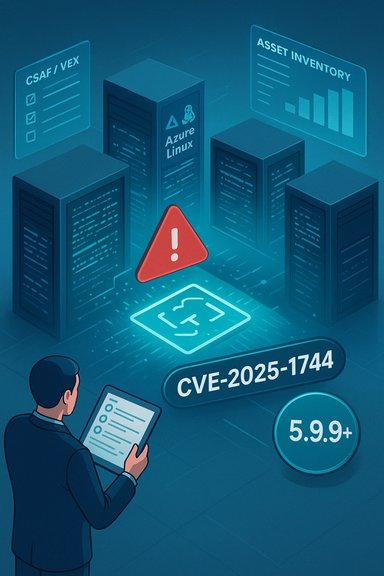 Background / Overview
radare2 is a free, open‑source reverse‑engineering framework and toolchain that ships as a userland package across many Linux distributions. It provides disassembly, debugging, binary analysis, and scripting capabilities; because of its scope it is commonly packaged by distro maintainers and available in distribution repositories.The vulnerability identified as CVE‑2025‑1744 is an Out‑of‑bounds Write (CWE‑787) in radare2 that permits heap‑based buffer over‑reads or overflows in certain code paths. The public vulnerability records and distribution trackers indicate the flaw affects radare2 versions before 5.9.9; upstream and distribution vendors released fixed builds to remediate the issue. The vulnerability has been assessed as critical (CVSS highest severity ratings in multiple public assessments) because buffer overwrites in a userland binary that parses untrusted inputs can lead to memory corruption and, in some contexts, remote code execution.
Multiple independent vulnerability databases and distribution trackers have the same high‑level description and the same affected release boundary (radare2 < 5.9.9), and downstream distributions like Debian and various RPM‑based distros treated the issue as high/critical and prepared or shipped fixes. Those independent confirmations establish the core technical facts: what the bug is, which upstream project it affects, and the version range containing the fix.
What Microsoft actually said — and how to read it
Microsoft’s security advisory language for CVE‑2025‑1744 confirms that Azure Linux (Microsoft’s maintained Linux distro family used for certain Azure images and artifacts) “includes this open‑source library and is therefore potentially affected.” Microsoft also wrote that it began publishing machine‑readable impact attestations (CSAF/VEX) for third‑party components starting with Azure Linux and that it would update the CVE mapping if further product impact is discovered.That statement should be read precisely:
- Affirmative: Microsoft has checked and confirmed that the Azure Linux product family contains the vulnerable component (radare2 packages or an image containing radare2 builds or archives) and that customers running Azure Linux images should prioritize remediation.
- Scoped: The statement is an attestation limited to the product family Microsoft has finished inventorying at the time of the advisory. It is not a negative proof that other Microsoft products do not contain the same component.
- Process‑driven: Large vendors commonly publish attestations incrementally — they start with products they have completed inventorying and add more as the supply‑chain mapping work finishes. Microsoft’s advisory follows that pattern.
Is Azure Linux the only Microsoft product that could be affected?
Short answer: No — not necessarily. The more accurate answer depends on product class and how a Microsoft product “includes” third‑party code.Key distinctions to keep in mind
- Userland packages vs. system kernels and drivers. radare2 is userland software (a reverse engineering suite). For a Microsoft product to “include” it, the product must ship a Linux userland image or package set that contains radare2. Microsoft’s Azure Linux images and package repositories are an obvious example.
- Microsoft‑shipped kernels vs. distro packages. Some Microsoft artifacts are kernel‑only (for example WSL2 kernel builds published on GitHub). Those kernel artifacts do not by themselves contain radare2 (which is userland). However, other Microsoft offerings distribute or host entire VM images, repositories, or marketplace images that can and do include userland packages maintained by Microsoft or by marketplace partners.
- User‑installed software inside a Microsoft product. On Windows Subsystem for Linux (WSL), users install distribution packages inside their WSL instance. Microsoft does not necessarily ship radare2 as part of a default WSL userland, but customers can (and often do) install radare2 within their WSL distributions — and that runtime instance becomes an operational risk for that machine.
Microsoft products and artifacts to consider for inventory
- Azure Linux images and repositories. Microsoft’s own Azure Linux family (the explicit target of the advisory) is confirmed to include the component; customers running Azure Linux images or VMs need to apply the vendor patches or update packages.
- Azure Marketplace and publisher images. Microsoft publishes and hosts many marketplace images and “official” images; some are managed in partnership with Linux distro maintainers. Those images can contain radare2 if the distribution maintainer includes it in the base image or the image’s repository.
- WSL (Windows Subsystem for Linux). Microsoft publishes the WSL2 kernel source on GitHub; WSL instances run distribution userlands inside that kernel. While Microsoft doesn’t ship radare2 by default inside WSL userland images that end users install, customers frequently install radare2 inside WSL distros themselves—so WSL hosts may be vulnerable if radare2 is present and unpatched.
- Azure services that run Linux images or containers. Any Microsoft service that hosts or runs customer VM images or container images (for example container hosts, Azure App Service on Linux, AKS node pools using Microsoft‑provided node images) may be impacted if the running guest image includes radare2 and is not patched.
- Developer and CI environments provisioned by Microsoft tooling. Images used by managed build agents, cloud CI runners, or ephemeral developer VMs may include radare2 via base image or installed packages; those should be inventoried.
How to verify whether a given Microsoft product or image includes radare2
Inventory and verification are straightforward tasksets for an operations or Linux engineering team. Treat Microsoft’s Azure Linux attestation as the authoritative signal for Azure Linux itself, but treat other Microsoft artifacts as potential inclusions until verified.Practical steps to check hosts and images:
- On a running Linux host (including Azure Linux VMs and WSL distros), check for installed radare2 packages:
- For RPM‑based systems:
- rpm -qa | grep -i radare2
- dnf list installed radare2
- For Debian/Ubuntu‑based systems:
- dpkg -l | grep -i radare2
- apt‑list --installed | grep radare2
- Inspect available repositories in the image:
- Check /etc/apt/sources.list or /etc/yum.repos.d/* for vendor repos and list package candidates (apt-cache policy radare2 or yum info radare2).
- For WSL instances:
- Start the WSL distro, then run dpkg -l | grep -i radare2 or rpm -qa as appropriate.
- Confirm whether the WSL image is the stock distro or a custom image that might include extra packages.
- For Azure Marketplace images or VM images:
- Review the image manifest or package list if the publisher provides one, or spin up a test VM from the image and run the local package checks in step 1.
- For container images:
- Inspect the Dockerfile or run docker run --rm image dpkg -l | grep radare2 (or equivalent) to determine whether radare2 is copied into the image.
Realistic threat model and where the risk matters most
Not every inclusion of radare2 is equally dangerous. The operational risk depends on how the binary is used and whether it is reachable by untrusted input.- High‑risk scenarios
- radare2 is exposed as a network‑facing service or automated parser that accepts untrusted inputs over a network interface.
- Multi‑user systems where unprivileged or semi‑trusted users can run radare2 on files uploaded by other users (e.g., shared analysis servers, triage workstations).
- CI/CD systems or build hosts that automatically process untrusted artifacts without sandboxing.
- Lower‑risk scenarios
- radare2 installed only on isolated developer laptops or privileged admin machines that do not process untrusted files.
- Base images that include radare2 but are not used to process untrusted binaries and have no remote exposure.
Actionable remediation and prioritization
Apply defense‑in‑depth: patch early where possible, and use compensating controls when immediate patching isn’t possible.- Priority 1 — Patch confirmed Azure Linux hosts now
- If you run Azure Linux images (Microsoft‑maintained Azure Linux), treat these as confirmed affected by Microsoft’s attestation; update radare2 packages to 5.9.9 or later, or apply the distribution vendor’s security update.
- If you use managed Azure images that Microsoft publishes (linux‑azure kernels, Azure tuned images), check both kernel and userland packages as appropriate.
- Priority 2 — Inventory and remediate other cloud images and VMs
- Run the package presence checks across your fleet (see verification steps above). Patch or remove radare2 where it exists and is unnecessary.
- Priority 3 — Check WSL and developer endpoints
- Query WSL instances used by developers and CI runners; if radare2 is installed in WSL, update it there.
- Consider blocking installation of unmaintained reverse‑engineering tools in shared build agents or CI runners unless explicitly required.
- Priority 4 — Apply compensating controls
- For environments where immediate patching is impractical, restrict which users can run radare2, enforce mandatory sandboxing, or isolate systems that process untrusted binaries.
- Monitor logs for abnormal radare2 usage and for anomalous child processes or unusual file reads.
- Debian/Ubuntu family:
- dpkg -l | grep -i radare2
- apt update && apt install --only-upgrade radare2
- RHEL/CentOS/Alma/Fedora family:
- rpm -qa | grep -i radare2
- dnf update radare2 (or yum update radare2)
- WSL:
- wsl -l -v
- wsl -d <distro> -- bash -lc "dpkg -l | grep -i radare2 || rpm -qa | grep -i radare2"
Supply‑chain transparency and vendor attestations — why Microsoft named Azure Linux first
Large vendors are now publishing machine‑readable attestations (CSAF/VEX) to help customers automate supply‑chain impact analysis. Microsoft’s initial rollout focused on Azure Linux for practical reasons:- Azure Linux is a Microsoft‑maintained, Microsoft‑published Linux distro family and is straightforward to inventory and map to a CVE.
- Starting with a single product family allows Microsoft to ship usable machine‑readable attestations quickly and expand the mapping to other product lines as inventories complete.
- Microsoft’s statement that it will update the CVE mapping if additional Microsoft products are found to be affected is consistent with phased attestation rollout practices used by several large vendors.
Cross‑checks and independent confirmations
Multiple independent vulnerability and distribution trackers confirm the technical core of CVE‑2025‑1744:- Official vulnerability databases list CVE‑2025‑1744 as an out‑of‑bounds write in radare2 and identify radare2 versions prior to 5.9.9 as affected.
- Distribution trackers (Debian package tracker and RPM‑based distribution security hubs) show radare2 packaged in major distributions and list the CVE against packaged versions; the Debian tracker and package listings show radare2 present in Debian unstable with affected versions flagged for security maintenance.
- Distribution maintainers and repository mirrors show radare2 package builds across multiple architectures — which confirms that radare2 is broadly packaged by Linux distributions and therefore commonly present in images.
What to tell executive teams and security leadership
- Confirmed hit on Azure Linux: Microsoft’s advisory is authoritative for Azure Linux; treat Azure Linux as confirmed affected and remediate immediately.
- Do not assume safety for other Microsoft products: Absence of an immediate attestation in Microsoft’s advisory does not equal absence of the vulnerable code. Inventory other Microsoft‑managed Linux artifacts (WSL instances, Azure marketplace images, managed node images) to be sure.
- Prioritize by exposure and use case: Patching priority should be governed by exposure and how radare2 is used. Externally exposed services and automated parsers come first.
- Use Microsoft’s CSAF/VEX feeds as they appear: Once Microsoft publishes additional attestations, automate feeding those signals into your asset‑management and vulnerability‑triage pipelines.
Caveats and unverifiable claims
- Microsoft’s advisory explicitly states Azure Linux includes the component. That is a factual attestation for the specific product family Microsoft inspected. It is not possible from that one statement to infer whether every Microsoft product has been scanned; a lack of mapping for a product does not prove the product is free of the component.
- It is not possible to generically declare that no other Microsoft product includes radare2 without Microsoft completing a comprehensive inventory and publishing that attestative mapping. Until Microsoft does so, statements about other Microsoft SKUs require direct verification on a per‑product basis.
- Public advisories sometimes aggregate many CVEs and may have contextual noise; verify the exact CVE text and fix commits upstream (radare2 upstream and distribution patches) whenever you build a formal remediation plan.
Final recommendations — quick checklist
- Immediately inventory Azure Linux images and update radare2 to 5.9.9 or later where present.
- Run package checks across all Linux images in your cloud tenancy and ephemeral build fleets; patch or remove radare2 as instructed by your patch policy.
- Audit WSL instances used by developers and CI runners; update or remove radare2 where required.
- For shared analysis hosts or services that accept untrusted binaries, enforce sandboxing or isolate the services until patched.
- Ingest vendor CSAF/VEX attestations into your vulnerability management pipeline and automate mapping of vendor attestations against your asset inventory.
- Monitor for suspicious radare2 execution patterns and unusual child processes as part of endpoint detection and response playbooks.
CVE‑2025‑1744 is a stark reminder that widely packaged userland tools carry real risk when they parse untrusted data. Microsoft’s public attestation that Azure Linux includes the affected open‑source library gives Azure customers a clear, authoritative signal to act on today. For everyone else running Microsoft‑hosted or Microsoft‑published Linux artifacts, the pragmatic approach is to inventory, verify, and remediate: assume potential exposure until you have definitive evidence to the contrary, prioritize by exposure and usage, and apply the available vendor fixes.
Source: MSRC Security Update Guide - Microsoft Security Response Center
