

A newly assigned CVE, CVE-2025-40294, identifies an out‑of‑bounds (OOB) access in the Linux kernel’s Bluetooth management path that can cause memory corruption and crashes when userland supplies overly large advertising‑pattern lengths. The defect lives in the MGMT layer’s parse_adv_monitor_pattern routine and stems from a mismatch between the limits used while validating user input and the hard‑coded buffer size used by the kernel to store pattern values. Upstream kernel maintainers have landed a conservative fix that reverts the checks to the shorter legacy advertising length; vendors and distributions are being urged to publish backports and kernel updates immediately.
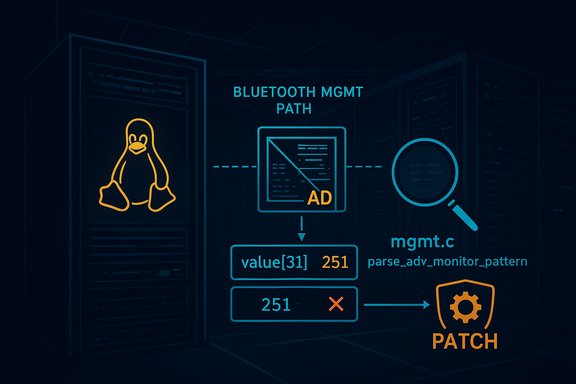
Bluetooth Low Energy advertising and scanner filtering are widely used features; the Linux kernel exposes an MGMT (management) API that lets userspace programs add advertisement monitor patterns to filter and match advertising payloads. The userspace API — and the associated mgmt structures — assume a fixed maximum advertising data payload of 31 bytes in the standard (legacy) advertising PDU. The kernel also supports extended advertising with a much larger maximum payload (251 bytes) for extended PDUs. A recent code path in parse_adv_monitor_pattern inadvertently allowed pattern lengths validated against the extended advertising size (251) to be copied into a structure whose value[] field is only 31 bytes long. That mismatch is the root cause of the OOB access.
Source: MSRC Security Update Guide - Microsoft Security Response Center*
 Background
Bluetooth Low Energy advertising and scanner filtering are widely used features; the Linux kernel exposes an MGMT (management) API that lets userspace programs add advertisement monitor patterns to filter and match advertising payloads. The userspace API — and the associated mgmt structures — assume a fixed maximum advertising data payload of 31 bytes in the standard (legacy) advertising PDU. The kernel also supports extended advertising with a much larger maximum payload (251 bytes) for extended PDUs. A recent code path in parse_adv_monitor_pattern inadvertently allowed pattern lengths validated against the extended advertising size (251) to be copied into a structure whose value[] field is only 31 bytes long. That mismatch is the root cause of the OOB access. What the code did (short technical summary)
- The MGMT command parsing code reads an array of mgmt_adv_pattern structures from userspace; each pattern contains ad_type, offset, length, and a fixed-size value[31] array.
- parse_adv_monitor_pattern validated pattern offset and length against HCI_MAX_EXT_AD_LENGTH (251), not against the legacy HCI_MAX_AD_LENGTH (31).
- After validation, the code allocated an adv_pattern structure containing a value[] sized to the legacy limit and copied p->length bytes from patterns*.value into p->value, opening a path to copy more than 31 bytes into a 31‑byte buffer when userspace supplied a large length.
Overview of CVE-2025-40294
- Vulnerability: Out‑of‑bounds memory access in parse_adv_monitor_pattern when copying pattern values from userspace into kernel structures that assume a fixed 31‑byte advertising value buffer.
- Root cause: Validation used HCI_MAX_EXT_AD_LENGTH (251) while the in‑kernel mgmt_adv_pattern.value array is 31 bytes. The code therefore allowed a length value larger than the receiving buffer.
- Discovery: Reported by InfoTeCS on behalf of Linux Verification Center (linuxtesting.org) using static analysis tools and code review.
- Fix: Upstream maintainers reverted the validation bounds for offset and length to HCI_MAX_AD_LENGTH (the 31‑byte legacy limit) rather than increasing the kernel structure size; this preserves userspace ABI and eliminates the OOB copy. Fixes have been merged into mainline and stable trees and have been tagged for multiple stable releases.
- Exploitability: The vulnerability is a kernel memory‑safety issue. Public records show no confirmed public proof‑of‑concept that elevates this into a kernel RCE; the observable practical impact is memory corruption leading to kernel oops / crash (availability impact). Treat escalation to remote code execution as a theoretical possibility that would require additional primitives.
Technical analysis: how the bug arises and why the fix was chosen
The mismatch in constants
Two constants are central:- HCI_MAX_AD_LENGTH — the legacy maximum advertising data length; historically 31 bytes and what many userspace tools and existing MGMT structures assume. The mgmt_adv_pattern structure declares value[31], enforcing that limit in the ABI.
- HCI_MAX_EXT_AD_LENGTH — the extended advertising maximum (251 bytes), introduced for extended advertising PDUs. The kernel contains this larger constant where extended advertising is supported.
Why the chosen fix is sensible
- Preserves ABI compatibility: Many userspace tools and daemons expect the mgmt adv pattern structure to be 31 bytes for the value field; changing structure size would require coordinated userspace updates.
- Removes the immediate memory‑safety hazard without speculatively increasing attack surface.
- Simple to backport: A conservative check change is easy for vendors to backport into long‑lived stable kernels and embedded vendor trees. That increases the chance that device OEMs and distributions will actually ship fixes.
Residual complexity
The patch closes this specific OOB path, but it does not change the fact that the kernel supports both legacy and extended advertising APIs. There are two long‑term design possibilities that were weighed by maintainers:- Accept an ABI break and increase mgmt_adv_pattern.value to accommodate extended advertising payloads (would require simultaneous userspace changes).
- Keep the legacy ABI and map extended advertising semantics separately, ensuring userspace and kernel agree on limits at every boundary (the approach chosen).
Affected platforms and fixed versions
Public vulnerability trackers and the OSV records show the kernel fix landed across multiple stable branches. Representative fixed tags and snapshots include stable kernels that vendors commonly track:- Fixed in upstream/stable snapshots such as 6.1.159, 6.6.117, 6.12.59, and 6.17.9 (or subsequent patch-level releases). If you run kernels older than those fixes in the matching branch, you are likely vulnerable.
Practical risk and exploitability assessment
- Primary observed impact: stability and availability — kernel oops, panic, or memory corruption that can be triggered by crafted user inputs. This is consistent with KASAN traces and test harness failures reported by maintainers.
- Remote exploitability: Requires userland access to issue MGMT commands that supply crafted patterns, or an untrusted process with access to MGMT/Netlink interfaces. An attacker already having local access or code execution on the host can trigger the bug; turning this into a remote kernel RCE would require additional heap manipulation and favorable mitigations being absent (KASLR, SMEP/SMAP, CFI, etc.. Public trackers report no widely available proof‑of‑concept that grants RCE at disclosure. Treat RCE as theoretical but unproven at the present time.
- Real‑world exposure: Highest risk populations are embedded appliances, IoT gateways, test automation rigs, and cloud images that enable Bluetooth MGMT functionality or leave the MGMT/Netlink control plane exposed to untrusted workloads. Many desktops and laptops are low‑risk unless they specifically enable Bluetooth advertisement monitoring or run untrusted userspace that can call MGMT commands.
Detection and evidence collection
Administrators and security teams should hunt for the following signals:- Kernel logs (dmesg, journalctl -k) with KASAN slab‑use‑after‑free, stack traces referencing net/bluetooth/mgmt.c, or crashes that occur during advertising/monitor operations. Search for strings like “parse_adv_monitor_pattern”, “mgmt_adv_pattern”, or the stack traces noted in sanitizer outputs.
- Repeated kernel oopses or hung worker threads originating from Bluetooth timers/tasks in devices that run BlueZ mesh or use MGMT programmatic interfaces heavily. Automated BlueZ mesh tests and sanitizer runs were instrumental in discovering related MGMT errors; similar test harness failures are strong indicators of exposure or residual issues.
- For cloud images and curated artifacts, consult vendor VEX/CSAF attestations (when available) to determine whether a specific image or SKU contains the vulnerable kernel component. Microsoft’s machine‑readable attestations for Azure Linux are an example of a vendor-provided signal to automate triage.
Remediation and mitigation (operational checklist)
Apply the following prioritized actions in the order appropriate for your environment:- Patch (primary, recommended)
- Install vendor-supplied kernel updates that explicitly mention Bluetooth/MGMT patches or the CVE identifier and reboot into the updated kernel. Look for package changelogs that reference the upstream commit messages that fix parse_adv_monitor_pattern. Vendor advisories from major distributions will contain the authoritative package names and versions.
- Verify (after patch)
- Confirm the running kernel contains the fix by inspecting the kernel sources used to build the running image (if available) or by consulting vendor release notes. On self-built kernels, ensure the mgmt.c code no longer validates lengths against HCI_MAX_EXT_AD_LENGTH for mgmt adv patterns.
- Short‑term mitigations (if unable to patch immediately)
- Disable the Bluetooth stack or unload the Bluetooth kernel modules on hosts that do not need Bluetooth: stop the Bluetooth daemon (systemctl stop bluetooth) and unload modules (modprobe -r bluetooth; modprobe -r btusb) where possible.
- Restrict access to the MGMT/Netlink interfaces so that untrusted local users cannot submit MGMT commands. Use Linux capabilities, file permissions, or LSMs (SELinux/AppArmor) to constrain who can talk to the control interfaces.
- For embedded devices and appliances, coordinate with vendors to obtain patched firmware; many embedded products require vendor-supplied backports.
- Monitor and detect
- Add detections for kernel oops frequency, KASAN traces, and specific MGMT-related stack frames. Preserve kernel traces and crash artifacts for forensic analysis.
Why this matters to WindowsForum readers and enterprise ops
Although this is a Linux kernel issue, the implications extend into mixed‑OS environments and cloud operations:- Many organizations run Linux images inside Azure, AWS, or private clouds. Public vendor attestations (including Microsoft’s Azure Linux VEX entries) mean cloud image operators must triage image exposure and roll patched images to VM fleets. Treat such VEX/CSAF attestations as product‑specific signals, not a universal inventory guarantee for every vendor artifact.
- IoT gateways, testbeds, and appliances that bridge BLE networks to IP networks are high‑value targets for availability attacks — kernel crashes on a gateway can sever sensor streams and automation flows, creating outsized business impact.
- Kernel fixes that preserve ABI are preferable operationally: the upstream decision to keep the mgmt structure size at 31 bytes avoids breaking widely deployed userspace tools, which reduces the risk of deployment regressions and speeds vendor backports. This pragmatic choice reduces operational churn for administrators.
Strengths and limitations of the upstream response
Strengths- The fix is small and surgical, minimizing regression risk and enabling straightforward backporting into stable branches and vendor kernels. That makes it practical for vendors to push updates to embedded devices and distributions quickly.
- Maintainability and ABI compatibility were prioritized, which reduces the chance of breaking userspace tools that expect the mgmt struct layout.
- The patch addresses a particular copy/OOB path but does not remove the underlying complexity of supporting legacy and extended advertising semantics in the kernel. Future features that touch advertising lengths will need careful ABI coordination.
- Many embedded devices and IoT appliances ship kernels that are seldom updated. Even a small fix can take long to reach fleets where vendor update cycles or certification processes are slow. That long tail is the most significant operational risk.
Practical verification checklist (for sysadmins)
- 1. Identify the running kernel: uname -r
- 2. Check distro package changelogs for Bluetooth kernel patches or the CVE number. Use your vendor’s security advisory portal.
- 3. If you build kernels yourself, inspect net/bluetooth/mgmt.c to verify parse_adv_monitor_pattern bounds checks use HCI_MAX_AD_LENGTH and that memcpys do not copy more than sizeof(p->value).
- 4. If patching is delayed, disable Bluetooth services and blacklist Bluetooth modules on hosts where Bluetooth is not required. Validate functionality after each change.
- 5. Monitor kernel logs for KASAN reports or OOPS traces referencing mgmt and advertising monitor code paths. Preserve and analyze crash dumps if crashes recur.
Caveats and unverifiable points
- There is no public, reliable proof‑of‑concept showing this specific OOB copy is currently weaponized into a remote kernel RCE; public trackers and early advisories describe the issue as a memory‑safety bug with primary impact on stability. That assessment is supported by KASAN traces and upstream test failures. However, memory‑safety bugs in kernel space can sometimes be chained into more powerful primitives by skilled attackers, and the absence of a public exploit is not a guarantee of safety. Treat claims of RCE as speculative until a PoC appears.
- Vendor‑specific impact varies: the presence or absence of the vulnerable code in an image is an artifact‑level property (kernel version + CONFIG flags). Blanket statements about a vendor’s entire product catalog are therefore not reliable. Use product‑scoped attestations (VEX/CSAF) and per‑artifact verification. Microsoft has followed that model for Azure Linux attestations; their attestation applies to Azure Linux images they've examined, not to every Microsoft product automatically.
Conclusion
CVE‑2025‑40294 is a classic, avoidable memory‑safety error with tangible consequences for system stability: the MGMT layer validated advertising pattern lengths using the extended advertising constant and then copied the values into a fixed 31‑byte buffer. Upstream maintainers responsibly closed the hazard by reverting the bounds checks to the legacy limit, preserving userspace ABI and enabling quick backports. Administrators should treat this as a routine but important kernel update: prioritize installing vendor kernel updates, monitor for kernel oopses and KASAN traces, and apply short‑term mitigations (disable Bluetooth, restrict MGMT access) where patching cannot be done immediately. The fix is small, but its operational value is high — for IoT gateways, BLE testbeds, and any system that exposes Bluetooth management interfaces, timely patching is the appropriate defensive choice.Source: MSRC Security Update Guide - Microsoft Security Response Center*
