

Microsoft has published a security update addressing CVE-2025-60715 — a heap‑based buffer‑overflow in the Windows Routing and Remote Access Service (RRAS) that can lead to remote code execution on RRAS‑enabled hosts, and administrators should treat any internet‑facing or otherwise reachable RRAS endpoint as high‑priority for immediate remediation.
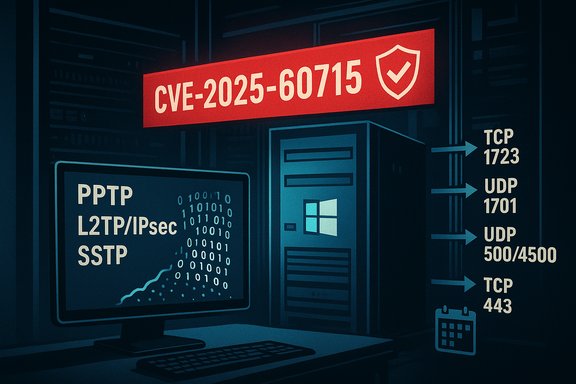
Routing and Remote Access Service (RRAS) is a long‑standing Windows Server role that implements VPN termination (PPTP, L2TP/IPsec, SSTP), NAT, routing and legacy dial‑up services. Because RRAS routinely parses complex, attacker‑controlled network input and runs in a privileged context, memory‑handling defects in RRAS have outsized operational impact: a remotely exploitable bug in RRAS can lead directly to system compromise of a perimeter gateway, credential theft, and network pivoting. Independent reporting across 2025 documented a cluster of RRAS issues — including both information‑disclosure and heap‑corruption families — and security teams repeatedly prioritized RRAS remediation in their patch cycles. The new entry, CVE‑2025‑60715, is described by vendor advisories and early threat‑intelligence feeds as a heap‑based buffer overflow in RRAS that permits remote code execution when exploited against vulnerable hosts. Multiple public trackers and payload aggregators list a high severity rating and a CVSS v3.1 base score in the high range (Feedly shows a base score of 8.0 for the CVE), and Microsoft has published updates on Patch Tuesday that include fixes for affected SKUs.
Source: MSRC Security Update Guide - Microsoft Security Response Center
 Background / Overview
Routing and Remote Access Service (RRAS) is a long‑standing Windows Server role that implements VPN termination (PPTP, L2TP/IPsec, SSTP), NAT, routing and legacy dial‑up services. Because RRAS routinely parses complex, attacker‑controlled network input and runs in a privileged context, memory‑handling defects in RRAS have outsized operational impact: a remotely exploitable bug in RRAS can lead directly to system compromise of a perimeter gateway, credential theft, and network pivoting. Independent reporting across 2025 documented a cluster of RRAS issues — including both information‑disclosure and heap‑corruption families — and security teams repeatedly prioritized RRAS remediation in their patch cycles. The new entry, CVE‑2025‑60715, is described by vendor advisories and early threat‑intelligence feeds as a heap‑based buffer overflow in RRAS that permits remote code execution when exploited against vulnerable hosts. Multiple public trackers and payload aggregators list a high severity rating and a CVSS v3.1 base score in the high range (Feedly shows a base score of 8.0 for the CVE), and Microsoft has published updates on Patch Tuesday that include fixes for affected SKUs. What the vulnerability is (technical summary)
Root cause and exploit class
CVE‑2025‑60715 is reported as a heap‑based buffer overflow inside RRAS packet‑processing code. In practical terms, a crafted network packet or protocol negotiation message can cause RRAS to write beyond an allocated heap buffer (or otherwise corrupt heap metadata), which — with a carefully crafted payload and under the right environmental conditions — can lead to arbitrary code execution in the RRAS process context (typically SYSTEM). This is the same high‑impact class of memory corruption that has affected RRAS in previous 2025 advisories.Attack vector and preconditions
- Attack vector: Network. Exploitation requires sending specially crafted RRAS protocol messages to a vulnerable RRAS listener.
- Reachability: The attacker must be able to reach an RRAS endpoint (public internet, partner network, or internal network segment).
- Privileges: Reports indicate low privileges are sufficient in many cases (the vulnerability affects a privileged service but can often be triggered by unauthenticated or low‑privileged network interactions).
- User interaction: Some public summaries include a UI‑required flag in CVSS strings used by vendors; however, vendor wording can vary across CVEs in the RRAS family — treat this as environment dependent and do not assume user interaction protects you.
Practical impact
Successful exploitation can deliver remote code execution with elevated privileges on the target host. Because RRAS typically runs as SYSTEM and mediates VPN and routing functions, a compromised RRAS host is an ideal beachhead for network‑wide escalation and lateral movement. Security vendors and incident responders have repeatedly stressed that RRAS vulnerabilities, even when classified as information disclosure in some variants, are operationally critical because leaked memory or execution control can be rapidly weaponized.Affected systems and scope
Which systems are in scope
- Any Windows host with the Routing and Remote Access role installed and the RemoteAccess service running is potentially affected.
- RRAS is not installed by default on most SKUs; however, it remains widely used for on‑prem VPN termination and branch gateway scenarios, and those are precisely the systems most likely to be internet‑ or partner‑network‑exposed.
Protocol endpoints to prioritize
Common protocol endpoints that RRAS exposes and that defenders should treat as in‑scope include:- PPTP — TCP 1723 and GRE (IP protocol 47)
- L2TP/IPsec — UDP 1701 (plus IKE UDP 500 / UDP 4500)
- SSTP — TCP 443 (HTTPS‑based VPN)
- IKE/IPsec control flows — UDP 500 and UDP 4500
Windows versions and builds
Microsoft’s advisory mechanism maps CVEs to specific KBs and update packages per Windows build. Historically, RRAS CVEs have affected a wide range of Server and client SKUs when the RRAS role is enabled (Server 2012 R2, 2016, 2019, 2022 and later, and certain Windows 10/11 images where administrators enabled RRAS). Always confirm the CVE→KB mapping in the Microsoft Security Update Guide for your exact OS build before applying updates.Evidence and verification
Publicly available feeds and vendor trackers corroborate the RCE characterization:- Microsoft published an advisory entry for CVE‑2025‑60715 in the Security Update Guide (MSRC entry for the CVE), which is the authoritative mapping to the KBs and update packages. Note: the MSRC page requires a full browser render (JavaScript) to view the advisory content directly.
- Threat‑intelligence aggregators and feed services (Feedly and others) list the CVE as a heap‑based buffer overflow with a high base score and report the Microsoft patch availability on November 11, 2025.
- Security vendor databases and vulnerability trackers have cataloged RRAS memory‑corruption issues throughout 2025, confirming the broader pattern of heap overflows and out‑of‑bounds reads in RRAS that produce either information disclosure or remote code execution depending on the defect variant. These independent corroborations reinforce the vendor advisory and the urgency of remediation.
Exploitability — current landscape
- Public proof‑of‑concepts: At initial publication, commercial trackers indicated no widely shared public PoC and no confirmed active exploitation in the wild for CVE‑2025‑60715; however, RRAS vulnerabilities in 2025 have historically attracted rapid scanning and automated exploit attempts after disclosure, so defenders should assume opportunistic scanning will begin quickly.
- Ease of exploitation: Heap overflows can be more complex to exploit than simple info leaks due to modern mitigations (ASLR, DEP, CFG, heap hardening), but a network‑facing service that runs as SYSTEM is still a high‑value target. Skilled adversaries or exploit chains that combine information leaks with heap corruption can bypass mitigations.
- Likely attacker profile: opportunistic internet scanners, ransomware groups seeking edge‑gateway compromises, and advanced actors wanting persistent footholds in enterprise networks are all plausible adversaries. Even if exploitation requires some user interaction or precise conditions, the consequence of exploitation (full system compromise) elevates urgency.
Immediate mitigation and remediation (prioritized)
Apply vendor updates as the first and highest priority. Microsoft’s security update published on November 11, 2025 contains fixes for the affected Windows builds — map the CVE to the exact KB for your SKU and deploy via your patch management system (WSUS, SCCM, Intune, Microsoft Update Catalog). If immediate patching is not possible, implement these compensating controls in priority order:- Block or restrict RRAS‑related ports at the perimeter and on host‑based firewalls to only trusted management or partner IPs (drop public access where possible).
- Temporarily stop and disable the RemoteAccess service on non‑critical systems:
- Stop-Service -Name RemoteAccess -Force
- Set-Service -Name RemoteAccess -StartupType Disabled
- Uninstall the RRAS role on servers that do not require it (Uninstall‑WindowsFeature -Name RemoteAccess -IncludeManagementTools).
These PowerShell commands are standard operational mitigations documented in RRAS advisories. - Harden authentication: enforce certificate‑based VPN authentication and multi‑factor authentication (MFA) for remote access where possible to reduce the value of any leaked credential material.
- Increase logging and telemetry retention for RRAS events and forward logs to your SIEM for immediate rule deployment (see Detection section below).
Detection and forensics guidance
High‑value telemetry sources
- Windows Event Logs:
- Applications and Services Logs → Microsoft → Windows → RemoteAccess
- RasMan events in the System/Application logs
- Network telemetry:
- IDS/IPS alerts for malformed PPTP / L2TP / SSTP / IKE traffic
- NetFlow and NGFW logs showing spikes or repeated small probes to RRAS ports (TCP 1723, UDP 1701, UDP 500/4500, TCP 443) from unknown sources
- Packet captures (PCAPs) around suspected activity windows — retain for offline inspection; memory‑leak primitives can be identified by anomalous binary responses that look like heap fragments.
Detection heuristics and rules to deploy now (examples)
- Alert on bursts of negotiation failures or malformed requests to RRAS ports originating from single external IPs.
- Alert on repeated small, high‑entropy responses from RRAS listeners that do not match normal VPN negotiation payloads.
- Correlate RRAS traffic with unusual authentication events or new administrative sessions following RRAS access.
If you suspect exploitation
- Isolate the host (network quarantine) to prevent lateral movement.
- Acquire volatile memory (a full process dump of RemoteAccess) and preserve PCAPs for the relevant timeframe.
- Hunt for signs of credential theft, new scheduled tasks, or unusual service accounts and check for lateral authentication events across AD logs.
- If a host is confirmed compromised, rebuild where practical and perform credential rotation for accounts exposed via the gateway.
Operational analysis — strengths and shortcomings of the response
Notable strengths
- Microsoft published the update and made fixes available via the standard update channels — organizations with good patch governance can eliminate the exposure quickly by applying the KBs mapped to their builds. The monthly Patch Tuesday cadence and the MSRC advisory model provide an authoritative place to find KB mappings.
- Vendor and community reporting across multiple RRAS CVEs in 2025 has increased awareness, producing a variety of practical mitigation playbooks and detection rules that defenders can adapt quickly.
Potential risks and limitations
- CVE→KB mapping confusion across third‑party feeds: Several community trackers in 2025 documented inconsistent CVE identifiers or KB mappings for related RRAS issues; reliance on mirrors can misdirect patching efforts. Confirm the exact KB in MSRC for your specific OS build before mass deployment.
- MSRC page rendering: MSRC advisory pages sometimes require a full browser render to access the advisory content (JavaScript), complicating automated scraping and some SOAR workflows. Operations teams that rely on automated feeds should validate MSRC entries manually when mapping KBs.
- Residual risk from previously leaked material: If RRAS endpoints were exposed prior to patching, leaked memory fragments (tokens, ephemeral keys, routing metadata) may already have been harvested by adversaries. Organizations should assume the possibility of pre‑patch data leakage and rotate any high‑value secrets tied to RRAS authentication (client certificates, service account credentials) and force reauthentication where feasible.
Longer‑term recommendations
- Minimize RRAS usage: Where operationally feasible, replace legacy on‑prem RRAS gateways with modern, managed VPN appliances or cloud‑provided VPN/broker services that receive vendor‑managed security updates and improved telemetry.
- Inventory and governance: Ensure RRAS deployment is tracked in CMDBs and vulnerability management systems; use automated inventory queries (Get‑WindowsFeature -Name RemoteAccess; Get‑Service -Name RemoteAccess) to find unmanaged RRAS instances.
- Network segmentation: Place RRAS servers inside well‑limited network zones, restrict administrative access to hardened jump hosts, and enforce least privilege for accounts that configure RRAS.
- Replace legacy protocols: Phase out insecure protocols (PPTP) and prefer modern, certificate+MFA protected remote access methods.
- Continuous testing: Increase fuzzing and memory‑safety testing coverage for any in‑house or third‑party services that parse network protocols at the edge. The RRAS cluster in 2025 shows how repeated protocol parsing defects can persist across codebases and versions.
Practical checklist — first 24–72 hours (step by step)
- Inventory: Run elevated PowerShell to detect RRAS role installations and running RemoteAccess services across your estate (Get‑WindowsFeature; Get‑Service).
- Map: Open Microsoft’s Security Update Guide entry for CVE‑2025‑60715 and map that CVE to the KB(s) that match each Windows build in your environment (do not rely solely on third‑party feeds).
- Patch: Schedule emergency patching for internet‑facing RRAS hosts; deploy updates to internal hosts in a rapid ring once external hosts are secured.
- Compensate: If a host cannot be patched within the window, block RRAS ports at the perimeter and disable RRAS on nonessential servers (Stop‑Service / Set‑Service or uninstall the role).
- Monitor: Deploy detection rules for unusual negotiation traffic and forward RRAS logs to your SIEM. Increase PCAP retention for RRAS endpoints for retrospective analysis.
- Forensics & recovery: If exploitation is suspected, isolate, capture memory and PCAPs, hunt for lateral movement, rotate exposed credentials, and rebuild compromised hosts where necessary.
Conclusion
CVE‑2025‑60715 is another instance of a high‑impact memory‑corruption vulnerability in RRAS that can yield remote code execution on vulnerable Windows servers where the Routing and Remote Access role is installed. The immediate operational imperative is clear: identify RRAS hosts, apply the Microsoft KBs mapped to your specific builds, and implement compensating controls for any servers that cannot be patched immediately. The combined lessons from 2025’s RRAS cluster remain relevant — patch promptly, verify vendor KB mappings against MSRC, reduce RRAS exposure where possible, and assume that any previously exposed tokens or session material may have been harvested until proven otherwise.Source: MSRC Security Update Guide - Microsoft Security Response Center
