

Microsoft’s Security Update Guide lists CVE‑2025‑62550 as a Remote Code Execution (RCE) entry affecting the Azure Monitor Agent, but the vendor page is client‑side rendered and does not expose full advisory text without JavaScript, so the public technical details remain limited until the MSRC advisory is viewable and mapped to a specific KB/agent build. This article explains what the entry likely means for operators, summarizes the verifiable evidence from previous Azure Monitor Agent advisories, evaluates the maturity and credibility of the published details, and lays out a prioritized remediation and detection playbook for Windows fleets and hybrid Azure hosts. The analysis draws on vendor trackers and independent third‑party advisories as corroborating evidence and flags any claims that are currently unverifiable.
Azure Monitor Agent (AMA) is Microsoft’s modern, privileged data‑collection service used on Windows and Linux hosts to collect logs, metrics, and telemetry for Azure Monitor, Log Analytics, and related services. Because AMA runs with elevated privileges, handles external input, and interacts with local and cloud‑side identity endpoints, bugs in the agent can yield severe outcomes — from local code execution to management‑plane token theft and tenant compromise.
The MSRC vulnerability page for CVE‑2025‑62550 exists, but the page requires client‑side rendering, which prevents programmatic or automated extraction of the advisory text without loading the MSRC app. Until the MSRC advisory is rendered and the vendor maps the CVE to a KB/article and fixed package version, organizations should avoid assuming a specific remediation artifact and instead follow an inventory‑first approach.
Context matters: 2024–2025 saw multiple high‑impact Azure Monitor / Azure Connected Machine (azcmagent) advisories. For example, a July 8, 2025 code‑injection RCE tracked as CVE‑2025‑47988 affected AMA builds prior to 1.35.1 and required upgrading to 1.35.1 or later. Third‑party scanners and advisories (Tenable, CVE aggregators) corroborate those mappings and recommended upgrades. Community and vendor trackers have cataloged several additional AMA issues later in 2025 (heap overflows, improper access control, deserialization flaws) that illustrate the recurring attack surface and the operational urgency these defects create.
Common root causes seen across AMA advisories:
Immediate triage (0–24 hours)
Source: MSRC Security Update Guide - Microsoft Security Response Center
 Background / Overview
Azure Monitor Agent (AMA) is Microsoft’s modern, privileged data‑collection service used on Windows and Linux hosts to collect logs, metrics, and telemetry for Azure Monitor, Log Analytics, and related services. Because AMA runs with elevated privileges, handles external input, and interacts with local and cloud‑side identity endpoints, bugs in the agent can yield severe outcomes — from local code execution to management‑plane token theft and tenant compromise.The MSRC vulnerability page for CVE‑2025‑62550 exists, but the page requires client‑side rendering, which prevents programmatic or automated extraction of the advisory text without loading the MSRC app. Until the MSRC advisory is rendered and the vendor maps the CVE to a KB/article and fixed package version, organizations should avoid assuming a specific remediation artifact and instead follow an inventory‑first approach.
Context matters: 2024–2025 saw multiple high‑impact Azure Monitor / Azure Connected Machine (azcmagent) advisories. For example, a July 8, 2025 code‑injection RCE tracked as CVE‑2025‑47988 affected AMA builds prior to 1.35.1 and required upgrading to 1.35.1 or later. Third‑party scanners and advisories (Tenable, CVE aggregators) corroborate those mappings and recommended upgrades. Community and vendor trackers have cataloged several additional AMA issues later in 2025 (heap overflows, improper access control, deserialization flaws) that illustrate the recurring attack surface and the operational urgency these defects create.
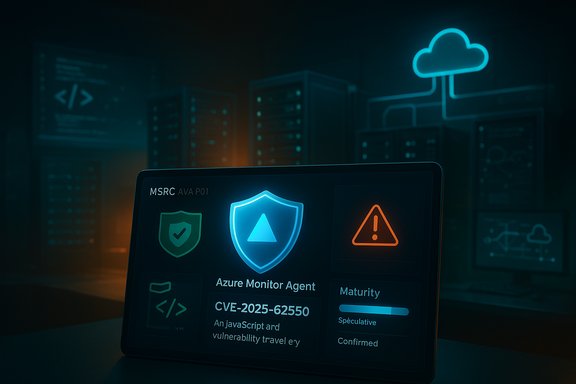
What the MSRC “vulnerability maturity” metric means — and why it matters
Microsoft’s MSRC includes descriptive language about a vulnerability maturity metric: this measures the confidence in the vulnerability’s existence and in the credibility of its technical details. The maturity scale ranges from speculative (low) to confirmed (high). When maturity is high — for example when Microsoft publishes a KB and a fixed product build — defenders can automate patching with confidence. When maturity is medium or low, the right operational posture is aggressive detection, containment, and inventory while waiting for vendor confirmation. The presence of a CVE entry in MSRC implies a certain level of vendor tracking, but it does not automatically mean the advisory is fully detailed or that a KB and package have been published in plain text. Why this matters operationally:- High‑maturity (vendor‑confirmed) advisories map directly to KBs and packages — ideal for automated remediation pipelines.
- Medium‑maturity advisories may be corroborated by third‑party research but lack definitive package mappings — require hunting and compensating controls.
- Low‑maturity advisories are signals to harden detections and inventory while avoiding blind mass‑deploys keyed only to CVE strings.
Verifiable facts and independent corroboration
What we can verify today (based on public trackers and vendor‑agnostic scanners):- The MSRC page for CVE‑2025‑62550 exists but is client‑side rendered (requires JavaScript), preventing straightforward extraction of advisory text without loading the MSRC UI. Treat the MSRC entry as authoritative but incomplete until the rendered advisory text and KB mapping are confirmed.
- Azure Monitor Agent has been the subject of several distinct RCE and EoP advisories in 2024–2025. Independent trackers list multiple CVEs (for example, CVE‑2025‑47988 and CVE‑2025‑59504) with different root‑cause classes (code injection, heap‑overflow, improper access control) and fixed version mappings in vendor guidance. These earlier advisories provide a reliable operational pattern for how vendor mapping and remediation proceed.
- Third‑party vulnerability scanners and security vendors (Nessus/Tenable, CVE aggregation sites, Wiz, and others) have published advisory synopses and detection signatures for the AMA lineage of vulnerabilities. Use these as corroborating signals, not as replacements for MSRC’s KB → package mapping.
- Publicly available sources (searches and aggregators) do not present a clear, widely published technical write‑up or proof‑of‑concept tied to CVE‑2025‑62550 at the time of writing. Multiple AMA CVEs exist; ensure you are not conflating separate CVE IDs when mapping to a patch. Treat the numeric label CVE‑2025‑62550 as provisional until you confirm the MSRC advisory’s KB and fixed package.
Technical analysis — likely root causes, attack vectors, and real‑world impact
Although the MSRC entry for CVE‑2025‑62550 is terse in its public form, the family of AMA advisories in 2025 highlights recurring vulnerability classes and exploitation models:Common root causes seen across AMA advisories:
- Improper input validation / code injection (CWE‑94) — parsing of telemetry or configuration that allows attacker‑controlled input to flow into an execution or evaluation context. This was the root pattern for CVE‑2025‑47988.
- Heap / boundary errors (CWE‑122) — unsafe memory writes, leading to heap‑based buffer overflows that can be exploited for local or network code execution (observed in later advisories such as CVE‑2025‑59504).
- Improper access control / missing authorization (CWE‑284) — privileged agent endpoints or install/repair paths callable from lower‑privileged contexts without adequate checks, enabling privilege escalation.
- Deserialization / unsafe parsing (CWE‑502) — processing of serialized telemetry or configuration objects without validation, allowing arbitrary object instantiation or code paths.
- Adjacent‑network RCE: a network attacker on the local LAN crafts a packet or payload that the agent accepts and parses, triggering code execution (this model was part of the July 2025 RCE).
- Local escalation / token theft: an attacker with a local foothold (malicious user, compromised build agent, or container) triggers an AMA EoP to gain SYSTEM/root, then queries local metadata endpoints (IMDS/HIMDS) to obtain machine‑assigned tokens and access Azure resources. This cross‑plane amplification is a recurring risk for AMA and connected agents.
- Installer/repair chain: unsanitized MSI repair arguments or elevated installer flows permit command injection, enabling an attacker who can run msiexec (or that installer) to execute arbitrary commands under elevated privileges.
- Full host compromise under SYSTEM/root or equivalent.
- Management‑plane abuse via machine‑assigned tokens (read/write to storage accounts, Key Vault access, extension installation, RBAC changes).
- Rapid lateral movement across hybrid fleets due to the agent’s widespread deployment.
- Complexity ranges from low (straightforward logic/authorization bypasses) to higher (heap overflows and race conditions require development of more reliable exploit chains).
- Historically, code‑injection and EoP classes tend to be weaponized rapidly once detailed technical information is available, which is why maturity (i.e., vendor confirmation and KB mapping) should drive urgency.
Operational risk assessment and prioritized mitigation
Treat any MSRC entry affecting AMA as high urgency until the advisory mapping and KB/package are validated. The following prioritized playbook converts ambiguity into action.Immediate triage (0–24 hours)
- Inventory: Identify every host running Azure Monitor Agent or related Azure Connected Machine agents. Use Azure Resource Graph for cloud‑connected/Arc hosts and inventory tools (WSUS/Intune/EndpointMgmt) for on‑prem fleets. Query agent versions centrally.
- Confirm vendor advisory: Open the MSRC entry for CVE‑2025‑62550 and extract the KB mapping and fixed package. If MSRC is not fully renderable, open the vendor KB or the Microsoft Update Catalog to find the exact package and agentVersion. Do not rely solely on third‑party CVE strings for automated patching.
- Prioritize for remediation: Patch bastions, jump hosts, build agents, CI/CD runners, and any hosts holding machine‑assigned identities first.
- Restrict network exposure: use host firewalls and network controls to limit inbound local‑network traffic to agent endpoints; block access from untrusted subnets.
- Restrict access to IMDS/HIMDS: where feasible, limit which processes and users can access local metadata endpoints, and monitor token requests.
- Apply application allow‑listing (WDAC / AppLocker) for agent binaries and restrict MSI repair privileges to a small admin cohort.
- Deploy vendor‑published fixes or upgrade to the fixed AMA build specified by Microsoft.
- Validate via two independent checks: local file/version checks and central agentVersion fields (Azure Resource Graph or endpoint management system). Don’t assume a single verification method is sufficient.
- Alert for non‑standard processes querying local metadata endpoints or IMDS calls from unexpected processes.
- Monitor for unexpected extension installs, MSI repair operations, and agent binary crashes or restarts.
- Create SIEM/EDR hunts for suspicious child processes spawned by agent binaries and for sudden creation of scheduled tasks or services tied to agent updater activity.
- Azure Activity: detect unexpected role assignment or RBAC edits just after host activity.
- Log Analytics: find process names such as azcmagent or known AMA binaries spawning unusual children.
- Enforce least privilege for install/repair operations and require signed packages.
- Move management plane traffic to private link / private endpoints where possible.
- Centralize azcmagent/AMA telemetry and keep longer retention to support forensic recon.
Detection recipes and practical SIEM rules
The following detection hypotheses are practical, deployable, and map to the AMA threat model.- IMDS/HIMDS anomalies: alert when non‑service processes query local metadata endpoints or when token requests originate from interactive sessions or low‑privilege accounts.
- Installer anomalies: alert on msiexec runs with unusual arguments launched by non‑admin users, or on a spike in MSI repair operations across the fleet.
- Agent process behavior: alert when agent binaries spawn command interpreters (cmd, PowerShell) or create scheduled tasks/services in a short window around update activity.
- Cross‑plane correlation: tie host‑level logs showing local elevation to tenant activities (role assignment events, Key Vault access) within a tight timeframe.
Critical analysis — strengths, limitations, and systemic risks
Strengths in the current ecosystem- Microsoft’s Security Update Guide is the canonical record and, when fully rendered, provides authoritative CVE→KB→package mappings essential for accurate remediation.
- Third‑party scanners and security vendors typically produce detection rules and version‑based checks quickly after disclosures, which helps defenders identify affected hosts even when vendor text is terse.
- Client‑side rendering of MSRC entries complicates automated ingestion for some tooling and can leave teams blind if they rely on simple CVE strings rather than the vendor KB/package mapping.
- CVE fragmentation: community feeds sometimes assign different CVE numbers to closely related agent/extension issues. This fragmentation can cause blind spots when automated patching relies only on CVE strings. Operators must map advisories to exact KBs and package versions.
- Vendor advisories sometimes deliberately omit exploit details (to reduce immediate risk), but the lack of public PoC does not equal lack of exploitation interest — weaponization often follows quickly once exploit techniques are understood.
- Agents run across thousands of hosts including bastions and build servers; a single exploited agent can be amplified via machine identities into tenant‑level compromise. This cross‑plane amplification makes agent defects disproportionately dangerous even if they require local access.
Verification checklist (convert uncertainty into operational certainty)
- Open the MSRC Security Update Guide entry for CVE‑2025‑62550 and capture the KB/article and fixed installer version(s). If the MSRC UI does not render, use the Microsoft Update Catalog or the vendor KB referenced by MSRC.
- Map KB/package → agent build number and confirm against your inventory (azcmagent/AMA version fields).
- Deploy the vendor update to testing rings; verify behavior and validate agentVersion centrally.
- If you cannot patch immediately, apply compensating controls: restrict metadata access, block management endpoints from untrusted networks, and tighten installer privileges.
- Hunt for the post‑exploit artifacts described above (IMDS calls from nonstandard processes, MSI repair spikes, unexpected extension installs).
Conclusion
CVE‑2025‑62550 is cataloged in Microsoft’s Security Update Guide as an Azure Monitor Agent RCE entry, but the public advisory content is currently limited by MSRC’s client‑side rendering and no independent, vendor‑mapped KB/package has been extractable in the public record at the time of this writing. Given the family of Azure Monitor Agent vulnerabilities disclosed earlier in 2025 — including confirmed RCEs and heap‑overflow defects — organizations should treat any MSRC entry impacting AMA as urgent until the vendor publishes and operators verify the exact KB and fixed package. Practical next steps for defenders are clear:- Inventory all AMA/azcmagent hosts, confirm installed builds, and map them to vendor KBs.
- Validate the MSRC advisory for CVE‑2025‑62550 for KB/package details before automating mass patching.
- If patching is delayed, apply compensating network and host controls and implement the SIEM/EDR hunts outlined above.
- Treat agent class vulnerabilities as high‑impact even when initial details are scarce: the privileged context and token access of these agents amplify risk across host and cloud planes.
Source: MSRC Security Update Guide - Microsoft Security Response Center
