

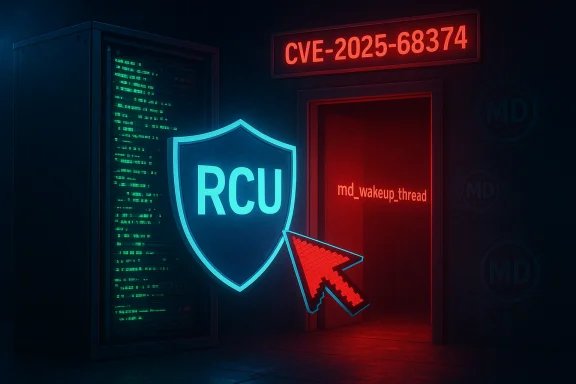
A new Linux kernel vulnerability, tracked as CVE‑2025‑68374, corrects a subtle but serious RCU lifetime bug in the md (multiple‑device / software RAID) subsystem: maintainers attempted to use RCU to protect a pointer named
RCU (Read‑Copy‑Update) is a core Linux kernel synchronization primitive used to allow high‑performance, lockless reads while ensuring safe, deferred reclamation of objects. RCU requires a precise discipline: readers must acquire an RCU read‑side lock (for example, via
Administrators should prioritize: inventory md‑using hosts, map affected kernels to vendor advisories, apply the kernel updates that include the fix, and validate by checking package changelogs for the upstream commit IDs referenced in public CVE records. In the short term, reduce exposure by limiting local, untrusted control over md operations and increase kernel log monitoring to detect related oopses. The patch is small and low‑regression, but the risk posed by unpatched devices — especially in shared infrastructure — makes timely remediation essential.
(Selected public vulnerability records and commentary used to prepare this analysis are available in the NVD, OSV and related CVE mirrors; operators should consult their vendor’s security advisory and package changelog for the authoritative remediation mapping.
Source: MSRC Security Update Guide - Microsoft Security Response Center
thread, but passed that raw pointer into md_wakeup_thread before entering the RCU read‑side window, effectively rendering rcu_read_lock ineffective and opening a narrow use‑after‑free (UAF) window that can lead to kernel instability.
 Background / Overview
RCU (Read‑Copy‑Update) is a core Linux kernel synchronization primitive used to allow high‑performance, lockless reads while ensuring safe, deferred reclamation of objects. RCU requires a precise discipline: readers must acquire an RCU read‑side lock (for example, via rcu_read_lock) before they dereference RCU‑protected pointers or call rcu_dereference–style accessors. If that ordering is violated, the apparent protection is meaningless and a reader may see a pointer that is freed by a concurrent writer, producing a use‑after‑free and potentially a kernel oops. The recently assigned CVE describes exactly this class of error inside the md code path that wakes and dispatches a worker thread. The md subsystem (software RAID) is critical infrastructure on many servers, storage appliances, and embedded devices. Bugs here are operationally sensitive because they can cause kernel oopses, system panics, or sustained denial‑of‑service conditions for I/O. Historically, small logic or synchronization mistakes in md code have generated availability‑focused CVEs and required targeted, low‑risk patches that are later backported into stable kernels and vendor trees. The recent CVE is consistent with that pattern and is being tracked across open vulnerability databases. What the vulnerability is and how it happens
The core failure mode
- The commit message and public vulnerability records summarize the problem succinctly: the code attempted to use RCU to protect a pointer named
thread, but the code passed the pointer value intomd_wakeup_threadbefore callingrcu_read_lock. That ordering mistake means the pointer could be observed or used outside the RCU read‑side critical section, allowing it to be freed concurrently and producing a use‑after‑free. - This is a lifetime bug rather than a bounds or arithmetic error: the pointer’s lifetime was not guaranteed for the duration of its use because RCU protection was not correctly established first. The attacker model is local: code or a user with local capability to interact with md devices can, in principle, trigger the vulnerable path. Public trackers classify the vector as local with low complexity and low privilege requirements in many environments.
Why this matters in practice
A UAF in kernel space frequently manifests as a kernel oops or panic. For a storage subsystem like md, such an oops can interrupt I/O, crash VMs hosted on the box, or require a reboot — all high‑impact outcomes for production servers and multi‑tenant infrastructure. Even when an immediate remote exploitation path is not obvious, memory lifecycle bugs are dangerous and merit rapid remediation because they can sometimes be chained into more powerful primitives on complex attack surfaces. The vulnerability therefore carries a primarily availability and stability risk, with a theoretical, but non‑trivial, risk of being escalated in skilled hands.Evidence and verification
Multiple independent vulnerability aggregators and trackers have ingested and posted the CVE entry and the short description above (NVD, OSV, CVE‑details, OpenCVE, and others), and the CVE metadata points to upstream stable Git commits that resolve the bug. Those references allow vendors and administrators to map the fix to specific stable commit IDs when confirming whether their kernel package contains the remediation. Practical verification paths for operators:- Confirm that your distribution’s kernel package changelog or security advisory contains the upstream stable commit IDs referenced in the CVE/OSV records. Trusted trackers list those commit IDs as the canonical fixes.
- If you maintain in‑house kernel builds, search your local git history for
md_wakeup_threadand inspect recent stable branch commits for RCU ordering changes; the CVE references several stable commits that resolve the issue. If those commit IDs are present in your package changelog, the fix is included.
git.kernel.org commit pages programmatically may be blocked or return HTTP 403 for automated crawlers; trust the vulnerability database references but confirm by checking the kernel source tree directly on a trusted mirror or by using your distribution’s changelog when possible. Public CVE entries include the same upstream commit identifiers to make this mapping precise. Technical analysis — what went wrong, and why the patch is the right approach
RCU discipline and common pitfalls
RCU protects read‑side concurrency by deferring reclamation until all preexisting readers have completed. The correct pattern is:- Enter the read‑side critical section (rcu_read_lock.
- Acquire a pointer via rcu_dereference or another RCU accessor.
- Use the pointer safely during the critical section.
- Exit with rcu_read_unlock.
The right fix: rework ordering and accessors
The correct remediation is narrow and surgical: ensure that any access to thethread pointer happens while the RCU read‑side is held or that a safe reference is taken (for example, by converting the pointer to a reference count or otherwise ensuring its lifetime). Upstream stable commits referenced in the CVE correct the ordering or make md_wakeup_thread accept an RCU‑stable dereferenced pointer taken inside a read‑side window. Because the change is small and local to md code, it is suitable for backporting to stable kernels and distributor kernel trees. Is the patch risky?
- Strength: the fix is minimal, targets only the RCU ordering, and does not alter higher‑level md semantics. Minimal patches reduce regression risk and make vendor backports straightforward.
- Residual risk: the long tail of vendor and OEM kernels means some embedded systems, appliance images, or vendor kernels might not pick up the commit quickly; those devices remain at risk until a vendor backport or firmware/kernel update is delivered.
Impact, exploitability, and operational risk
Scope of impact
- Affected component: Linux kernel — md/RAID subsystem.
- Typical impact: Availability — kernel oops/panic, I/O disruption on md‑managed devices.
- Attack vector: Local. Triggering the vulnerable path requires local ability to operate on md devices or to influence kernel md workflows (for example, running mdadm, device‑mapper operations, or other local interactions).
Exploitability
- Privileges required: in many setups, low — local users or misbehaving processes that can interact with device files may be able to provoke the path. In hardened systems where only administrators can touch md devices, the vector is more constrained.
- Complexity: low to moderate — this is a timing/lifetime bug rather than a complicated exploitation chain.
- Real‑world weaponization: as of the CVE publication, there are no widely published public PoCs demonstrating a reliable escalation to remote code execution; the primary observed outcome is a kernel stability failure (oops/panic). Nonetheless, memory lifecycle bugs can be weaponized by skilled attackers in specific environments, so treat this as a live risk until patched.
Who should prioritize remediation
- Virtualization/cloud hypervisors and multi‑tenant hosts (where a host kernel oops can impact many tenants).
- Storage nodes, NAS appliances, and servers that host critical filesystems on md arrays.
- CI/build systems and developer workstations that automatically mount block images or manage arrays.
- Embedded systems and appliances with long maintenance tails — they typically require vendor engagement for backports.
Immediate actions and remediation checklist
Operators should treat CVE‑2025‑68374 as a kernel correctness and availability risk and apply the following prioritized plan:- Inventory:
- Identify hosts that run md-managed arrays: check /proc/mdstat, mdadm process status, and loaded md modules.
- Locate kernel packages and versions: uname -r and distribution package manager (apt/rpm) queries.
- Map:
- Consult your distribution’s security advisory or kernel package changelog to map the patched upstream commit IDs referenced in the CVE/OSV/NVD records to your vendor’s fixed package. Do not assume a package is fixed without verifying the changelog or commit mapping.
- Patch:
- Apply vendor kernel updates that explicitly list the fix or the upstream commit ID. If your vendor supplies livepatches, evaluate and apply them in accordance with your patching policies; otherwise schedule a maintenance window and reboot into the patched kernel.
- Validate:
- After update and reboot, confirm no md related oopses appear in
dmesg/journalctl -k. - Optionally reproduce the previously failing stop/suspend sequences in a controlled lab to confirm the hang-UAF no longer occurs (only in isolated test systems).
- Short‑term mitigations if you cannot patch immediately:
- Restrict local access to hosts that can manipulate md arrays (limit who can run mdadm/device‑mapper operations).
- Isolate high‑value tenants or untrusted containers from hosts that manage md arrays.
- Increase monitoring for kernel logs that mention md_stop, md_check_recovery, MD_RECOVERY_RUNNING, or any md daemon‑thread waits; capture full stack traces for vendor support.
- Vendor engagement:
- For appliances and OEM kernels, open support tickets and request explicit backports to your kernel branch if no vendor advisory appears promptly. Embedded and appliance fleets represent the “long tail” risk.
Practical detection and hunting queries
- Identify md arrays:
- sudo mdadm --detail --scan
- cat /proc/mdstat
- lsblk | grep md
- Inspect kernel logs for related symptoms:
- journalctl -k | egrep -i 'md_check_recovery|md_stop|MD_RECOVERY|md_wakeup_thread'
- dmesg | egrep -i 'md|rcu|use-after-free|oops'
- Confirm your running kernel includes the fix:
- uname -r
- Check package changelog (apt or rpm) for the upstream commit IDs referenced by NVD/OSV/CVE aggregators.
Broader context and related md synchronization issues
This CVE sits in a family of recent kernel fixes where RCU, timer, and thread‑lifecycle ordering errors produced UAFs or deterministic hangs in networking and storage subsystems. Public analyses and vendor advisories have repeatedly favored surgical, minimal changes — correct the synchronization ordering or switch to RCU‑aware accessors — because those fixes are easy to reason about, simple to backport, and carry low regression risk. Examples of similar fixes in other subsystems include adding RCU protection around timer deletion in MPTCP or hardening device pointer reads withdst_dev_rcu in networking paths. The operational guidance across these cases is consistent: inventory, map to vendor patches, update, and reboot.Critical analysis — strengths, gaps, and residual risk
Notable strengths
- The fix is small and narrowly scoped to RCU ordering; that is the right engineering approach for a lifetime bug. Minimal changes reduce the risk of regressions and make vendor backports practical.
- Public CVE records and vulnerability databases have ingested the issue quickly, and references to upstream commit IDs are available, allowing administrators a precise verification path.
Potential risks and remaining concerns
- Long‑tail exposures: many embedded devices, appliance images, and vendor‑supplied kernels lag upstream; unless the vendor explicitly backports the stable commit, those devices remain vulnerable indefinitely.
- Local attack surface: while the vector is local, cloud and multi‑tenant environments routinely expose local operations via guest interactions or misconfigured containers; the practical exposure may be larger than anticipated in shared infrastructures.
- Evidence vs. exploitation: there is no published public PoC converting the bug into a reliable RCE at disclosure, but the presence of a kernel UAF is a high‑value primitive for attackers in sophisticated campaigns. Treat the absence of public exploitation as provisional.
Recommended risk controls beyond patching
- Harden access to device management: enforce strict RBAC for mdadm and device‑mapper tooling; consider kernel lockdown or host isolation for multi‑tenant platforms.
- Enhance kernel crash and log capture: enable kdump and persistent journaling to retain pre‑patch traces if an oops occurs; these logs are vital for vendor remediation and root cause analysis.
Conclusion
CVE‑2025‑68374 is a classic kernel correctness vulnerability: a subtle RCU ordering mistake that can expose a use‑after‑free in the md subsystem. While its primary publicized impact is availability (kernel oops and I/O disruption), the underlying memory lifetime semantics make it serious: memory lifecycle bugs can have outsized consequences in multi‑tenant and production systems. The remediation path is straightforward — apply vendor kernel updates that contain the upstream stable commits referenced in the CVE and reboot — but the operational cost and residual risk depend heavily on distribution/vendor response times and the long tail of embedded or OEM kernels.Administrators should prioritize: inventory md‑using hosts, map affected kernels to vendor advisories, apply the kernel updates that include the fix, and validate by checking package changelogs for the upstream commit IDs referenced in public CVE records. In the short term, reduce exposure by limiting local, untrusted control over md operations and increase kernel log monitoring to detect related oopses. The patch is small and low‑regression, but the risk posed by unpatched devices — especially in shared infrastructure — makes timely remediation essential.
(Selected public vulnerability records and commentary used to prepare this analysis are available in the NVD, OSV and related CVE mirrors; operators should consult their vendor’s security advisory and package changelog for the authoritative remediation mapping.
Source: MSRC Security Update Guide - Microsoft Security Response Center
