

CVE-2026-10275 is a disclosed OpenSC vulnerability affecting pkcs11-tool in versions up to 0.26.1, where the test_kpgen_certwrite function in src/tools/pkcs11-tool.c can overflow a fixed-size buffer during PKCS#11 key-generation testing when handed an oversized CKA_ID value. The bug is not another faceless entry in a vulnerability database; it is a small, sharp example of how trust boundaries blur when security tools accept data from smart cards, tokens, and pluggable crypto modules. Its practical risk is narrower than the phrase “buffer overflow” suggests, but the lesson is broader than OpenSC. If your authentication stack depends on removable hardware and vendor-supplied middleware, the boring command-line utilities around that stack deserve the same scrutiny as the production services they support.
OpenSC is the kind of software that sits beneath more visible security workflows. It provides smart-card tools and middleware, including PKCS#11 support, used by administrators, developers, and users working with PIV cards, CAC environments, hardware tokens, and certificate-backed authentication. That makes it easy to underestimate: OpenSC is not usually the thing executives buy, but it is often the thing that makes the purchased identity system work.
CVE-2026-10275 centers on
That distinction matters. This is not a remote wormable flaw in a default Windows service, and treating it like one would inflate the risk. But it is also not harmless simply because it appears in a test-oriented tool. In real environments, support utilities are routinely run by administrators, scripted during token initialization, embedded in troubleshooting guides, and invoked with elevated trust because “it’s just the smart-card tool.”
The vulnerability’s most interesting property is therefore not only memory corruption. It is misplaced confidence.
But “local” is not the same as “irrelevant.” PKCS#11 exists precisely to let applications talk to cryptographic devices and modules through a common interface. In practice, that interface often crosses organizational trust lines: a driver from one vendor, a card from another, a laptop image maintained by IT, a user following setup documentation, and a help-desk technician trying to make a certificate appear in a browser.
A malicious PKCS#11 module is not science fiction. The interface is designed around loadable libraries, and users can often point tools at a module path. If an attacker convinces a victim to test a “driver,” “middleware update,” or “token diagnostic package,” the boundary between social engineering and code execution begins to collapse.
A malicious or compromised smart card is a higher-friction scenario, but it is the one that should make security architects pause. Hardware-backed identity systems are often treated as trust anchors. CVE-2026-10275 is a reminder that the host still parses what the token returns, and bad parsing in the host can turn a supposedly subordinate device into an input source capable of corrupting memory.
Here, the public record appears stronger than a vague advisory. The issue has a named function, a named file, an affected version range, a concrete attribute involved in the overflow, a described buffer size, reproduction details, and a patch reference. That combination gives the vulnerability more operational weight than an advisory that merely says “memory corruption may occur.”
This cuts both ways. Better details help maintainers and downstream packagers fix the problem quickly. They also help attackers understand which code path to exercise and what kind of malicious input matters. Vulnerability disclosure always walks that line, but with memory-safety bugs in security tooling, the line is especially visible.
The confidence metric should not be confused with severity. A high-confidence vulnerability can still have limited exploitability. A low-confidence report can still describe a catastrophic bug. What confidence tells administrators is how much ambiguity remains around existence and mechanics; it does not tell them whether the affected binary is present in their estate, whether the vulnerable code path is reachable, or whether a plausible attacker can put malicious PKCS#11 input in front of it.
In the reported OpenSC path, the problematic value is the
A global buffer overflow differs in texture from the stack overflows that dominate older exploit lore, but it is still memory corruption. Depending on layout, compiler options, platform hardening, and adjacent global state, the result may range from a clean crash to state corruption to more serious control-flow consequences. Responsible defenders should avoid assuming the worst exploit primitive is always practical, but they should also avoid assuming that AddressSanitizer output equals mere denial of service.
The more durable engineering lesson is that security tools must treat hardware and middleware responses as untrusted input. A smart card can be defective. A token can be malicious. A PKCS#11 module can be swapped. A driver can be compromised. A parser that handles any of those responses needs bounds checks as much as a parser that handles packets from the public internet.
There is also a MiniDriver world on Windows and a PKCS#11 world around it, and the two frequently meet in enterprise troubleshooting. A user cannot sign in. A certificate is not visible. A token works in one browser but not another. Someone reaches for
For WindowsForum readers, the practical question is not whether every Windows endpoint suddenly needs emergency remediation because of CVE-2026-10275. It does not. The better question is whether your organization has an inventory of the smart-card middleware and crypto tooling used by admins, developers, build systems, and enrollment stations. Many do not.
The security industry spends enormous energy tracking browser versions and Exchange cumulative updates. It spends less energy tracking the small binaries that initialize credentials, test tokens, and bridge identity hardware to operating systems. CVE-2026-10275 is a useful prod: identity infrastructure is not only the directory and the cloud tenant; it is also the utility someone installed three years ago to make a card reader behave.
A reproduction harness that loads a malicious PKCS#11 module and triggers AddressSanitizer is valuable evidence. It shows that the bug can be exercised and that the report is technically credible. It does not automatically prove a reliable weaponized exploit across hardened systems, nor does it mean remote unauthenticated attackers can compromise machines running OpenSC from across the internet.
The distinction matters because defenders triage under pressure. If a vulnerability scanner flags CVE-2026-10275 as “critical” solely because it is a buffer overflow with proof-of-concept material, teams may misallocate time away from exposed services or actively exploited products. If they dismiss it because it is “only local,” they may miss the environments where smart-card tooling is run by privileged personnel against untrusted modules or devices.
The colder reading is this: the bug appears real, the vulnerable pattern is understandable, and the exploitation path depends heavily on operational context. That makes it a patch-and-inventory issue first, and an emergency-response issue only for organizations that handle untrusted tokens, accept third-party PKCS#11 modules, or run OpenSC tooling in privileged enrollment workflows.
PKCS#11’s modularity is a strength. It lets software interact with many tokens through a common API rather than one bespoke integration per device. That same modularity means the host application is often trusting code and data that originate outside the application’s own project. In security architecture, that is a trust boundary whether or not the diagram bothers to draw it.
The OpenSC issue also exposes a cultural habit. We often call smart cards and hardware security modules “trusted” because their job is to protect private keys. But trusted for key storage does not mean trusted for arbitrary-length metadata returned to host software. The token may be trusted not to export a private key and still be untrusted as an input parser adversary.
That is the kind of nuance that disappears in procurement language. A device can satisfy a compliance requirement and still be part of an attack surface. A middleware stack can enable phishing-resistant authentication and still contain memory-unsafe code. Secure systems are assembled from components that must distrust one another at the right seams.
The problem with relying too heavily on the number is that PKCS#11 deployments are not uniform. A hobbyist using OpenSC occasionally to inspect a personal token faces a different risk than a defense contractor provisioning smart cards at scale. A Linux desktop with OpenSC installed but unused is different from an enrollment workstation that runs scripts against batches of cards from a supplier.
Severity is therefore less portable than the CVE identifier makes it seem. The same vulnerability can be a nuisance in one environment and a credible foothold in another. This is one reason vulnerability management often feels disconnected from reality: the database score describes a generalized product condition, while the defender’s problem is a specific workflow.
The right operational lens is exposure, not drama. Is OpenSC installed? Which version? Is
This is especially true in Windows-adjacent identity environments. A Windows login issue may send an administrator to a Linux machine to inspect a token. A browser certificate problem may lead someone to a PKCS#11 command copied from an old setup guide. A vendor support engineer may recommend loading a module directly because it is the fastest way to isolate a driver problem.
Patch management alone does not clean up those paths. If your organization uses OpenSC in smart-card workflows, the remediation should include the boring work: update packages, then search documentation and scripts for commands that load arbitrary PKCS#11 modules or run key-generation tests against unknown tokens. The goal is not to ban diagnostics. It is to stop diagnostics from becoming an unexamined trust elevator.
There is also a training issue. Administrators should understand that
OpenSC lives in that world. It has to interact with decades of smart-card behavior, PKCS#11 semantics, platform-specific middleware expectations, and hardware that may not behave consistently. That is difficult engineering, and it is exactly the kind of environment where fixed buffers and historical assumptions tend to accumulate.
The answer is not to sneer at maintainers. Open-source security infrastructure often survives on thin resources while supporting workflows that enterprises rely on heavily. The better takeaway is that security-critical maintenance code deserves funding, fuzzing, and review even when it does not sit on a network port or ship in a glossy product.
CVE-2026-10275 is a good candidate for targeted regression testing. Any path that retrieves variable-length attributes from a token or module and then copies them into bounded storage should be audited. The fix for one buffer should prompt maintainers and downstream consumers to ask where else the code trusts length values from external components.
If OpenSC packages are managed by a Linux distribution, the fixed version may arrive through the normal security channel rather than through a manual upstream build. That is usually preferable in enterprise environments because the distribution maintainers handle integration, dependency expectations, and backported patches. But administrators should verify the package changelog rather than assuming that an upstream version number maps cleanly to a downstream fix.
Where manual builds exist, the risk of drift is higher. A copy of OpenSC compiled for one project can linger under
For high-assurance environments, the review should include how untrusted tokens are handled. If your team evaluates hardware from vendors, tests returned devices, provisions cards from batches, or works with customer-supplied smart cards, you should avoid running vulnerable tooling on privileged workstations. A sacrificial, isolated test host is cheap compared with the blast radius of treating unknown hardware as benign.
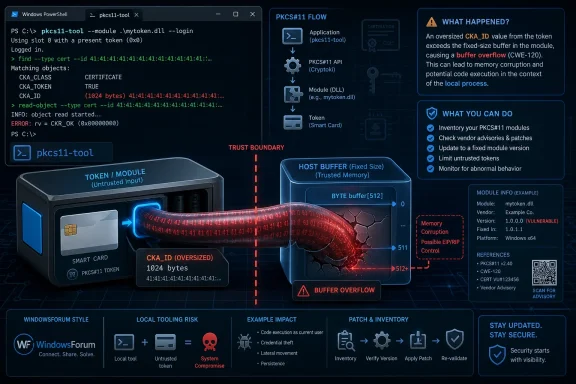 The Bug Lives in the Tooling Around the Keys
OpenSC is the kind of software that sits beneath more visible security workflows. It provides smart-card tools and middleware, including PKCS#11 support, used by administrators, developers, and users working with PIV cards, CAC environments, hardware tokens, and certificate-backed authentication. That makes it easy to underestimate: OpenSC is not usually the thing executives buy, but it is often the thing that makes the purchased identity system work.CVE-2026-10275 centers on
pkcs11-tool, a command-line utility used to inspect, test, and operate against PKCS#11 tokens and modules. The vulnerable path is tied to key-pair generation testing, including code paths associated with test_kpgen_certwrite. The reported flaw is straightforward in C terms: data returned as a PKCS#11 attribute is copied into a fixed-size global buffer without first proving that the returned length fits.That distinction matters. This is not a remote wormable flaw in a default Windows service, and treating it like one would inflate the risk. But it is also not harmless simply because it appears in a test-oriented tool. In real environments, support utilities are routinely run by administrators, scripted during token initialization, embedded in troubleshooting guides, and invoked with elevated trust because “it’s just the smart-card tool.”
The vulnerability’s most interesting property is therefore not only memory corruption. It is misplaced confidence.
pkcs11-tool asked a token or module for an attribute, received a length, and then acted as though that lower-level component was honest enough not to hand back something dangerous.A Local Flaw Can Still Cross an Organizational Boundary
The reported attack scenarios are not effortless. An attacker would generally need to influence the PKCS#11 module being loaded, the smart card or token being queried, or the workflow that causes an administrator or user to run the vulnerable command path. That is a meaningful constraint, and it should keep defenders from ranking CVE-2026-10275 alongside internet-facing remote code execution bugs.But “local” is not the same as “irrelevant.” PKCS#11 exists precisely to let applications talk to cryptographic devices and modules through a common interface. In practice, that interface often crosses organizational trust lines: a driver from one vendor, a card from another, a laptop image maintained by IT, a user following setup documentation, and a help-desk technician trying to make a certificate appear in a browser.
A malicious PKCS#11 module is not science fiction. The interface is designed around loadable libraries, and users can often point tools at a module path. If an attacker convinces a victim to test a “driver,” “middleware update,” or “token diagnostic package,” the boundary between social engineering and code execution begins to collapse.
A malicious or compromised smart card is a higher-friction scenario, but it is the one that should make security architects pause. Hardware-backed identity systems are often treated as trust anchors. CVE-2026-10275 is a reminder that the host still parses what the token returns, and bad parsing in the host can turn a supposedly subordinate device into an input source capable of corrupting memory.
The Report Confidence Signal Is Doing Real Work Here
The text supplied from Microsoft’s vulnerability page describes a confidence metric: how certain the ecosystem is that the vulnerability exists and how credible the technical details are. That is not cosmetic metadata. For a bug like CVE-2026-10275, confidence is the difference between “someone claimed a scary overflow” and “there is enough public technical detail for defenders and attackers to reason about the flaw.”Here, the public record appears stronger than a vague advisory. The issue has a named function, a named file, an affected version range, a concrete attribute involved in the overflow, a described buffer size, reproduction details, and a patch reference. That combination gives the vulnerability more operational weight than an advisory that merely says “memory corruption may occur.”
This cuts both ways. Better details help maintainers and downstream packagers fix the problem quickly. They also help attackers understand which code path to exercise and what kind of malicious input matters. Vulnerability disclosure always walks that line, but with memory-safety bugs in security tooling, the line is especially visible.
The confidence metric should not be confused with severity. A high-confidence vulnerability can still have limited exploitability. A low-confidence report can still describe a catastrophic bug. What confidence tells administrators is how much ambiguity remains around existence and mechanics; it does not tell them whether the affected binary is present in their estate, whether the vulnerable code path is reachable, or whether a plausible attacker can put malicious PKCS#11 input in front of it.
The Patch Tells a Familiar C Story
The apparent fix is the sort of patch C programmers have written for decades: check the length before copying into a fixed buffer. That simplicity should not make the flaw seem trivial. Simple memory-safety mistakes remain dangerous precisely because they hide in glue code, diagnostic paths, and interfaces where developers assume the other side of the API will behave.In the reported OpenSC path, the problematic value is the
CKA_ID attribute associated with a generated private key. The function retrieves that value, receives a length, and copies the data into a static array sized for 100 bytes. If the returned length is larger than the destination, the copy writes beyond the buffer.A global buffer overflow differs in texture from the stack overflows that dominate older exploit lore, but it is still memory corruption. Depending on layout, compiler options, platform hardening, and adjacent global state, the result may range from a clean crash to state corruption to more serious control-flow consequences. Responsible defenders should avoid assuming the worst exploit primitive is always practical, but they should also avoid assuming that AddressSanitizer output equals mere denial of service.
The more durable engineering lesson is that security tools must treat hardware and middleware responses as untrusted input. A smart card can be defective. A token can be malicious. A PKCS#11 module can be swapped. A driver can be compromised. A parser that handles any of those responses needs bounds checks as much as a parser that handles packets from the public internet.
Windows Shops Should Care Even When the Bug Is Not in Windows
The Windows angle is subtle but real. OpenSC is cross-platform, and many Windows administrators encounter it in mixed environments: Linux jump boxes for certificate management, developer workstations, identity labs, smart-card enrollment stations, or documentation that spans Windows, macOS, and Linux. Even when Windows itself is not the vulnerable component, Windows identity operations often depend on the same cards, certificates, and PKCS#11 concepts.There is also a MiniDriver world on Windows and a PKCS#11 world around it, and the two frequently meet in enterprise troubleshooting. A user cannot sign in. A certificate is not visible. A token works in one browser but not another. Someone reaches for
pkcs11-tool because it gives a direct view into the token. That is exactly how administrative utilities drift from “lab only” into daily operational use.For WindowsForum readers, the practical question is not whether every Windows endpoint suddenly needs emergency remediation because of CVE-2026-10275. It does not. The better question is whether your organization has an inventory of the smart-card middleware and crypto tooling used by admins, developers, build systems, and enrollment stations. Many do not.
The security industry spends enormous energy tracking browser versions and Exchange cumulative updates. It spends less energy tracking the small binaries that initialize credentials, test tokens, and bridge identity hardware to operating systems. CVE-2026-10275 is a useful prod: identity infrastructure is not only the directory and the cloud tenant; it is also the utility someone installed three years ago to make a card reader behave.
“Exploit Available” Needs a Colder Reading
Some vulnerability trackers describe an exploit as available for CVE-2026-10275. That phrase can trigger a predictable reaction: patch now, panic later. But exploit availability is not a binary measure of real-world danger.A reproduction harness that loads a malicious PKCS#11 module and triggers AddressSanitizer is valuable evidence. It shows that the bug can be exercised and that the report is technically credible. It does not automatically prove a reliable weaponized exploit across hardened systems, nor does it mean remote unauthenticated attackers can compromise machines running OpenSC from across the internet.
The distinction matters because defenders triage under pressure. If a vulnerability scanner flags CVE-2026-10275 as “critical” solely because it is a buffer overflow with proof-of-concept material, teams may misallocate time away from exposed services or actively exploited products. If they dismiss it because it is “only local,” they may miss the environments where smart-card tooling is run by privileged personnel against untrusted modules or devices.
The colder reading is this: the bug appears real, the vulnerable pattern is understandable, and the exploitation path depends heavily on operational context. That makes it a patch-and-inventory issue first, and an emergency-response issue only for organizations that handle untrusted tokens, accept third-party PKCS#11 modules, or run OpenSC tooling in privileged enrollment workflows.
Supply Chain Risk Starts Smaller Than the Supply Chain Slide Deck
Security vendors love talking about supply chain compromise in grand terms: poisoned updates, hijacked build systems, nation-state implants. CVE-2026-10275 points to a smaller and more ordinary version. What happens when the thing you plug in, or the library you load to talk to it, returns data your tool was never prepared to distrust?PKCS#11’s modularity is a strength. It lets software interact with many tokens through a common API rather than one bespoke integration per device. That same modularity means the host application is often trusting code and data that originate outside the application’s own project. In security architecture, that is a trust boundary whether or not the diagram bothers to draw it.
The OpenSC issue also exposes a cultural habit. We often call smart cards and hardware security modules “trusted” because their job is to protect private keys. But trusted for key storage does not mean trusted for arbitrary-length metadata returned to host software. The token may be trusted not to export a private key and still be untrusted as an input parser adversary.
That is the kind of nuance that disappears in procurement language. A device can satisfy a compliance requirement and still be part of an attack surface. A middleware stack can enable phishing-resistant authentication and still contain memory-unsafe code. Secure systems are assembled from components that must distrust one another at the right seams.
The CVSS Conversation Will Miss the Operational Point
CVE-2026-10275 is likely to generate uneven scoring across databases and vendors because its exploitability assumptions are awkward. If the attacker needs local interaction, a malicious module, or a compromised token, the score drops. If the overflow is treated as potentially leading to code execution in a security-sensitive utility, the score rises. Both instincts have some truth.The problem with relying too heavily on the number is that PKCS#11 deployments are not uniform. A hobbyist using OpenSC occasionally to inspect a personal token faces a different risk than a defense contractor provisioning smart cards at scale. A Linux desktop with OpenSC installed but unused is different from an enrollment workstation that runs scripts against batches of cards from a supplier.
Severity is therefore less portable than the CVE identifier makes it seem. The same vulnerability can be a nuisance in one environment and a credible foothold in another. This is one reason vulnerability management often feels disconnected from reality: the database score describes a generalized product condition, while the defender’s problem is a specific workflow.
The right operational lens is exposure, not drama. Is OpenSC installed? Which version? Is
pkcs11-tool used? Are admins instructed to load vendor-provided or user-supplied modules? Are tokens from untrusted or semi-trusted sources tested on production workstations? Are those tools run as elevated users? Those answers matter more than whether one tracker says medium and another says high.The Quiet Failure Mode Is Documentation Drift
One underappreciated risk with bugs like this is stale documentation. Smart-card setup guides age badly. Internal wikis preserve commands long after packages change. Help-desk runbooks copy snippets from forums, vendor PDFs, and old tickets. A vulnerablepkcs11-tool invocation can survive in that sediment even after the package manager offers a fixed build.This is especially true in Windows-adjacent identity environments. A Windows login issue may send an administrator to a Linux machine to inspect a token. A browser certificate problem may lead someone to a PKCS#11 command copied from an old setup guide. A vendor support engineer may recommend loading a module directly because it is the fastest way to isolate a driver problem.
Patch management alone does not clean up those paths. If your organization uses OpenSC in smart-card workflows, the remediation should include the boring work: update packages, then search documentation and scripts for commands that load arbitrary PKCS#11 modules or run key-generation tests against unknown tokens. The goal is not to ban diagnostics. It is to stop diagnostics from becoming an unexamined trust elevator.
There is also a training issue. Administrators should understand that
--module is not just a path to a harmless driver; it can be a path to executable code inside the process. Treating PKCS#11 modules as software, not configuration, is a small conceptual shift with large security consequences.Memory Safety Keeps Finding the Maintenance Paths
The broader industry context is hard to miss. Microsoft, Google, Apple, and the open-source ecosystem have spent years pushing memory-safe languages, compiler hardening, fuzzing, and sanitizers. Yet C and C++ remain deeply embedded in the layers that talk to devices, parse certificates, and bridge old standards to modern operating systems.OpenSC lives in that world. It has to interact with decades of smart-card behavior, PKCS#11 semantics, platform-specific middleware expectations, and hardware that may not behave consistently. That is difficult engineering, and it is exactly the kind of environment where fixed buffers and historical assumptions tend to accumulate.
The answer is not to sneer at maintainers. Open-source security infrastructure often survives on thin resources while supporting workflows that enterprises rely on heavily. The better takeaway is that security-critical maintenance code deserves funding, fuzzing, and review even when it does not sit on a network port or ship in a glossy product.
CVE-2026-10275 is a good candidate for targeted regression testing. Any path that retrieves variable-length attributes from a token or module and then copies them into bounded storage should be audited. The fix for one buffer should prompt maintainers and downstream consumers to ask where else the code trusts length values from external components.
The Practical Response Is Inventory Before Alarm
For most readers, the immediate response should be disciplined rather than dramatic. Identify whether OpenSC is installed anywhere that matters. Check whether the installed build is at or below the affected range. Determine whetherpkcs11-tool is actually used in scripts, support procedures, enrollment workflows, or developer environments.If OpenSC packages are managed by a Linux distribution, the fixed version may arrive through the normal security channel rather than through a manual upstream build. That is usually preferable in enterprise environments because the distribution maintainers handle integration, dependency expectations, and backported patches. But administrators should verify the package changelog rather than assuming that an upstream version number maps cleanly to a downstream fix.
Where manual builds exist, the risk of drift is higher. A copy of OpenSC compiled for one project can linger under
/usr/local, in a tool bundle, or inside a container image. Smart-card tooling also has a habit of living on shared jump boxes and lab machines that fall outside ordinary endpoint reporting.For high-assurance environments, the review should include how untrusted tokens are handled. If your team evaluates hardware from vendors, tests returned devices, provisions cards from batches, or works with customer-supplied smart cards, you should avoid running vulnerable tooling on privileged workstations. A sacrificial, isolated test host is cheap compared with the blast radius of treating unknown hardware as benign.
The Small OpenSC Overflow Carries a Larger Message
CVE-2026-10275 is not the biggest vulnerability of the year, but it is unusually good at illustrating how security assumptions leak through infrastructure. The concrete actions are modest, and that is exactly why they should happen quickly.- Organizations using OpenSC should update affected installations at or below version 0.26.1 once a fixed package or patched build is available through their trusted distribution or vendor channel.
- Administrators should search scripts, runbooks, and support documentation for
pkcs11-toolusage, especially commands that load explicit PKCS#11 modules or run key-generation test paths. - Teams should treat PKCS#11 modules as executable software and handle unfamiliar modules with the same caution they would apply to any other shared library.
- Environments that test untrusted smart cards or tokens should perform that work on isolated systems rather than on privileged enrollment stations or administrator workstations.
- Security teams should use this CVE as a prompt to inventory smart-card middleware, not merely as another scanner finding to close.
- Developers maintaining PKCS#11-facing tools should audit all variable-length attributes returned by modules or hardware before copying them into fixed-size storage.
References
- Primary source: MSRC
Published: 2026-06-19T01:40:27-07:00
Security Update Guide - Microsoft Security Response Center
 msrc.microsoft.com
- Related coverage: archive.fosdem.org
- Related coverage: docs.oasis-open.org
PKCS #11 Cryptographic Token Interface Current Mechanisms Specification Version 2.40
PDF documentdocs.oasis-open.org
