CISA published an advisory warning that Rockwell Automation 1715-AENTR firmware through version 3.003 exposes a network-accessible debug interface that can give an unauthenticated remote attacker access to intrusive command-line functions. Tracked as CVE-2026-10577 and rated 10 out of 10 under both CVSS v3.1 and CVSS v4.0, the flaw could let an attacker read or delete files, stop tasks, modify memory, and change I/O states—capabilities that turn an overlooked maintenance interface into a direct threat to industrial operations.
Rockwell Automation recommends updating to version 3.011 or later. CISA says it has received no reports of public exploitation specifically targeting the vulnerability, but that absence should not be mistaken for a comfortable remediation window: the exposed function requires no authentication, no privileges, no user interaction, and no elaborate attack conditions once an adversary can reach the device.
The defining problem in CVE-2026-10577 is not merely that a diagnostic service was left available. According to CISA’s republication of Rockwell Automation security advisory SD1785, the 1715-AENTR exposes a debug port over the network without enforcing the privilege controls needed to protect its command-line interface.
That distinction matters. Debug services often sit below the configuration interfaces administrators normally use, exposing low-level operations intended for engineering, diagnostics, or vendor support. When authentication is missing at that layer, an attacker may not need to defeat the security controls presented by a management application or ordinary industrial protocol.
CISA classifies the weakness as CWE-306, Missing Authentication for Critical Function. In practical terms, the adapter does not adequately establish that a remote party is authorized before making intrusive command-line commands available.
The resulting capabilities cross every major security boundary. Reading files threatens confidentiality; deleting files and modifying memory threaten integrity; stopping tasks threatens availability. The ability to change I/O states is especially consequential because it can extend the attack from the adapter’s internal environment into the process with which the device communicates.
That does not prove that every available command will cause an immediate physical incident, nor does the advisory describe a specific attack sequence against a particular plant. It does mean operators must treat the flaw as more than a conventional embedded-device information leak. The exposed interface reportedly provides capabilities that could be used to manipulate how the affected device operates.
The supplied advisory does not identify a specific debug-port number, logging method, firmware utility, or step-by-step upgrade workflow. Administrators should not guess at those details or apply generic embedded-device instructions. Device-specific procedures should come from SD1785, the relevant Rockwell documentation, or Rockwell support.
Under CVSS v3.1, the published vector is
The CVSS v4.0 vector is
Neither score establishes that a particular adapter is reachable in a given facility, and neither measures the operational consequence of changing a particular I/O state. Those questions depend on network architecture, process design, controller configuration, safety controls, and the adapter’s actual role.
For administrators, the practical takeaway is narrower: network reachability is the major barrier standing between an attacker and an unauthenticated critical function. Restricting that reachability is an important interim control, but the stated remediation remains an upgrade to version 3.011 or later.
The distinction around versions 3.004 through 3.010 is important. CISA identifies version 3.003 and earlier as affected, while Rockwell Automation recommends version 3.011 or later. The supplied advisory does not establish the exposure status of every intermediate release.
Administrators should therefore avoid turning that information gap into an unsupported safe-version range. An intermediate build should not automatically be marked vulnerable, but it also should not be declared remediated merely because its version number is higher than 3.003. The practical target remains the vendor’s stated baseline of version 3.011 or later.
Deployments may be distributed across plants, remote facilities, packaged systems, or long-lived installations where firmware changes are tightly controlled. That makes ownership data as important as version data. An inventory entry should identify not only the device address and firmware but also the plant owner, system integrator, operational function, maintenance authority, and team empowered to approve an outage.
This is also where the asset-owner handoff must be explicit. Enterprise security may discover a device or identify a reachable network path, but the plant or process owner must validate its operational role and coordinate the maintenance decision. A finding should not disappear into a general vulnerability queue simply because the affected asset is not administered like a Windows server.
There is also an important limit in that wording. CISA is describing the information reported to the agency, not certifying that exploitation has never occurred. Activity involving an industrial debug interface may be difficult to recognize where organizations lack suitable network visibility or do not have an established baseline for engineering and diagnostic activity.
Missing authentication changes the evidence defenders might expect. An attacker would not necessarily need to obtain or misuse a named administrator account, so familiar signs such as failed logins, suspicious credential use, or privilege escalation may not appear. Investigation may instead depend on broader evidence: unexpected network connections, unexplained task interruptions, unauthorized file or configuration changes, unusual device behavior, or process and I/O changes that cannot be matched to approved work.
Rockwell Automation reported the vulnerability to CISA, and CISA republished Rockwell security advisory SD1785. Those facts establish the reporting relationship and the source of the remediation guidance. They do not, by themselves, establish broader conclusions about the complete disclosure process, the timing of every vendor action, or patch availability for every deployment and support arrangement.
For asset owners, “no known exploitation” should therefore be recorded as context rather than used as a reason to postpone ownership assignment. Every known-affected device still needs a named remediation owner, an interim access decision, and a planned path to version 3.011 or later.
Those operational requirements should shape the deployment plan, not become an indefinite exception. The immediate task is to reduce unnecessary reachability. The permanent task is to move affected adapters to version 3.011 or later using vendor-supported procedures and the organization’s approved change process.
The supplied advisory does not provide firmware click paths, name a required update tool, or prescribe a universal workflow. Teams should consult SD1785 and Rockwell support for the procedure applicable to their hardware, firmware state, support agreement, and operating environment. Any test and rollback plan should be tailored to the affected process rather than copied from an unrelated installation.
Remote access deserves particular scrutiny even though the vulnerable adapter may not be directly exposed to the internet. A VPN, jump host, remote desktop server, contractor workstation, or engineering laptop can create an indirect route from an enterprise or third-party environment into an OT segment. VPN use should not be treated as proof that the destination is adequately isolated; administrators still need to inspect what routes are available after a remote session is established and which endpoints can initiate traffic toward the adapter.
The useful question is not simply whether a firewall or VPN exists. It is whether a compromised Windows engineering endpoint, remote-support host, or corporate system can reach the affected device through the allowed path. Rules granting broad corporate subnets, vendor ranges, or entire remote-access pools access to industrial networks deserve priority review.
Access restrictions should be based on verified operational requirements and known management sources. Because the advisory does not identify the debug port by number, administrators should not assume that blocking a guessed service alone resolves the issue. Work with the asset owner and Rockwell Automation to identify legitimate communications and then limit paths without disrupting required control traffic.
An attacker does not need the adapter to be globally discoverable if a compromised intermediary can reach it. A phished engineering laptop, exposed remote desktop host, compromised VPN account, or poorly isolated support server may provide the necessary position. That is the WindowsForum angle: the vulnerable component is industrial, but the route to it may run through familiar Windows and enterprise infrastructure.
Windows administrators should identify the endpoints and servers that bridge administrative domains. Questions worth answering include:
The advisory’s confidentiality, integrity, and availability impacts should also be translated into operational language during the asset-owner handoff. Teams should determine what files or configurations are relevant, which tasks could be interrupted, what process behavior could be affected by memory modification, which I/O states matter, and what independent controls exist if behavior changes unexpectedly.
Those answers cannot be derived from a CVSS score alone. They require cybersecurity staff, Windows and network administrators, control engineers, and process owners to map the advisory’s technical capabilities onto the actual installation.
Rockwell Automation recommends updating to version 3.011 or later. CISA says it has received no reports of public exploitation specifically targeting the vulnerability, but that absence should not be mistaken for a comfortable remediation window: the exposed function requires no authentication, no privileges, no user interaction, and no elaborate attack conditions once an adversary can reach the device.
Do this now
- Identify every Rockwell Automation 1715-AENTR running firmware version 3.003 or earlier.
- Restrict reachable management, engineering, and remote-support paths to those devices while remediation is pending.
- Schedule an upgrade to firmware version 3.011 or later, using the procedures in Rockwell Automation advisory SD1785 or instructions obtained from Rockwell support.
 A Debug Interface Becomes an Industrial Control Interface
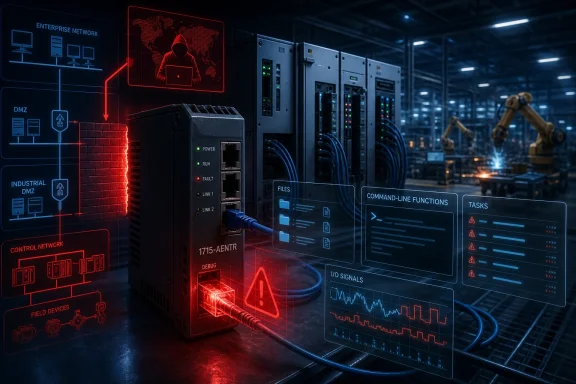
The defining problem in CVE-2026-10577 is not merely that a diagnostic service was left available. According to CISA’s republication of Rockwell Automation security advisory SD1785, the 1715-AENTR exposes a debug port over the network without enforcing the privilege controls needed to protect its command-line interface.That distinction matters. Debug services often sit below the configuration interfaces administrators normally use, exposing low-level operations intended for engineering, diagnostics, or vendor support. When authentication is missing at that layer, an attacker may not need to defeat the security controls presented by a management application or ordinary industrial protocol.
CISA classifies the weakness as CWE-306, Missing Authentication for Critical Function. In practical terms, the adapter does not adequately establish that a remote party is authorized before making intrusive command-line commands available.
The resulting capabilities cross every major security boundary. Reading files threatens confidentiality; deleting files and modifying memory threaten integrity; stopping tasks threatens availability. The ability to change I/O states is especially consequential because it can extend the attack from the adapter’s internal environment into the process with which the device communicates.
That does not prove that every available command will cause an immediate physical incident, nor does the advisory describe a specific attack sequence against a particular plant. It does mean operators must treat the flaw as more than a conventional embedded-device information leak. The exposed interface reportedly provides capabilities that could be used to manipulate how the affected device operates.
The supplied advisory does not identify a specific debug-port number, logging method, firmware utility, or step-by-step upgrade workflow. Administrators should not guess at those details or apply generic embedded-device instructions. Device-specific procedures should come from SD1785, the relevant Rockwell documentation, or Rockwell support.
The Maximum Score Reflects an Almost Frictionless Attack Path
CVE-2026-10577 received a maximum base score of 10 and a CRITICAL severity under both CVSS v3.1 and CVSS v4.0. Those ratings are consistent with a vulnerability that is remotely reachable, requires low attack complexity, needs no privileges, and involves no user interaction.Under CVSS v3.1, the published vector is
CVSS:3.1/AV:N/AC:L/PR:N/UI:N/S:C/C:H/I:H/A:H. The changed-scope assessment indicates that successful exploitation may have security consequences beyond the initially vulnerable component, while confidentiality, integrity, and availability impacts are all rated high.The CVSS v4.0 vector is
CVSS:4.0/AV:N/AC:L/AT:N/PR:N/UI:N/VC:H/VI:H/VA:H/SC:H/SI:H/SA:H. It likewise describes a network attack path without additional attack requirements, privileges, or user action, with high impacts across the vulnerable system and subsequent systems.Neither score establishes that a particular adapter is reachable in a given facility, and neither measures the operational consequence of changing a particular I/O state. Those questions depend on network architecture, process design, controller configuration, safety controls, and the adapter’s actual role.
For administrators, the practical takeaway is narrower: network reachability is the major barrier standing between an attacker and an unauthenticated critical function. Restricting that reachability is an important interim control, but the stated remediation remains an upgrade to version 3.011 or later.
Firmware 3.011 Is the Security Boundary
The affected and corrected releases provide a clear remediation destination, even though administrators may find intermediate firmware versions during discovery.| 1715-AENTR firmware | Advisory status | What admins should conclude | Recommended response |
|---|---|---|---|
| Version 3.003 and earlier | Identified as affected | The unauthenticated debug-interface vulnerability applies | Restrict reachable paths and upgrade to version 3.011 or later |
| Versions 3.004 through 3.010 | Not addressed by the supplied advisory’s affected-version statement | Do not infer either confirmed exposure or confirmed remediation from the supplied information | Consult Rockwell Automation and target version 3.011 or later |
| Version 3.011 and later | Vendor-recommended remediation target | This is the stated corrected baseline | Deploy under approved operational change procedures |
Administrators should therefore avoid turning that information gap into an unsupported safe-version range. An intermediate build should not automatically be marked vulnerable, but it also should not be declared remediated merely because its version number is higher than 3.003. The practical target remains the vendor’s stated baseline of version 3.011 or later.
Deployments may be distributed across plants, remote facilities, packaged systems, or long-lived installations where firmware changes are tightly controlled. That makes ownership data as important as version data. An inventory entry should identify not only the device address and firmware but also the plant owner, system integrator, operational function, maintenance authority, and team empowered to approve an outage.
This is also where the asset-owner handoff must be explicit. Enterprise security may discover a device or identify a reachable network path, but the plant or process owner must validate its operational role and coordinate the maintenance decision. A finding should not disappear into a general vulnerability queue simply because the affected asset is not administered like a Windows server.
“No Known Exploitation” Is Context, Not Clearance
CISA states that no known public exploitation specifically targeting CVE-2026-10577 had been reported when the advisory was published. That distinguishes the issue from a confirmed active-exploitation incident, but it does not reduce the vulnerability’s technical severity.There is also an important limit in that wording. CISA is describing the information reported to the agency, not certifying that exploitation has never occurred. Activity involving an industrial debug interface may be difficult to recognize where organizations lack suitable network visibility or do not have an established baseline for engineering and diagnostic activity.
Missing authentication changes the evidence defenders might expect. An attacker would not necessarily need to obtain or misuse a named administrator account, so familiar signs such as failed logins, suspicious credential use, or privilege escalation may not appear. Investigation may instead depend on broader evidence: unexpected network connections, unexplained task interruptions, unauthorized file or configuration changes, unusual device behavior, or process and I/O changes that cannot be matched to approved work.
Rockwell Automation reported the vulnerability to CISA, and CISA republished Rockwell security advisory SD1785. Those facts establish the reporting relationship and the source of the remediation guidance. They do not, by themselves, establish broader conclusions about the complete disclosure process, the timing of every vendor action, or patch availability for every deployment and support arrangement.
For asset owners, “no known exploitation” should therefore be recorded as context rather than used as a reason to postpone ownership assignment. Every known-affected device still needs a named remediation owner, an interim access decision, and a planned path to version 3.011 or later.
Patching OT Requires More Than Pushing a Package
For conventional IT software, a critical unauthenticated network vulnerability may trigger an emergency update through familiar management systems. Industrial firmware requires a more deliberate handoff because an adapter upgrade can involve maintenance windows, engineering validation, redundancy planning, configuration preservation, compatibility checks, and confirmation that communications and I/O behavior remain correct after the change.Those operational requirements should shape the deployment plan, not become an indefinite exception. The immediate task is to reduce unnecessary reachability. The permanent task is to move affected adapters to version 3.011 or later using vendor-supported procedures and the organization’s approved change process.
The supplied advisory does not provide firmware click paths, name a required update tool, or prescribe a universal workflow. Teams should consult SD1785 and Rockwell support for the procedure applicable to their hardware, firmware state, support agreement, and operating environment. Any test and rollback plan should be tailored to the affected process rather than copied from an unrelated installation.
Remote access deserves particular scrutiny even though the vulnerable adapter may not be directly exposed to the internet. A VPN, jump host, remote desktop server, contractor workstation, or engineering laptop can create an indirect route from an enterprise or third-party environment into an OT segment. VPN use should not be treated as proof that the destination is adequately isolated; administrators still need to inspect what routes are available after a remote session is established and which endpoints can initiate traffic toward the adapter.
The useful question is not simply whether a firewall or VPN exists. It is whether a compromised Windows engineering endpoint, remote-support host, or corporate system can reach the affected device through the allowed path. Rules granting broad corporate subnets, vendor ranges, or entire remote-access pools access to industrial networks deserve priority review.
Access restrictions should be based on verified operational requirements and known management sources. Because the advisory does not identify the debug port by number, administrators should not assume that blocking a guessed service alone resolves the issue. Work with the asset owner and Rockwell Automation to identify legitimate communications and then limit paths without disrupting required control traffic.
Action checklist for admins
- Inventory all Rockwell Automation 1715-AENTR devices and record their firmware versions, IP addresses, physical locations, operational roles, and asset owners.
- Treat version 3.003 and earlier as known affected.
- Record versions 3.004 through 3.010 as not addressed by the supplied advisory’s affected-version statement, rather than labeling them confirmed safe or confirmed vulnerable.
- Use version 3.011 or later as the practical remediation target.
- Assign each device to a plant, process, or system owner who can approve testing and maintenance.
- Identify Windows engineering workstations, jump hosts, VPN address pools, remote-support systems, and IT-to-OT routes that can reach the device.
- Remove unnecessary paths and tightly restrict required access while remediation is pending.
- Do not rely on an assumed debug-port number or generic firmware procedure; obtain device-specific guidance from SD1785 or Rockwell support.
- Test the upgrade in a representative environment where feasible, with checks appropriate to the installation’s communications, redundancy, task behavior, and I/O operation.
- Schedule production deployment through approved operational change management and confirm service after the maintenance window.
- Review available network, endpoint, engineering, and process evidence for unexpected access or unexplained changes.
- Follow established incident-response procedures and report suspected malicious activity to CISA as appropriate.
The Real Exposure May Be Hidden in Network Assumptions
The most concerning installations are not necessarily those deliberately published to the internet. They may be systems considered “internal” and therefore trusted despite indirect paths from Windows engineering workstations, remote-support systems, business applications, wireless infrastructure, or third-party maintenance networks.An attacker does not need the adapter to be globally discoverable if a compromised intermediary can reach it. A phished engineering laptop, exposed remote desktop host, compromised VPN account, or poorly isolated support server may provide the necessary position. That is the WindowsForum angle: the vulnerable component is industrial, but the route to it may run through familiar Windows and enterprise infrastructure.
Windows administrators should identify the endpoints and servers that bridge administrative domains. Questions worth answering include:
- Which engineering workstations have routes into the affected OT segment?
- Can general-purpose Windows systems initiate connections toward the adapter?
- Do remote desktop or jump hosts allow file transfer, clipboard use, or broad outbound access beyond their intended management role?
- Which VPN users or contractor groups receive routes to the relevant plant networks?
- Are IT-to-OT firewall rules limited to named sources and required destinations, or do they trust large address ranges?
- Who reviews changes to those routes, and does the industrial asset owner participate?
- Can endpoint and network evidence be correlated with approved engineering work?
The advisory’s confidentiality, integrity, and availability impacts should also be translated into operational language during the asset-owner handoff. Teams should determine what files or configurations are relevant, which tasks could be interrupted, what process behavior could be affected by memory modification, which I/O states matter, and what independent controls exist if behavior changes unexpectedly.
Those answers cannot be derived from a CVSS score alone. They require cybersecurity staff, Windows and network administrators, control engineers, and process owners to map the advisory’s technical capabilities onto the actual installation.
What Defenders Should Carry Into the Maintenance Window
CVE-2026-10577 is unusually direct: a reachable debug interface lacks the authentication needed to protect commands capable of altering the device. The remediation target is also direct, but deploying it safely requires accurate inventory, constrained access, a named asset owner, and disciplined operational change management.- The affected product is the Rockwell Automation 1715-AENTR running firmware version 3.003 or earlier.
- Versions 3.004 through 3.010 are not addressed by the supplied advisory’s affected-version statement and should not be assigned a confirmed exposure status without vendor guidance.
- The vendor-recommended remediation target is version 3.011 or later.
- Exploitation requires no privileges or user interaction once the vulnerable network service is reachable.
- Potential actions include reading or deleting files, stopping tasks, modifying memory, and changing I/O states.
- CISA reported no known public exploitation specifically targeting the vulnerability when it published the advisory.
- Restricting management, engineering, remote-support, and IT-to-OT paths can reduce immediate exposure, but it does not replace firmware remediation.
- Upgrade instructions, tool requirements, and device-specific procedures should come from SD1785 or Rockwell support.
References
- Primary source: CISA
Published: 2026-07-14T12:00:00+00:00
- Related coverage: industrialmonitordirect.com
1715-AENTR Adapter Loses Static IP Configuration After Power Cycle – Industrial Monitor Direct
The 1715-AENTR Redundant I/O Ethernet Adapter fails to retain its statically assigned IP address after a power cycle, despite BOOTP being disabled and configuration appearing successful. The root c... industrialmonitordirect.com