

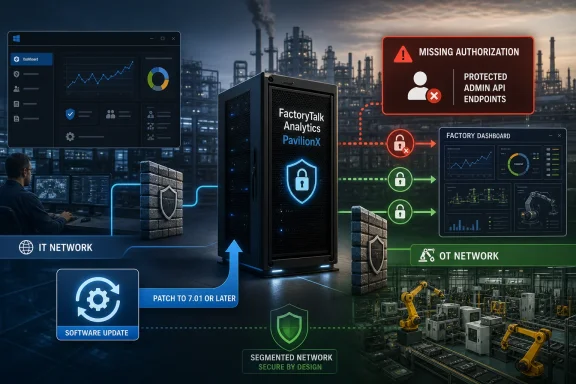
The Bug Is Administrative, Not Merely Technical
The vulnerability described by CISA and Rockwell is a classic missing authorization problem: API endpoints that should verify a caller’s rights apparently failed to enforce those checks properly. In practical terms, that means the application may have been able to distinguish between ordinary and privileged operations in the user interface while leaving one or more backend routes insufficiently guarded.
That distinction matters. Industrial software increasingly presents polished dashboards, role-based access controls, and enterprise-style identity integration, but the real security boundary is usually the API surface behind those features. If the backend accepts privileged requests without correctly checking authorization, the front-end permission model becomes theater.
CISA says successful exploitation could allow an unauthorized actor to execute privileged operations, including user and role management and other administrative actions. That is a broad category, and it lands in a sensitive place: control over who can see, change, and administer an analytics environment used in manufacturing operations.
This is not described as remote code execution, and CISA notes that the attack complexity is high. But “high complexity” is not the same thing as “low consequence.” In industrial environments, administrative access to an analytics platform can become a staging point for broader mischief, especially where analytics outputs feed operational decisions, reporting, process optimization, or compliance workflows.
PavilionX Shows How OT Risk Has Moved Up the Stack
FactoryTalk Analytics PavilionX is not a PLC, a safety controller, or an HMI in the traditional sense. That is precisely why the advisory is interesting. The security conversation around operational technology has spent decades focusing on field devices and control-layer protocols, but the attack surface has steadily climbed into servers, data platforms, historians, dashboards, model-management systems, and industrial analytics applications.
That shift is logical. Manufacturers want higher efficiency, better yield, faster root-cause analysis, and tighter integration between operations and business systems. Analytics software promises to turn plant-floor signals into business value, but it also gives attackers a richer layer to abuse.
The risk is not limited to direct manipulation of machinery. An attacker who can alter users, roles, dashboards, configuration, or analytic assumptions may be able to distort what operators and engineers believe is happening. In a plant environment, bad information can be almost as damaging as bad commands.
That is why authorization bugs deserve more attention in OT than their CVSS shorthand often receives. The flaw is scored high, not critical, under both CVSS 3.1 and CVSS 4.0. Still, the category touches the administrative fabric of a system that may be embedded in production visibility and decision support.
The Score Says “High,” but the Network Says Everything
CVE-2025-14272 carries a CVSS 3.1 base score of 7.0 and a CVSS 4.0 base score of 8.3, both rated high. The vector tells a nuanced story: network attack vector, no privileges required, no user interaction required, but high attack complexity. That combination is familiar in industrial advisories, where exploitation may require knowledge of deployment details, reachable services, timing, configuration, or application behavior.
For defenders, the most important variable is not the decimal score. It is whether PavilionX is reachable from networks where untrusted users, compromised workstations, remote-access accounts, vendors, or business-side systems can talk to it.
CISA’s boilerplate mitigation advice is boilerplate because it remains correct. Minimize network exposure. Keep control-system devices and systems off the public internet. Put control networks and remote devices behind firewalls. Isolate them from business networks. Use secure remote-access methods, and keep those methods patched.
The uncomfortable part is that many real environments only partially match that model. Industrial analytics platforms are often installed exactly where IT and OT meet, because their value depends on ingesting operational data and presenting it to people outside the control room. That makes segmentation less clean and access governance more political.
The Patch Is Simple; the Change Window Is Not
Rockwell recommends updating FactoryTalk Analytics PavilionX to version 7.01 or later, available through its Download Center. As remediations go, this is refreshingly direct. There is no sprawling matrix of workarounds, compensating controls, or version-dependent caveats in the CISA summary.
But anyone who has patched industrial software knows that “upgrade to 7.01” is not the same thing as “click update.” Plants may need vendor validation, internal testing, backup and restore planning, change-control approval, and downtime coordination. Even analytics software can have dependencies that matter: databases, connectors, identity providers, historian integrations, reporting pipelines, and custom models.
That friction is why exposure reduction has to accompany patch management. If an organization cannot immediately upgrade, it should at least make the vulnerable application harder to reach. The right question is not only “are we on 7.01?” but “who can send traffic to the PavilionX API today?”
The answer should be narrower than many organizations will initially discover. If ordinary corporate workstations, broad VPN pools, unmanaged vendor laptops, or flat plant networks can reach the service, the advisory should trigger a segmentation review rather than a ticket that simply says “patch when possible.”
Authorization Bugs Are Especially Awkward in Shared Industrial Platforms
The user and role-management angle is particularly important because shared industrial platforms tend to accumulate exceptions. Engineers need access for troubleshooting. Vendors need temporary access that becomes semi-permanent. Corporate users want dashboards. Site managers want reports. Central IT wants identity integration. OT wants the system not to break during a production run.
Over time, that produces an access model that may look reasonable in a diagram but messy in practice. A missing-authorization vulnerability lands on top of that mess and makes it harder to know which actions were legitimate. If an attacker can create or modify users, change roles, or perform administrative operations, logs and audit trails become critical evidence rather than routine compliance artifacts.
Organizations running affected versions should preserve relevant logs before and after patching. They should review accounts, role assignments, recent administrative changes, unusual API activity, and any unexpected configuration modifications. CISA says it has no reports of known public exploitation targeting this vulnerability at the time of the advisory, which is good news. It is not a reason to skip the audit.
The absence of known exploitation is also narrower than many headlines imply. It means no known public exploitation specifically targeting the vulnerability has been reported to CISA. It does not prove that nobody has touched a vulnerable instance, and it does not prove that exposed environments were safe.
Windows Shops Should Treat This as an Identity and Segmentation Story
For WindowsForum readers, the relevance is not just that Rockwell software often runs in Microsoft-heavy industrial environments. The deeper connection is that these systems live in the same operational reality as Windows servers, Active Directory, VPN clients, jump hosts, endpoint agents, backup infrastructure, and patch-management processes.
A PavilionX authorization flaw can become more serious if the surrounding Windows environment is permissive. Broad domain groups, overpowered service accounts, weak remote-access controls, stale vendor accounts, and insufficient logging all make application-layer bugs harder to contain. Conversely, strong segmentation and identity hygiene can turn a high-severity vulnerability into a bounded maintenance event.
This is where IT and OT priorities sometimes collide. IT teams may want centralized identity and monitoring. OT teams may worry about latency, vendor supportability, and unplanned disruption. Both are right, but the advisory shows why the compromise cannot be a flat network with inherited trust.
The safer model is boring: dedicated management paths, least-privilege access, monitored administrative actions, restricted API reachability, tested backups, and a patch process that respects production constraints without using them as an excuse for indefinite delay. None of that is glamorous. It is also the difference between a contained bug and an incident.
CISA’s Advice Is Generic Because the Pattern Keeps Repeating
CISA’s recommended practices are familiar to the point of fatigue: reduce exposure, firewall control networks, isolate business and control environments, use secure remote access, update VPNs, perform risk assessment before changes, and report suspected malicious activity. The repetition can make the guidance sound perfunctory.
It is not perfunctory. It is a reflection of how many ICS vulnerabilities become dangerous only after architecture gives them room to breathe. A network-reachable authorization flaw is alarming on an exposed system and far less alarming on a tightly segmented system accessible only through monitored administrative paths.
The advisory’s high attack complexity also should not be over-read. Attack complexity can change as researchers, criminals, and state-linked groups learn more about a product. A bug that begins as difficult can become operationally routine once enough deployment patterns, endpoints, and exploit preconditions are understood.
That is especially true for widely deployed industrial ecosystems. Rockwell Automation has a large installed base, and FactoryTalk-branded software is familiar territory in manufacturing environments. Even if PavilionX itself is more specialized than core HMI or controller tooling, attackers increasingly understand that adjacent platforms can be useful footholds.
The Vendor Did the Easy Part; Operators Own the Hard Part
Rockwell reported the vulnerability to CISA and has released a corrected version. That is the vendor doing what customers generally ask vendors to do: disclose, score, and patch. The remaining burden sits with asset owners.
The first task is inventory. Organizations need to know whether they run FactoryTalk Analytics PavilionX at all, where it is installed, which version is deployed, and what networks can reach it. That sounds elementary until a global manufacturer has to answer across plants, regions, integrators, test labs, and legacy deployments.
The second task is prioritization. A PavilionX instance isolated inside a tightly controlled plant network may not demand the same emergency cadence as one reachable from a broad corporate VPN segment. But both need a plan, and both need a documented reason for whatever timetable is chosen.
The third task is validation. After upgrading to 7.01 or later, teams should confirm the version, test expected workflows, verify integrations, review accounts and roles, and make sure no emergency firewall exceptions were left behind during the maintenance window. Industrial patching often fails less because the patch is unavailable than because the process ends when the installer exits.
The PavilionX Advisory Compresses the Modern OT Problem
This advisory is small enough to summarize in a sentence and large enough to stand for a decade of OT change. The vulnerable component is not the physical process itself, but a software layer that helps interpret and administer industrial information. The bug is not a spectacular memory-corruption exploit, but a failure to enforce who is allowed to do powerful things. The mitigation is not exotic, but it depends on disciplined architecture that many environments still struggle to maintain.
That is the modern industrial security problem in miniature. The factory has become a data system, the data system has become an application stack, and the application stack has inherited the oldest web-security sins in the book. Missing authorization is not new. Missing authorization in a critical manufacturing analytics platform is the part that should make defenders sit up.
CISA lists the affected critical infrastructure sector as Critical Manufacturing, with worldwide deployment and Rockwell headquartered in the United States. Those details matter because they place the advisory in a global supply-chain context rather than a niche software corner. Even a specialized product can matter when it sits inside plants that produce goods, materials, or components other sectors depend on.
The sensible response is neither alarmism nor dismissal. There is no public exploitation known to CISA, and exploitation is assessed as complex. But the flaw affects administrative operations, requires no prior privileges, and is network-reachable under the CVSS model. That is enough to justify prompt attention.
The Practical Reading for PavilionX Sites
The immediate lesson is not that every PavilionX deployment is on the brink. It is that every affected deployment deserves a precise answer about version, exposure, and administrative integrity. A high-complexity flaw still becomes a board-level problem if it is sitting on an overexposed system with weak logging and broad remote access.
- Organizations running FactoryTalk Analytics PavilionX earlier than 7.01 should plan an upgrade to version 7.01 or later rather than relying on compensating controls indefinitely.
- Security teams should determine whether PavilionX API endpoints are reachable from corporate networks, remote-access pools, vendor connections, or any internet-facing path.
- Administrators should review user accounts, role assignments, and recent privileged actions for signs of unexpected administrative activity.
- Plant operators should coordinate patching through normal OT change-control processes, but they should not let production caution become open-ended deferral.
- Network teams should use this advisory as a reason to recheck segmentation between business systems, remote access infrastructure, and industrial analytics platforms.
The broader takeaway is that industrial cybersecurity is now as much about application governance as it is about controllers and protocols.
Rockwell’s PavilionX fix gives asset owners a clear destination, but the advisory’s real value is the map it draws around the problem: identity, APIs, segmentation, and operational trust are now first-class OT security concerns. The plants that handle this well will not be the ones that treat CVE-2025-14272 as a one-off patch ticket; they will be the ones that use it to narrow who can administer industrial data systems before the next missing-authorization bug arrives.
References
- Rockwell Automation FactoryTalk Analytics PavilionX CISA · 2026-06-16T12:00:00+00:00