

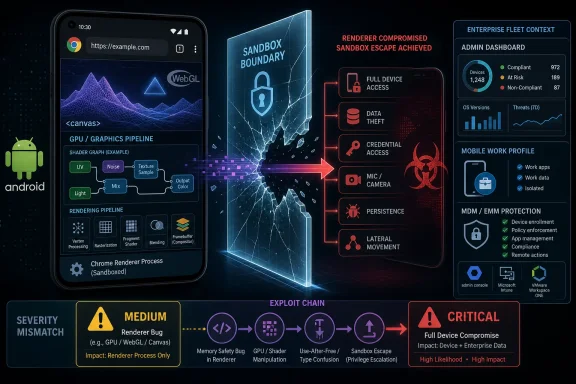
A “Medium” Chrome Bug Can Still Be a Critical Enterprise Problem
CVE-2026-11082 sits in the GPU component of Chrome for Android, and its description is short in the way many important Chrome vulnerability records are short. A race condition in GPU handling could allow a remote attacker, after compromising the renderer process, to potentially perform a sandbox escape through a crafted HTML page. In plain language, this is not described as a one-click full-device compromise from a clean starting point. It is described as a second-stage escape from one of Chrome’s key containment layers.
That distinction explains why Chrome can call the issue “Medium” while an automated or analyst-provided CVSS vector can land at “Critical.” Chrome’s severity taxonomy tends to account for exploit preconditions inside the browser’s architecture. CVSS, by contrast, often rewards worst-case impact once the listed conditions are satisfied. If the attacker already has code execution inside the renderer, a sandbox escape can become the difference between “bad tab” and “broader device risk.”
The Windows angle is easy to miss because the vulnerable configuration listed by NVD pairs Chrome with Android. But Windows administrators increasingly manage Chrome as a cross-platform identity and work surface, not just a Windows executable. A user who syncs passwords, sessions, enterprise bookmarks, SSO cookies, and browser profiles across desktop and mobile can carry risk across operating system boundaries even when the CVE’s affected CPE points at Android.
This is the uncomfortable reality of browser security in 2026: the browser is no longer an application in the old sense. It is a privileged runtime, a document viewer, an identity broker, a password vault, an enterprise app launcher, and a partially hardware-accelerated graphics engine. When one of those layers cracks, the blast radius is rarely confined to the label printed in the CVE headline.
The GPU Is Where the Browser’s Clean Abstractions Get Messy
Chrome’s sandbox model depends on separating untrusted web content from more privileged browser services. The renderer handles hostile pages under tight constraints; other processes broker access to the network, filesystem, graphics stack, and operating system interfaces. That design has made modern browsers dramatically harder to exploit than their predecessors, but it has also pushed attackers toward the seams between processes.
The GPU process is one of those seams. It exists because modern web pages are not merely text and images; they are animated, composited, accelerated, decoded, transformed, and rendered through layers of graphics APIs and drivers. WebGL, video decode, canvas rendering, compositing, and UI acceleration all require performance-sensitive interaction with graphics resources. Performance-sensitive code is precisely where synchronization mistakes, lifetime bugs, and race conditions become attractive.
CVE-2026-11082 is described as a race in GPU, while the weakness mapping also references CWE-416, use after free. That pairing is not unusual in spirit, even if vulnerability databases sometimes compress complex implementation details into tidy buckets. Race conditions can create the timing window in which an object is freed, reused, or accessed after its intended lifetime. When the object in question belongs to a graphics pipeline that crosses trust boundaries, the security implications can escalate quickly.
The phrase “crafted HTML page” should not lull anyone into thinking this is merely a web-design bug. Crafted HTML in a browser CVE usually means a malicious page can steer the browser into a vulnerable state, often by combining script, layout, graphics calls, timing, and memory pressure. Attackers do not need the page to look suspicious. They need it to exercise the right code path at the right time.
Chrome’s architecture is built to survive renderer compromise. That is the whole point of the sandbox. But CVE-2026-11082 describes a path where an already-compromised renderer may reach beyond that containment. In the exploit-chain economy, that is valuable: one bug gets code running in the renderer, another bug breaks out, and the user experiences only a webpage loading.
The Severity Split Is the Story Administrators Should Actually Read
The most interesting part of this CVE record is the conflict in tone. Chromium’s listed security severity is Medium. CISA-ADP’s CVSS 3.1 score is 9.6 Critical, with network attack vector, low attack complexity, no privileges required, user interaction required, changed scope, and high impact to confidentiality, integrity, and availability. Those two assessments are not necessarily contradictory; they are answering different questions.
Chrome’s internal severity has to fit into a release engineering model that accounts for exploitability, prerequisites, component boundaries, bug class, and the presence or absence of evidence of exploitation. A sandbox escape that requires a prior renderer compromise may be downgraded relative to a bug that directly grants code execution from a clean browser state. That does not mean the sandbox escape is unimportant. It means the vendor is judging the vulnerability inside a chain-aware architecture.
CVSS tends to look at the vulnerability as an entry in a general-purpose risk database. Once the preconditions are accepted, the consequences of breaking out of the renderer are severe. The changed-scope element is doing a lot of work here: the attacker starts in one security authority and potentially crosses into another. For enterprise risk scoring tools, that can push the number sharply upward.
This is why patch dashboards that simply sort by vendor severity can mislead. A Chrome “Medium” affecting sandbox boundaries may deserve faster action than a “High” in a less exposed or less reachable component. Conversely, a “Critical” CVSS score does not prove that mass exploitation is underway. It says the theoretical impact is grave if the attack path is completed.
Security teams should treat the discrepancy as a prompt for context, not as a reason to pick whichever label is more convenient. The record says the issue requires renderer compromise. That means defenders should ask whether there are neighboring Chrome bugs in the same release that could plausibly provide that first stage. In a release that fixed hundreds of vulnerabilities, the answer may not be comforting.
Chrome 149 Was Not a Normal Patch Tuesday Footnote
The referenced Chrome 149 stable update was unusually large, with public reporting and advisory summaries describing hundreds of security fixes in the release family. Version 149.0.7827.53 was listed for Linux, while Windows and macOS received 149.0.7827.53 or .54 builds in the desktop stable channel. The CVE at issue here is specifically described as affecting Chrome on Android before 149.0.7827.53, but it landed in the shadow of a much broader Chrome security drop.
That broader context matters because attackers do not organize their work around CVE pages one at a time. They look for chains. A renderer compromise bug paired with a sandbox escape is a classic browser exploitation pattern. When a release contains many memory-safety and component-boundary fixes, defenders should assume that some combinations are more dangerous together than any individual summary suggests.
For Windows administrators, the temptation is to say: this CVE says Android, so desktop Chrome policy can wait. That is the wrong lesson. Chrome’s desktop release cadence, Android rollout mechanics, WebView dependencies, and managed browser policies all sit inside the same operational reality: users run Chrome everywhere, and attackers follow the user rather than the asset inventory spreadsheet.
On Android, Chrome updates may arrive through Google Play rather than the traditional operating system update channel, but that does not make them automatic in every enterprise environment. Some devices are unmanaged. Some are in work-profile configurations. Some are pinned by MDM policies. Some are vendor-customized Android builds with odd update behavior. “Available” is not the same as “installed.”
The NVD change history also matters here. The CVE was received from Chrome on June 4, modified by CISA-ADP on June 5, and received NIST CPE configuration enrichment on June 8. That is a short but meaningful lag between disclosure and the appearance of structured affected-product data. Any organization that waited for every database field to be populated before acting would have lost several days.
The CPE Confusion Is a Symptom of a Bigger Inventory Problem
The user-supplied NVD excerpt asks, in effect, whether a CPE is missing. NVD’s affected configuration lists Chrome versions before 149.0.7827.53 running on or with Android. That is coherent for the CVE description as written, but it also exposes the awkwardness of using CPEs to model modern browser exposure.
Chrome is not a simple operating-system package. It is a fast-moving application, a channelized release train, a mobile app, a desktop app, an embedded WebView-adjacent ecosystem player, and a dependency for identity workflows. CPE can represent part of that reality, but not all of it. A CPE entry can tell a scanner what product-version combination is believed to be vulnerable. It cannot tell you whether a user’s synchronized browser state turns a mobile compromise into an enterprise access problem.
The record’s current configuration is therefore useful but incomplete in the operational sense. It tells teams to look for Chrome on Android below 149.0.7827.53. It does not answer whether related Chromium-based browsers, embedded WebView consumers, OEM browser variants, or managed Android containers introduce adjacent exposure. Those questions require vendor advisories, device telemetry, MDM inventory, and sometimes uncomfortable manual checking.
There is also a naming wrinkle. The headline supplied by the user calls this “Use after free in GPU,” while the CVE description says “Race in GPU.” The weakness enumeration maps to CWE-416, use after free. This is not necessarily a contradiction; a race can produce a use-after-free condition, and CVE descriptions often choose one phrasing while CWE mappings choose another. But for search, detection, and dashboarding, the difference matters.
Security tooling may flag this as a race, a GPU issue, a Chrome Android issue, or a use-after-free issue depending on the feed. A human reading the record should connect those dots rather than assume separate findings. The practical question is simpler than the taxonomy: is Chrome on Android at or above 149.0.7827.53, and have managed users actually received the fixed build?
The Renderer Precondition Is Not a Comfort Blanket
The CVE description says the attacker must have compromised the renderer process. That is a meaningful precondition, but it is not a reason to ignore the issue. Renderer compromise is exactly the kind of primitive browser exploit developers try to obtain, and Chrome regularly patches renderer-reachable memory corruption vulnerabilities in JavaScript, layout, media, WebAssembly, graphics, and DOM-adjacent components.
A sandbox escape often looks less urgent in isolation because it does not necessarily provide the first foothold. But exploit chains are assembled from parts. The first part gets code execution in a constrained context. The second part escapes the constraint. The third part persists, steals, pivots, or abuses tokens. Security teams that patch only the first part or only the second part are betting that attackers will not have the missing half.
Browser vendors have spent years making that bet worse for attackers. Site isolation, process sandboxing, memory safety work, MiraclePtr-style mitigations, exploit hardening, and tighter IPC boundaries have all raised the cost of exploitation. But the existence of CVE-2026-11082 is a reminder that the sandbox is a living system, not a wall poured in concrete. It has moving parts, and moving parts create races.
User interaction is also narrower than many people think. CVSS marks this as requiring user interaction because the victim likely has to visit or load attacker-controlled content. That does not mean the user has to approve a prompt, install an app, or tap through a warning. In browser exploitation, “interaction” can be as mundane as opening a link, following a redirect, scanning a QR code, or viewing content inside an app that launches a browser component.
The mobile setting can make that interaction easier, not harder. Users browse from messaging apps, email clients, social feeds, QR codes, and embedded links while distracted. The attacker does not need to persuade a systems administrator to run an executable. The attacker needs a path to web content and a vulnerable browser build.
Android Is the Named Platform, but Windows Shops Still Own the Risk
WindowsForum readers understandably start from Windows desktops, Windows Server, Intune, Configuration Manager, Group Policy, Defender, Edge, and Chrome on managed PCs. CVE-2026-11082 is not a Windows Chrome CVE as described. But modern enterprise endpoint management does not stop at the Windows taskbar.
A Windows-heavy organization may still depend on Android phones for MFA prompts, authenticator apps, Outlook, Teams, browser-based SSO, corporate portals, and remote administration dashboards. If the same user identity flows through Chrome on Android and Chrome on Windows, a mobile browser compromise can become an identity event. That is especially true when session tokens, password managers, synced browser data, or device-trust signals are involved.
This is why “bring your own device” remains a deceptively expensive phrase. The organization may not own the phone, but it may still own the consequences of compromised access. If an employee uses personal Chrome on Android to reach corporate SaaS, a browser sandbox escape is not merely a consumer security issue. It is an unmanaged endpoint issue wearing consumer clothing.
For administrators, the right response is not panic. It is verification. Confirm managed Android Chrome versions. Confirm whether MDM or EMM policies allow browser version reporting. Confirm whether conditional access policies distinguish compliant devices from merely authenticated users. Confirm whether risky sign-ins from mobile browsers are visible in identity logs. The CVE is one record; the exposure is the gap between policy assumptions and device reality.
There is also a lesson for Edge-first Windows environments. Microsoft Edge is Chromium-based, but this CVE is identified against Google Chrome on Android, not Edge on Windows. That distinction should be preserved. Still, Chromium component bugs have a way of reminding everyone that browser monoculture creates shared engineering risk even when branding differs. Administrators should follow vendor-specific advisories, not assume all Chromium derivatives are affected in the same way at the same time.
The Patch Is Straightforward; Proving It Landed Is Not
For individual users, the practical instruction is simple: update Chrome on Android to 149.0.7827.53 or later. For administrators, the harder part is proving that this has happened across the population that matters. Mobile patch compliance is often less visible than desktop patch compliance, and Chrome’s rapid release cadence can make “current” a moving target.
By June 9, 2026, later Chrome 149 builds were already being discussed in relation to additional security updates, including separate V8 activity in the same release family. That is the normal browser world now: a fixed version for one CVE may be superseded almost immediately by a newer fixed version for another. The operational goal should not be “reach exactly 149.0.7827.53 and stop.” It should be “keep Chrome on the latest stable build available for the device and channel.”
Enterprise tooling should treat browser updates as high-frequency security operations rather than monthly housekeeping. That includes Android. If an organization can enforce Windows browser updates but cannot see mobile browser state, it has a blind spot at precisely the layer where users increasingly authenticate and consume work content.
There is a second proof problem: scanners often depend on CPE enrichment and vulnerability feed normalization. As this CVE’s timeline shows, NVD enrichment can trail initial disclosure by days. CISA-ADP scoring can appear before NIST scoring. Vendor advisories may contain the earliest actionable version guidance. If your vulnerability management workflow waits for a single canonical database to become complete, your browser patching process is slower than the browser threat model allows.
The healthiest approach is layered. Vendor release notes should drive urgent browser patch awareness. MDM and endpoint telemetry should prove installed versions. Vulnerability scanners should confirm and trend compliance. Identity telemetry should watch for suspicious post-compromise behavior. No single feed should be asked to carry the whole process.
NVD’s Lag Is Now Part of the Risk Model
NVD remains a critical piece of the vulnerability ecosystem, but CVE-2026-11082 illustrates a broader operational truth: enrichment is not instant, and incomplete records are not harmless. On June 4, the CVE existed with a description and references. On June 5, CISA-ADP added a CVSS vector and CWE. On June 8, NIST added affected configuration data. Those dates matter because exploitation and patch deployment do not wait for database completeness.
This is not an argument against NVD. It is an argument against treating NVD as the starting gun. For fast-moving browser vulnerabilities, the starting gun is usually the vendor release. Once Google ships a stable update fixing security bugs, administrators should begin assessment even if every downstream feed has not yet caught up. Structured data helps automation, but it should not be the only trigger for human urgency.
The CPE question is a good example. A vulnerability manager may look at a missing or delayed CPE and see uncertainty. An attacker sees a patch diff, a bug class, and a population of devices that have not updated yet. The defender’s data model is always a little behind the attacker’s opportunity model.
This asymmetry is especially painful for Chrome because releases are frequent and bug volumes can be high. Security teams must distinguish between “we do not yet have perfect metadata” and “we do not yet know enough to act.” CVE-2026-11082 provides enough to act: Chrome on Android before 149.0.7827.53 is the named vulnerable population, and the consequence is a possible sandbox escape after renderer compromise.
The unresolved parts should be tracked, not used as excuses. If related CPEs appear later, revise detection. If vendor advisories clarify affected products, update scope. If exploit reports emerge, escalate. But the first move is still patch verification.
The Browser Sandbox Is a Strategy, Not a Guarantee
The security industry sometimes talks about sandboxing as though it converts browser compromise into a contained nuisance. That is the right aspiration, but it is not the right assumption. Sandboxes reduce the impact of many bugs and force attackers to chain exploits. They do not eliminate the possibility of escape.
CVE-2026-11082 is a classic reminder of that layered model. The renderer is presumed compromised first. The GPU race then potentially crosses a boundary. That is not a failure of the sandbox concept; it is the reason the sandbox must be continuously audited, fuzzed, hardened, and patched. Defense in depth only works if every layer is maintained.
GPU code is a recurring source of concern because it combines complexity, performance pressure, hardware abstraction, driver interaction, and historically memory-unsafe implementation languages. Browser teams have made enormous investments in isolating and brokering graphics work, but the web platform keeps demanding richer graphics and media capabilities. Users want the browser to behave like an operating system, a game engine, and a video workstation. Security teams inherit the consequences.
This is also why “just disable risky features” is rarely a satisfying enterprise answer. Disabling hardware acceleration may mitigate some classes of graphics exposure in some circumstances, but it can also break performance, accessibility, video conferencing, web apps, and user experience. The sustainable answer is not to retreat from modern browser capabilities. It is to keep the update channel fast enough that known flaws do not linger.
For highly sensitive environments, browser isolation, remote browsing, hardened mobile profiles, and stricter conditional access may be justified. But for most organizations, the biggest win is still boring: update quickly, verify widely, and reduce the number of unmanaged browsers touching corporate identity.
Chrome’s Fast Release Machine Is Both the Cure and the Headache
Google’s Chrome security process is one of the reasons the modern web is survivable. Bugs are found, patched, and shipped at a pace that would have seemed remarkable in the old desktop software era. But that pace creates a management problem: every fix becomes a race between rollout and weaponization.
The CVE-2026-11082 record shows the machine at work. A bug is identified, assigned a CVE, referenced in a Chrome release, scored by CISA-ADP, and enriched by NVD. That pipeline is a success. Yet every handoff introduces timing gaps and interpretation differences. The enterprise has to consume the result without being paralyzed by it.
The Chrome version number also deserves respect. 149.0.7827.53 is not a decorative string; it is the line between the named vulnerable versions and the first fixed build identified in the record. Administrators should resist the urge to translate that into “Chrome 149 is safe” without checking the full build. Early or channel-specific builds can complicate assumptions, and later point releases may supersede the first fixed version.
On Windows, this discipline is familiar. Teams know to check exact build numbers for cumulative updates, browser versions, Edge channels, and Office builds. The same precision needs to apply to Android Chrome. “It updated recently” is not an asset-management statement. “It is at or above the fixed build” is.
There is a cultural issue here as well. Desktop patching is still treated as enterprise infrastructure. Mobile browser patching is often treated as user hygiene. CVE-2026-11082 argues for closing that gap. If the mobile browser can carry corporate access, it belongs in the enterprise patch conversation.
The Enterprise Response Should Be Boring, Fast, and Measurable
The best response to this CVE is not a dramatic emergency meeting. It is a tight operational loop. Identify the affected population, push or require the fixed build, verify installation, and watch for laggards. The more interesting the exploit chain sounds, the more boring the response should be.
Administrators should also avoid overfitting to this single CVE. The same release train contained numerous other Chrome security fixes, and later Chrome 149 updates were already moving through the ecosystem by June 9. If your process wakes up only when a CVE receives a scary score, it will miss the less theatrical bugs that make chains possible.
For managed Android fleets, MDM policy should enforce or strongly encourage Play Store updates for Chrome, prevent indefinite deferral where possible, and surface installed app versions. For BYOD environments, conditional access can require compliant devices, updated browsers, or managed browser contexts for sensitive resources. Where that is not politically or technically possible, organizations should at least stop pretending the risk is measured.
For Windows desktops, the direct action is to keep Chrome and Chromium-based browsers current, while recognizing that this particular CVE’s named affected platform is Android. That distinction matters for accurate reporting. But the operational pattern is the same across platforms: browser updates are security updates, and browser security updates should not wait for a monthly patch window.
Security teams should also document how they handle CVEs with mismatched severities. If a tool says Critical and the vendor says Medium, the response should not be improvised every time. A sensible policy weighs exploit prerequisites, exposure, asset criticality, compensating controls, known exploitation, and availability of a patch. CVE-2026-11082 would likely land in a “patch promptly and verify” category even without evidence of active exploitation.
The Concrete Readout for Chrome-on-Android Fleets
CVE-2026-11082 is not the largest Chrome headline of the year, but it is the kind of vulnerability that tests whether an organization understands browser risk as a chain rather than a label. The facts are narrow enough to act on and messy enough to expose weak process. Treat the CPE as useful guidance, not a complete model of exposure.
- Chrome on Android versions before 149.0.7827.53 are the named vulnerable target for CVE-2026-11082.
- The vulnerability is described as a GPU race that could enable a sandbox escape after the renderer process has already been compromised.
- Chromium’s “Medium” severity and CISA-ADP’s 9.6 “Critical” CVSS score can both make sense because they measure different aspects of the same risk.
- The practical fix is to update Chrome on Android to 149.0.7827.53 or later, preferably the latest stable build available rather than the first fixed build only.
- Windows administrators should still care because Android Chrome often participates in the same enterprise identity, SaaS, sync, and BYOD workflows as managed Windows browsers.
- Vulnerability teams should not wait for perfect NVD enrichment before acting on fast-moving browser advisories.
The larger lesson is that browser security has become a logistics discipline. Google can patch a GPU sandbox escape, NVD can enrich the record, and CISA-ADP can score the impact, but none of that protects an organization until the fixed browser is actually running on the device that opens the link. CVE-2026-11082 is a medium-labeled reminder with critical-shaped consequences: in a world where identity follows the browser across Windows desktops and Android phones, the weakest update path is part of the attack surface.