

The Browser Bug Is Real, but the Inventory Story Is Still Half-Baked
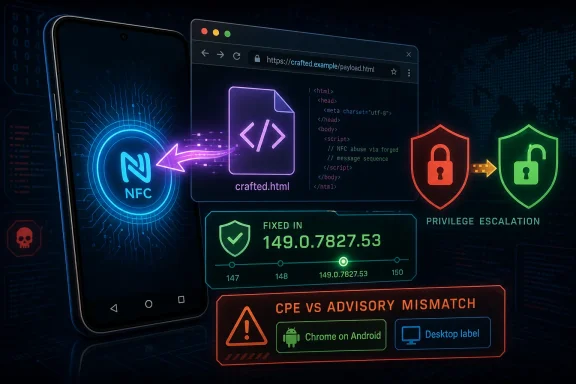
CVE-2026-11108 lands in a familiar Chrome security rhythm: a terse vulnerability description, a fixed version number, limited technical detail while users update, and downstream enrichment from NVD, CISA-ADP, vendors, and vulnerability-intelligence platforms. The description says “Inappropriate implementation in NFC in Google Chrome on Android prior to 149.0.7827.53,” which is already enough to set boundaries around the issue. This is not a generic Android NFC flaw, nor a desktop Chrome bug merely because the Chrome Releases reference is labeled as a desktop stable-channel post.
The affected surface is Chrome on Android, and the component is NFC. That means the interesting security boundary is not just “website versus browser,” but “web content versus device capability.” NFC is one of those interfaces that forces browsers to become brokers between untrusted web pages and hardware-adjacent functions, and mistakes in those brokers can become privilege-management problems even when the starting point is “just a crafted HTML page.”
The CVE’s public scoring tells a second story. Chromium’s own severity is Medium, while CISA-ADP assigned a CVSS 3.1 score of 8.8, which falls into High. That is not necessarily a contradiction; it is a reminder that vendor severity and CVSS often measure different things. Chrome’s internal severity reflects exploitability, architecture, mitigations, and the project’s own triage model, while CVSS is a standardized attempt to describe impact and attack conditions.
The metadata is where the thread gets tangled. NVD’s change history shows a CPE configuration involving Google Chrome versions before 149.0.7827.53 and the Android operating system. Read literally, that sounds like a conjunctive platform statement: vulnerable Chrome running on Android. Read carelessly by a scanner, it can become either too broad or too narrow, depending on how the product inventory is modeled.
CPEs Are Not Paperwork When They Drive Patch Decisions
It is tempting to treat CPEs as administrative clutter attached to the “real” vulnerability. In enterprise environments, that is exactly backwards. The CPE is often the part of the CVE record that decides whether a dashboard lights up, whether a ticket is generated, whether a device fleet is counted as exposed, and whether a compliance report shows red or green.
For CVE-2026-11108, the CPE question is especially important because Chrome exists in several overlapping identities. It is an application on Windows, macOS, Linux, Android, iOS, and ChromeOS-adjacent environments. It is also the upstream Chromium engine behind other browsers and embedded WebView-like use cases. A single CPE that says “Google Chrome” may be syntactically valid but operationally ambiguous if the bug only applies to the Android build and an Android-only NFC code path.
The configuration visible in NVD’s change history appears to acknowledge that platform specificity by pairing the Chrome application CPE with the Android OS CPE. That is a reasonable way to say “this is Chrome, but only in the Android environment.” It is not the same thing as saying Android itself is independently vulnerable.
That nuance matters for WindowsForum readers because mixed-fleet management tools often normalize products aggressively. A vulnerability-management platform might ingest the Chrome CPE and flag every Chrome instance below the fixed version, including Windows desktops that do not expose the Android NFC implementation. Another platform might require both Chrome and Android CPEs to match and therefore correctly restrict exposure to Android devices. The same CVE can therefore produce different operational answers before anyone has even debated exploitability.
The Desktop Advisory Link Muddying an Android Bug
The reference trail adds to the confusion. The public CVE entry points to a Chrome Releases stable-channel update page that is labeled for desktop. That page is part of Google’s normal release machinery, and Chrome milestones often share fixed version numbers across platforms or adjacent announcements. But when an Android-specific CVE uses a desktop-labeled advisory as its vendor reference, it invites exactly the sort of CPE anxiety now surrounding this entry.
This is not unprecedented. Chrome’s release and security-advisory ecosystem often consolidates information around milestone releases, and individual CVEs can be listed or referenced in places that are not perfectly aligned with every affected platform. The CVE description remains the stronger signal here: “Google Chrome on Android” is the operative phrase.
Still, the mismatch has practical consequences. A sysadmin scanning a Windows estate may see “Chrome prior to 149.0.7827.53” and a vendor advisory for desktop, then wonder whether the Android-only language is an error. A mobile-security engineer may see the Android condition and wonder whether the desktop advisory omitted the Android stable-channel counterpart. A vulnerability analyst may ask whether NVD should include a more explicit platform-limited CPE configuration rather than relying on readers to interpret the AND/OR structure correctly.
This is where machine-readable metadata should reduce ambiguity, not amplify it. If the vulnerable product is Chrome on Android, the record needs to express that in a way tools can consume without treating Windows Chrome, Linux Chrome, or standalone Android as equally implicated. The question is less “are we missing a CPE?” than “is the current CPE configuration precise enough for the way scanners actually behave?”
NFC Turns a Web Page Into a Hardware-Boundary Problem
The presence of NFC is what makes CVE-2026-11108 more interesting than a routine browser issue. Browsers are designed to process hostile input all day; every web page is untrusted by default. But APIs that touch local device capabilities change the stakes because they connect remote content to hardware, permissions, prompts, and operating-system-mediated privilege boundaries.
Near-field communication has legitimate web uses, especially on mobile devices. It can support payments-adjacent workflows, identity badges, device pairing, logistics tags, and consumer hardware setup flows. But the security model has to be conservative because NFC interactions often involve proximity, user gestures, permissions, and sensitive device context.
A vulnerability described as “inappropriate implementation” does not reveal the exploit mechanics. It may involve insufficient validation, a bad permission transition, an unexpected state change, an incorrect origin check, or a failure to enforce the intended boundary between a web document and privileged browser or platform code. The assigned CWE, Improper Privilege Management, points in that direction without giving away the exploit path.
The attack vector is still web-shaped. The public description says a remote attacker could use a crafted HTML page, and CISA-ADP’s CVSS vector requires user interaction. That usually means the victim must visit or interact with attacker-controlled content. It does not necessarily mean the attacker needs physical NFC proximity, though the NFC component suggests device capability and permission context may matter. Without the restricted Chromium issue details, defenders should avoid pretending to know more than the record says.
Medium in Chromium, High in CVSS Is a Signal, Not a Scandal
The severity split will bother some readers. Chromium labels the issue Medium, while CISA-ADP gives it an 8.8 High score with high confidentiality, integrity, and availability impacts. That looks inconsistent only if one assumes all severity systems are trying to answer the same question.
CVSS describes a theoretical worst-case path under a defined vector. For CVE-2026-11108, the vector says network attack, low complexity, no privileges required, user interaction required, unchanged scope, and high impact across confidentiality, integrity, and availability. That is a serious abstract profile, especially for a browser bug that begins with a malicious page.
Chromium’s security severity, however, is informed by project-specific context. Browser vendors consider exploit primitives, sandbox boundaries, mitigations, platform reach, user prompts, exploit reliability, and whether a bug is likely to chain into something worse. A Chrome Medium can still matter, but it usually means the vendor does not view the bug as a straightforward remote-code-execution disaster on its own.
For administrators, the right response is not to average the two labels. Treat CVSS as a prioritization accelerator and vendor severity as exploit-context evidence. The fix exists in Chrome 149.0.7827.53 and later, so the practical decision is simple: mobile Chrome should be updated, while vulnerability tooling should not overstate exposure on platforms where the NFC implementation is not present.
The CPE Shape Should Say “Chrome on Android,” Not “Chrome Everywhere”
The NVD change history shows an added CPE configuration that includes Google Chrome versions up to but excluding 149.0.7827.53, as well as Android. The visible structure matters because CPE logic can be nested. An AND containing Chrome and Android can be the right expression for an application vulnerability constrained to a platform. An OR at the wrong level can accidentally imply either Chrome or Android alone is sufficient for exposure.
The user-facing question — “Are we missing a CPE here?” — deserves a careful answer. Based on the description, the essential CPE ingredients are Chrome as the vulnerable application and Android as the affected operating environment. A separate CPE for Chromium may be useful for downstream distributions if evidence shows Chromium builds before the fixed code are affected, but the CVE source names Google Chrome on Android, not every Chromium-derived browser.
There is also a naming wrinkle. Some CPE dictionaries historically use google:chrome; others in older tooling or third-party advisories may refer to google:google_chrome. Those naming differences can create false “missing CPE” alarms when one system’s expected product key does not match another’s canonical entry. The important question is not whether every alias appears, but whether the canonical CPE used by NVD accurately matches the affected product and platform.
A more complete enrichment might eventually include a cleaner applicability statement that makes the Android constraint unambiguous. It might also refine version ranges, add or correct platform data, or tag references more precisely. But from the available description, adding a broad desktop Chrome CPE without the Android condition would be worse than leaving the record in an “undergoing enrichment” state.
Windows Admins Should Care, but Not Because Their Desktops Are Suddenly NFC Targets
For WindowsForum readers, the immediate risk is not that Chrome on Windows inherited an Android NFC privilege-escalation bug. The issue is that Chrome’s cross-platform release cadence and shared version numbers can make vulnerability reporting look flatter than the underlying code reality. When a mobile-only issue shares a release reference with desktop stable-channel updates, Windows patch teams can end up chasing ghosts.
That does not mean Windows administrators can ignore the Chrome 149 release family. The same release train includes many security fixes, some of which do apply to desktop Chrome. But CVE-2026-11108 specifically should be handled as an Android Chrome exposure unless later vendor clarification expands the affected set.
In mature environments, this is where asset context earns its keep. A good vulnerability program does not merely ask, “Do we have Chrome below this version?” It asks, “Do we have the affected product, on the affected platform, exposing the affected component, under the affected configuration?” For this CVE, that means Android devices with Chrome before 149.0.7827.53 are the center of gravity.
The hardest cases will be bring-your-own-device programs and unmanaged Android endpoints. Corporate Windows desktops may be patched by Microsoft Intune, Group Policy, Chrome Browser Cloud Management, Patch My PC, or other tools. Personal Android devices, by contrast, may live outside formal asset inventory while still accessing company email, SaaS apps, and identity flows. That is where a “medium” mobile browser bug can become a real enterprise concern.
The Android Patch Path Is Simpler Than the Metadata
For end users, the fix path is not complicated. Update Chrome from Google Play and verify that the installed version is 149.0.7827.53 or later. On managed Android devices, administrators should confirm that app update policies are not delaying Chrome beyond the organization’s risk tolerance.
The more interesting enterprise question is whether Chrome’s version floor is enough. Android fleets may include device-owner mode, work profiles, managed Google Play, OEM update policies, kiosk browsers, and alternate Chromium-based browsers. CVE-2026-11108 names Google Chrome on Android, but security teams should still check whether their tooling maps Chromium vulnerabilities into other browser packages. That mapping should be evidence-based, not assumed.
There is also the WebView distinction. Android System WebView and Chrome share some underlying technology, and on many devices Chrome participates in web rendering infrastructure. But a Chrome CVE is not automatically a WebView CVE unless the advisory says so or the affected code path is demonstrably shared in the vulnerable product. Over-broad assumptions create noise; under-broad assumptions create blind spots.
The safest operational posture is to patch Chrome everywhere as part of normal hygiene, while reporting CVE-2026-11108 as materially relevant to Android Chrome. That keeps remediation moving without overstating the vulnerability to Windows desktop owners.
Public Details Are Sparse Because Browser Vendors Are Buying Time
The Chromium issue tracker reference requires permissions, which is normal for recently fixed security bugs. Browser vendors often keep details restricted until the patched build has propagated, especially when the bug could be weaponized from a web page. That creates a familiar gap between disclosure and understanding: defenders know enough to patch, but not enough to reconstruct the exploit.
This is frustrating but defensible. Full technical detail too early can turn a patched vulnerability into a live exploit recipe for slow-moving fleets. The tradeoff is that administrators must make decisions from incomplete signals: affected product, fixed version, component, severity, CVSS vector, CWE, and a terse description.
In this case, the sparse description still gives useful constraints. The attacker is remote. The trigger is a crafted HTML page. User interaction is required according to the CISA-ADP vector. The component is NFC. The affected product is Chrome on Android before 149.0.7827.53. That is enough to prioritize mobile browser updates and to challenge scanner output that flags unrelated desktop assets.
The absence of public exploit details should not be mistaken for absence of risk. Browser bugs are valuable because the browser is the universal application runtime. Even a bug that needs user interaction can be attractive in phishing, malvertising, watering-hole, or targeted mobile scenarios.
The Real Failure Mode Is Vulnerability Automation Without Skepticism
CVE-2026-11108 is a small case study in a larger problem: vulnerability automation is increasingly authoritative, but the data it consumes is still assembled by humans, vendors, enrichment teams, and parsers working on different clocks. The CVE arrived from Chrome on June 4. CISA-ADP modified scoring and CWE information on June 6. NVD added initial analysis and CPE configuration on June 8. During that window, scanners and security teams were already ingesting whatever fields existed at the time.
That moving-target period is where mistakes propagate. A dashboard might flag the wrong platform. A vendor advisory might inherit a broad package range. A ticket might be assigned to the Windows desktop team when it belongs to mobile device management. Or, worse, an organization might suppress the alert as “just Chrome noise” and miss the Android fleet entirely.
The remedy is not to distrust NVD or CPEs. It is to treat early enrichment as provisional and to read the description before acting on the machine fields. When the human text says “Chrome on Android” and the CPE logic appears to include Android as an operating condition, the vulnerability-management interpretation should preserve that platform boundary.
Security teams should also resist the urge to resolve every ambiguity by broadening scope. “Patch all Chrome” is fine as hygiene. “All Chrome installs are vulnerable to this NFC privilege-escalation issue” is a claim that needs evidence. Precision matters because teams eventually tune out noisy tools, and noisy tools make real emergencies harder to see.
The Scanner Output Needs a Human Sentence Attached
This is the sort of CVE that should be annotated in vulnerability-management systems. A short internal note can prevent days of misrouting: “Applies to Google Chrome on Android before 149.0.7827.53; do not count Windows, macOS, or Linux Chrome as exposed for this CVE unless vendor data changes.” That sentence is more useful than a severity label alone.
For managed Android fleets, the next step is to check version compliance. If devices are managed through Intune, Android Enterprise, Google endpoint management, or another MDM platform, administrators should verify that Chrome updates are allowed, deployed, and visible in inventory. Where app versions are not collected, this CVE is a good excuse to fix that gap.
For BYOD programs, the control plane is weaker. Conditional access policies may enforce minimum OS versions, device compliance, or managed browser requirements, but they may not inspect every Chrome build on every personal phone. Organizations with high-risk users should consider communicating the update requirement directly, especially for staff who use Android devices to access privileged SaaS apps or administrative portals.
For Windows environments, the lesson is mostly about triage discipline. Keep Chrome current because Chrome’s desktop release includes its own security fixes, but do not let CVE-2026-11108 distort desktop exposure metrics. The correct story is platform-specific, and the reporting should stay that way.
A Narrow Bug With Broad Lessons for Chrome’s Security Machinery
CVE-2026-11108 is not the loudest Chrome vulnerability in the 149 release cycle. It is not labeled critical by Chromium, and there is no public indication in the supplied record that it is being exploited in the wild. Yet it is revealing because it sits at the intersection of browser capability APIs, mobile hardware features, automated vulnerability intelligence, and enterprise patch operations.
The phrase “crafted HTML page” is doing a lot of work. It reminds us that modern web content can reach surprisingly deep into device behavior when browser APIs are involved. The phrase “NFC” reminds us that mobile browsers are not merely smaller desktop browsers; they mediate radios, sensors, identity flows, wallet-adjacent behaviors, and physical-world interactions.
The CPE discussion is equally revealing. In a world where patching is automated, the accuracy of vulnerability metadata has become part of the security boundary. A bug described correctly but modeled ambiguously can waste time, obscure true exposure, or distort compliance metrics.
This is why the answer to “Are we missing a CPE?” should be cautious. The record does need a CPE expression that captures Chrome on Android before 149.0.7827.53. The visible NVD change history appears to be moving in that direction by combining Chrome and Android. What it should not do is flatten the issue into all Chrome platforms or all Android devices without Chrome.
The Practical Reading of CVE-2026-11108 Is Smaller, Sharper, and More Useful
The cleanest interpretation is also the most operationally useful: CVE-2026-11108 is a Chrome-on-Android vulnerability fixed in 149.0.7827.53, involving NFC and privilege management, triggerable through crafted web content with user interaction. Treating it that way lets defenders act quickly without polluting their risk model.
That does not make the vulnerability trivial. Privilege escalation from web content on a mobile browser is exactly the kind of thing security teams should patch promptly, especially on devices used for work authentication, admin consoles, banking, or sensitive communications. The fact that the affected component is NFC narrows the platform, but it also highlights a sensitive device interface.
The right remediation message should be boring: update Chrome on Android now, verify managed fleet compliance, and keep watching for NVD or vendor enrichment changes. The right reporting message should be more nuanced: do not count desktop Chrome as exposed to this specific NFC issue solely because the fixed version number or release reference overlaps with desktop Chrome.
That distinction is not pedantry. It is the difference between security operations that can prioritize and security operations that merely accumulate alerts.
The Patch Note Is Short; the Operational Note Should Not Be
The most useful internal advisory for this CVE should include only a few concrete points, but each one should be explicit enough to survive ticket routing, scanner imports, and management summaries.
- CVE-2026-11108 affects Google Chrome on Android before version 149.0.7827.53, based on the public vulnerability description.
- The vulnerability is tied to Chrome’s NFC implementation and is described as an improper privilege-management issue reachable through a crafted HTML page.
- CISA-ADP rates the issue High under CVSS 3.1, while Chromium’s own security severity is Medium, so teams should prioritize patching without overstating public exploit certainty.
- NVD’s early CPE enrichment appears to combine the Chrome application with the Android operating environment, which should be read as a platform constraint rather than proof that desktop Chrome is affected.
- Windows, macOS, and Linux Chrome installations should still be kept current, but they should not be reported as exposed to this Android NFC vulnerability unless later vendor guidance expands the affected platforms.
- Managed Android fleets should verify Chrome version compliance through MDM or managed app inventory rather than assuming Google Play auto-update has completed everywhere.
CVE-2026-11108 is a reminder that the modern browser is no longer just a renderer of pages; on phones, it is a policy engine sitting between hostile markup and device capabilities. Google has shipped the fix, and the immediate action is straightforward, but the metadata lesson will outlast this particular bug. As Chrome, Android, and enterprise vulnerability tooling continue to converge, the organizations that do best will be the ones that patch quickly while still reading the fine print with human skepticism.