CVE-2026-11145 is a medium-severity Chrome for Android vulnerability, published by NVD on June 4, 2026 and last modified on June 8, that affects Google Chrome before version 149.0.7827.53 and can allow cross-origin data leakage through a crafted HTML page. The bug is not the sort of headline-grabbing browser flaw that screams remote code execution, but it cuts into one of the web’s most important promises: that one site should not be able to peek into another. The awkward detail is that the public record now tells two stories at once — one about a geolocation race condition, and another about how vulnerability metadata struggles to keep up with platform-specific Chrome bugs. For WindowsForum readers, the lesson is broader than Android: browser patch management is now a cross-platform inventory problem, not a desktop-only ritual.
Google’s Chrome 149 stable-channel update arrived on June 2, 2026, with Chrome 149.0.7827.53 for Linux and 149.0.7827.53/54 for Windows and Mac. The release was unusually dense, carrying 429 security fixes, including a long slate of critical, high, and medium vulnerabilities across graphics, media, authentication, site isolation, password handling, extensions, and other browser subsystems. CVE-2026-11145 sits inside that larger wave as “Race in Geolocation,” reported by Google on April 11, 2026.
That context matters because a vulnerability like this can disappear inside a jumbo Chrome advisory. It is neither the scariest entry in the release nor the easiest to explain. Yet it targets a permissioned browser feature that users tend to understand in human terms — “this site wants your location” — while the vulnerability description points at something more subtle: cross-origin data leakage.
The Chrome project rated it medium. CISA’s ADP enrichment currently lists a CVSS 3.1 score of 5.3, with network attack vector, high attack complexity, no privileges required, user interaction required, unchanged scope, high confidentiality impact, and no integrity or availability impact. In plain English, the attacker needs to get a user to interact with a malicious page, exploitation is not considered trivial, and the payoff is information disclosure rather than code execution.
That should not lull anyone into dismissing it. Browser security is cumulative. A medium confidentiality bug in one component may be unremarkable on its own, but it becomes more interesting when paired with phishing, session state, permissive enterprise browsing habits, or another browser weakness that shifts the attacker’s position.
Underneath that prompt is a more complicated security model. The browser must track which origin asked for access, which frame made the request, which permission decision applies, what data is returned, and whether the answer can be exposed to the requesting script. That origin bookkeeping is not an accessory; it is the product.
CVE-2026-11145 is described as a race in Geolocation that allowed a remote attacker to leak cross-origin data via a crafted HTML page. A race condition means the vulnerable code has a timing window where state can change unexpectedly while another operation assumes it has not. In browser terms, that can be especially dangerous because modern pages are not static documents. They are event-driven applications juggling frames, workers, permission prompts, navigation changes, redirects, and asynchronous APIs.
The phrase cross-origin data is doing a lot of work. The same-origin policy is one of the oldest and most important rules in the web platform. A script from one origin should not simply read sensitive data belonging to another origin. When a Chrome bug says cross-origin data leakage is possible, the issue is not merely that a webpage can behave badly; it is that a browser-enforced boundary may have been weakened.
The public record does not currently provide a full exploit narrative, and the Chromium issue is permission-restricted. That is normal for Chrome security bugs while patches propagate. But the pieces we do have suggest a classic browser-security pattern: a feature designed to safely broker privileged information becomes risky when asynchronous state and origin checks do not line up perfectly.
Still, Windows-centric administrators should not skip the story. Most enterprises are no longer cleanly divided into “desktop fleet” and “mobile fleet.” Users sign in to the same identity provider from Windows laptops, Android phones, unmanaged tablets, and embedded browsers inside mobile apps. Browser exposure follows the user, not the asset tag.
There is also a Chrome-family problem. Microsoft Edge, Brave, Vivaldi, Opera, Electron-based applications, Android WebView, and in-app browser components all orbit the Chromium ecosystem in different ways. A CVE assigned to Chrome on Android is not proof that every Chromium derivative is vulnerable, but it is a prompt to check vendor advisories and update channels rather than assume the desktop patch dashboard tells the whole story.
The WindowsForum angle is therefore practical. If your patch process ends at Windows Update, Intune’s Windows rings, or a third-party desktop updater, you are not managing browser risk. You are managing part of browser risk. The Android side, especially bring-your-own-device and contractor devices, may be where the exposed Chrome version lives.
That line is easy to ignore, but it captures a real weakness in vulnerability operations. CPEs are supposed to turn human-readable product descriptions into machine-usable affected-product data. Security scanners, asset inventories, compliance tools, and reporting pipelines depend on that mapping. If the CPE is absent, late, too broad, or awkwardly modeled, the vulnerability can be undercounted or misrouted.
Here, the description says Chrome on Android. The NIST configuration reportedly models this as Chrome affected before 149.0.7827.53 and Android present as the operating-system platform. That is reasonable, but it also exposes a familiar limitation: CPEs are not a perfect language for modern software distribution. Chrome on Android is an app, an updater-managed component, a Google Play package, a browser runtime, and in some environments a companion to Android System WebView. It does not fit as neatly into old-school inventory categories as “product X version Y on operating system Z.”
This is where the article’s thesis becomes operational. The problem is not only whether CVE-2026-11145 has the “right” CPE today. The problem is that defenders increasingly depend on enrichment metadata that changes after publication. NVD’s own banner notes that the CVE record was modified after enrichment efforts were completed and that NVD-supplied enrichment data may require amendment. That is not a bureaucratic footnote; it is a warning label for automated security programs.
That shift matters. Low attack complexity suggests exploitation is straightforward once the victim interacts with the malicious page. High attack complexity suggests the exploit depends on conditions that are harder to win reliably, which makes sense for a race condition. Timing bugs often need careful orchestration, environmental assumptions, repeated attempts, or specific browser state.
What did not change is the confidentiality impact. The vector still indicates high confidentiality impact and no integrity or availability impact. That is a very particular profile: not a crash, not a takeover, not a persistence mechanism, but a possible leak of data that should have remained isolated.
This is why CVSS can both help and mislead. A 5.3 sounds modest compared with the critical memory-corruption bugs patched in the same Chrome release. But a confidentiality-only browser bug can be serious in the right workflow. If a crafted page can expose information from another origin, the value of the bug depends on what the victim is logged into, what the browser can reach, and what other defenses are in place.
The same-origin policy is supposed to stop a malicious site in one tab or frame from reading data belonging to another. There are legitimate cross-origin mechanisms — CORS, postMessage, navigations, embeds, storage partitioning, and permission prompts — but each is supposed to be constrained. When a bug bypasses those constraints, the attacker’s page may become a pry bar.
We should be careful here. The public CVE text does not specify which data could be leaked, whether location data itself was involved, whether another origin’s response body could be inferred, or what preconditions were required beyond user interaction and high attack complexity. Security writing often overstates cross-origin bugs by jumping from “data leak” to “account compromise” without evidence.
The better reading is narrower and still important. A crafted HTML page could exploit a geolocation race in Chrome for Android before 149.0.7827.53 to leak data across an origin boundary. That is enough to justify patch urgency because origin boundaries are the browser’s security perimeter.
Permissions are scoped to origins. They can be remembered. They can be granted to sites that users trust. They can be embedded in workflows where users do not realize which frame or page is making a request. They also sit alongside navigation and frame lifecycle changes that may happen faster than a human can reason about.
A race condition in this area raises the possibility that the bug is not simply “the user clicked allow.” The danger is that the browser’s internal state may briefly disagree with itself about which origin owns a request, response, permission, or data channel. That is precisely the kind of bug modern browser architecture tries to eliminate with strict process isolation, careful permission plumbing, and defensive checks at multiple layers.
For users, the advice remains simple: update Chrome. For administrators, the lesson is different: do not treat permission prompts as policy enforcement by themselves. They are user-interface expressions of deeper browser invariants. When the invariants fail, the prompt may not save you.
The tradeoff is that defenders must operate with partial information. CVE-2026-11145 gives us the component, weakness class, affected platform, version boundary, attack shape, and severity. It does not give us proof-of-concept code, a detailed exploit chain, affected API flows, or a clear statement about exploitation in the wild.
That uncertainty should not lead to paralysis. In browser security, the absence of public exploit detail is not the same as low risk. Chrome bugs are frequently patched before the most useful details emerge. By the time technical writeups circulate, competent patch programs should already be finished.
The better operational stance is to separate remediation from curiosity. Patch because the fixed version exists and the affected version boundary is clear. Investigate exposure based on asset data. Wait for deeper technical detail only if you need to write detections, evaluate compensating controls, or understand whether related Chromium consumers are exposed.
That fragmentation is where medium browser bugs can linger. A user may have a fully patched Windows laptop and an outdated Android browser signed into the same corporate account. If conditional access policies do not check browser posture or device compliance rigorously, the mobile browser becomes the weaker endpoint.
The issue is more pronounced in mixed ownership environments. BYOD programs often prioritize email and app management while treating the browser as a personal app. But browser vulnerabilities do not respect that administrative boundary. If a personal Chrome instance can access corporate SaaS, it belongs in the threat model.
Enterprises should be especially cautious with Android devices used by administrators, developers, finance staff, executives, and support personnel. The higher the value of the authenticated web sessions on the phone, the more a confidentiality-only browser flaw matters.
This is not unprecedented. Chrome security advisories often aggregate fixes across components and platforms, and CVE references do not always land on a platform-specific blog post. Still, it creates friction for vulnerability managers trying to answer a simple question: which package do I patch?
The answer from the CVE text is Chrome on Android before 149.0.7827.53. The answer from the release context is that Chrome 149 is the fixed train and that the bug was included in a massive stable-channel security update. The answer from CPE enrichment is that Chrome versions before 149.0.7827.53 are vulnerable when running on Android.
Those answers are compatible, but they are not elegant. This is exactly why automated vulnerability ingestion needs human review for high-volume products like Chrome. A scanner may flag desktop Chrome because the CVE references a desktop advisory. Another tool may suppress the issue because its Android CPE matching is incomplete. Both outcomes are plausible failure modes.
In a browser, those assumptions are everywhere. Which origin owns this document? Which frame is active? Has the user granted permission? Did navigation occur? Is a page still same-origin with the requester? Is a response associated with the correct renderer process? Is a callback still valid?
The Geolocation component adds another layer because it bridges web content and privileged platform data. The browser is not just parsing HTML. It is brokering access to a sensitive capability. That makes synchronization errors more consequential than a garden-variety UI glitch.
CWE-362, the weakness linked to the CVE, is the canonical race-condition category: concurrent execution using a shared resource with improper synchronization. In normal software, that can mean corrupted state or inconsistent output. In browser security, it can mean a boundary check that succeeds for one state and leaks under another.
Administrators should avoid treating “Chrome patched on Windows” as a proxy for “Chrome patched everywhere.” The fixed version boundary in this CVE points to Android. If your reporting only covers desktop Chrome, you have not answered the vulnerability question.
For WindowsForum’s sysadmin audience, the immediate checklist is familiar but worth repeating in this specific context. Confirm Chrome versions on managed Android devices. Check work-profile and personal-profile separation where corporate access is allowed. Review whether Android browser compliance is enforced before access to sensitive SaaS resources. Validate that third-party vulnerability tools are not misclassifying the CVE because of the desktop advisory reference or incomplete CPE data.
There is also a user-education angle, though it should not be oversold. Because the CVSS vector requires user interaction, phishing and malicious-link exposure matter. But “don’t click bad links” is not a control. It is a slogan. The real control is making sure the vulnerable code path no longer exists on devices that can reach sensitive sessions.
CVE-2026-11145 illustrates the mess. The CVE arrived on June 4. CISA added enrichment on June 6. NIST added CPE configuration and references on June 8. CISA then revised the CVSS vector the same day, increasing attack complexity from low to high. NVD warns that the record was modified after enrichment and that its enrichment may require amendment.
That chronology is not a scandal. It is the modern vulnerability pipeline working in public. But it means organizations that ingest CVEs once and never revisit enrichment can end up with stale severity, stale affected-product mappings, or stale prioritization.
The practical response is not to wait for perfect metadata. It is to design patch workflows that can tolerate metadata churn. For Chrome, that often means prioritizing stable-channel security updates rapidly, then using CVE-level details for reporting and exception handling after the fleet is already moving.
CVE-2026-11145 should not be automatically projected onto every Chromium-based browser. The CVE says Chrome on Android. That boundary matters. But defenders should still ask whether related products have issued their own updates, because the same underlying code may be present, absent, patched differently, or unreachable depending on the product.
This is especially important for organizations that standardize on Edge for Windows but leave Chrome installed for compatibility, developer use, or unmanaged mobile browsing. In real environments, browser sprawl is common. The “default browser” is rarely the only browser.
For developers, the lesson is similar. If your mobile app embeds web content, relies on Chrome Custom Tabs, or depends on WebView behavior, platform browser updates are part of your application’s security posture. The user may experience it as your app. The vulnerable code may live elsewhere.
But “medium” should not become “ignore.” Security teams sometimes overfit to CVSS thresholds because ticket queues are brutal. Anything below high gets deferred, anything without known exploitation gets batched, and anything mobile gets handled after desktop. That approach is increasingly brittle for browser bugs.
A browser confidentiality bug can be strategically useful. Attackers do not always need to execute code if they can extract tokens, infer sensitive state, expose private content, or assist a broader phishing flow. Again, the public record does not prove CVE-2026-11145 enables those specific outcomes. But it does place the bug in the category of origin-boundary leaks, which is exactly where sensitive web data lives.
The right response is proportionate urgency: patch promptly, verify inventory, and avoid panic. There is no public basis here for claims of widespread exploitation or account takeover. There is every basis for treating Chrome 149.0.7827.53 as the minimum safe Android version for this issue.
The CPE question is the sharpest example. If vulnerability tooling fails to map Chrome-on-Android correctly, the issue may not appear where mobile admins expect it. If tooling sees the desktop Chrome advisory and overgeneralizes, it may create noise on Windows systems that are not affected by this Android-specific description. Both errors waste time.
Good vulnerability management requires a second layer of judgment. Does the CVE text identify a platform? Does the vendor advisory aggregate multiple platforms? Does the scanner’s affected-product logic match the vendor’s affected-version language? Has the record changed since the first ingestion? Those are not academic questions when security teams are measured on remediation SLAs.
This is also why security programs should preserve change history, not just current severity. The CVSS vector changed after initial enrichment. The NVD record was modified. The CPE data appeared after publication. If your internal ticket was created from the first version of the record, it may now be wrong in subtle ways.
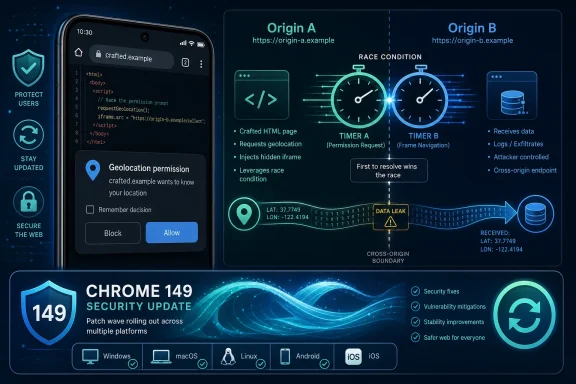 A Medium Chrome Bug Lands in a Very Large Patch Wave
Google’s Chrome 149 stable-channel update arrived on June 2, 2026, with Chrome 149.0.7827.53 for Linux and 149.0.7827.53/54 for Windows and Mac. The release was unusually dense, carrying 429 security fixes, including a long slate of critical, high, and medium vulnerabilities across graphics, media, authentication, site isolation, password handling, extensions, and other browser subsystems. CVE-2026-11145 sits inside that larger wave as “Race in Geolocation,” reported by Google on April 11, 2026.That context matters because a vulnerability like this can disappear inside a jumbo Chrome advisory. It is neither the scariest entry in the release nor the easiest to explain. Yet it targets a permissioned browser feature that users tend to understand in human terms — “this site wants your location” — while the vulnerability description points at something more subtle: cross-origin data leakage.
The Chrome project rated it medium. CISA’s ADP enrichment currently lists a CVSS 3.1 score of 5.3, with network attack vector, high attack complexity, no privileges required, user interaction required, unchanged scope, high confidentiality impact, and no integrity or availability impact. In plain English, the attacker needs to get a user to interact with a malicious page, exploitation is not considered trivial, and the payoff is information disclosure rather than code execution.
That should not lull anyone into dismissing it. Browser security is cumulative. A medium confidentiality bug in one component may be unremarkable on its own, but it becomes more interesting when paired with phishing, session state, permissive enterprise browsing habits, or another browser weakness that shifts the attacker’s position.
The Geolocation API Was Built on Trust Boundaries
Geolocation is one of those browser features that feels simple because the user-facing prompt is simple. A site asks for location. The user allows or denies it. The browser mediates access between web content, operating-system location services, and privacy policy.Underneath that prompt is a more complicated security model. The browser must track which origin asked for access, which frame made the request, which permission decision applies, what data is returned, and whether the answer can be exposed to the requesting script. That origin bookkeeping is not an accessory; it is the product.
CVE-2026-11145 is described as a race in Geolocation that allowed a remote attacker to leak cross-origin data via a crafted HTML page. A race condition means the vulnerable code has a timing window where state can change unexpectedly while another operation assumes it has not. In browser terms, that can be especially dangerous because modern pages are not static documents. They are event-driven applications juggling frames, workers, permission prompts, navigation changes, redirects, and asynchronous APIs.
The phrase cross-origin data is doing a lot of work. The same-origin policy is one of the oldest and most important rules in the web platform. A script from one origin should not simply read sensitive data belonging to another origin. When a Chrome bug says cross-origin data leakage is possible, the issue is not merely that a webpage can behave badly; it is that a browser-enforced boundary may have been weakened.
The public record does not currently provide a full exploit narrative, and the Chromium issue is permission-restricted. That is normal for Chrome security bugs while patches propagate. But the pieces we do have suggest a classic browser-security pattern: a feature designed to safely broker privileged information becomes risky when asynchronous state and origin checks do not line up perfectly.
Android Is the Named Target, but Windows Admins Should Still Care
The CVE description specifically says Google Chrome on Android prior to 149.0.7827.53. That is not a throwaway platform note. Mobile Chrome has platform-specific integrations, including how it talks to Android services, handles permissions, and participates in app-to-web flows. A bug in Geolocation on Android does not automatically mean the same defect affects Chrome on Windows.Still, Windows-centric administrators should not skip the story. Most enterprises are no longer cleanly divided into “desktop fleet” and “mobile fleet.” Users sign in to the same identity provider from Windows laptops, Android phones, unmanaged tablets, and embedded browsers inside mobile apps. Browser exposure follows the user, not the asset tag.
There is also a Chrome-family problem. Microsoft Edge, Brave, Vivaldi, Opera, Electron-based applications, Android WebView, and in-app browser components all orbit the Chromium ecosystem in different ways. A CVE assigned to Chrome on Android is not proof that every Chromium derivative is vulnerable, but it is a prompt to check vendor advisories and update channels rather than assume the desktop patch dashboard tells the whole story.
The WindowsForum angle is therefore practical. If your patch process ends at Windows Update, Intune’s Windows rings, or a third-party desktop updater, you are not managing browser risk. You are managing part of browser risk. The Android side, especially bring-your-own-device and contractor devices, may be where the exposed Chrome version lives.
The NVD Record Shows the Messiness Behind “Known Affected Software”
The most interesting part of the user-supplied NVD entry is not the CVSS score. It is the CPE trail. NIST’s initial analysis on June 8 added a configuration using Google Chrome versions up to, but excluding, 149.0.7827.53, combined with Android as the operating system. Then the page asks, almost apologetically, “Are we missing a CPE here? Please let us know.”That line is easy to ignore, but it captures a real weakness in vulnerability operations. CPEs are supposed to turn human-readable product descriptions into machine-usable affected-product data. Security scanners, asset inventories, compliance tools, and reporting pipelines depend on that mapping. If the CPE is absent, late, too broad, or awkwardly modeled, the vulnerability can be undercounted or misrouted.
Here, the description says Chrome on Android. The NIST configuration reportedly models this as Chrome affected before 149.0.7827.53 and Android present as the operating-system platform. That is reasonable, but it also exposes a familiar limitation: CPEs are not a perfect language for modern software distribution. Chrome on Android is an app, an updater-managed component, a Google Play package, a browser runtime, and in some environments a companion to Android System WebView. It does not fit as neatly into old-school inventory categories as “product X version Y on operating system Z.”
This is where the article’s thesis becomes operational. The problem is not only whether CVE-2026-11145 has the “right” CPE today. The problem is that defenders increasingly depend on enrichment metadata that changes after publication. NVD’s own banner notes that the CVE record was modified after enrichment efforts were completed and that NVD-supplied enrichment data may require amendment. That is not a bureaucratic footnote; it is a warning label for automated security programs.
The CVSS Change Tells a Story About Exploitability, Not Impact
The change history also shows CISA-ADP revising the CVSS vector. On June 6, the vulnerability was given a CVSS 3.1 vector with low attack complexity. On June 8, that was removed and replaced with high attack complexity, keeping the overall rating medium at 5.3 in the current ADP view.That shift matters. Low attack complexity suggests exploitation is straightforward once the victim interacts with the malicious page. High attack complexity suggests the exploit depends on conditions that are harder to win reliably, which makes sense for a race condition. Timing bugs often need careful orchestration, environmental assumptions, repeated attempts, or specific browser state.
What did not change is the confidentiality impact. The vector still indicates high confidentiality impact and no integrity or availability impact. That is a very particular profile: not a crash, not a takeover, not a persistence mechanism, but a possible leak of data that should have remained isolated.
This is why CVSS can both help and mislead. A 5.3 sounds modest compared with the critical memory-corruption bugs patched in the same Chrome release. But a confidentiality-only browser bug can be serious in the right workflow. If a crafted page can expose information from another origin, the value of the bug depends on what the victim is logged into, what the browser can reach, and what other defenses are in place.
Cross-Origin Leakage Is a Privacy Bug With Security Teeth
The phrase “leak cross-origin data” sounds abstract until you translate it into normal browsing. Users keep authenticated sessions open to mail, collaboration suites, admin dashboards, password managers, internal portals, cloud consoles, ticketing systems, banking sites, and identity providers. The browser is the shared workspace where those origins coexist.The same-origin policy is supposed to stop a malicious site in one tab or frame from reading data belonging to another. There are legitimate cross-origin mechanisms — CORS, postMessage, navigations, embeds, storage partitioning, and permission prompts — but each is supposed to be constrained. When a bug bypasses those constraints, the attacker’s page may become a pry bar.
We should be careful here. The public CVE text does not specify which data could be leaked, whether location data itself was involved, whether another origin’s response body could be inferred, or what preconditions were required beyond user interaction and high attack complexity. Security writing often overstates cross-origin bugs by jumping from “data leak” to “account compromise” without evidence.
The better reading is narrower and still important. A crafted HTML page could exploit a geolocation race in Chrome for Android before 149.0.7827.53 to leak data across an origin boundary. That is enough to justify patch urgency because origin boundaries are the browser’s security perimeter.
The Permission Prompt Is Not a Complete Defense
It is tempting to think geolocation vulnerabilities are mostly contained by the permission prompt. If a malicious site asks for location and the user denies it, case closed. But browser permission systems are more complicated than a one-time yes-or-no box.Permissions are scoped to origins. They can be remembered. They can be granted to sites that users trust. They can be embedded in workflows where users do not realize which frame or page is making a request. They also sit alongside navigation and frame lifecycle changes that may happen faster than a human can reason about.
A race condition in this area raises the possibility that the bug is not simply “the user clicked allow.” The danger is that the browser’s internal state may briefly disagree with itself about which origin owns a request, response, permission, or data channel. That is precisely the kind of bug modern browser architecture tries to eliminate with strict process isolation, careful permission plumbing, and defensive checks at multiple layers.
For users, the advice remains simple: update Chrome. For administrators, the lesson is different: do not treat permission prompts as policy enforcement by themselves. They are user-interface expressions of deeper browser invariants. When the invariants fail, the prompt may not save you.
Chrome’s Restricted Bugs Force Defenders to Read Between the Lines
Google’s Chrome advisory notes that access to bug details and links may remain restricted until most users are updated with a fix. That policy is sensible. Full technical details released too early can hand attackers a roadmap while hundreds of millions of browsers are still on vulnerable builds.The tradeoff is that defenders must operate with partial information. CVE-2026-11145 gives us the component, weakness class, affected platform, version boundary, attack shape, and severity. It does not give us proof-of-concept code, a detailed exploit chain, affected API flows, or a clear statement about exploitation in the wild.
That uncertainty should not lead to paralysis. In browser security, the absence of public exploit detail is not the same as low risk. Chrome bugs are frequently patched before the most useful details emerge. By the time technical writeups circulate, competent patch programs should already be finished.
The better operational stance is to separate remediation from curiosity. Patch because the fixed version exists and the affected version boundary is clear. Investigate exposure based on asset data. Wait for deeper technical detail only if you need to write detections, evaluate compensating controls, or understand whether related Chromium consumers are exposed.
The Android Update Path Is Still the Weak Link
On managed Windows desktops, Chrome updates can be forced, reported, and verified with enterprise tooling. On Android, the story is more fragmented. Google Play, OEM policies, managed Google Play, work profiles, personal profiles, regional rollout timing, and user behavior all affect whether a device receives and applies the update promptly.That fragmentation is where medium browser bugs can linger. A user may have a fully patched Windows laptop and an outdated Android browser signed into the same corporate account. If conditional access policies do not check browser posture or device compliance rigorously, the mobile browser becomes the weaker endpoint.
The issue is more pronounced in mixed ownership environments. BYOD programs often prioritize email and app management while treating the browser as a personal app. But browser vulnerabilities do not respect that administrative boundary. If a personal Chrome instance can access corporate SaaS, it belongs in the threat model.
Enterprises should be especially cautious with Android devices used by administrators, developers, finance staff, executives, and support personnel. The higher the value of the authenticated web sessions on the phone, the more a confidentiality-only browser flaw matters.
The Desktop Advisory Reference Is Odd, but Not Necessarily Wrong
One eyebrow-raising detail is that the CVE record points to Google’s “Stable Channel Update for Desktop” post, even though the CVE description says Chrome on Android. The advisory itself lists a broad set of Chrome 149 security fixes, including CVE-2026-11145, while the release headline is framed around Windows, Mac, and Linux.This is not unprecedented. Chrome security advisories often aggregate fixes across components and platforms, and CVE references do not always land on a platform-specific blog post. Still, it creates friction for vulnerability managers trying to answer a simple question: which package do I patch?
The answer from the CVE text is Chrome on Android before 149.0.7827.53. The answer from the release context is that Chrome 149 is the fixed train and that the bug was included in a massive stable-channel security update. The answer from CPE enrichment is that Chrome versions before 149.0.7827.53 are vulnerable when running on Android.
Those answers are compatible, but they are not elegant. This is exactly why automated vulnerability ingestion needs human review for high-volume products like Chrome. A scanner may flag desktop Chrome because the CVE references a desktop advisory. Another tool may suppress the issue because its Android CPE matching is incomplete. Both outcomes are plausible failure modes.
Race Conditions Are Small Windows With Big Consequences
Race conditions are often described as timing bugs, but that phrase undersells them. In security engineering, a race is a disagreement between what code checked and what code later used. If the checked state changes before the action completes, the program may make a security decision on stale assumptions.In a browser, those assumptions are everywhere. Which origin owns this document? Which frame is active? Has the user granted permission? Did navigation occur? Is a page still same-origin with the requester? Is a response associated with the correct renderer process? Is a callback still valid?
The Geolocation component adds another layer because it bridges web content and privileged platform data. The browser is not just parsing HTML. It is brokering access to a sensitive capability. That makes synchronization errors more consequential than a garden-variety UI glitch.
CWE-362, the weakness linked to the CVE, is the canonical race-condition category: concurrent execution using a shared resource with improper synchronization. In normal software, that can mean corrupted state or inconsistent output. In browser security, it can mean a boundary check that succeeds for one state and leaks under another.
The Patch Is Straightforward; The Inventory Is Not
The remediation path for users is uncomplicated: run Chrome for Android version 149.0.7827.53 or later. The harder part is knowing whether every relevant browser instance is actually there. On consumer devices, that means checking the Play Store update status or Chrome’s About screen. In enterprise environments, it means reporting from mobile device management, endpoint management, browser management, or app inventory systems.Administrators should avoid treating “Chrome patched on Windows” as a proxy for “Chrome patched everywhere.” The fixed version boundary in this CVE points to Android. If your reporting only covers desktop Chrome, you have not answered the vulnerability question.
For WindowsForum’s sysadmin audience, the immediate checklist is familiar but worth repeating in this specific context. Confirm Chrome versions on managed Android devices. Check work-profile and personal-profile separation where corporate access is allowed. Review whether Android browser compliance is enforced before access to sensitive SaaS resources. Validate that third-party vulnerability tools are not misclassifying the CVE because of the desktop advisory reference or incomplete CPE data.
There is also a user-education angle, though it should not be oversold. Because the CVSS vector requires user interaction, phishing and malicious-link exposure matter. But “don’t click bad links” is not a control. It is a slogan. The real control is making sure the vulnerable code path no longer exists on devices that can reach sensitive sessions.
Browser Vulnerability Management Has Outgrown the Single Endpoint
Chrome’s scale has changed how vulnerability management works. A single Chrome release can patch hundreds of flaws, touch multiple operating systems, and feed downstream Chromium-based products. Security teams then ingest records from NVD, CISA ADP, vendor blogs, scanner plugins, package managers, and threat-intelligence feeds that may not agree on timing or scope.CVE-2026-11145 illustrates the mess. The CVE arrived on June 4. CISA added enrichment on June 6. NIST added CPE configuration and references on June 8. CISA then revised the CVSS vector the same day, increasing attack complexity from low to high. NVD warns that the record was modified after enrichment and that its enrichment may require amendment.
That chronology is not a scandal. It is the modern vulnerability pipeline working in public. But it means organizations that ingest CVEs once and never revisit enrichment can end up with stale severity, stale affected-product mappings, or stale prioritization.
The practical response is not to wait for perfect metadata. It is to design patch workflows that can tolerate metadata churn. For Chrome, that often means prioritizing stable-channel security updates rapidly, then using CVE-level details for reporting and exception handling after the fleet is already moving.
The Chromium Ecosystem Turns One Fix Into Many Questions
Chrome is the named product, but Chromium is the substrate for a much wider ecosystem. Microsoft Edge on Windows, Android, and other platforms shares large portions of browser engine lineage, though it ships through Microsoft’s own channels and includes its own patches and platform differences. Android WebView is another critical related component, used by apps to display web content inside native experiences.CVE-2026-11145 should not be automatically projected onto every Chromium-based browser. The CVE says Chrome on Android. That boundary matters. But defenders should still ask whether related products have issued their own updates, because the same underlying code may be present, absent, patched differently, or unreachable depending on the product.
This is especially important for organizations that standardize on Edge for Windows but leave Chrome installed for compatibility, developer use, or unmanaged mobile browsing. In real environments, browser sprawl is common. The “default browser” is rarely the only browser.
For developers, the lesson is similar. If your mobile app embeds web content, relies on Chrome Custom Tabs, or depends on WebView behavior, platform browser updates are part of your application’s security posture. The user may experience it as your app. The vulnerable code may live elsewhere.
The Security Rating Is Medium Because Exploitation Is Hard, Not Because Boundaries Are Optional
The current scoring tells us this is not an emergency on the level of an actively exploited V8 zero-day or a renderer-to-sandbox escape. Attack complexity is high, user interaction is required, and the impact is limited to confidentiality. Those are meaningful constraints.But “medium” should not become “ignore.” Security teams sometimes overfit to CVSS thresholds because ticket queues are brutal. Anything below high gets deferred, anything without known exploitation gets batched, and anything mobile gets handled after desktop. That approach is increasingly brittle for browser bugs.
A browser confidentiality bug can be strategically useful. Attackers do not always need to execute code if they can extract tokens, infer sensitive state, expose private content, or assist a broader phishing flow. Again, the public record does not prove CVE-2026-11145 enables those specific outcomes. But it does place the bug in the category of origin-boundary leaks, which is exactly where sensitive web data lives.
The right response is proportionate urgency: patch promptly, verify inventory, and avoid panic. There is no public basis here for claims of widespread exploitation or account takeover. There is every basis for treating Chrome 149.0.7827.53 as the minimum safe Android version for this issue.
The Real Risk Is the Metadata Gap Between Chrome and the Fleet
For individual users, the fix is a version number. For administrators, the work is reconciling that version number with real devices, real users, and real tooling. CVE-2026-11145 is small enough to be missed and specific enough to expose the cracks in patch governance.The CPE question is the sharpest example. If vulnerability tooling fails to map Chrome-on-Android correctly, the issue may not appear where mobile admins expect it. If tooling sees the desktop Chrome advisory and overgeneralizes, it may create noise on Windows systems that are not affected by this Android-specific description. Both errors waste time.
Good vulnerability management requires a second layer of judgment. Does the CVE text identify a platform? Does the vendor advisory aggregate multiple platforms? Does the scanner’s affected-product logic match the vendor’s affected-version language? Has the record changed since the first ingestion? Those are not academic questions when security teams are measured on remediation SLAs.
This is also why security programs should preserve change history, not just current severity. The CVSS vector changed after initial enrichment. The NVD record was modified. The CPE data appeared after publication. If your internal ticket was created from the first version of the record, it may now be wrong in subtle ways.
What Chrome’s Geolocation Race Leaves on the Admin’s Desk
CVE-2026-11145 is not the biggest Chrome bug of the month, but it is a useful test of whether your browser-security process can handle platform-specific nuance. The facts are narrow, the metadata is still settling, and the operational consequences are wider than the CVE score suggests.- Chrome for Android versions before 149.0.7827.53 are the affected target named in the CVE description.
- The vulnerability is a Geolocation race condition that can leak cross-origin data through a crafted HTML page.
- The current CISA ADP CVSS 3.1 assessment is 5.3 medium, with high attack complexity and user interaction required.
- The NVD record changed after enrichment, and the CPE mapping should be reviewed rather than blindly trusted.
- Windows administrators should verify Android browser exposure if those devices access corporate accounts, SaaS apps, or administrative portals.
- The safest operational response is to update Chrome promptly and treat CVE metadata as living data, not a one-time truth.
References
- Primary source: NVD / Chromium
Published: 2026-06-09T07:00:57-07:00
NVD - CVE-2026-11145
 nvd.nist.gov
- Security advisory: MSRC
Published: 2026-06-09T07:00:57-07:00
Original feed URL
Security Update Guide - Microsoft Security Response Center
 msrc.microsoft.com
- Related coverage: radar.offseq.com
CVE-2026-11145: Race in Google Chrome - Live Threat Intelligence - Threat Radar | OffSeq.com
Detailed information about CVE-2026-11145: Race in Google Chrome affecting Google Chrome. Get real-time updates, technical details, and mitigation strategies.radar.offseq.com - Related coverage: stack.watch
- Related coverage: security.snyk.io