

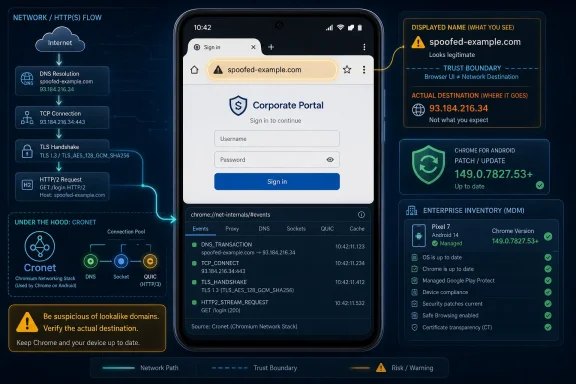
Google’s CVE-2026-11215, published June 4, 2026 and modified June 5, describes a medium-severity Chrome-on-Android flaw in Cronet before version 149.0.7827.53 that could let a remote attacker spoof a domain name using a crafted domain. The bug is not a memory-corruption panic button; it is a trust-boundary problem. That makes it easy to underestimate and dangerous to ignore, because the entire mobile web security model depends on users and apps believing the name they are shown.
The short answer to the CPE question is: no obvious Chrome CPE is missing for the vulnerability as currently described, but the record is awkwardly shaped. NVD models it as Google Chrome versions before 149.0.7827.53 running on Android, which matches the text of the CVE. What remains less tidy is the surrounding evidence trail: the public Chrome release reference points to a desktop stable-channel post, while the affected component and description point specifically at Chrome on Android and Cronet.
CVE-2026-11215 is the kind of vulnerability that lands in the middle of a Chrome security update and risks being skimmed past by everyone who is not directly responsible for mobile browser fleets. The phrase “inappropriate implementation” is Chromium’s all-purpose bucket for bugs that do not fit neatly into the more dramatic categories: use-after-free, heap overflow, type confusion, sandbox escape. In security dashboards, that wording can look almost bureaucratic.
But the impact field is doing more work here than the bug class. Domain spoofing is not about stealing RAM or popping calc; it is about confusing the human and software layers that decide whether a site, service, login flow, or embedded web transaction is legitimate. A browser that shows or accepts the wrong identity at the wrong moment can turn a phishing lure into something much harder for ordinary defenses to catch.
The CVSS 3.1 vector contributed by CISA’s ADP program scores the issue at 6.5, squarely in medium territory. That vector says the attack is network-reachable, low-complexity, requires no privileges, but does require user interaction. It also says confidentiality and availability are not directly affected, while integrity impact is high. In plain English: the attacker does not need an account or local access, but somebody has to be lured into the crafted domain context, and the thing being attacked is trust.
That distinction matters for WindowsForum readers even though the CVE says Android. Chrome is no longer just a desktop browser, and Chromium is no longer just the thing that renders pages in Chrome. It is an application platform, a mobile runtime dependency, an enterprise identity surface, and increasingly a shared substrate across browsers, embedded views, and network stacks.
The CVE text says the vulnerability is in Cronet in Google Chrome on Android. That phrasing is narrower than “all apps using Cronet,” and public records should not be stretched beyond what they say. Still, the presence of Cronet in the description is important because it points to the part of the browser stack where names, certificates, redirects, protocols, and application expectations meet.
Domain spoofing can emerge from surprisingly small mismatches. A URL parser can disagree with a display routine. A Unicode or internationalized domain name can look one way to the user and resolve another way internally. A network library can canonicalize a hostname differently than a policy layer. A browser can enforce the right rule but show the wrong thing at the exact moment a user is asked to trust it.
That is why CWE-451, “User Interface Misrepresentation of Critical Information,” is a revealing classification. This is not merely a backend validation issue. It is a bug in the way security-relevant information is represented to the user or to a consuming interface. Security fails not because cryptography stops working, but because the system persuades the user that the wrong party is the right one.
For administrators, that should trigger a familiar instinct. Some vulnerabilities break machines. Others break decisions. The latter are harder to quantify, harder to scan for, and often more useful in real campaigns than their CVSS scores suggest.
The user-facing oddity is not that NVD lacks an Android condition. It has one. The oddity is that the reference trail includes a Chrome stable-channel update for desktop, while the vulnerability itself is Android-specific. That can happen for mundane reasons: Google sometimes consolidates security notes, CVE batches, or stable-channel announcements across platforms, and downstream databases often ingest whatever reference the CNA supplies.
Still, this is where enterprise vulnerability management gets messy. A scanner may read “Chrome before 149.0.7827.53” and flag desktop assets. A human analyst may read “Chrome on Android” and suppress desktop findings. A mobile device management console may lag behind both, especially if Chrome updates are governed by Play Store policy rather than Windows-style patch cadence.
The CPE therefore answers the inventory question but not the operational one. If your asset system understands platform-qualified CPEs properly, this should resolve to Chrome on Android. If it flattens the CPE into “Chrome less than 149.0.7827.53,” you may see noise on Windows, macOS, or Linux. If it ignores the Chrome application CPE and keys only on Android, you may see even worse noise.
This is not just a database quirk. It is a reminder that vulnerability records are structured approximations of real products. The further software moves into shared components, embedded libraries, and platform-specific behavior, the less comfortable CPE becomes as the sole source of truth.
That mismatch invites suspicion, but it does not automatically mean the CPE is wrong. CVE references are not always platform-perfect. A vendor advisory can serve as a batch announcement even when individual CVEs inside that batch have narrower platform scope. The more important source of scope is the CVE description itself, and here the description explicitly says Android.
The permission-restricted Chromium issue does not help public defenders much. When a bug tracker entry is locked down, administrators are left with the CVE summary, release notes, NVD enrichment, and whatever CISA or other coordinators add. That is enough to patch. It is not always enough to understand exploit mechanics, affected code paths, or whether adjacent embedders should worry.
This is the familiar bargain of browser security disclosure. Details are withheld long enough to protect users who have not yet updated. Defenders get just enough information to prioritize. Attackers, meanwhile, may be able to infer more from code changes, regression tests, or the shape of the fix once it lands.
In this case, the responsible operational answer is not to overfit the reference. Treat the vulnerability as Chrome on Android before 149.0.7827.53 unless Google expands the scope. Treat the desktop release page as a vendor advisory pointer, not proof that Windows Chrome is affected by this specific Cronet domain-spoofing flaw.
CVE-2026-11215 is different in one practical respect: domain spoofing bugs tend to compose well with social engineering. They can make a fake login prompt look more convincing, make a malicious redirection harder to spot, or undermine a user’s last line of defense when app-based identity flows open browser surfaces on mobile devices. The attacker still needs interaction, but phishing is the internet’s most reliable interaction engine.
The integrity-heavy CVSS vector reflects that. The damage is not that a crafted domain reads secrets directly. It is that the user or application may be induced to act on a false representation of origin. In identity, payments, SSO enrollment, device registration, and help-desk workflows, that can be enough.
For individual users, the mitigation is boring and effective: update Chrome on Android. For organizations, the answer is to verify that managed Android devices have received a Chrome build at or above 149.0.7827.53, and to avoid assuming that desktop Chrome patch compliance says anything about mobile exposure.
That last point deserves emphasis. Many Windows-centric IT teams still treat browser patching as a desktop discipline. But the same users who receive carefully managed Edge and Chrome updates on Windows may be authenticating to corporate services from Android phones whose browser updates are governed by Play Store rollout timing, OEM policy, personal-device habits, or MDM enforcement gaps.
That does not make Android unmanageable, but it does mean the old mental model breaks. A desktop vulnerability scan may give you a clear version line across Windows endpoints. A mobile fleet may require MDM inventory, managed Google Play reporting, device compliance policies, and conditional access rules to reach the same confidence level.
BYOD makes the picture even murkier. A company may not control Chrome directly on a personal Android phone, but it may still allow that phone to complete web SSO, approve MFA prompts, access SaaS dashboards, or open links from corporate email. In that world, a browser domain-spoofing issue is not “just a mobile bug.” It is a possible weakness in the identity perimeter.
The prudent enterprise response is therefore not panic, but alignment. Make sure mobile browser version compliance is visible. Make sure conditional access policies distinguish between managed and unmanaged devices. Make sure phishing-resistant authentication is not treated as optional simply because a browser CVE is only medium severity.
This is where security-minded Windows shops have an advantage if they use it. The same discipline that matured around Windows patch telemetry can be extended to mobile endpoints. The tools differ, but the principle is identical: if a device can participate in trust decisions, its browser stack belongs in the risk model.
A crafted domain name exploits that confusion. The danger may involve lookalike characters, deceptive formatting, unexpected parsing, or display inconsistencies. The precise mechanics of CVE-2026-11215 are not public, but the class is well understood: when the name shown to the user is not a reliable guide to the entity being contacted, the web’s trust rituals degrade.
Modern browsers have tried to reduce this problem by emphasizing registrable domains, warning on suspicious sites, limiting URL clutter, and integrating Safe Browsing or equivalent protections. Those defenses help, but they also centralize trust in the browser’s own interpretation of identity. If that interpretation is wrong, the user has fewer independent signals left.
This is one reason passkeys and phishing-resistant authentication matter. A passkey bound to the legitimate origin is harder to trick than a password typed into a convincing fake page. But the transition is incomplete. Passwords, one-time codes, recovery flows, OAuth grants, and mobile deep links remain everywhere.
CVE-2026-11215 should be read against that background. It is not the browser apocalypse. It is a reminder that the user interface is part of the security boundary, and on mobile, that boundary is under constant pressure from space constraints, app handoffs, and user fatigue.
For this CVE, the visible affected configuration is Chrome on Android. That is sufficient for ordinary patch guidance. But if an organization is trying to reason about Cronet as a component across mobile applications, CPE alone may be too blunt. CPE is good at naming products. It is less good at expressing component lineage, build-time dependencies, and platform-specific code paths.
This is where SBOM rhetoric meets operational reality. Everyone wants component-level visibility until the component is a fast-moving browser networking library inside a mobile app that updates outside the organization’s normal release process. Even when the data exists, mapping a CVE from “Chrome on Android” to “our app uses Cronet version X” is not automatic.
That does not mean the NVD record should invent broader affected software. It should not. Overbroad CPEs create false positives, and false positives train teams to ignore alerts. But it does mean defenders should understand the difference between public vulnerability scope and internal dependency analysis.
The right question is not merely whether NVD is missing a CPE. It is whether your organization has a way to discover where Cronet is used, whether those uses inherit Chrome’s fix, and whether vendor apps in your environment ship their own vulnerable networking stack. For most organizations, the honest answer will be uncomfortable.
Version 149.0.7827.53 is the important floor for CVE-2026-11215 as described. Anything below that on Android should be considered affected. Later Chrome 149 updates have already appeared for other security issues, including a separate actively exploited V8 flaw disclosed after this CVE, so “at least 149.0.7827.53” should be treated as the minimum, not the ideal target.
That is especially true on managed devices. If administrators are touching policy anyway, the goal should be current stable, not merely the first build that fixed this one issue. Browser patching as single-CVE whack-a-mole is a losing game; the product moves too quickly, and attackers do not care which advisory finally caused the update.
For WindowsForum’s core audience, the practical lesson is to resist desktop tunnel vision. Chrome on Windows, Edge on Windows, and WebView2 deserve attention, but so does Chrome on Android when those devices touch corporate identity and data. Browser risk follows the user, not the operating-system preference of the IT department.
The patch itself is the easy part. The harder part is proving coverage across unmanaged or lightly managed mobile endpoints. If you cannot answer which Android Chrome versions are currently authenticating to your tenant, this medium CVE is a useful excuse to fix that visibility gap before a high-severity mobile browser issue makes it urgent.
The most important thing about CVE-2026-11215 may be what it reveals about modern browser security management. The vulnerability itself is a medium-severity domain-spoofing flaw with a straightforward update path, but the surrounding ambiguity — Cronet, Android, Chrome, desktop release notes, CPE modeling, and mobile fleet visibility — is the real story. Browser security has become a cross-platform identity problem, and the organizations that treat it as merely another desktop patch line will keep discovering that the weakest browser in the workflow is often the one they forgot to inventory.
The short answer to the CPE question is: no obvious Chrome CPE is missing for the vulnerability as currently described, but the record is awkwardly shaped. NVD models it as Google Chrome versions before 149.0.7827.53 running on Android, which matches the text of the CVE. What remains less tidy is the surrounding evidence trail: the public Chrome release reference points to a desktop stable-channel post, while the affected component and description point specifically at Chrome on Android and Cronet.
 The Bug Is Small Enough to Miss and Fundamental Enough to Matter
CVE-2026-11215 is the kind of vulnerability that lands in the middle of a Chrome security update and risks being skimmed past by everyone who is not directly responsible for mobile browser fleets. The phrase “inappropriate implementation” is Chromium’s all-purpose bucket for bugs that do not fit neatly into the more dramatic categories: use-after-free, heap overflow, type confusion, sandbox escape. In security dashboards, that wording can look almost bureaucratic.But the impact field is doing more work here than the bug class. Domain spoofing is not about stealing RAM or popping calc; it is about confusing the human and software layers that decide whether a site, service, login flow, or embedded web transaction is legitimate. A browser that shows or accepts the wrong identity at the wrong moment can turn a phishing lure into something much harder for ordinary defenses to catch.
The CVSS 3.1 vector contributed by CISA’s ADP program scores the issue at 6.5, squarely in medium territory. That vector says the attack is network-reachable, low-complexity, requires no privileges, but does require user interaction. It also says confidentiality and availability are not directly affected, while integrity impact is high. In plain English: the attacker does not need an account or local access, but somebody has to be lured into the crafted domain context, and the thing being attacked is trust.
That distinction matters for WindowsForum readers even though the CVE says Android. Chrome is no longer just a desktop browser, and Chromium is no longer just the thing that renders pages in Chrome. It is an application platform, a mobile runtime dependency, an enterprise identity surface, and increasingly a shared substrate across browsers, embedded views, and network stacks.
Cronet Makes This More Than a Chrome Address-Bar Story
Cronet is Chromium’s networking stack packaged for apps. Developers use it because it brings Chrome-grade HTTP behavior, protocol support, caching, and performance characteristics into Android applications without requiring every app to reinvent networking. That is a powerful model, and like all powerful shared plumbing, it turns obscure implementation details into ecosystem-level concerns.The CVE text says the vulnerability is in Cronet in Google Chrome on Android. That phrasing is narrower than “all apps using Cronet,” and public records should not be stretched beyond what they say. Still, the presence of Cronet in the description is important because it points to the part of the browser stack where names, certificates, redirects, protocols, and application expectations meet.
Domain spoofing can emerge from surprisingly small mismatches. A URL parser can disagree with a display routine. A Unicode or internationalized domain name can look one way to the user and resolve another way internally. A network library can canonicalize a hostname differently than a policy layer. A browser can enforce the right rule but show the wrong thing at the exact moment a user is asked to trust it.
That is why CWE-451, “User Interface Misrepresentation of Critical Information,” is a revealing classification. This is not merely a backend validation issue. It is a bug in the way security-relevant information is represented to the user or to a consuming interface. Security fails not because cryptography stops working, but because the system persuades the user that the wrong party is the right one.
For administrators, that should trigger a familiar instinct. Some vulnerabilities break machines. Others break decisions. The latter are harder to quantify, harder to scan for, and often more useful in real campaigns than their CVSS scores suggest.
NVD’s CPE Tells the Right Story, but Not a Complete One
The CPE configuration added by NVD describes Google Chrome up to, but excluding, 149.0.7827.53, running on Android. That is a reasonable representation of the vulnerability as described. A Chrome application CPE combined with an Android operating-system CPE is exactly how one would expect NVD to express “Chrome on Android” in the CPE language.The user-facing oddity is not that NVD lacks an Android condition. It has one. The oddity is that the reference trail includes a Chrome stable-channel update for desktop, while the vulnerability itself is Android-specific. That can happen for mundane reasons: Google sometimes consolidates security notes, CVE batches, or stable-channel announcements across platforms, and downstream databases often ingest whatever reference the CNA supplies.
Still, this is where enterprise vulnerability management gets messy. A scanner may read “Chrome before 149.0.7827.53” and flag desktop assets. A human analyst may read “Chrome on Android” and suppress desktop findings. A mobile device management console may lag behind both, especially if Chrome updates are governed by Play Store policy rather than Windows-style patch cadence.
The CPE therefore answers the inventory question but not the operational one. If your asset system understands platform-qualified CPEs properly, this should resolve to Chrome on Android. If it flattens the CPE into “Chrome less than 149.0.7827.53,” you may see noise on Windows, macOS, or Linux. If it ignores the Chrome application CPE and keys only on Android, you may see even worse noise.
This is not just a database quirk. It is a reminder that vulnerability records are structured approximations of real products. The further software moves into shared components, embedded libraries, and platform-specific behavior, the less comfortable CPE becomes as the sole source of truth.
The Desktop Reference Is a Clue, Not a Contradiction
The Chrome Releases blog reference attached to the CVE points to the June 2026 stable-channel update that promoted Chrome 149 for desktop. Public mirrors and security advisories around that release describe a large security batch, with Chrome 149.0.7827.53 for Linux and 149.0.7827.53/.54 for Windows and macOS. The NVD record, however, says CVE-2026-11215 affects Chrome on Android before 149.0.7827.53.That mismatch invites suspicion, but it does not automatically mean the CPE is wrong. CVE references are not always platform-perfect. A vendor advisory can serve as a batch announcement even when individual CVEs inside that batch have narrower platform scope. The more important source of scope is the CVE description itself, and here the description explicitly says Android.
The permission-restricted Chromium issue does not help public defenders much. When a bug tracker entry is locked down, administrators are left with the CVE summary, release notes, NVD enrichment, and whatever CISA or other coordinators add. That is enough to patch. It is not always enough to understand exploit mechanics, affected code paths, or whether adjacent embedders should worry.
This is the familiar bargain of browser security disclosure. Details are withheld long enough to protect users who have not yet updated. Defenders get just enough information to prioritize. Attackers, meanwhile, may be able to infer more from code changes, regression tests, or the shape of the fix once it lands.
In this case, the responsible operational answer is not to overfit the reference. Treat the vulnerability as Chrome on Android before 149.0.7827.53 unless Google expands the scope. Treat the desktop release page as a vendor advisory pointer, not proof that Windows Chrome is affected by this specific Cronet domain-spoofing flaw.
Medium Severity Still Belongs in the Patch Queue
Security teams often reserve urgency for critical and high-severity Chrome bugs, especially when the words “V8,” “sandbox escape,” or “actively exploited” appear. That triage habit is understandable. Chrome ships a relentless stream of fixes, and not every medium CVE deserves a weekend change window.CVE-2026-11215 is different in one practical respect: domain spoofing bugs tend to compose well with social engineering. They can make a fake login prompt look more convincing, make a malicious redirection harder to spot, or undermine a user’s last line of defense when app-based identity flows open browser surfaces on mobile devices. The attacker still needs interaction, but phishing is the internet’s most reliable interaction engine.
The integrity-heavy CVSS vector reflects that. The damage is not that a crafted domain reads secrets directly. It is that the user or application may be induced to act on a false representation of origin. In identity, payments, SSO enrollment, device registration, and help-desk workflows, that can be enough.
For individual users, the mitigation is boring and effective: update Chrome on Android. For organizations, the answer is to verify that managed Android devices have received a Chrome build at or above 149.0.7827.53, and to avoid assuming that desktop Chrome patch compliance says anything about mobile exposure.
That last point deserves emphasis. Many Windows-centric IT teams still treat browser patching as a desktop discipline. But the same users who receive carefully managed Edge and Chrome updates on Windows may be authenticating to corporate services from Android phones whose browser updates are governed by Play Store rollout timing, OEM policy, personal-device habits, or MDM enforcement gaps.
Mobile Browser Risk Lives Outside the Windows Console
Windows administrators are used to a patching universe with familiar landmarks: Patch Tuesday, WSUS, Intune rings, Group Policy, Edge stable channels, reboot windows, compliance reports. Android Chrome lives in a different operational culture. Updates flow through the Play Store, can be staged by Google, may be constrained by device policy, and often coexist with personal ownership models.That does not make Android unmanageable, but it does mean the old mental model breaks. A desktop vulnerability scan may give you a clear version line across Windows endpoints. A mobile fleet may require MDM inventory, managed Google Play reporting, device compliance policies, and conditional access rules to reach the same confidence level.
BYOD makes the picture even murkier. A company may not control Chrome directly on a personal Android phone, but it may still allow that phone to complete web SSO, approve MFA prompts, access SaaS dashboards, or open links from corporate email. In that world, a browser domain-spoofing issue is not “just a mobile bug.” It is a possible weakness in the identity perimeter.
The prudent enterprise response is therefore not panic, but alignment. Make sure mobile browser version compliance is visible. Make sure conditional access policies distinguish between managed and unmanaged devices. Make sure phishing-resistant authentication is not treated as optional simply because a browser CVE is only medium severity.
This is where security-minded Windows shops have an advantage if they use it. The same discipline that matured around Windows patch telemetry can be extended to mobile endpoints. The tools differ, but the principle is identical: if a device can participate in trust decisions, its browser stack belongs in the risk model.
The Real Weakness Is the Human-Machine Boundary
Domain spoofing sits in an uncomfortable place because it attacks a boundary we pretend is sturdier than it is. Users are told to check the domain. Browsers are designed to simplify, truncate, decorate, or hide parts of URLs. Mobile screens are small, app transitions are fast, and identity providers often bounce users through multiple domains before the real work begins.A crafted domain name exploits that confusion. The danger may involve lookalike characters, deceptive formatting, unexpected parsing, or display inconsistencies. The precise mechanics of CVE-2026-11215 are not public, but the class is well understood: when the name shown to the user is not a reliable guide to the entity being contacted, the web’s trust rituals degrade.
Modern browsers have tried to reduce this problem by emphasizing registrable domains, warning on suspicious sites, limiting URL clutter, and integrating Safe Browsing or equivalent protections. Those defenses help, but they also centralize trust in the browser’s own interpretation of identity. If that interpretation is wrong, the user has fewer independent signals left.
This is one reason passkeys and phishing-resistant authentication matter. A passkey bound to the legitimate origin is harder to trick than a password typed into a convincing fake page. But the transition is incomplete. Passwords, one-time codes, recovery flows, OAuth grants, and mobile deep links remain everywhere.
CVE-2026-11215 should be read against that background. It is not the browser apocalypse. It is a reminder that the user interface is part of the security boundary, and on mobile, that boundary is under constant pressure from space constraints, app handoffs, and user fatigue.
CPE Precision Is Becoming a Supply-Chain Problem
The “are we missing a CPE?” prompt on NVD pages can look like boilerplate, but in cases like this it points to a broader vulnerability-management challenge. Software identity is getting harder to describe. Chrome is a browser, Chromium is a project, Cronet is a component, Android is the platform, and apps may embed or depend on parts of that stack in ways a simple product-version tuple cannot express.For this CVE, the visible affected configuration is Chrome on Android. That is sufficient for ordinary patch guidance. But if an organization is trying to reason about Cronet as a component across mobile applications, CPE alone may be too blunt. CPE is good at naming products. It is less good at expressing component lineage, build-time dependencies, and platform-specific code paths.
This is where SBOM rhetoric meets operational reality. Everyone wants component-level visibility until the component is a fast-moving browser networking library inside a mobile app that updates outside the organization’s normal release process. Even when the data exists, mapping a CVE from “Chrome on Android” to “our app uses Cronet version X” is not automatic.
That does not mean the NVD record should invent broader affected software. It should not. Overbroad CPEs create false positives, and false positives train teams to ignore alerts. But it does mean defenders should understand the difference between public vulnerability scope and internal dependency analysis.
The right question is not merely whether NVD is missing a CPE. It is whether your organization has a way to discover where Cronet is used, whether those uses inherit Chrome’s fix, and whether vendor apps in your environment ship their own vulnerable networking stack. For most organizations, the honest answer will be uncomfortable.
Google’s Patch Cadence Leaves Little Room for Delay
Chrome’s security model assumes speed. Bugs are found, fixed, batched, and shipped continuously. Users who stay current benefit from that machinery; users who lag behind are left in a widening gap where attackers can study public fixes and target stale versions.Version 149.0.7827.53 is the important floor for CVE-2026-11215 as described. Anything below that on Android should be considered affected. Later Chrome 149 updates have already appeared for other security issues, including a separate actively exploited V8 flaw disclosed after this CVE, so “at least 149.0.7827.53” should be treated as the minimum, not the ideal target.
That is especially true on managed devices. If administrators are touching policy anyway, the goal should be current stable, not merely the first build that fixed this one issue. Browser patching as single-CVE whack-a-mole is a losing game; the product moves too quickly, and attackers do not care which advisory finally caused the update.
For WindowsForum’s core audience, the practical lesson is to resist desktop tunnel vision. Chrome on Windows, Edge on Windows, and WebView2 deserve attention, but so does Chrome on Android when those devices touch corporate identity and data. Browser risk follows the user, not the operating-system preference of the IT department.
The patch itself is the easy part. The harder part is proving coverage across unmanaged or lightly managed mobile endpoints. If you cannot answer which Android Chrome versions are currently authenticating to your tenant, this medium CVE is a useful excuse to fix that visibility gap before a high-severity mobile browser issue makes it urgent.
The CVE Says “Medium”; the Workflow Says “Verify”
The actionable reading of CVE-2026-11215 is narrower than the anxiety it may generate and broader than the severity label implies.- Chrome on Android versions before 149.0.7827.53 are the affected target described by the CVE and NVD configuration.
- The NVD CPE entry already includes a Chrome application condition running on Android, so there is no clear missing Chrome-on-Android CPE based on the public description.
- The desktop Chrome release reference is confusing but not enough to override the Android-specific wording in the CVE description.
- The risk is domain spoofing, which makes this more relevant to phishing, identity, and user-trust workflows than to traditional code-execution triage.
- Organizations should verify Android Chrome versions through MDM or mobile inventory rather than relying on desktop browser compliance reports.
- Teams using or shipping Cronet in Android applications should treat the CVE as a prompt for dependency review, even if the public affected product remains Chrome on Android.
The most important thing about CVE-2026-11215 may be what it reveals about modern browser security management. The vulnerability itself is a medium-severity domain-spoofing flaw with a straightforward update path, but the surrounding ambiguity — Cronet, Android, Chrome, desktop release notes, CPE modeling, and mobile fleet visibility — is the real story. Browser security has become a cross-platform identity problem, and the organizations that treat it as merely another desktop patch line will keep discovering that the weakest browser in the workflow is often the one they forgot to inventory.
References
- Primary source: NVD / Chromium
Published: 2026-06-09T07:00:16-07:00
NVD - CVE-2026-11215
 nvd.nist.gov
- Security advisory: MSRC
Published: 2026-06-09T07:00:16-07:00
Original feed URL
Security Update Guide - Microsoft Security Response Center
 msrc.microsoft.com
- Related coverage: vulnerability.circl.lu
Vulnerability-Lookup
Vulnerability-Lookup - Fast vulnerability lookup correlation from different sources.vulnerability.circl.lu - Official source: nist.gov
National Vulnerability Database
NIST maintains the National Vulnerability Database (NVD), a repository of information on software and hardware flaws that can compromise computer security. This is a key piece of the nation’s cybersecurity infrastructure.www.nist.gov - Related coverage: labs.cloudsecurityalliance.org
NVD Enrichment Triage: Enterprise Vulnerability Programs Must Adapt
PDF documentlabs.cloudsecurityalliance.org
