

Google disclosed CVE-2026-11668 on June 8, 2026, as a high-severity Chromium codecs flaw affecting Google Chrome on Linux and ChromeOS before version 149.0.7827.103, where a crafted video file could let a remote attacker leak cross-origin data. The bug is not the loudest item in the June Chrome security train, but it is the kind administrators should not dismiss because its impact lives in the browser’s most sensitive promise: site isolation. A browser that mishandles video parsing is not merely failing at playback; it is potentially exposing data that another origin was never supposed to see. For WindowsForum readers, the immediate Windows exposure appears limited by the published affected platforms, but the operational lesson is broader: Chromium’s media stack remains a high-value attack surface, and cross-origin leakage bugs deserve more respect than their medium CVSS scores often receive.
The plain-English version of CVE-2026-11668 is deceptively simple. Chrome’s codecs component could use uninitialized data while processing media, and a maliciously crafted video file could cause the browser to leak information across origins. That is a narrower outcome than arbitrary code execution, but it cuts directly into the web’s security model.
Modern browsers are built around the idea that one site should not casually read data belonging to another. The same-origin policy, site isolation, process sandboxing, cookie partitioning, CORS rules, and a thicket of mitigations all exist because the browser is the place where hostile and trusted code share the same machine, screen, memory pressure, GPU, network, and user session. When a vulnerability is described as “cross-origin data” leakage, the phrase should make administrators sit up.
The bug is in codecs, not in JavaScript, authentication, or a browser extension API. That matters because media parsing is one of the browser’s unavoidable exposure points. Users do not think of a video file as executable content, but the software needed to decode it is complicated, performance-sensitive, and frequently written close to the metal.
Chrome’s security severity is listed as High, while CISA’s ADP CVSS 3.1 score is 4.3, or Medium. That gap is not necessarily a contradiction. CVSS measures a specific set of exploitability and impact dimensions, while a browser vendor’s severity rating tends to account for where the bug sits in the product, how reachable it is, how often the code runs, and how badly things can go when an attacker chains it with something else.
But browser vulnerabilities rarely live alone. A confidentiality-only bug can become much more meaningful if the leaked data includes tokens, cross-origin responses, browser-internal memory fragments, or information that helps defeat another mitigation. It can also become a reconnaissance primitive, giving an attacker a small but valuable read across a boundary that should have been absolute.
The most important word in the CVE description may be “allowed,” not “could.” The description says the flaw allowed a remote attacker to leak cross-origin data through a crafted video file. That is stronger than a theoretical warning about hardening. It frames the bug as a reachable violation of a core security property.
There is also a familiar browser-security asymmetry at work. Users see a video thumbnail, a social feed, a web app, a training portal, a support page, or a chat attachment. The browser sees a complex chain of demuxers, decoders, buffering logic, hardware acceleration paths, MIME sniffing, origin checks, process boundaries, and memory management. The attacker only needs one edge case in that chain to behave differently than the security model assumes.
Still, “Linux and ChromeOS” is hardly a niche in enterprise environments. Linux desktops may be less common than Windows endpoints in many organizations, but they are disproportionately present among developers, infrastructure engineers, security teams, build systems, and privileged technical staff. ChromeOS, meanwhile, is widely deployed in education and managed fleets where browser security is the device security model.
The ChromeOS angle is especially important because the browser is not just an app on that platform. It is the center of the operating environment. A browser media bug on ChromeOS may not mean the same thing as kernel compromise, but it lands closer to the main security boundary users actually depend on day to day.
Linux also complicates patch visibility. Some users run Google Chrome from Google’s repository. Others run Chromium builds supplied by distributions, snaps, flatpaks, enterprise mirrors, or custom packaging. Ubuntu’s security page notes that its
CPE data is supposed to turn narrative vulnerability descriptions into machine-actionable inventory rules. In practice, CPEs often trail, overfit, underfit, or encode platform relationships clumsily. A scanner can tell you a CVE exists, but it may not understand whether your Chromium snap, Chrome .deb, ChromeOS channel, unmanaged browser profile, containerized browser, or embedded browser dependency is actually vulnerable.
For this CVE, the question “Are we missing a CPE?” is not bureaucratic trivia. If the affected software list is incomplete or incorrectly modeled, organizations may either miss vulnerable Chrome builds or chase ghosts on systems that are not exposed. Both outcomes are bad, but they fail differently: one leaves risk untreated, the other burns credibility with administrators who have to explain false positives.
The safest interpretation is to anchor remediation on product version and platform rather than blindly trusting a single CPE expression. If the device runs Chrome or a Chromium-derived browser using the affected codecs code on Linux or ChromeOS, it deserves scrutiny. If it runs Windows Chrome, the available public description does not put it in the primary affected set for CVE-2026-11668, though it may still be affected by other CVEs in the same release.
But vulnerability triage can be distorted by the zero-day spotlight. Administrators may patch for the actively exploited V8 bug and mentally file the rest of the bulletin as background noise. That is a mistake. Browser updates are cumulative security events, and the less glamorous entries often represent bug classes attackers have already studied for years.
The codecs bug is a good example. Media code is old, optimized, format-heavy, and often shaped by compatibility with files produced by every camera, phone, editor, streaming service, and hardware encoder on the planet. Bugs in that layer are not exotic. They are the cost of turning the open web into a universal playback machine.
The June update’s platform versioning also adds a wrinkle. Advisories around the release describe patched stable versions as 149.0.7827.102 or .103 depending on platform. The CVE text says “prior to 149.0.7827.103,” while other advisory summaries list Linux as 149.0.7827.102 in the stable rollout. That does not mean administrators should panic over a one-build ambiguity, but it does mean they should rely on Chrome’s own update channel and security bulletin rather than inventing their own version threshold from a single database line.
In a browser, those leftovers can matter. They may include pieces of decoded media, internal state, object metadata, timing-sensitive values, or fragments connected to another context. Most of the time, uninitialized reads crash, produce junk, or go nowhere. Occasionally, they become data exposure.
The codecs layer is a particularly plausible place for this class of issue. Decoders juggle buffers, frames, partial streams, hardware interfaces, color spaces, and error recovery paths. They must process broken files gracefully because the web is full of broken files. Attackers love the gap between “gracefully recover from malformed input” and “accidentally reveal something while recovering.”
Browser vendors have invested enormously in fuzzing media parsers because fuzzers are good at finding exactly these malformed-input paths. But fuzzing does not eliminate all state-dependent bugs, especially those that require platform-specific behavior or subtle interaction with process isolation and origin checks. CVE-2026-11668 looks like the kind of flaw that survives not because browser engineering is careless, but because the attack surface is vast.
Not all leaks are equally severe. A bug that exposes a few bytes under constrained conditions is not the same as a universal read primitive. But defenders do not get to evaluate leaks in isolation from the user’s real session. Browsers are full of secrets: cookies, bearer tokens, CSRF tokens, intranet responses, cached data, document previews, signed URLs, and sensitive application state.
The crafted-video requirement is also less reassuring than it sounds. Video is everywhere on the modern web, and users have been trained to accept autoplay previews, embedded clips, uploaded training files, customer support recordings, and social media attachments as normal. If a malicious file can trigger a leak during decoding, user interaction may be as simple as visiting a page that presents the media or opening a shared link.
The security model depends not just on preventing code execution, but on preventing confused observation. If a hostile origin can infer or retrieve data from another origin because a media subsystem mishandles memory, the sandbox has failed in a way that is quiet, hard to notice, and potentially useful to attackers who value stealth over spectacle.
Administrators should confirm update policy, not just trust it. Devices on stable channel should be checked for the relevant patched build, and any long-tail machines stuck below the fixed version should be treated as exceptions worth investigating. In education environments, the riskiest devices are often not the ones actively used every day, but carts, spares, kiosks, labs, and shared machines that miss normal reboot rhythms.
ChromeOS also concentrates browser risk in a way that can simplify response. If the fleet is enrolled, reporting and enforcement can be centralized. If it is not enrolled, the organization has a governance problem larger than one CVE.
The practical question is whether administrators can answer, by device and by channel, what Chrome version is actually running. If they cannot, CVE-2026-11668 is a useful prompt to fix the inventory gap before the next browser bug is actively exploited.
A Chrome codecs bug on Linux should therefore get more attention than its desktop market share suggests. A developer browsing documentation, sample media, bug reports, or customer uploads may have access to source repositories, package registries, production dashboards, SSH keys, and internal services. A confidentiality bug that leaks cross-origin data is more concerning when the browser session includes privileged internal origins.
The packaging story is messy. Google Chrome users may receive updates through Google’s Linux repository. Chromium users may depend on distro maintainers, snaps, flatpaks, or third-party builds. Some organizations deliberately freeze browser versions for compatibility testing, and some Linux users disable automatic update prompts because they consider them intrusive.
That is where browser policy should meet endpoint policy. If Chrome or Chromium is allowed on managed Linux devices, the organization needs a way to inventory browser versions and enforce minimum builds. If it cannot do that, it should at least narrow where sensitive internal applications are accessible and require stronger session protections.
But Windows users still have two reasons to care. First, the same Chrome stable update addressed many vulnerabilities across desktop platforms, including issues unrelated to CVE-2026-11668. A Windows endpoint that is current is safer not because this specific codecs bug necessarily applies, but because Chrome’s June update carried a broader security payload.
Second, Chromium is an ecosystem, not a single executable. Microsoft Edge, Brave, Vivaldi, Opera, Electron apps, embedded webviews, and Linux-based containers may inherit, fork, patch, or lag parts of the same upstream codebase in different ways. A CVE labeled “Chrome on Linux, ChromeOS” does not automatically describe every downstream product, but neither should administrators assume downstream products are safe without vendor confirmation.
For Windows administrators, the better response is disciplined rather than theatrical. Verify Chrome and Edge update baselines. Check whether any Linux desktops or ChromeOS devices are managed outside the main endpoint platform. Ask whether security tooling can distinguish Chrome, Chromium, and Chromium-based applications. Then patch the browser fleet because browser patching is one of the few security controls that works only when it is boring and frequent.
Google commonly restricts bug details until enough users have updated. That is good practice, but it does not make the bug unknowable. Skilled vulnerability researchers can diff Chromium changes, inspect related commits, fuzz adjacent code, and look for likely fix patterns. Once a security bulletin exists, the race is no longer secret; it is simply asymmetric.
For a confidentiality bug requiring user interaction, that race may not produce mass exploitation. It may never appear in a public exploit kit. But attackers who target Linux-heavy developer environments, journalists, activists, research labs, or education fleets do not need mass exploitation. They need a plausible lure and a population that patches slowly.
The lesson is not that every Chrome CVE is an existential crisis. It is that browser disclosure starts the clock. If your update process depends on users noticing a relaunch prompt, your real control is hope.
Media decoding stresses that model because it often involves data from one origin being processed through complex shared code paths. Hardware acceleration and platform-specific codecs can add further complexity. Even when browser architecture is sound, implementation bugs can create exceptions that architecture was supposed to prevent.
CVE-2026-11668 is therefore a reminder that browser security is layered, not singular. The same-origin policy is a rule. Site isolation is an architecture. Sandboxing is a containment strategy. Memory-safe coding and initialization discipline are implementation requirements. A failure in one layer may be contained by another, but defenders should not assume containment equals irrelevance.
That is also why Chrome’s own severity can exceed a simple confidentiality score. Browser vendors understand that a leak primitive can be chained, and that cross-origin boundaries are central to user trust. The risk may be narrow, but the boundary it touches is foundational.
Security teams should resist the temptation to spend the first meeting debating whether the CVSS score is “really” medium or high. That debate can be useful for prioritization, but it often becomes a substitute for action. The update is available, the affected platforms are named, and the attack vector is remote with low complexity and no privileges required.
There is a more useful debate to have: which endpoints are likely to process untrusted media inside authenticated browser sessions? That includes help desks reviewing customer uploads, HR teams opening applicant videos, marketing departments handling media files, education users in shared learning platforms, and developers testing content pipelines. Risk is not only about exploit mechanics; it is about the workflows that put crafted files in front of browsers.
For managed environments, the response should be measurable. Chrome version compliance should be visible in endpoint management, Chrome Browser Cloud Management, distro package reporting, or whatever inventory system the organization trusts. If it is not visible, the organization has found the real remediation task.
This is where CVE-2026-11668 intersects with a broader WindowsForum concern. Windows administrators may run mostly Windows endpoints, but their application estate increasingly includes Chromium components: Edge WebView2, Electron-based productivity apps, cross-platform developer tools, and browsers used inside virtual desktops or Linux subsystems. The line between “browser vulnerability” and “application vulnerability” has blurred.
The challenge is that upstream Chromium patches do not land everywhere at once. Google Chrome may update quickly. Microsoft Edge follows its own release process. Electron apps may depend on maintainers rebuilding against a newer Chromium. Linux distributions may backport fixes without changing the apparent upstream version. Vulnerability scanners may or may not understand those nuances.
CVE-2026-11668 does not prove that every Chromium consumer is exposed. It does prove that organizations need to know where Chromium lives. The browser engine is no longer just something users launch from a taskbar. It is a dependency hiding inside the software supply chain.
For administrators, the work is assurance. A patched build on paper does not help a device that has not restarted, a kiosk pinned to an old channel, or a developer workstation using an unmanaged Chromium build. Browser updates are only as strong as the last mile between the vendor release and the running process.
There is also a communications challenge. Users are fatigued by browser restarts because browsers have become workspaces. A restart can mean losing context across dozens of tabs, web apps, meetings, and documents. That annoyance is real, but it is not a reason to tolerate stale builds indefinitely.
The best organizations treat browser relaunches like routine hygiene rather than emergency theater. They set deadlines, notify users, enforce restarts after a grace period, and make exceptions visible. The goal is not to make every Chrome CVE a crisis. The goal is to make browser patching so predictable that crisis language becomes unnecessary.
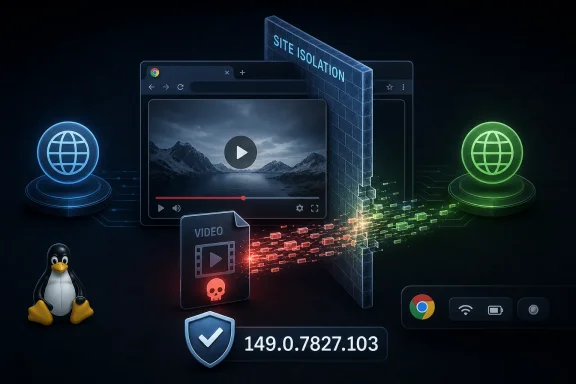 A Video Bug Becomes a Browser Boundary Problem
The plain-English version of CVE-2026-11668 is deceptively simple. Chrome’s codecs component could use uninitialized data while processing media, and a maliciously crafted video file could cause the browser to leak information across origins. That is a narrower outcome than arbitrary code execution, but it cuts directly into the web’s security model.Modern browsers are built around the idea that one site should not casually read data belonging to another. The same-origin policy, site isolation, process sandboxing, cookie partitioning, CORS rules, and a thicket of mitigations all exist because the browser is the place where hostile and trusted code share the same machine, screen, memory pressure, GPU, network, and user session. When a vulnerability is described as “cross-origin data” leakage, the phrase should make administrators sit up.
The bug is in codecs, not in JavaScript, authentication, or a browser extension API. That matters because media parsing is one of the browser’s unavoidable exposure points. Users do not think of a video file as executable content, but the software needed to decode it is complicated, performance-sensitive, and frequently written close to the metal.
Chrome’s security severity is listed as High, while CISA’s ADP CVSS 3.1 score is 4.3, or Medium. That gap is not necessarily a contradiction. CVSS measures a specific set of exploitability and impact dimensions, while a browser vendor’s severity rating tends to account for where the bug sits in the product, how reachable it is, how often the code runs, and how badly things can go when an attacker chains it with something else.
CVSS Says Medium, Browser Reality Says Pay Attention
The CISA ADP vector is telling: network attack vector, low complexity, no privileges required, user interaction required, unchanged scope, low confidentiality impact, no integrity impact, and no availability impact. That translates into a bug that needs a user to load or interact with a crafted video and is currently described as leaking some data rather than taking over a system. On a spreadsheet, that looks manageable.But browser vulnerabilities rarely live alone. A confidentiality-only bug can become much more meaningful if the leaked data includes tokens, cross-origin responses, browser-internal memory fragments, or information that helps defeat another mitigation. It can also become a reconnaissance primitive, giving an attacker a small but valuable read across a boundary that should have been absolute.
The most important word in the CVE description may be “allowed,” not “could.” The description says the flaw allowed a remote attacker to leak cross-origin data through a crafted video file. That is stronger than a theoretical warning about hardening. It frames the bug as a reachable violation of a core security property.
There is also a familiar browser-security asymmetry at work. Users see a video thumbnail, a social feed, a web app, a training portal, a support page, or a chat attachment. The browser sees a complex chain of demuxers, decoders, buffering logic, hardware acceleration paths, MIME sniffing, origin checks, process boundaries, and memory management. The attacker only needs one edge case in that chain to behave differently than the security model assumes.
The Linux and ChromeOS Scope Is Narrow, but Not Comforting
The public description names Google Chrome on Linux and ChromeOS before 149.0.7827.103. That specificity matters. It suggests the relevant code path, build configuration, platform media integration, or mitigation state was not identical across all desktop platforms. Windows administrators should not overstate the CVE as a direct Windows Chrome bug unless later advisories expand the affected configurations.Still, “Linux and ChromeOS” is hardly a niche in enterprise environments. Linux desktops may be less common than Windows endpoints in many organizations, but they are disproportionately present among developers, infrastructure engineers, security teams, build systems, and privileged technical staff. ChromeOS, meanwhile, is widely deployed in education and managed fleets where browser security is the device security model.
The ChromeOS angle is especially important because the browser is not just an app on that platform. It is the center of the operating environment. A browser media bug on ChromeOS may not mean the same thing as kernel compromise, but it lands closer to the main security boundary users actually depend on day to day.
Linux also complicates patch visibility. Some users run Google Chrome from Google’s repository. Others run Chromium builds supplied by distributions, snaps, flatpaks, enterprise mirrors, or custom packaging. Ubuntu’s security page notes that its
chromium-browser package has long functioned as a path to the Chromium snap, and its status table lists supported Ubuntu releases as not affected. That is useful, but it also reinforces a common administrative problem: “Chrome” and “Chromium” are not always the same package, from the same vendor, on the same patch cadence.The CPE Confusion Is a Symptom of a Bigger Inventory Problem
The user-supplied NVD change history shows an initially added CPE configuration that is awkward on its face: Google Chrome versions up to but excluding 149.0.7827.102 combined with ChromeOS and the Linux kernel. The description, however, says Chrome on Linux and ChromeOS prior to 149.0.7827.103. That mismatch is precisely the kind of thing that makes vulnerability management teams distrust automated matching.CPE data is supposed to turn narrative vulnerability descriptions into machine-actionable inventory rules. In practice, CPEs often trail, overfit, underfit, or encode platform relationships clumsily. A scanner can tell you a CVE exists, but it may not understand whether your Chromium snap, Chrome .deb, ChromeOS channel, unmanaged browser profile, containerized browser, or embedded browser dependency is actually vulnerable.
For this CVE, the question “Are we missing a CPE?” is not bureaucratic trivia. If the affected software list is incomplete or incorrectly modeled, organizations may either miss vulnerable Chrome builds or chase ghosts on systems that are not exposed. Both outcomes are bad, but they fail differently: one leaves risk untreated, the other burns credibility with administrators who have to explain false positives.
The safest interpretation is to anchor remediation on product version and platform rather than blindly trusting a single CPE expression. If the device runs Chrome or a Chromium-derived browser using the affected codecs code on Linux or ChromeOS, it deserves scrutiny. If it runs Windows Chrome, the available public description does not put it in the primary affected set for CVE-2026-11668, though it may still be affected by other CVEs in the same release.
Chrome’s June Patch Was Bigger Than This One CVE
CVE-2026-11668 arrived in a June 2026 stable-channel update that also included more attention-grabbing Chrome flaws. Public reporting and advisories focused heavily on CVE-2026-11645, a V8 issue for which Google acknowledged an exploit existed in the wild. That is understandable: V8 bugs with active exploitation tend to dominate headlines because the path from a crafted web page to meaningful compromise is easier for readers to grasp.But vulnerability triage can be distorted by the zero-day spotlight. Administrators may patch for the actively exploited V8 bug and mentally file the rest of the bulletin as background noise. That is a mistake. Browser updates are cumulative security events, and the less glamorous entries often represent bug classes attackers have already studied for years.
The codecs bug is a good example. Media code is old, optimized, format-heavy, and often shaped by compatibility with files produced by every camera, phone, editor, streaming service, and hardware encoder on the planet. Bugs in that layer are not exotic. They are the cost of turning the open web into a universal playback machine.
The June update’s platform versioning also adds a wrinkle. Advisories around the release describe patched stable versions as 149.0.7827.102 or .103 depending on platform. The CVE text says “prior to 149.0.7827.103,” while other advisory summaries list Linux as 149.0.7827.102 in the stable rollout. That does not mean administrators should panic over a one-build ambiguity, but it does mean they should rely on Chrome’s own update channel and security bulletin rather than inventing their own version threshold from a single database line.
Uninitialized Memory Is an Old Bug Class in a New Browser War
CWE-457, use of an uninitialized variable, is not glamorous. It is one of those old programming errors that sounds like it belongs in a C textbook rather than a modern browser with fuzzing, sanitizers, code review, sandboxing, and a multibillion-user deployment pipeline. Yet it remains dangerous because memory that has not been deliberately initialized may contain leftovers from previous operations.In a browser, those leftovers can matter. They may include pieces of decoded media, internal state, object metadata, timing-sensitive values, or fragments connected to another context. Most of the time, uninitialized reads crash, produce junk, or go nowhere. Occasionally, they become data exposure.
The codecs layer is a particularly plausible place for this class of issue. Decoders juggle buffers, frames, partial streams, hardware interfaces, color spaces, and error recovery paths. They must process broken files gracefully because the web is full of broken files. Attackers love the gap between “gracefully recover from malformed input” and “accidentally reveal something while recovering.”
Browser vendors have invested enormously in fuzzing media parsers because fuzzers are good at finding exactly these malformed-input paths. But fuzzing does not eliminate all state-dependent bugs, especially those that require platform-specific behavior or subtle interaction with process isolation and origin checks. CVE-2026-11668 looks like the kind of flaw that survives not because browser engineering is careless, but because the attack surface is vast.
Cross-Origin Leaks Are the Browser Version of a Locked Door Left Ajar
The web’s origin model is a bargain between convenience and danger. A user can keep corporate email open in one tab, a payroll portal in another, a cloud admin console in a third, and a random news site in a fourth because the browser promises that those contexts cannot freely read each other. Every cross-origin leak undermines that bargain.Not all leaks are equally severe. A bug that exposes a few bytes under constrained conditions is not the same as a universal read primitive. But defenders do not get to evaluate leaks in isolation from the user’s real session. Browsers are full of secrets: cookies, bearer tokens, CSRF tokens, intranet responses, cached data, document previews, signed URLs, and sensitive application state.
The crafted-video requirement is also less reassuring than it sounds. Video is everywhere on the modern web, and users have been trained to accept autoplay previews, embedded clips, uploaded training files, customer support recordings, and social media attachments as normal. If a malicious file can trigger a leak during decoding, user interaction may be as simple as visiting a page that presents the media or opening a shared link.
The security model depends not just on preventing code execution, but on preventing confused observation. If a hostile origin can infer or retrieve data from another origin because a media subsystem mishandles memory, the sandbox has failed in a way that is quiet, hard to notice, and potentially useful to attackers who value stealth over spectacle.
ChromeOS Admins Should Treat This as a Fleet Hygiene Test
For managed ChromeOS fleets, CVE-2026-11668 is less about emergency drama and more about policy verification. ChromeOS updates are usually one of the platform’s strengths, but real fleets still have pinned versions, delayed channels, blocked reboots, end-of-support devices, kiosk configurations, and users who habitually close lids instead of restarting. The difference between “Google shipped a fix” and “the device is running the fix” is where incidents are born.Administrators should confirm update policy, not just trust it. Devices on stable channel should be checked for the relevant patched build, and any long-tail machines stuck below the fixed version should be treated as exceptions worth investigating. In education environments, the riskiest devices are often not the ones actively used every day, but carts, spares, kiosks, labs, and shared machines that miss normal reboot rhythms.
ChromeOS also concentrates browser risk in a way that can simplify response. If the fleet is enrolled, reporting and enforcement can be centralized. If it is not enrolled, the organization has a governance problem larger than one CVE.
The practical question is whether administrators can answer, by device and by channel, what Chrome version is actually running. If they cannot, CVE-2026-11668 is a useful prompt to fix the inventory gap before the next browser bug is actively exploited.
Linux Desktops Remain the Patch-Management Blind Spot
Linux endpoints occupy a strange place in corporate security programs. They are often trusted more because their users are technical, yet managed less because they do not fit neatly into Windows-centric endpoint tooling. That is backwards. Developer workstations and admin laptops can be among the most sensitive endpoints in the company.A Chrome codecs bug on Linux should therefore get more attention than its desktop market share suggests. A developer browsing documentation, sample media, bug reports, or customer uploads may have access to source repositories, package registries, production dashboards, SSH keys, and internal services. A confidentiality bug that leaks cross-origin data is more concerning when the browser session includes privileged internal origins.
The packaging story is messy. Google Chrome users may receive updates through Google’s Linux repository. Chromium users may depend on distro maintainers, snaps, flatpaks, or third-party builds. Some organizations deliberately freeze browser versions for compatibility testing, and some Linux users disable automatic update prompts because they consider them intrusive.
That is where browser policy should meet endpoint policy. If Chrome or Chromium is allowed on managed Linux devices, the organization needs a way to inventory browser versions and enforce minimum builds. If it cannot do that, it should at least narrow where sensitive internal applications are accessible and require stronger session protections.
Windows Users Are Not the Main Target, but They Are Not Off the Hook
Because the CVE description names Linux and ChromeOS, Windows users should avoid overstating CVE-2026-11668 as their own platform-specific emergency. That distinction matters on a Windows-focused forum. Security writing loses value when every bug becomes “update now or else” without explaining who is actually exposed.But Windows users still have two reasons to care. First, the same Chrome stable update addressed many vulnerabilities across desktop platforms, including issues unrelated to CVE-2026-11668. A Windows endpoint that is current is safer not because this specific codecs bug necessarily applies, but because Chrome’s June update carried a broader security payload.
Second, Chromium is an ecosystem, not a single executable. Microsoft Edge, Brave, Vivaldi, Opera, Electron apps, embedded webviews, and Linux-based containers may inherit, fork, patch, or lag parts of the same upstream codebase in different ways. A CVE labeled “Chrome on Linux, ChromeOS” does not automatically describe every downstream product, but neither should administrators assume downstream products are safe without vendor confirmation.
For Windows administrators, the better response is disciplined rather than theatrical. Verify Chrome and Edge update baselines. Check whether any Linux desktops or ChromeOS devices are managed outside the main endpoint platform. Ask whether security tooling can distinguish Chrome, Chromium, and Chromium-based applications. Then patch the browser fleet because browser patching is one of the few security controls that works only when it is boring and frequent.
The Real Risk Is the Patch Gap After Disclosure
The vulnerability was received from Chrome on June 8 and modified by CISA-ADP shortly afterward, with NVD enrichment following on June 10. That timeline is normal, but it creates a familiar window in which attackers, defenders, vendors, and scanners are all reading the same sparse clues. The public gets a description, a CWE, a severity label, a version threshold, and a restricted Chromium issue link. Attackers get those too.Google commonly restricts bug details until enough users have updated. That is good practice, but it does not make the bug unknowable. Skilled vulnerability researchers can diff Chromium changes, inspect related commits, fuzz adjacent code, and look for likely fix patterns. Once a security bulletin exists, the race is no longer secret; it is simply asymmetric.
For a confidentiality bug requiring user interaction, that race may not produce mass exploitation. It may never appear in a public exploit kit. But attackers who target Linux-heavy developer environments, journalists, activists, research labs, or education fleets do not need mass exploitation. They need a plausible lure and a population that patches slowly.
The lesson is not that every Chrome CVE is an existential crisis. It is that browser disclosure starts the clock. If your update process depends on users noticing a relaunch prompt, your real control is hope.
Site Isolation Cannot Save Every Bug Below It
Chrome’s site isolation work has dramatically improved browser resilience by separating sites into different processes and reducing the blast radius of renderer compromise. But site isolation is not magic. It depends on lower layers correctly enforcing what data belongs where and ensuring that shared subsystems do not become side channels or confused deputies.Media decoding stresses that model because it often involves data from one origin being processed through complex shared code paths. Hardware acceleration and platform-specific codecs can add further complexity. Even when browser architecture is sound, implementation bugs can create exceptions that architecture was supposed to prevent.
CVE-2026-11668 is therefore a reminder that browser security is layered, not singular. The same-origin policy is a rule. Site isolation is an architecture. Sandboxing is a containment strategy. Memory-safe coding and initialization discipline are implementation requirements. A failure in one layer may be contained by another, but defenders should not assume containment equals irrelevance.
That is also why Chrome’s own severity can exceed a simple confidentiality score. Browser vendors understand that a leak primitive can be chained, and that cross-origin boundaries are central to user trust. The risk may be narrow, but the boundary it touches is foundational.
Enterprise Triage Should Start With Versions, Not Arguments About Labels
The practical remediation for CVE-2026-11668 is not complicated: get Chrome on affected platforms to a fixed stable build. The complicated part is proving that happened everywhere. Browser inventory still sounds trivial until an organization discovers four packaging sources, five update cadences, unmanaged contractor laptops, and a handful of lab machines running stale images.Security teams should resist the temptation to spend the first meeting debating whether the CVSS score is “really” medium or high. That debate can be useful for prioritization, but it often becomes a substitute for action. The update is available, the affected platforms are named, and the attack vector is remote with low complexity and no privileges required.
There is a more useful debate to have: which endpoints are likely to process untrusted media inside authenticated browser sessions? That includes help desks reviewing customer uploads, HR teams opening applicant videos, marketing departments handling media files, education users in shared learning platforms, and developers testing content pipelines. Risk is not only about exploit mechanics; it is about the workflows that put crafted files in front of browsers.
For managed environments, the response should be measurable. Chrome version compliance should be visible in endpoint management, Chrome Browser Cloud Management, distro package reporting, or whatever inventory system the organization trusts. If it is not visible, the organization has found the real remediation task.
The Browser Supply Chain Is Now the Enterprise Supply Chain
One reason Chrome CVEs generate so much operational noise is that Chromium has become infrastructure. It is the basis for major browsers, app runtimes, embedded UI shells, testing frameworks, and internal tools. A bug in Chromium is not always a bug in every Chromium-derived product, but the dependency graph is too large to ignore.This is where CVE-2026-11668 intersects with a broader WindowsForum concern. Windows administrators may run mostly Windows endpoints, but their application estate increasingly includes Chromium components: Edge WebView2, Electron-based productivity apps, cross-platform developer tools, and browsers used inside virtual desktops or Linux subsystems. The line between “browser vulnerability” and “application vulnerability” has blurred.
The challenge is that upstream Chromium patches do not land everywhere at once. Google Chrome may update quickly. Microsoft Edge follows its own release process. Electron apps may depend on maintainers rebuilding against a newer Chromium. Linux distributions may backport fixes without changing the apparent upstream version. Vulnerability scanners may or may not understand those nuances.
CVE-2026-11668 does not prove that every Chromium consumer is exposed. It does prove that organizations need to know where Chromium lives. The browser engine is no longer just something users launch from a taskbar. It is a dependency hiding inside the software supply chain.
The Fix Is Easy; the Assurance Is Not
For individual users, the advice is straightforward. Open Chrome’s about page, let it check for updates, relaunch when prompted, and confirm the browser reports a fixed version. On ChromeOS, apply the available system update and restart. That is the simple part.For administrators, the work is assurance. A patched build on paper does not help a device that has not restarted, a kiosk pinned to an old channel, or a developer workstation using an unmanaged Chromium build. Browser updates are only as strong as the last mile between the vendor release and the running process.
There is also a communications challenge. Users are fatigued by browser restarts because browsers have become workspaces. A restart can mean losing context across dozens of tabs, web apps, meetings, and documents. That annoyance is real, but it is not a reason to tolerate stale builds indefinitely.
The best organizations treat browser relaunches like routine hygiene rather than emergency theater. They set deadlines, notify users, enforce restarts after a grace period, and make exceptions visible. The goal is not to make every Chrome CVE a crisis. The goal is to make browser patching so predictable that crisis language becomes unnecessary.
What the June Codecs Bug Should Change This Week
CVE-2026-11668 is small enough to triage quickly but serious enough to expose weak assumptions about browser inventory. The useful response is not panic; it is a short, concrete audit of affected platforms, update channels, and places where untrusted media meets authenticated sessions.- Confirm that Google Chrome on Linux and ChromeOS is updated beyond the affected range described for CVE-2026-11668.
- Treat version ambiguity between 149.0.7827.102 and 149.0.7827.103 as a reason to rely on vendor update channels and current stable builds, not as an excuse to delay.
- Check whether Linux desktops, developer machines, lab systems, and ChromeOS kiosks are visible in the same vulnerability workflow as Windows endpoints.
- Do not downgrade the issue solely because the CISA ADP CVSS score is Medium; cross-origin data leakage affects a core browser security boundary.
- Review Chromium-derived applications and browsers separately, because upstream Chromium risk does not always map cleanly to downstream product exposure.
- Use this advisory as a test of whether your organization can prove browser patch compliance, not merely assume it.
References
- Primary source: NVD / Chromium
Published: 2026-06-15T19:14:26-07:00
NVD - CVE-2026-11668
 nvd.nist.gov
- Security advisory: MSRC
Published: 2026-06-15T19:14:26-07:00
Original feed URL
Security Update Guide - Microsoft Security Response Center
 msrc.microsoft.com
