

CISA republished Yokogawa’s advisory for CVE-2026-11833 on June 25, 2026, warning that affected FAST/TOOLS R9.01 through R10.04 and Collaborative Information Server R1.01 through R1.04 deployments may expose CI Server setting information through web server responses. The flaw is not a plant-floor apocalypse in a single packet. It is the quieter kind of industrial-control vulnerability that matters because it gives attackers the map before they try the door. For operators in manufacturing, energy, food, and agriculture, the lesson is blunt: configuration disclosure in OT is rarely “just information.”
Yokogawa FAST/TOOLS sits in the SCADA and operational data layer, the place where industrial processes become screens, events, histories, and decisions. CI Server, formally Collaborative Information Server, belongs to the same information-sharing fabric. That makes the affected products awkwardly important: they are not merely endpoints, and they are not merely databases. They are connective tissue.
The advisory describes a web server that may return responses containing CI Server setting information. That phrasing is spare, almost antiseptic, but the risk is easier to understand in operational terms. Settings can describe how systems are arranged, what services exist, what components talk to one another, and where an attacker might turn next.
CVE-2026-11833 is classified as CWE-319, cleartext transmission of sensitive information. CISA lists the CVSS 3.1 score as 7.5 high, with a network attack vector, low complexity, no required privileges, no user interaction, and high confidentiality impact. Yokogawa’s CVSS 4.0 score lands at 8.2 high, reflecting the same basic reality: this is remotely reachable information disclosure with little friction once the vulnerable surface is exposed.
The absence of reported public exploitation should not lull anyone into treating the bug as academic. Industrial compromises often begin with reconnaissance, not disruption. A response that tells an attacker how a CI Server is configured may be less cinematic than ransomware, but it can be more useful than a crash.
That is especially true in OT environments, where uptime pressures and legacy architecture often produce uneven visibility. An attacker who can identify FAST/TOOLS and CI Server configuration details may be able to shape follow-on activity more carefully. The advisory does not say the disclosed information enables direct control of industrial processes, and defenders should not exaggerate the claim. But it does say the information could be exploited for other attacks, which is precisely the part that should get attention.
The modern industrial attack chain is rarely a single exploit fired blindly into a control network. It is a sequence: discover the exposed service, fingerprint the product, learn the configuration, identify trust relationships, locate weak remote access, and only then attempt credential theft, lateral movement, or process interference. CVE-2026-11833 appears to sit near the beginning of that chain.
That placement matters. Security teams often prioritize vulnerabilities by immediate blast radius: remote code execution first, denial of service second, information disclosure later. In a power plant, water facility, factory, or food-processing environment, that ordering can be too crude. Information disclosure inside a poorly segmented industrial network can reduce the time and noise required for the next stage.
That distinction is important because it suggests two different operational tasks, not a single generic “patch Yokogawa” ticket. FAST/TOOLS environments may need a service pack on top of an upgrade path. CI Server environments need to move to a fixed release. Asset owners that treat the advisory as one line item risk discovering too late that one half of the stack was fixed and the other was merely inventoried.
The listed FAST/TOOLS packages include RVSVRN, UNSVRN, HMIWEB, FTEES, and HMIMOB. The affected CI Server range covers all packages. For administrators, that means the web-facing and mobile/HMI-adjacent pieces deserve special scrutiny, not just the central server installed under the most obvious product name.
This is where industrial patching becomes less like Windows Update and more like change management surgery. A sysadmin can patch a fleet of workstations on a schedule and tolerate a small failure rate. An OT engineer has to consider process availability, vendor certification, maintenance windows, redundancy, operator training, and rollback procedures. The advisory’s severity score says “high,” but the remediation path still runs through the plant calendar.
For CVE-2026-11833, exposure is the multiplier. A vulnerable web server buried inside a well-segmented engineering network is still a problem, but it is a bounded one. The same server reachable from a flat corporate network, a forgotten vendor VPN, or the public internet is a reconnaissance service waiting to be queried.
The advisory notes that no known public exploitation specifically targeting this vulnerability had been reported to CISA at publication. That is useful, but it is not a control. Industrial defenders should read it as a reason to move deliberately, not as permission to defer indefinitely.
The hard truth is that many OT environments still rely on implicit obscurity. They assume that a system is safe because it is old, specialized, obscure, or reachable only through paths that no one has bothered to document. Modern scanning, exposure management, and opportunistic exploitation have made that assumption brittle. An attacker does not need to understand a refinery to understand that a web server leaking configuration deserves attention.
That does not mean CVE-2026-11833 should be described as a direct shutdown bug. It should not. The known impact is disclosure of CI Server setting information, with no listed integrity or availability impact in the CVSS 3.1 vector. But dismissing it because “nothing crashes” misunderstands the way industrial intrusions mature.
Configuration information can reveal naming conventions, server roles, network assumptions, or integration points. It can help an attacker avoid noisy guessing. It can reduce the cost of building a targeted phishing lure or selecting the next vulnerability to test. In environments where the boundary between corporate IT and OT is imperfect, that kind of detail can be a bridge.
This is the central tension of the advisory. The bug is narrow, but the environment is consequential. A vulnerability that would be moderately annoying in a low-value web application can be strategically useful when it describes operational infrastructure.
The right response starts with inventory. Operators need to know whether FAST/TOOLS is present, which packages are installed, which release is running, whether CI Server is deployed, and which hosts expose the relevant web service. If that sounds basic, it is because the basics are often where industrial security programs still struggle. You cannot patch what the asset database treats as a rumor.
Next comes exposure reduction. If patching cannot happen immediately, the web interface should be reachable only from known management hosts or tightly controlled network zones. Remote access paths should be reviewed for stale vendor accounts, broad VPN access, split tunneling, and weak segmentation. A firewall rule is not a patch, but in OT it is often the difference between a vulnerability that exists and a vulnerability that is reachable.
Monitoring should also change. Teams should look for unexpected HTTP requests to FAST/TOOLS web components and CI Server-adjacent services, especially from unusual subnets, remote access ranges, jump hosts, or business-network devices that should not be querying OT applications. The most valuable log entry may not say “exploit”; it may say that someone is asking configuration-shaped questions from the wrong place.
Finally, incident responders should resist the temptation to treat an information-disclosure scan as harmless noise. If a vulnerable system has been exposed, defenders should ask what the disclosed settings could enable. That means reviewing downstream access, service accounts, integration points, and any trust relationships that would be more dangerous if known.
That makes Windows administration part of the OT security boundary. A vulnerable FAST/TOOLS or CI Server deployment may not be patched by the same team that manages Microsoft Defender, Active Directory, WSUS, Intune, or server hardening baselines. But the attacker will not respect that org chart. If a leaked configuration helps them identify a Windows host, a domain trust, a service account, or a remote desktop path, the Windows estate becomes part of the industrial incident.
This is why segmentation has to be more than a diagram. A flat network where engineering workstations, corporate laptops, file shares, and SCADA support systems can all see one another is an invitation to turn a narrow OT advisory into a broader enterprise compromise. The Windows side of the house should be asking whether OT management hosts are isolated, whether privileged accounts are separated, and whether remote administration tooling creates hidden shortcuts.
There is also a cultural issue. Enterprise IT often sees OT as slow, vendor-bound, and conservative. OT often sees enterprise IT as reckless, patch-happy, and insufficiently aware of process risk. CVE-2026-11833 is a case where both instincts need correction. Patching matters, but so does validation. Isolation matters, but so does visibility. Neither side can solve the problem alone.
CVSS is useful because it strips away local assumptions. The vector tells us the vulnerability is network reachable, low complexity, requires no privileges, and needs no user interaction. Those are bad properties. But the score does not know whether a particular plant has compensating controls, whether the vulnerable service is exposed, or whether the disclosed settings would materially assist an attacker.
For that, organizations need threat modeling and asset context. Which networks can reach the affected web server? Which users can reach those networks? Are there internet-facing paths through reverse proxies or remote support platforms? Are logs retained long enough to detect probing? Are backups and recovery procedures separate from the environment whose configuration might be exposed?
The advisory’s “no known public exploitation” line should fit into that analysis, not replace it. Public exploitation often lags disclosure, and industrial targeting can be quiet. A lack of known exploitation is not the same as a lack of scanning, and a lack of scanning is not the same as safety.
Industrial vendors are under increasing pressure to disclose vulnerabilities, coordinate through national CERTs, publish CVEs, and provide fixed versions. That process can make a vendor look more vulnerable than competitors that disclose less. The more useful question is not whether an industrial product has CVEs. It is whether the vendor documents them clearly, ships fixes, and gives operators a realistic path to remediation.
Here, the public facts are specific enough to act on. The affected versions are named. The product packages are named. The fixed directions are named. CISA’s republication adds defensive guidance and critical-infrastructure context. That is not everything an operator might want, but it is enough to begin triage.
The harder part is what happens after triage. Industrial security succeeds or fails in the messy middle: validating version numbers, negotiating downtime, testing service packs, updating runbooks, confirming firewall rules, and making sure a temporary mitigation does not quietly become permanent technical debt.
This advisory is also a useful test of whether an organization’s OT asset inventory is real. If it takes days to determine whether FAST/TOOLS R10.04 is running anywhere, the vulnerability has already revealed a process weakness. If teams cannot say which network zones can reach HMIWEB or HMIMOB components, the issue is bigger than one CVE.
The near-term work is concrete:
The Yokogawa advisory is a reminder that the next industrial-security crisis may not begin with malware changing a setpoint; it may begin with a web server politely disclosing how the environment is put together. Organizations that patch, segment, and monitor now will reduce the value of that disclosure before anyone tries to build an attack around it. Those that wait for public exploitation reports may discover that in industrial security, the warning shot is often the quietest packet on the wire.
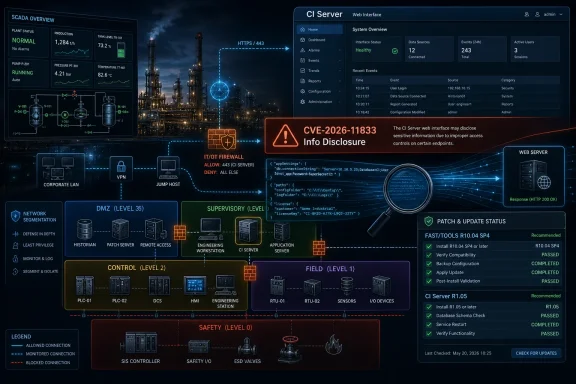 The Leak Is Small, but the System It Describes Is Not
Yokogawa FAST/TOOLS sits in the SCADA and operational data layer, the place where industrial processes become screens, events, histories, and decisions. CI Server, formally Collaborative Information Server, belongs to the same information-sharing fabric. That makes the affected products awkwardly important: they are not merely endpoints, and they are not merely databases. They are connective tissue.The advisory describes a web server that may return responses containing CI Server setting information. That phrasing is spare, almost antiseptic, but the risk is easier to understand in operational terms. Settings can describe how systems are arranged, what services exist, what components talk to one another, and where an attacker might turn next.
CVE-2026-11833 is classified as CWE-319, cleartext transmission of sensitive information. CISA lists the CVSS 3.1 score as 7.5 high, with a network attack vector, low complexity, no required privileges, no user interaction, and high confidentiality impact. Yokogawa’s CVSS 4.0 score lands at 8.2 high, reflecting the same basic reality: this is remotely reachable information disclosure with little friction once the vulnerable surface is exposed.
The absence of reported public exploitation should not lull anyone into treating the bug as academic. Industrial compromises often begin with reconnaissance, not disruption. A response that tells an attacker how a CI Server is configured may be less cinematic than ransomware, but it can be more useful than a crash.
Industrial Security Still Has a Reconnaissance Problem
Enterprise defenders have spent years learning that the first useful attacker asset is not always a password. Sometimes it is a version string. Sometimes it is a path. Sometimes it is a configuration response that explains how a sensitive system is wired.That is especially true in OT environments, where uptime pressures and legacy architecture often produce uneven visibility. An attacker who can identify FAST/TOOLS and CI Server configuration details may be able to shape follow-on activity more carefully. The advisory does not say the disclosed information enables direct control of industrial processes, and defenders should not exaggerate the claim. But it does say the information could be exploited for other attacks, which is precisely the part that should get attention.
The modern industrial attack chain is rarely a single exploit fired blindly into a control network. It is a sequence: discover the exposed service, fingerprint the product, learn the configuration, identify trust relationships, locate weak remote access, and only then attempt credential theft, lateral movement, or process interference. CVE-2026-11833 appears to sit near the beginning of that chain.
That placement matters. Security teams often prioritize vulnerabilities by immediate blast radius: remote code execution first, denial of service second, information disclosure later. In a power plant, water facility, factory, or food-processing environment, that ordering can be too crude. Information disclosure inside a poorly segmented industrial network can reduce the time and noise required for the next stage.
The Affected Version Range Reaches Across Real Deployments
The affected FAST/TOOLS versions run from R9.01 through R10.04. The affected CI Server versions run from R1.01 through R1.04. Yokogawa’s remediation guidance is similarly specific: FAST/TOOLS users should update to R10.04 and apply R10.04 SP4, while CI Server users should update to R1.05.That distinction is important because it suggests two different operational tasks, not a single generic “patch Yokogawa” ticket. FAST/TOOLS environments may need a service pack on top of an upgrade path. CI Server environments need to move to a fixed release. Asset owners that treat the advisory as one line item risk discovering too late that one half of the stack was fixed and the other was merely inventoried.
The listed FAST/TOOLS packages include RVSVRN, UNSVRN, HMIWEB, FTEES, and HMIMOB. The affected CI Server range covers all packages. For administrators, that means the web-facing and mobile/HMI-adjacent pieces deserve special scrutiny, not just the central server installed under the most obvious product name.
This is where industrial patching becomes less like Windows Update and more like change management surgery. A sysadmin can patch a fleet of workstations on a schedule and tolerate a small failure rate. An OT engineer has to consider process availability, vendor certification, maintenance windows, redundancy, operator training, and rollback procedures. The advisory’s severity score says “high,” but the remediation path still runs through the plant calendar.
CISA’s Generic ICS Advice Is Generic Because It Keeps Being Right
CISA’s recommendations will sound familiar to anyone who has read an industrial-control advisory in the last decade: minimize network exposure, keep control system devices off the public internet, place OT networks behind firewalls, isolate them from business networks, and use secure remote access such as VPNs when remote connectivity is required. The repetition is not laziness. It is an indictment of how often the same architectural mistakes turn product bugs into incidents.For CVE-2026-11833, exposure is the multiplier. A vulnerable web server buried inside a well-segmented engineering network is still a problem, but it is a bounded one. The same server reachable from a flat corporate network, a forgotten vendor VPN, or the public internet is a reconnaissance service waiting to be queried.
The advisory notes that no known public exploitation specifically targeting this vulnerability had been reported to CISA at publication. That is useful, but it is not a control. Industrial defenders should read it as a reason to move deliberately, not as permission to defer indefinitely.
The hard truth is that many OT environments still rely on implicit obscurity. They assume that a system is safe because it is old, specialized, obscure, or reachable only through paths that no one has bothered to document. Modern scanning, exposure management, and opportunistic exploitation have made that assumption brittle. An attacker does not need to understand a refinery to understand that a web server leaking configuration deserves attention.
Confidentiality Is an Availability Issue in Disguise
CVSS separates confidentiality, integrity, and availability because scoring systems need categories. Real systems are messier. In industrial environments, a confidentiality failure can become an availability problem if the disclosed data helps an attacker find the path to disruption.That does not mean CVE-2026-11833 should be described as a direct shutdown bug. It should not. The known impact is disclosure of CI Server setting information, with no listed integrity or availability impact in the CVSS 3.1 vector. But dismissing it because “nothing crashes” misunderstands the way industrial intrusions mature.
Configuration information can reveal naming conventions, server roles, network assumptions, or integration points. It can help an attacker avoid noisy guessing. It can reduce the cost of building a targeted phishing lure or selecting the next vulnerability to test. In environments where the boundary between corporate IT and OT is imperfect, that kind of detail can be a bridge.
This is the central tension of the advisory. The bug is narrow, but the environment is consequential. A vulnerability that would be moderately annoying in a low-value web application can be strategically useful when it describes operational infrastructure.
The Patch Is the Easy Sentence and the Hard Project
“Update to R10.04 SP4” is easy to write. It is harder to execute across globally deployed industrial systems that may be tied to validation cycles, vendor support contracts, and site-specific engineering. That gap between advisory language and operational reality is where many ICS vulnerabilities linger.The right response starts with inventory. Operators need to know whether FAST/TOOLS is present, which packages are installed, which release is running, whether CI Server is deployed, and which hosts expose the relevant web service. If that sounds basic, it is because the basics are often where industrial security programs still struggle. You cannot patch what the asset database treats as a rumor.
Next comes exposure reduction. If patching cannot happen immediately, the web interface should be reachable only from known management hosts or tightly controlled network zones. Remote access paths should be reviewed for stale vendor accounts, broad VPN access, split tunneling, and weak segmentation. A firewall rule is not a patch, but in OT it is often the difference between a vulnerability that exists and a vulnerability that is reachable.
Monitoring should also change. Teams should look for unexpected HTTP requests to FAST/TOOLS web components and CI Server-adjacent services, especially from unusual subnets, remote access ranges, jump hosts, or business-network devices that should not be querying OT applications. The most valuable log entry may not say “exploit”; it may say that someone is asking configuration-shaped questions from the wrong place.
Finally, incident responders should resist the temptation to treat an information-disclosure scan as harmless noise. If a vulnerable system has been exposed, defenders should ask what the disclosed settings could enable. That means reviewing downstream access, service accounts, integration points, and any trust relationships that would be more dangerous if known.
Windows Shops Are in This Story Even When the CVE Is Not About Windows
WindowsForum readers may reasonably ask why a Yokogawa ICS advisory belongs in a Windows community publication. The answer is that industrial software rarely lives in a vacuum. HMIs, engineering workstations, historian clients, remote-access tools, jump boxes, domain services, and administrative consoles often sit on Windows infrastructure.That makes Windows administration part of the OT security boundary. A vulnerable FAST/TOOLS or CI Server deployment may not be patched by the same team that manages Microsoft Defender, Active Directory, WSUS, Intune, or server hardening baselines. But the attacker will not respect that org chart. If a leaked configuration helps them identify a Windows host, a domain trust, a service account, or a remote desktop path, the Windows estate becomes part of the industrial incident.
This is why segmentation has to be more than a diagram. A flat network where engineering workstations, corporate laptops, file shares, and SCADA support systems can all see one another is an invitation to turn a narrow OT advisory into a broader enterprise compromise. The Windows side of the house should be asking whether OT management hosts are isolated, whether privileged accounts are separated, and whether remote administration tooling creates hidden shortcuts.
There is also a cultural issue. Enterprise IT often sees OT as slow, vendor-bound, and conservative. OT often sees enterprise IT as reckless, patch-happy, and insufficiently aware of process risk. CVE-2026-11833 is a case where both instincts need correction. Patching matters, but so does validation. Isolation matters, but so does visibility. Neither side can solve the problem alone.
The CVSS Number Tells Only Half the Story
A 7.5 or 8.2 high-severity score is enough to trigger attention, but it does not fully capture site-specific risk. The same affected version can represent very different exposure depending on where it sits. A lab instance behind strict access controls is not the same as a production CI Server reachable through a broad contractor VPN.CVSS is useful because it strips away local assumptions. The vector tells us the vulnerability is network reachable, low complexity, requires no privileges, and needs no user interaction. Those are bad properties. But the score does not know whether a particular plant has compensating controls, whether the vulnerable service is exposed, or whether the disclosed settings would materially assist an attacker.
For that, organizations need threat modeling and asset context. Which networks can reach the affected web server? Which users can reach those networks? Are there internet-facing paths through reverse proxies or remote support platforms? Are logs retained long enough to detect probing? Are backups and recovery procedures separate from the environment whose configuration might be exposed?
The advisory’s “no known public exploitation” line should fit into that analysis, not replace it. Public exploitation often lags disclosure, and industrial targeting can be quiet. A lack of known exploitation is not the same as a lack of scanning, and a lack of scanning is not the same as safety.
Yokogawa’s Advisory Lands in a Familiar FAST/TOOLS Pattern
This is not the first time FAST/TOOLS and CI Server have appeared in security advisories. Yokogawa has previously published advisories covering vulnerabilities in the same product family, including a 2024 advisory for FAST/TOOLS and CI Server and a 2026 advisory for FAST/TOOLS. That history does not make Yokogawa unusual; it makes Yokogawa visible.Industrial vendors are under increasing pressure to disclose vulnerabilities, coordinate through national CERTs, publish CVEs, and provide fixed versions. That process can make a vendor look more vulnerable than competitors that disclose less. The more useful question is not whether an industrial product has CVEs. It is whether the vendor documents them clearly, ships fixes, and gives operators a realistic path to remediation.
Here, the public facts are specific enough to act on. The affected versions are named. The product packages are named. The fixed directions are named. CISA’s republication adds defensive guidance and critical-infrastructure context. That is not everything an operator might want, but it is enough to begin triage.
The harder part is what happens after triage. Industrial security succeeds or fails in the messy middle: validating version numbers, negotiating downtime, testing service packs, updating runbooks, confirming firewall rules, and making sure a temporary mitigation does not quietly become permanent technical debt.
The Operators Who Move First Will Treat This as an Exposure Audit
The most mature response to CVE-2026-11833 is not panic patching. It is an exposure audit with a patch plan attached. That means identifying every affected FAST/TOOLS and CI Server instance, determining whether the web server component is reachable from untrusted networks, applying Yokogawa’s updates, and closing unnecessary access paths.This advisory is also a useful test of whether an organization’s OT asset inventory is real. If it takes days to determine whether FAST/TOOLS R10.04 is running anywhere, the vulnerability has already revealed a process weakness. If teams cannot say which network zones can reach HMIWEB or HMIMOB components, the issue is bigger than one CVE.
The near-term work is concrete:
- Organizations running FAST/TOOLS R9.01 through R10.04 should plan to reach R10.04 and apply the R10.04 SP4 patch software.
- Organizations running CI Server R1.01 through R1.04 should plan to update to R1.05.
- Administrators should verify whether RVSVRN, UNSVRN, HMIWEB, FTEES, or HMIMOB packages are installed and reachable.
- Network teams should restrict access to affected web interfaces to trusted management hosts and OT zones.
- Security teams should review logs for unusual unauthenticated web requests to FAST/TOOLS and CI Server systems.
- Incident responders should treat confirmed exposure as a reason to review downstream trust relationships, not merely as a closed patch ticket.
The Yokogawa advisory is a reminder that the next industrial-security crisis may not begin with malware changing a setpoint; it may begin with a web server politely disclosing how the environment is put together. Organizations that patch, segment, and monitor now will reduce the value of that disclosure before anyone tries to build an attack around it. Those that wait for public exploitation reports may discover that in industrial security, the warning shot is often the quietest packet on the wire.
References
- Primary source: CISA
Published: 2026-06-25T12:00:00+00:00

Yokogawa FAST/TOOLS and CI Server | CISA
www.cisa.gov
- Related coverage: incibe.es
Transmisión de información sensible en texto claro en productos de Yokogawa | INCIBE-CERT | INCIBE
Yokogawa ha publicado una vulnerabilidad de severidad alta que, en caso de ser explotada, podría provowww.incibe.es
- Related coverage: yokogawa.com
Yokogawa Security Advisory Report List | Yokogawa America
Yokogawa Security Advisory Report List | Yokogawa Americawww.yokogawa.com
- Related coverage: web-material3.yokogawa.com
- Related coverage: yokogawa.co.jp
