CISA republished ABB PSIRT advisory SA26P009 on June 30, 2026, warning that CVE-2025-31115 in XZ Utils affects multiple B&R Industrial Automation terminal products worldwide, with fixed Terminal OS releases now available for PPC3100, C50, C80, FT50, MT50, T30, T80, and T50 devices. The flaw is not the infamous 2024 XZ backdoor, but it lands in the same uncomfortable place for defenders: a small, widely reused open-source component embedded inside industrial products that do not patch on consumer-software timelines. The immediate risk is denial of service and memory corruption, not espionage-grade remote code execution, but in factory systems a crash can be more than an inconvenience. This advisory is a reminder that modern industrial security increasingly depends on knowing what is inside the box long after the box has been commissioned.
The vulnerable component is liblzma, the compression library shipped with XZ Utils. In ordinary IT environments, XZ is the sort of infrastructure software people rarely think about until something goes wrong: it compresses and decompresses archives, sits in package-management workflows, and appears as a dependency in operating systems and appliances. In industrial environments, that same quiet ubiquity becomes harder to manage because components are often bundled into vendor-maintained firmware images, terminal operating systems, and embedded platforms.
CVE-2025-31115 affects XZ Utils versions 5.3.3alpha through 5.8.0. The specific weak spot is the multithreaded
That matters because B&R’s affected products are not general-purpose Linux desktops sitting under a developer’s desk. They are industrial terminal products used in critical manufacturing settings, deployed worldwide, and maintained under operational constraints that make even a “simple” library update a planning exercise. A bug that would be handled with a routine package update in a server fleet can become a production-window negotiation on the plant floor.
The advisory says an attacker with network access to an affected system node could exploit the vulnerability. It also says B&R had not received reports of exploitation when the advisory was originally issued, and that the vulnerability had already been publicly disclosed. That combination is familiar in industrial cybersecurity: public technical knowledge exists, vendor fixes exist, active exploitation is not reported, and defenders still have to decide how quickly they can touch equipment that may be tied to uptime commitments.
CVE-2025-31115 is different. It is a software bug in the multithreaded decoder, not an alleged backdoor and not a covert authentication bypass. Its described impact is crash and memory corruption from invalid input, with availability impact scored high and confidentiality and integrity impact scored none in the vendor vector.
That distinction should calm some of the more dramatic instincts around the advisory, but it should not make administrators complacent. Industrial operators care deeply about availability because downtime has physical-world consequences: stopped lines, delayed batches, interrupted human-machine interface sessions, or cascading operational workarounds. In a manufacturing environment, an attack that “only” crashes a node can still be a business-impacting incident.
There is also a subtler lesson. The XZ backdoor made headlines because it was spectacular; this bug is more mundane, and therefore more representative. Most supply-chain risk is not a spy-novel compromise. It is an ordinary vulnerability in a common component that becomes difficult to remediate because it is buried in a product lifecycle that spans years.
The phrase “earliest convenience” always reads differently in industrial control than it does in consumer computing. On a Windows laptop, it may mean tonight. In a regulated or safety-sensitive manufacturing cell, it may mean after validation, after backups, after change-control approval, after operator communication, and after a maintenance window that may already be overbooked.
That does not make the patch optional. It means the real work is inventory and sequencing. Operators need to know which terminals are running which Terminal OS release, where those terminals sit in the production architecture, whether they are reachable from less trusted networks, and whether updating one node has implications for HMI behavior, application compatibility, or support contracts.
B&R points customers to the user manual for update installation and version identification. That is useful, but it also illustrates the tension in ICS remediation. The vendor can publish a version table; the customer still has to map that table onto living infrastructure, including spare units, lab systems, contractor-maintained panels, and machines delivered by OEMs that may not be documented as cleanly as central IT would like.
That is a useful starting point, but CVSS has always struggled with industrial context. The scoring system can describe the software impact, but it does not know whether the affected terminal sits in a training room, a packaging line, a pharmaceutical batch process, or a machine guarding environment. Availability has different meanings depending on what the unavailable thing is doing.
This is why CISA’s standard recommended practices still matter even when a vendor patch exists. Minimize network exposure. Keep control systems off the public internet. Place them behind firewalls. Separate control networks from business networks. Use remote access cautiously, preferably through maintained VPN infrastructure and with the understanding that VPNs are not magic shields.
Those recommendations can sound boilerplate because they appear in advisory after advisory. They are boilerplate for a reason: if a vulnerability is network reachable, network architecture determines whether it is a practical threat or a theoretical one. A vulnerable node that cannot be reached from untrusted segments is still vulnerable, but the defender has bought time and reduced blast radius.
Not every memory corruption bug becomes reliable code execution, and this advisory does not claim remote code execution. But memory corruption has a long history of surprising people who initially categorized a flaw as merely a stability problem. The prudent operational stance is to treat the availability impact as confirmed and anything beyond that as unproven, not impossible.
That nuance matters for WindowsForum readers because many of us come from traditional IT, where patch triage often sorts vulnerabilities into neat buckets: RCE, privilege escalation, information disclosure, denial of service. Industrial environments resist those tidy labels. A denial-of-service bug in the wrong embedded terminal can be operationally more serious than a theoretical privilege escalation on a well-isolated desktop.
The other lesson is that multithreading remains a rich source of security bugs. Race conditions within a thread or between execution paths are notoriously hard to reason about, especially in performance-sensitive code that processes hostile or malformed input. Compression libraries are optimized, widely reused, and often trusted to parse files or streams before higher-level application logic gets involved. That is a combustible combination.
For defenders, public disclosure changes the calculation. Attackers do not need intimate knowledge of B&R’s product internals to understand the general XZ Utils bug. They need only find reachable products using affected code paths and determine whether malformed compressed input can be delivered in a useful way. Whether that path exists in a given deployment depends on product behavior, configuration, and exposure.
The CSAF conversion into a CISA ICS advisory also expands visibility. That is the point of republication: to put vendor advisories in front of operators who may not track every supplier’s security page. But visibility cuts both ways. The same searchable notice that helps asset owners can also help threat researchers, red teams, and opportunists build target lists.
This is why the best answer is not panic, but acceleration. If an operator already has a defensible patch process, this advisory should move affected terminals into that process quickly. If the process depends on informal spreadsheets and tribal knowledge, this advisory is another argument for building a real software bill of materials and firmware inventory discipline.
But ownership in industrial environments is often more complicated than the product table. A plant may use B&R terminals directly, or they may arrive as part of a larger machine built by an OEM. The people responsible for cybersecurity may not be the same people authorized to change the machine. The device may be supported by a vendor contract that requires coordination before firmware changes.
That is where vulnerability management stops being a scanner report and becomes a governance problem. Security teams can identify affected assets, but operations teams must schedule and validate changes. Engineering teams may need to confirm that HMI projects, recipes, drivers, or peripheral integrations behave as expected after the Terminal OS update. Procurement may need to press OEMs for updated images or explicit confirmation that shipped systems are not affected.
The advisory’s worldwide deployment language also matters. This is not a niche regional issue. B&R products are used across global manufacturing footprints, which means large organizations may have to coordinate remediation across sites, languages, time zones, and differing local maintenance cultures.
The deeper Windows lesson is dependency awareness. Enterprise IT has spent years learning that applications are bundles of third-party libraries, package managers, runtimes, drivers, and services. OT is living through the same lesson, but with longer device lifecycles and higher tolerance for old-but-stable platforms. The library nobody thought about during procurement becomes the library everybody has to track during a vulnerability event.
Windows shops also know the cultural split between “patch now” and “do not break production.” That split is sharper in manufacturing. A sysadmin can usually reboot a redundant server cluster with planning; a plant engineer may be looking at a terminal attached to a machine that produces revenue every minute it is running. Advisories like this demand a bridge between those instincts.
That bridge is not built by pretending industrial systems can patch like laptops. It is built by bringing IT-grade inventory, segmentation, logging, and change management to OT without dismissing operational constraints. The answer is neither reckless speed nor indefinite deferral. It is measured urgency.
It is tempting to skip that text because it appears so often. That would be a mistake. For CVE-2025-31115, the difference between a high-severity vulnerability and an urgent incident may be whether the affected product is reachable by an attacker in the first place.
Segmentation is not a substitute for patching; it is what keeps patching from becoming a race against every newly published bug. A well-segmented architecture gives defenders time to test updates, coordinate maintenance windows, and apply fixes without gambling that no one will notice a public advisory. A flat network turns every vendor notice into a fire drill.
Remote access deserves special scrutiny. Many manufacturing environments have legitimate needs for vendor support, remote diagnostics, and engineering access. But a VPN into a poorly segmented environment can become a privileged tunnel to vulnerable assets, and CISA correctly notes that VPNs themselves must be kept current. “Remote access exists” should trigger a review of who can reach affected B&R nodes, from where, using which credentials, and with what logging.
CSAF, the Common Security Advisory Framework, is part of a larger shift toward machine-readable vulnerability communication. In theory, it allows vendors, coordinators, asset owners, and security tools to exchange advisory data more efficiently. Product names, versions, CVEs, scores, remediations, and affected statuses can be parsed without a human copying fields out of a PDF.
That matters enormously for industrial environments. If advisories remain prose documents, every organization has to manually interpret them, normalize product names, and compare them to inventory. If advisories become structured data and inventories become accurate, vulnerability response can become less artisanal. That is the promise, at least.
The risk is that structured advisories can create a false sense of precision. A CSAF file may describe affected versions cleanly, but it cannot know whether a terminal in a plant has been customized, isolated, left in a cabinet as a spare, or embedded into an OEM machine whose documentation uses a different naming convention. Automation helps most when humans have already done the hard work of asset hygiene.
For customers, that can be a benefit. A mature PSIRT can standardize advisory handling, publish structured data, coordinate with CISA, and maintain a public security posture. It can also be a source of confusion when a product is branded one way, supported through another channel, and republished by a government coordinator under a third banner.
The practical approach is to follow the product and version, not just the corporate name. If the plant has B&R PPC3100, C50, C80, FT50, MT50, T30, T80, or T50 terminals, the advisory is relevant regardless of whether the security bulletin arrives through B&R, ABB, CISA, an integrator, or an OEM. Asset owners should resist the common trap of assuming “we do not use that vendor” because procurement records name the machine builder rather than the embedded control component.
This is also where vendor communication quality matters. A good advisory does not merely say “update.” It tells customers which product versions are affected, which versions contain the fix, what kind of impact is expected, whether exploitation is known, and what mitigations apply if immediate patching is not feasible. This advisory largely does that, though customers will still need product manuals and local knowledge to execute the work.
There will be devices updated promptly by mature organizations with strong inventories and maintenance windows. There will be devices updated months later because a production line cannot stop until a seasonal shutdown. There will be devices nobody touches because they are behind a machine builder’s support boundary. There will be devices that remain vulnerable because the people who know they exist have retired, moved sites, or never had a reason to tell central security about them.
This long tail is where attackers thrive. They do not need every deployment to be exposed. They need enough exposed or reachable systems that the economics of scanning and probing make sense. Public advisories create a menu of possibilities; poor inventory and weak segmentation decide which items on the menu are reachable.
The fix, again, is not only technical. It is procedural. Organizations need a way to translate public vulnerability information into site-specific action: identify assets, confirm versions, determine exposure, schedule updates, validate function, document exceptions, and revisit temporary mitigations. Without that loop, every advisory becomes an isolated scramble.
That fragmentation is one reason advisories like this feel heavier than their CVSS score. A single Windows cumulative update can cover a broad fleet. A B&R Terminal OS update requires product-specific handling, and each affected model has its own fixed release threshold. The underlying library flaw may be common, but the remediation is productized.
The industry has improved. Coordinated disclosure is more normal. PSIRTs are more visible. CISA’s ICS advisories are easier to track than scattered vendor PDFs. Machine-readable formats are gaining ground. But the plant-floor patch model remains less mature than enterprise IT, especially for organizations that treat OT cybersecurity as an extension of safety or engineering rather than a shared responsibility with IT.
That maturity gap is where WindowsForum’s audience has a role. Sysadmins and IT pros understand patch governance, vulnerability prioritization, remote access hygiene, and network segmentation. The challenge is applying that muscle respectfully in environments where uptime, validation, and process safety are non-negotiable.
That supply chain is not inherently broken. Reusing open-source components is sensible, efficient, and often more secure than inventing proprietary equivalents. The problem is opacity: customers need to know what components they have, vendors need to communicate clearly when those components are affected, and operators need architectures that assume vulnerabilities will keep arriving.
CVE-2025-31115 is therefore not a once-in-a-generation event. It is ordinary modern infrastructure risk crossing into operational technology. Its very ordinariness is what makes it important. If defenders only mobilize for spectacular backdoors and headline-grabbing RCEs, they will miss the steady accumulation of bugs that can still interrupt production.
For B&R customers, the near-term answer is plain: check the Terminal OS version, apply the fixed release, and tighten exposure while updates move through change control. For everyone else, the advisory is a useful rehearsal. The next embedded dependency bug may not be in XZ Utils, and it may not affect these terminals, but it will arrive through the same fragile chain of component reuse, product packaging, advisory translation, and operational delay. The organizations that handle this one cleanly will be better prepared when the next quiet library becomes tomorrow’s factory-floor problem.
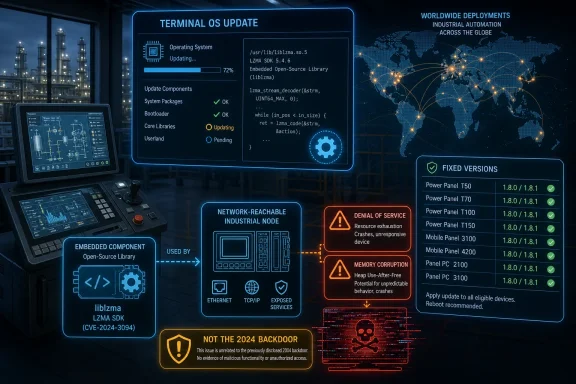 A Compression Bug Becomes an Industrial Reliability Problem
The vulnerable component is liblzma, the compression library shipped with XZ Utils. In ordinary IT environments, XZ is the sort of infrastructure software people rarely think about until something goes wrong: it compresses and decompresses archives, sits in package-management workflows, and appears as a dependency in operating systems and appliances. In industrial environments, that same quiet ubiquity becomes harder to manage because components are often bundled into vendor-maintained firmware images, terminal operating systems, and embedded platforms.CVE-2025-31115 affects XZ Utils versions 5.3.3alpha through 5.8.0. The specific weak spot is the multithreaded
.xz decoder path exposed through lzma_stream_decoder_mt, where invalid input can trigger a crash and memory-safety failures including heap use-after-free behavior and writes based on a null pointer plus an offset. The vendor-scored CVSS 3.1 rating is 7.5, with the vector describing a network-reachable, low-complexity, no-authentication attack that primarily affects availability.That matters because B&R’s affected products are not general-purpose Linux desktops sitting under a developer’s desk. They are industrial terminal products used in critical manufacturing settings, deployed worldwide, and maintained under operational constraints that make even a “simple” library update a planning exercise. A bug that would be handled with a routine package update in a server fleet can become a production-window negotiation on the plant floor.
The advisory says an attacker with network access to an affected system node could exploit the vulnerability. It also says B&R had not received reports of exploitation when the advisory was originally issued, and that the vulnerability had already been publicly disclosed. That combination is familiar in industrial cybersecurity: public technical knowledge exists, vendor fixes exist, active exploitation is not reported, and defenders still have to decide how quickly they can touch equipment that may be tied to uptime commitments.
This Is Not the XZ Backdoor, and That Distinction Matters
The word “XZ” still carries baggage. In 2024, XZ Utils became shorthand for a near-catastrophic open-source supply-chain compromise after malicious code was discovered in release tarballs for versions 5.6.0 and 5.6.1. That incident was a trust failure, a maintainer-takeover story, and a warning about the fragility of critical open-source infrastructure.CVE-2025-31115 is different. It is a software bug in the multithreaded decoder, not an alleged backdoor and not a covert authentication bypass. Its described impact is crash and memory corruption from invalid input, with availability impact scored high and confidentiality and integrity impact scored none in the vendor vector.
That distinction should calm some of the more dramatic instincts around the advisory, but it should not make administrators complacent. Industrial operators care deeply about availability because downtime has physical-world consequences: stopped lines, delayed batches, interrupted human-machine interface sessions, or cascading operational workarounds. In a manufacturing environment, an attack that “only” crashes a node can still be a business-impacting incident.
There is also a subtler lesson. The XZ backdoor made headlines because it was spectacular; this bug is more mundane, and therefore more representative. Most supply-chain risk is not a spy-novel compromise. It is an ordinary vulnerability in a common component that becomes difficult to remediate because it is buried in a product lifecycle that spans years.
B&R’s Fix Is Straightforward, but the Deployment Story Is Not
B&R’s remediation matrix is clean: update affected devices to the specified Terminal OS releases. PPC3100, FT50, MT50, and T50 devices are corrected in version 1.8.1. C50, C80, T30, and T80 devices are corrected in version 1.8.0. Earlier versions in the listed product lines are known affected, and the advisory recommends applying the update at the earliest convenience.The phrase “earliest convenience” always reads differently in industrial control than it does in consumer computing. On a Windows laptop, it may mean tonight. In a regulated or safety-sensitive manufacturing cell, it may mean after validation, after backups, after change-control approval, after operator communication, and after a maintenance window that may already be overbooked.
That does not make the patch optional. It means the real work is inventory and sequencing. Operators need to know which terminals are running which Terminal OS release, where those terminals sit in the production architecture, whether they are reachable from less trusted networks, and whether updating one node has implications for HMI behavior, application compatibility, or support contracts.
B&R points customers to the user manual for update installation and version identification. That is useful, but it also illustrates the tension in ICS remediation. The vendor can publish a version table; the customer still has to map that table onto living infrastructure, including spare units, lab systems, contractor-maintained panels, and machines delivered by OEMs that may not be documented as cleanly as central IT would like.
The CVSS Score Tells the Truth Only Narrowly
A 7.5 high-severity score is neither trivial nor apocalyptic. The vector says the attack can be launched over the network, requires low complexity, needs no privileges, and requires no user interaction. It also says the scoped impact is availability, not data theft or unauthorized modification.That is a useful starting point, but CVSS has always struggled with industrial context. The scoring system can describe the software impact, but it does not know whether the affected terminal sits in a training room, a packaging line, a pharmaceutical batch process, or a machine guarding environment. Availability has different meanings depending on what the unavailable thing is doing.
This is why CISA’s standard recommended practices still matter even when a vendor patch exists. Minimize network exposure. Keep control systems off the public internet. Place them behind firewalls. Separate control networks from business networks. Use remote access cautiously, preferably through maintained VPN infrastructure and with the understanding that VPNs are not magic shields.
Those recommendations can sound boilerplate because they appear in advisory after advisory. They are boilerplate for a reason: if a vulnerability is network reachable, network architecture determines whether it is a practical threat or a theoretical one. A vulnerable node that cannot be reached from untrusted segments is still vulnerable, but the defender has bought time and reduced blast radius.
Memory Corruption Still Haunts the Supposedly Boring Layers
The technical detail that should catch an engineer’s eye is not just “crash.” It is heap use after free and writing to an address derived from null plus an offset. Those are the kinds of memory-safety failures that security teams treat carefully, even when the published impact is denial of service.Not every memory corruption bug becomes reliable code execution, and this advisory does not claim remote code execution. But memory corruption has a long history of surprising people who initially categorized a flaw as merely a stability problem. The prudent operational stance is to treat the availability impact as confirmed and anything beyond that as unproven, not impossible.
That nuance matters for WindowsForum readers because many of us come from traditional IT, where patch triage often sorts vulnerabilities into neat buckets: RCE, privilege escalation, information disclosure, denial of service. Industrial environments resist those tidy labels. A denial-of-service bug in the wrong embedded terminal can be operationally more serious than a theoretical privilege escalation on a well-isolated desktop.
The other lesson is that multithreading remains a rich source of security bugs. Race conditions within a thread or between execution paths are notoriously hard to reason about, especially in performance-sensitive code that processes hostile or malformed input. Compression libraries are optimized, widely reused, and often trusted to parse files or streams before higher-level application logic gets involved. That is a combustible combination.
Public Disclosure Changes the Patch Clock
The advisory notes that the vulnerability had been publicly disclosed when the B&R advisory was issued. That does not automatically mean working exploit code is circulating for B&R devices, and the vendor reported no known exploitation at original publication. It does mean the underlying bug is no longer private knowledge.For defenders, public disclosure changes the calculation. Attackers do not need intimate knowledge of B&R’s product internals to understand the general XZ Utils bug. They need only find reachable products using affected code paths and determine whether malformed compressed input can be delivered in a useful way. Whether that path exists in a given deployment depends on product behavior, configuration, and exposure.
The CSAF conversion into a CISA ICS advisory also expands visibility. That is the point of republication: to put vendor advisories in front of operators who may not track every supplier’s security page. But visibility cuts both ways. The same searchable notice that helps asset owners can also help threat researchers, red teams, and opportunists build target lists.
This is why the best answer is not panic, but acceleration. If an operator already has a defensible patch process, this advisory should move affected terminals into that process quickly. If the process depends on informal spreadsheets and tribal knowledge, this advisory is another argument for building a real software bill of materials and firmware inventory discipline.
The Affected Product List Is Short, but the Ownership Chain May Not Be
The named affected products are clear: PPC3100 before and including 1.8.1 in the vulnerable range as described by the advisory, C50 before and including 1.8.0, C80 before and including 1.8.0, FT50 before and including 1.8.1, MT50 before and including 1.8.1, T30 before and including 1.8.0, T80 before and including 1.8.0, and T50 before and including 1.8.1, with corrected versions listed per product family. The practical reading is simple: check the installed Terminal OS version against B&R’s fixed release table and update if the device is below the corrected baseline.But ownership in industrial environments is often more complicated than the product table. A plant may use B&R terminals directly, or they may arrive as part of a larger machine built by an OEM. The people responsible for cybersecurity may not be the same people authorized to change the machine. The device may be supported by a vendor contract that requires coordination before firmware changes.
That is where vulnerability management stops being a scanner report and becomes a governance problem. Security teams can identify affected assets, but operations teams must schedule and validate changes. Engineering teams may need to confirm that HMI projects, recipes, drivers, or peripheral integrations behave as expected after the Terminal OS update. Procurement may need to press OEMs for updated images or explicit confirmation that shipped systems are not affected.
The advisory’s worldwide deployment language also matters. This is not a niche regional issue. B&R products are used across global manufacturing footprints, which means large organizations may have to coordinate remediation across sites, languages, time zones, and differing local maintenance cultures.
The Windows Lesson Is About Dependencies, Not Operating Systems
At first glance, a B&R terminal advisory about XZ Utils may seem outside the WindowsForum lane. It is not. Windows administrators increasingly own or influence edge systems, industrial PCs, HMI stations, jump boxes, and management workstations that sit near operational technology. Even when the vulnerable component is not inside Windows itself, the patching workflow often touches Windows-managed networks and Windows-based administrative tooling.The deeper Windows lesson is dependency awareness. Enterprise IT has spent years learning that applications are bundles of third-party libraries, package managers, runtimes, drivers, and services. OT is living through the same lesson, but with longer device lifecycles and higher tolerance for old-but-stable platforms. The library nobody thought about during procurement becomes the library everybody has to track during a vulnerability event.
Windows shops also know the cultural split between “patch now” and “do not break production.” That split is sharper in manufacturing. A sysadmin can usually reboot a redundant server cluster with planning; a plant engineer may be looking at a terminal attached to a machine that produces revenue every minute it is running. Advisories like this demand a bridge between those instincts.
That bridge is not built by pretending industrial systems can patch like laptops. It is built by bringing IT-grade inventory, segmentation, logging, and change management to OT without dismissing operational constraints. The answer is neither reckless speed nor indefinite deferral. It is measured urgency.
CISA’s Boilerplate Is Really the Architecture Argument
CISA’s recommended practices read familiar because they are designed to be reusable across ICS advisories. Minimize exposure. Keep control systems off the internet. Use firewalls. Isolate control networks from business networks. Use secure remote access methods and maintain the systems that provide that access. Perform impact analysis and risk assessment before defensive changes.It is tempting to skip that text because it appears so often. That would be a mistake. For CVE-2025-31115, the difference between a high-severity vulnerability and an urgent incident may be whether the affected product is reachable by an attacker in the first place.
Segmentation is not a substitute for patching; it is what keeps patching from becoming a race against every newly published bug. A well-segmented architecture gives defenders time to test updates, coordinate maintenance windows, and apply fixes without gambling that no one will notice a public advisory. A flat network turns every vendor notice into a fire drill.
Remote access deserves special scrutiny. Many manufacturing environments have legitimate needs for vendor support, remote diagnostics, and engineering access. But a VPN into a poorly segmented environment can become a privileged tunnel to vulnerable assets, and CISA correctly notes that VPNs themselves must be kept current. “Remote access exists” should trigger a review of who can reach affected B&R nodes, from where, using which credentials, and with what logging.
The Advisory Pipeline Is Becoming Part of the Product
One interesting aspect of this case is the route from vendor advisory to CISA republication. The CISA notice says it is a verbatim republication of ABB PSIRT SA26P009 from a direct conversion of the vendor’s CSAF advisory, provided as-is for visibility. That is not merely administrative trivia.CSAF, the Common Security Advisory Framework, is part of a larger shift toward machine-readable vulnerability communication. In theory, it allows vendors, coordinators, asset owners, and security tools to exchange advisory data more efficiently. Product names, versions, CVEs, scores, remediations, and affected statuses can be parsed without a human copying fields out of a PDF.
That matters enormously for industrial environments. If advisories remain prose documents, every organization has to manually interpret them, normalize product names, and compare them to inventory. If advisories become structured data and inventories become accurate, vulnerability response can become less artisanal. That is the promise, at least.
The risk is that structured advisories can create a false sense of precision. A CSAF file may describe affected versions cleanly, but it cannot know whether a terminal in a plant has been customized, isolated, left in a cabinet as a spare, or embedded into an OEM machine whose documentation uses a different naming convention. Automation helps most when humans have already done the hard work of asset hygiene.
ABB’s Role Reflects the Consolidated Industrial Market
B&R Industrial Automation is part of ABB, and the advisory is associated with ABB PSIRT. That corporate detail is more than a logo line. Industrial cybersecurity increasingly runs through large multinational vendors with broad portfolios, acquired product lines, and central product security teams responsible for coordinating disclosures across many device families.For customers, that can be a benefit. A mature PSIRT can standardize advisory handling, publish structured data, coordinate with CISA, and maintain a public security posture. It can also be a source of confusion when a product is branded one way, supported through another channel, and republished by a government coordinator under a third banner.
The practical approach is to follow the product and version, not just the corporate name. If the plant has B&R PPC3100, C50, C80, FT50, MT50, T30, T80, or T50 terminals, the advisory is relevant regardless of whether the security bulletin arrives through B&R, ABB, CISA, an integrator, or an OEM. Asset owners should resist the common trap of assuming “we do not use that vendor” because procurement records name the machine builder rather than the embedded control component.
This is also where vendor communication quality matters. A good advisory does not merely say “update.” It tells customers which product versions are affected, which versions contain the fix, what kind of impact is expected, whether exploitation is known, and what mitigations apply if immediate patching is not feasible. This advisory largely does that, though customers will still need product manuals and local knowledge to execute the work.
The Real Risk Is the Long Tail After the Fixed Version Exists
The fixed versions are available. That is the good news. The bad news is that availability of a fix is often the beginning, not the end, of industrial remediation.There will be devices updated promptly by mature organizations with strong inventories and maintenance windows. There will be devices updated months later because a production line cannot stop until a seasonal shutdown. There will be devices nobody touches because they are behind a machine builder’s support boundary. There will be devices that remain vulnerable because the people who know they exist have retired, moved sites, or never had a reason to tell central security about them.
This long tail is where attackers thrive. They do not need every deployment to be exposed. They need enough exposed or reachable systems that the economics of scanning and probing make sense. Public advisories create a menu of possibilities; poor inventory and weak segmentation decide which items on the menu are reachable.
The fix, again, is not only technical. It is procedural. Organizations need a way to translate public vulnerability information into site-specific action: identify assets, confirm versions, determine exposure, schedule updates, validate function, document exceptions, and revisit temporary mitigations. Without that loop, every advisory becomes an isolated scramble.
The Plant-Floor Version of Patch Tuesday Is Still Immature
Windows administrators live with Patch Tuesday as a rhythm. It is imperfect, sometimes painful, and occasionally dramatic, but it gives organizations a predictable cadence for vulnerability triage. Industrial firmware and terminal operating systems rarely enjoy that same rhythm. Updates arrive per vendor, per product family, and per operational constraint.That fragmentation is one reason advisories like this feel heavier than their CVSS score. A single Windows cumulative update can cover a broad fleet. A B&R Terminal OS update requires product-specific handling, and each affected model has its own fixed release threshold. The underlying library flaw may be common, but the remediation is productized.
The industry has improved. Coordinated disclosure is more normal. PSIRTs are more visible. CISA’s ICS advisories are easier to track than scattered vendor PDFs. Machine-readable formats are gaining ground. But the plant-floor patch model remains less mature than enterprise IT, especially for organizations that treat OT cybersecurity as an extension of safety or engineering rather than a shared responsibility with IT.
That maturity gap is where WindowsForum’s audience has a role. Sysadmins and IT pros understand patch governance, vulnerability prioritization, remote access hygiene, and network segmentation. The challenge is applying that muscle respectfully in environments where uptime, validation, and process safety are non-negotiable.
The Version Table Is Small Enough to Act On
The most useful feature of this advisory is that it gives defenders a bounded task. The product list is not endless, the fixed versions are explicit, and the impact statement is clear enough to support prioritization. That makes this a manageable remediation effort for organizations that have their inventories in order.- Organizations using B&R PPC3100, FT50, MT50, or T50 terminals should verify whether they are running Terminal OS 1.8.1 or later.
- Organizations using B&R C50, C80, T30, or T80 terminals should verify whether they are running Terminal OS 1.8.0 or later.
- Security teams should treat network reachability as the main exposure question because the advisory describes exploitation by an attacker with network access to an affected node.
- Operations teams should schedule updates through normal change-control processes, but they should not allow “no known exploitation” to become a reason for indefinite delay.
- Asset owners should confirm whether B&R components are present inside OEM-supplied machinery, not just in centrally purchased devices.
- Temporary reliance on segmentation, firewalls, and restricted remote access should be documented as a mitigation, not mistaken for permanent remediation.
Small Libraries Now Carry Factory-Scale Consequences
The larger story here is the shrinking distance between open-source maintenance and industrial uptime. A compression library maintained outside the traditional industrial vendor ecosystem can end up inside terminals that support real production environments. When that library fails, the response has to move through vendor advisories, government republication, plant maintenance windows, and risk committees.That supply chain is not inherently broken. Reusing open-source components is sensible, efficient, and often more secure than inventing proprietary equivalents. The problem is opacity: customers need to know what components they have, vendors need to communicate clearly when those components are affected, and operators need architectures that assume vulnerabilities will keep arriving.
CVE-2025-31115 is therefore not a once-in-a-generation event. It is ordinary modern infrastructure risk crossing into operational technology. Its very ordinariness is what makes it important. If defenders only mobilize for spectacular backdoors and headline-grabbing RCEs, they will miss the steady accumulation of bugs that can still interrupt production.
For B&R customers, the near-term answer is plain: check the Terminal OS version, apply the fixed release, and tighten exposure while updates move through change control. For everyone else, the advisory is a useful rehearsal. The next embedded dependency bug may not be in XZ Utils, and it may not affect these terminals, but it will arrive through the same fragile chain of component reuse, product packaging, advisory translation, and operational delay. The organizations that handle this one cleanly will be better prepared when the next quiet library becomes tomorrow’s factory-floor problem.
References
- Primary source: CISA
Published: 2026-06-30T12:00:00+00:00
- Related coverage: sentinelone.com
CVE-2025-31115: XZ Utils Use-After-Free Vulnerability
CVE-2025-31115 is a use-after-free vulnerability in XZ Utils liblzma decoder. Learn about its impact, affected versions, and mitigation methods.www.sentinelone.com
- Related coverage: wiz.io
CVE-2025-31115 Impact, Exploitability, and Mitigation Steps | Wiz
Understand the critical aspects of CVE-2025-31115 with a detailed vulnerability assessment, exploitation potential, affected technologies, and remediation guidance.www.wiz.io - Related coverage: br-automation.com
Cyber Security Advisories and Notices | B&R Industrial Automation
Current information and concrete recommendations from B&R for action around cyber security.www.br-automation.com - Related coverage: br-cws-assets.de-fra-1.linodeobjects.com