

Google Chrome’s CVE-2026-13776 is a critical type-confusion flaw in the Dawn graphics layer, fixed in Chrome 150.0.7871.47 on June 30, 2026, and NVD’s change history indicates that Chrome CPE data was added even if the public page still shows a loading prompt.
That is the small but important disconnect in this record: the vulnerability is not mysterious, but the metadata around it is visibly unsettled. The bigger story is that a browser sandbox escape no longer needs to look like a dramatic zero-day headline to deserve fast treatment from Windows admins. In 2026, the dangerous vulnerabilities are often the ones that arrive with enough structured data to trigger patching workflows, but not enough clarity to satisfy the people who have to defend those workflows.
The NVD entry for CVE-2026-13776 says “CPEs loading” in the affected software section, but the change history tells a more useful story. NIST’s initial analysis on July 1 added a CPE configuration for Google Chrome versions before 150.0.7871.47, with operating-system context for Windows, Linux, and macOS.
That means the practical answer is: no, this does not appear to be a truly absent CPE in the enrichment trail. It appears to be a presentation or synchronization issue on the NVD page, or at least a case where the visible “Known Affected Software Configurations” widget is lagging behind the record’s own change log.
For vulnerability managers, that distinction matters. A missing CPE can mean scanners fail to match vulnerable assets, dashboards undercount exposure, and compliance evidence becomes awkward. A slow-loading or inconsistently rendered CPE block is less severe, but it still creates friction because many teams treat the NVD page as the canonical place where the vulnerability becomes operationally real.
The exact CPE string shown in the change history is for Google Chrome with versions up to, but excluding, 150.0.7871.47. That is the line administrators should care about more than the spinner-like “loading” language. If your inventory contains Chrome below that build, the remediation target is clear even if the front-end display is not.
A type-confusion vulnerability is not automatically a full compromise by itself. At its simplest, it means software handles a resource as though it were one kind of object when it is really another, creating a path to memory corruption or unintended behavior. In a browser, that can become especially serious when the vulnerable component sits near powerful rendering or GPU pathways.
The CVE description is careful: an attacker would need to have compromised the renderer process first. That condition matters, because it means this is not described as a single-click, standalone compromise from a clean browser state. But it also means the flaw belongs in the second stage of the exploit chain, the point where an attacker tries to break out of the containment that makes browser exploitation survivable.
That is why Chromium classified the issue as critical. Browser sandboxes are designed around the assumption that renderer bugs will happen. A sandbox escape is the difference between “a hostile page abused the renderer” and “a hostile page may have reached beyond the renderer into the system boundary users actually care about.”
That is not just bookkeeping trivia. A crafted HTML page normally implies a user must visit or be redirected to content, which is why CISA’s vector includes user interaction. NVD’s vector, by contrast, treats the attack more abstractly as network-accessible and not requiring privileges or user interaction.
Neither score should lead defenders to complacency. Both land in critical territory, both include high confidentiality, integrity, and availability impact, and both describe a vulnerability that can be used after renderer compromise to attempt a sandbox escape. The difference is about modeling, not about whether the bug matters.
This is where CVSS can be both essential and misleading. It is essential because large enterprises need normalized severity data to sort thousands of issues. It is misleading because browser exploitability depends on chains, mitigations, site isolation, process boundaries, exploit reliability, and the availability of a first-stage renderer bug — factors that rarely fit neatly into one number.
That volume matters because it changes how administrators should read any single CVE in the batch. CVE-2026-13776 is serious on its own, but it arrived in a release train loaded with other high-impact fixes. Treating the update as a one-CVE emergency understates the release; treating it as routine browser churn understates the risk.
Chrome’s security model depends heavily on rapid update adoption. Google can fix the bug, Chromium downstreams can merge the patch, and NVD can enrich the record, but none of that helps a fleet that defers browser restarts for a week because “the browser updates itself.” On managed Windows endpoints, the distance between “update downloaded” and “protected process actually running” is often a reboot, a relaunch, or a user who keeps 47 tabs alive indefinitely.
The Extended Stable Channel also matters for enterprises. PCWorld noted that the extended stable channel for Windows and macOS included the relevant Chromium version. That gives slower-moving organizations a supported path, but it does not remove the need to verify the actual installed version rather than assume a policy ring has done its job.
That is why defenders should resist the temptation to downgrade this issue mentally just because it is not described as exploited in the wild. CISA’s SSVC data lists exploitation as “none,” and the NVD material does not say Google observed active exploitation for CVE-2026-13776. That is useful information, but it is not the same as safety.
A critical sandbox escape candidate is exactly the kind of vulnerability that becomes more valuable once paired with another bug. Browser exploit chains are assembled from parts: a renderer entry point, a sandbox escape, sometimes a privilege escalation, and often a bypass for a mitigation that previously made the chain unreliable. CVE-2026-13776 appears to sit in that second-stage category.
For consumer users, the advice is simple: update Chrome and restart it. For IT, the job is more tedious: prove which channel each device is on, prove the version actually launched after update, and check Chromium-based browsers that may inherit similar code paths on different schedules.
That does not mean every Chromium-based browser was automatically vulnerable to CVE-2026-13776 in the same build numbers. It means administrators should not stop at Chrome if their estate includes multiple Chromium derivatives. The responsible move is to check each vendor’s release notes and patch status rather than assume Google’s fixed version number maps cleanly across the ecosystem.
Microsoft Edge is the obvious one for Windows organizations, because Edge is present even in environments where Chrome is not the default browser. Edge’s servicing model is separate from Chrome’s, and Microsoft usually publishes its own security update notes for Chromium-based fixes. The operational point is that a Chromium bug can become a Windows fleet issue even when Chrome is not the corporate standard.
The same logic applies to application runtimes that embed Chromium technology. Electron apps, WebView2-dependent applications, and bundled browser components have made “the browser” less of a single executable and more of a supply chain. CVE-2026-13776 is specifically described against Google Chrome, but the component-level lesson is broader: graphics and rendering code travels.
In this case, the CVE was received from Chrome on June 30, NIST added analysis on July 1, CISA-ADP added its own CVSS vector and SSVC data later that day, and CISA modified the SSVC timestamp on July 2. The record also shows the public reference to Google’s Chrome Releases advisory and a restricted Chromium issue tracker entry.
That cadence is normal for fast-moving CVEs, but it creates ambiguity. A scanner may ingest the Chrome CNA description before NVD adds a CPE. A risk tool may ingest NVD’s CVSS vector before CISA’s alternative score appears. A human analyst may look at the affected-software block while it is not rendering properly and conclude the record lacks structured product data.
The fix is not to abandon NVD. The fix is to stop pretending NVD is the only source that matters in the first 48 hours of a major browser update. Vendor advisories, CVE change history, CISA enrichment, endpoint inventory, and patch management telemetry all need to be reconciled before a team can say with confidence that exposure is understood.
That restriction is defensible. Full technical detail too early can shorten the window between patch publication and exploit replication. For critical memory-safety and sandbox-escape issues, disclosure timing is part of the defense.
It is also frustrating for defenders. Security teams are asked to prioritize a bug whose deepest technical detail is hidden, while executives ask whether the risk is theoretical, weaponized, or relevant to their environment. The answer often has to be probabilistic: no public exploitation is reported, but the bug class and component justify fast patching.
This is where vendor severity still matters. Chromium’s “Critical” label is not decorative. Google uses it sparingly compared with the flood of medium and high issues that land in large browser releases, and a critical severity attached to a sandbox escape path should move the issue out of ordinary patch-cycle debate.
On Windows, administrators should verify the installed and running Chrome version through enterprise tooling, not just rely on update policy intent. Chrome’s About page is fine for an individual machine, but fleet verification belongs in Microsoft Intune, Configuration Manager, endpoint detection tooling, asset inventory, or whatever patch platform the organization trusts.
The awkward cases are the ones that always make browser patching messy. Shared workstations may have stale processes. Virtual desktop images may be patched in the gold image but not in persistent user profiles. Kiosk systems may suppress restarts. Servers with Chrome installed for automation may be forgotten because no one thinks of a browser as server software.
A good patch report for this issue should answer three questions: which devices had Chrome below the fixed build, which devices have launched the fixed build after update, and which Chromium-based browsers or embedded runtimes remain outside the Chrome update path. Anything less is an assumption dressed up as a dashboard.
In this record, the Chrome CPE appears in the change history, so the immediate concern is probably not a missing mapping. But the fact that the page can present uncertainty while the change log contains the answer is itself a problem. Humans should not have to inspect the audit trail to determine whether a critical browser CVE has an affected product configuration.
This matters most in environments that automate service-level agreements from CVSS and CPE data. A critical score plus a matched CPE may trigger a 72-hour remediation clock. A critical score without a matched CPE may sit in a queue until an analyst manually confirms applicability. If the metadata stutters, the remediation clock stutters with it.
The better workflow is to treat CPE as necessary but not sufficient. For high-volume software like Chrome, a vendor advisory and a version boundary should be enough to begin remediation. CPE can confirm and normalize the record later; it should not be the only thing that convinces an organization to patch a critical browser bug.
That makes Chrome updates both routine and urgent. Users are trained to ignore them because they arrive constantly. Attackers study them because the diff between old and new code can reveal the shape of a vulnerability. Administrators sit in the middle, trying to avoid both panic and drift.
The June 30 release is a case study in that tension. Hundreds of fixes landed at once, a subset carried critical severity, and at least one vulnerability in Dawn received a CVE description pointing to a possible sandbox escape after renderer compromise. No single sentence screams catastrophe, but the combined signal is strong: this is a release to verify, not merely trust.
For Windows environments, browser update compliance should be measured closer to endpoint security than application hygiene. Chrome is often the first parser of hostile internet content, the holder of corporate sessions, and the runtime for business-critical web apps. If it lags, the exposure is immediate even when the operating system is fully patched.
That does not mean teams should patch blindly. It means they should build rules for classes of bugs where vendor severity and product prevalence justify action before every database field is polished. A critical Chrome sandbox escape candidate meets that bar.
The common objection is change risk. Browser updates can break extensions, enterprise web apps, automation scripts, and media workflows. That risk is real, as any admin who has lived through extension policy changes or site compatibility regressions knows. But the answer is rings and rollback planning, not indefinite delay.
A mature Chrome update process should have a fast lane for critical security releases, a pilot ring that catches obvious breakage, and telemetry that proves completion. If the only process is “Chrome auto-updates eventually,” then the process is not a process; it is hope with a version number.
For WindowsForum readers, the most useful takeaways are concrete:
That is the small but important disconnect in this record: the vulnerability is not mysterious, but the metadata around it is visibly unsettled. The bigger story is that a browser sandbox escape no longer needs to look like a dramatic zero-day headline to deserve fast treatment from Windows admins. In 2026, the dangerous vulnerabilities are often the ones that arrive with enough structured data to trigger patching workflows, but not enough clarity to satisfy the people who have to defend those workflows.
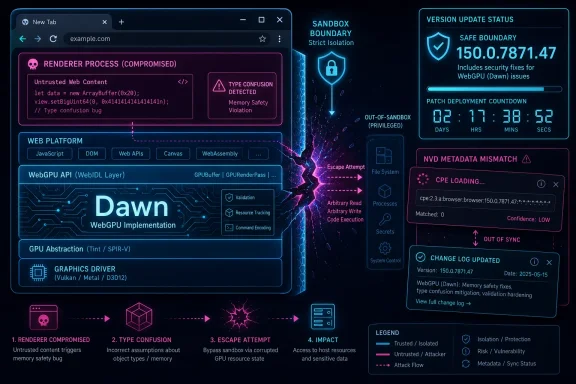 The Missing CPE Is Probably a Display Problem, Not a Missing Fact
The NVD entry for CVE-2026-13776 says “CPEs loading” in the affected software section, but the change history tells a more useful story. NIST’s initial analysis on July 1 added a CPE configuration for Google Chrome versions before 150.0.7871.47, with operating-system context for Windows, Linux, and macOS.That means the practical answer is: no, this does not appear to be a truly absent CPE in the enrichment trail. It appears to be a presentation or synchronization issue on the NVD page, or at least a case where the visible “Known Affected Software Configurations” widget is lagging behind the record’s own change log.
For vulnerability managers, that distinction matters. A missing CPE can mean scanners fail to match vulnerable assets, dashboards undercount exposure, and compliance evidence becomes awkward. A slow-loading or inconsistently rendered CPE block is less severe, but it still creates friction because many teams treat the NVD page as the canonical place where the vulnerability becomes operationally real.
The exact CPE string shown in the change history is for Google Chrome with versions up to, but excluding, 150.0.7871.47. That is the line administrators should care about more than the spinner-like “loading” language. If your inventory contains Chrome below that build, the remediation target is clear even if the front-end display is not.
Dawn Turns a Graphics Bug Into a Browser Boundary Problem
CVE-2026-13776 lives in Dawn, Chromium’s WebGPU implementation layer. That makes it part of a broader pattern in modern browser security: the web platform keeps becoming more capable, and the attack surface follows it into graphics, acceleration, machine learning, media, storage, and device-adjacent APIs.A type-confusion vulnerability is not automatically a full compromise by itself. At its simplest, it means software handles a resource as though it were one kind of object when it is really another, creating a path to memory corruption or unintended behavior. In a browser, that can become especially serious when the vulnerable component sits near powerful rendering or GPU pathways.
The CVE description is careful: an attacker would need to have compromised the renderer process first. That condition matters, because it means this is not described as a single-click, standalone compromise from a clean browser state. But it also means the flaw belongs in the second stage of the exploit chain, the point where an attacker tries to break out of the containment that makes browser exploitation survivable.
That is why Chromium classified the issue as critical. Browser sandboxes are designed around the assumption that renderer bugs will happen. A sandbox escape is the difference between “a hostile page abused the renderer” and “a hostile page may have reached beyond the renderer into the system boundary users actually care about.”
The CVSS Split Shows Why Browser Bugs Confuse Dashboards
The NVD and CISA-ADP scoring differ in a way that will look familiar to anyone who has watched browser CVEs move through automated systems. NVD lists a CVSS 3.1 base score of 9.8 with no user interaction and unchanged scope. CISA-ADP lists 9.6 with user interaction required and changed scope.That is not just bookkeeping trivia. A crafted HTML page normally implies a user must visit or be redirected to content, which is why CISA’s vector includes user interaction. NVD’s vector, by contrast, treats the attack more abstractly as network-accessible and not requiring privileges or user interaction.
Neither score should lead defenders to complacency. Both land in critical territory, both include high confidentiality, integrity, and availability impact, and both describe a vulnerability that can be used after renderer compromise to attempt a sandbox escape. The difference is about modeling, not about whether the bug matters.
This is where CVSS can be both essential and misleading. It is essential because large enterprises need normalized severity data to sort thousands of issues. It is misleading because browser exploitability depends on chains, mitigations, site isolation, process boundaries, exploit reliability, and the availability of a first-stage renderer bug — factors that rarely fit neatly into one number.
Chrome 150 Was Not a Routine Point Release
Google’s Chrome Releases blog shipped the fix as part of the Stable Channel Update for Desktop on June 30, moving Windows and macOS users to Chrome 150.0.7871.46 or 150.0.7871.47 and Linux users to 150.0.7871.46. PCWorld reported that Chrome 150 addressed nearly 400 security flaws, including a cluster of critical issues in the CVE-2026-13774 through CVE-2026-13788 range.That volume matters because it changes how administrators should read any single CVE in the batch. CVE-2026-13776 is serious on its own, but it arrived in a release train loaded with other high-impact fixes. Treating the update as a one-CVE emergency understates the release; treating it as routine browser churn understates the risk.
Chrome’s security model depends heavily on rapid update adoption. Google can fix the bug, Chromium downstreams can merge the patch, and NVD can enrich the record, but none of that helps a fleet that defers browser restarts for a week because “the browser updates itself.” On managed Windows endpoints, the distance between “update downloaded” and “protected process actually running” is often a reboot, a relaunch, or a user who keeps 47 tabs alive indefinitely.
The Extended Stable Channel also matters for enterprises. PCWorld noted that the extended stable channel for Windows and macOS included the relevant Chromium version. That gives slower-moving organizations a supported path, but it does not remove the need to verify the actual installed version rather than assume a policy ring has done its job.
The Renderer Requirement Is a Warning, Not a Reassurance
The phrase “attacker who had compromised the renderer process” may sound like a limiting factor. In practice, it is a reminder that Chrome vulnerabilities often become dangerous in combination. Attackers do not need every bug to do everything; they need one bug to get code running in the renderer and another to escape the sandbox.That is why defenders should resist the temptation to downgrade this issue mentally just because it is not described as exploited in the wild. CISA’s SSVC data lists exploitation as “none,” and the NVD material does not say Google observed active exploitation for CVE-2026-13776. That is useful information, but it is not the same as safety.
A critical sandbox escape candidate is exactly the kind of vulnerability that becomes more valuable once paired with another bug. Browser exploit chains are assembled from parts: a renderer entry point, a sandbox escape, sometimes a privilege escalation, and often a bypass for a mitigation that previously made the chain unreliable. CVE-2026-13776 appears to sit in that second-stage category.
For consumer users, the advice is simple: update Chrome and restart it. For IT, the job is more tedious: prove which channel each device is on, prove the version actually launched after update, and check Chromium-based browsers that may inherit similar code paths on different schedules.
Windows Shops Should Read This as a Chromium Ecosystem Event
WindowsForum readers know the trap: “Chrome bug” does not always mean “only Google Chrome problem.” Chromium is the base for Microsoft Edge, Brave, Vivaldi, Opera, and other browsers, though each vendor ships on its own cadence and may not expose every component in the same way at the same time.That does not mean every Chromium-based browser was automatically vulnerable to CVE-2026-13776 in the same build numbers. It means administrators should not stop at Chrome if their estate includes multiple Chromium derivatives. The responsible move is to check each vendor’s release notes and patch status rather than assume Google’s fixed version number maps cleanly across the ecosystem.
Microsoft Edge is the obvious one for Windows organizations, because Edge is present even in environments where Chrome is not the default browser. Edge’s servicing model is separate from Chrome’s, and Microsoft usually publishes its own security update notes for Chromium-based fixes. The operational point is that a Chromium bug can become a Windows fleet issue even when Chrome is not the corporate standard.
The same logic applies to application runtimes that embed Chromium technology. Electron apps, WebView2-dependent applications, and bundled browser components have made “the browser” less of a single executable and more of a supply chain. CVE-2026-13776 is specifically described against Google Chrome, but the component-level lesson is broader: graphics and rendering code travels.
NVD’s Enrichment Trail Is Now Part of the Story
The CVE page carries a banner saying the record was modified after NVD enrichment efforts were completed. That is bureaucratic language, but it describes a real problem for defenders: vulnerability records are no longer static enough to be treated as a one-time ingestion event.In this case, the CVE was received from Chrome on June 30, NIST added analysis on July 1, CISA-ADP added its own CVSS vector and SSVC data later that day, and CISA modified the SSVC timestamp on July 2. The record also shows the public reference to Google’s Chrome Releases advisory and a restricted Chromium issue tracker entry.
That cadence is normal for fast-moving CVEs, but it creates ambiguity. A scanner may ingest the Chrome CNA description before NVD adds a CPE. A risk tool may ingest NVD’s CVSS vector before CISA’s alternative score appears. A human analyst may look at the affected-software block while it is not rendering properly and conclude the record lacks structured product data.
The fix is not to abandon NVD. The fix is to stop pretending NVD is the only source that matters in the first 48 hours of a major browser update. Vendor advisories, CVE change history, CISA enrichment, endpoint inventory, and patch management telemetry all need to be reconciled before a team can say with confidence that exposure is understood.
The Restricted Chromium Bug Is Normal, and Still Frustrating
The Chromium issue linked from the CVE record is marked in a way that indicates restricted access or permissions required. That is common for serious browser security bugs. Vendors often limit details until enough users have updated, especially when a bug could be turned into a working exploit by someone with the right skills.That restriction is defensible. Full technical detail too early can shorten the window between patch publication and exploit replication. For critical memory-safety and sandbox-escape issues, disclosure timing is part of the defense.
It is also frustrating for defenders. Security teams are asked to prioritize a bug whose deepest technical detail is hidden, while executives ask whether the risk is theoretical, weaponized, or relevant to their environment. The answer often has to be probabilistic: no public exploitation is reported, but the bug class and component justify fast patching.
This is where vendor severity still matters. Chromium’s “Critical” label is not decorative. Google uses it sparingly compared with the flood of medium and high issues that land in large browser releases, and a critical severity attached to a sandbox escape path should move the issue out of ordinary patch-cycle debate.
The Version Boundary Is the Cleanest Signal Administrators Have
For all the complexity in the record, the remediation line is refreshingly concrete: Chrome before 150.0.7871.47 is in scope for this CVE, according to the NVD description and change history. The release itself uses slightly different build endings by platform, but the CVE record’s affected-version boundary points to 150.0.7871.47 as the exclusion line.On Windows, administrators should verify the installed and running Chrome version through enterprise tooling, not just rely on update policy intent. Chrome’s About page is fine for an individual machine, but fleet verification belongs in Microsoft Intune, Configuration Manager, endpoint detection tooling, asset inventory, or whatever patch platform the organization trusts.
The awkward cases are the ones that always make browser patching messy. Shared workstations may have stale processes. Virtual desktop images may be patched in the gold image but not in persistent user profiles. Kiosk systems may suppress restarts. Servers with Chrome installed for automation may be forgotten because no one thinks of a browser as server software.
A good patch report for this issue should answer three questions: which devices had Chrome below the fixed build, which devices have launched the fixed build after update, and which Chromium-based browsers or embedded runtimes remain outside the Chrome update path. Anything less is an assumption dressed up as a dashboard.
The CPE Question Exposes a Bigger Automation Weakness
The user-facing question — “Are we missing a CPE here?” — is exactly the kind of question vulnerability teams ask when structured metadata does not line up with the operational urgency of a patch. CPEs are the plumbing of vulnerability management. When they are absent, wrong, duplicated, or delayed, the rest of the machine makes bad decisions.In this record, the Chrome CPE appears in the change history, so the immediate concern is probably not a missing mapping. But the fact that the page can present uncertainty while the change log contains the answer is itself a problem. Humans should not have to inspect the audit trail to determine whether a critical browser CVE has an affected product configuration.
This matters most in environments that automate service-level agreements from CVSS and CPE data. A critical score plus a matched CPE may trigger a 72-hour remediation clock. A critical score without a matched CPE may sit in a queue until an analyst manually confirms applicability. If the metadata stutters, the remediation clock stutters with it.
The better workflow is to treat CPE as necessary but not sufficient. For high-volume software like Chrome, a vendor advisory and a version boundary should be enough to begin remediation. CPE can confirm and normalize the record later; it should not be the only thing that convinces an organization to patch a critical browser bug.
Chrome’s Security Velocity Is Becoming Its Own Administrative Burden
There is an uncomfortable truth in Chrome’s recent release pattern: the browser is patched aggressively because it has to be. Modern Chrome is an operating environment for untrusted code, graphics workloads, local storage, identity sessions, enterprise SaaS, extensions, media, and increasingly hardware-adjacent APIs. It is no longer a simple application in the old desktop sense.That makes Chrome updates both routine and urgent. Users are trained to ignore them because they arrive constantly. Attackers study them because the diff between old and new code can reveal the shape of a vulnerability. Administrators sit in the middle, trying to avoid both panic and drift.
The June 30 release is a case study in that tension. Hundreds of fixes landed at once, a subset carried critical severity, and at least one vulnerability in Dawn received a CVE description pointing to a possible sandbox escape after renderer compromise. No single sentence screams catastrophe, but the combined signal is strong: this is a release to verify, not merely trust.
For Windows environments, browser update compliance should be measured closer to endpoint security than application hygiene. Chrome is often the first parser of hostile internet content, the holder of corporate sessions, and the runtime for business-critical web apps. If it lags, the exposure is immediate even when the operating system is fully patched.
The Real Lesson Is to Patch Before the Metadata Settles
CVE-2026-13776 also shows why waiting for perfect vulnerability intelligence is a losing strategy. By the time NVD enrichment, CISA scoring, vendor advisories, scanner plugins, and asset mappings all agree, the useful patch window may already be shrinking.That does not mean teams should patch blindly. It means they should build rules for classes of bugs where vendor severity and product prevalence justify action before every database field is polished. A critical Chrome sandbox escape candidate meets that bar.
The common objection is change risk. Browser updates can break extensions, enterprise web apps, automation scripts, and media workflows. That risk is real, as any admin who has lived through extension policy changes or site compatibility regressions knows. But the answer is rings and rollback planning, not indefinite delay.
A mature Chrome update process should have a fast lane for critical security releases, a pilot ring that catches obvious breakage, and telemetry that proves completion. If the only process is “Chrome auto-updates eventually,” then the process is not a process; it is hope with a version number.
The Practical Signal Hiding in the CVE Noise
The clean reading of CVE-2026-13776 is narrower than the alarmist version and more urgent than the dismissive one. It is not currently described by NVD or CISA as exploited in the wild. It does require a prior renderer compromise. But it is critical, it affects Chrome before the fixed version, and it targets the sandbox boundary defenders rely on when renderer bugs happen.For WindowsForum readers, the most useful takeaways are concrete:
- The NVD change history indicates that a Chrome CPE configuration was added for versions before 150.0.7871.47, even if the affected-software display still appears incomplete or stuck.
- Chrome 150.0.7871.47 is the version boundary to use when checking exposure for CVE-2026-13776 in Google Chrome.
- The vulnerability is best understood as a sandbox-escape stage that becomes dangerous when paired with a renderer compromise.
- CISA’s current SSVC data indicates no known exploitation, but both CISA and NVD scoring still place the issue in critical territory.
- Windows administrators should verify the running browser version after restart, not merely confirm that an update package was offered.
- Chromium-based browsers and embedded runtimes should be reviewed separately because Google Chrome’s version number is not a universal patch-status signal.
References
- Primary source: NVD / Chromium
Published: 2026-07-03T07:00:40-07:00
NVD - CVE-2026-13776
 nvd.nist.gov
- Security advisory: MSRC
Published: 2026-07-03T07:00:40-07:00
Original feed URL
Security Update Guide - Microsoft Security Response Center
 msrc.microsoft.com
- Related coverage: cvefeed.io
CVE-2026-13776 - Google Chrome Type Confusion Sandbox Escape
Type Confusion in Dawn in Google Chrome prior to 150.0.7871.47 allowed a remote attacker who had compromised the renderer process to potentially perform a sandbox escape via a crafted HTML page. (Chromium security severity: Critical)cvefeed.io - Related coverage: labs.cloudsecurityalliance.org
NVD Enrichment Triage: Enterprise Vulnerability Programs Must Adapt
PDF documentlabs.cloudsecurityalliance.org
