

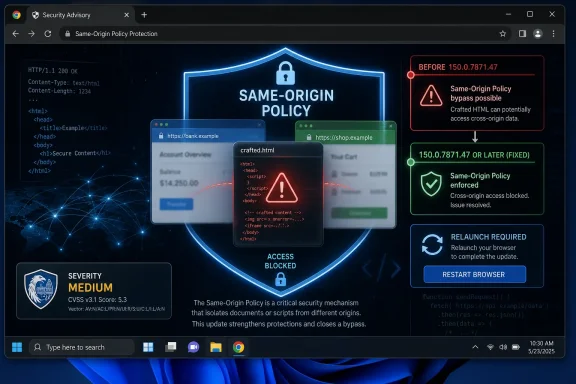
Google Chrome CVE-2026-13959 is a medium-severity Blink vulnerability, published by the National Vulnerability Database on June 30, 2026, that affected Chrome versions before 150.0.7871.47 and could let a remote attacker bypass the same-origin policy through a crafted HTML page. The bug is not the loudest item in Chrome 150’s security haul, but it lands close to the browser’s most important trust boundary. For Windows users and administrators, the right conclusion is not panic; it is that “medium” browser bugs can still matter when they touch the machinery that keeps one website from peering into another.
As detailed by the NVD entry, the flaw is an instance of insufficient validation of untrusted input in Blink, Chrome’s rendering engine, and Google’s own Chromium severity rating is Medium. CISA’s ADP enrichment assigned a CVSS 3.1 base score of 4.3, with network attack vector, low attack complexity, no privileges required, and user interaction required. Google tied the fix to the Chrome Stable Channel update for desktop at the end of June, while the underlying Chromium issue remains restricted in the familiar post-patch window that gives users time to update before technical details are widely exposed.
The same-origin policy is one of those security concepts that most people encounter only when it breaks. It is the browser rulebook that says a script from one origin should not freely read or manipulate data from another origin, even if both pages happen to be open in the same browser at the same time. Without it, the web’s basic bargain collapses: your banking tab, your webmail, your admin console, and a random marketing page would all be far too close for comfort.
That is why CVE-2026-13959 deserves more attention than a medium rating might suggest. The published description does not claim remote code execution, sandbox escape, or active exploitation. It says a remote attacker could bypass the same-origin policy via a crafted HTML page, which puts the vulnerability in a different risk category from memory-corruption showstoppers but still makes it relevant to real-world data exposure and web-application integrity.
The distinction matters because browser security is layered. A same-origin bypass may not by itself hand an attacker the operating system, but it can undermine the isolation that web applications assume is already enforced by the client. In environments where users live inside SaaS dashboards, identity portals, document platforms, and browser-based admin tools, that boundary is not academic plumbing; it is the wall between unrelated trust zones.
CISA’s enrichment helps frame the risk without inflating it. Its scoring marks exploitation as requiring user interaction and having partial technical impact, and the SSVC metadata says exploitation is currently “none.” That is the sober reading: this is a patch-now browser flaw, not an internet-on-fire emergency.
That volume can create a strange form of fatigue. When Chrome updates every few weeks and each release appears to fix dozens or hundreds of issues, individual CVEs blur together. Users click relaunch, administrators watch policy dashboards, and security teams fold the browser into their normal patch cadence.
But the scale of modern browser patching is itself the point. Chrome is no longer just an application; on Windows, it is often the main runtime for business logic, authentication flows, collaboration tools, and privileged web consoles. A Blink flaw is therefore not merely a rendering bug. It is a defect in the execution environment where much of the modern workplace happens.
For WindowsForum readers, the practical question is simple: which machines are still below 150.0.7871.47? Anything older than that build remains in scope for this CVE according to the NVD configuration data. That does not mean every such system is likely to be compromised, but it does mean the known-safe answer is to get Chrome past the fixed version and verify that managed fleets actually followed.
The CVSS vector tells a compact story. The attack is network-reachable and low-complexity, requires no privileges, but does require user interaction. Confidentiality impact is listed as none, integrity impact as low, and availability impact as none. That scoring reflects the information available to the enrichment provider, not a full public exploit analysis.
The awkward part is that browser bugs often become more understandable only after the patch is already out. Google commonly restricts bug details and links until a majority of users are updated, and the Chromium issue linked from the CVE is marked as requiring permissions. That policy is sensible, but it leaves defenders working from fragments: component, class of flaw, affected version, and broad impact.
In this case, those fragments point to a flaw worth treating seriously but proportionately. There is no public claim in the NVD entry that CVE-2026-13959 is being exploited in the wild. There is also no reason to wait for proof of exploitation when the fix is already in the stable channel and the affected software is a browser that users open all day.
That is where administrators should resist the temptation to read “Chrome” too narrowly. The CVE entry names Google Chrome, and the fixed version threshold is Chrome-specific. But a Blink same-origin policy issue naturally raises follow-up questions for any Chromium-based browser deployed in the same environment.
Microsoft Edge is the obvious Windows angle. Edge has its own release channel and versioning, and Microsoft typically ships Chromium security fixes through Edge updates rather than through Chrome’s installer. The action item is not to assume Edge is vulnerable based solely on this Chrome CVE; it is to verify Edge’s current stable release notes and ensure Chromium-derived fixes are landing on managed Windows endpoints promptly.
The same logic applies to Electron apps and embedded WebView2 surfaces, although mapping a browser CVE to every downstream consumer can be messy. Enterprises that depend on browser-based isolation should inventory more than the big blue, red, and multicolor icons on the taskbar. The web platform now hides inside help desks, collaboration clients, password managers, line-of-business apps, and administrative consoles.
That should lower the temperature, but not the priority. In browser security, “requires user interaction” often means “requires a person to browse the web,” which is not a rare condition. The interaction bar may be low enough that a convincing link, an injected ad, a poisoned search result, or a compromised legitimate site could become part of an exploit chain if technical details emerge.
The NVD description does not provide enough detail to say what data could be crossed, what exact browser state matters, or whether sensitive cookies, DOM content, storage, or web application actions are implicated. That uncertainty is not an invitation to speculate wildly. It is a reason to patch before researchers and attackers have more public material to work with.
The clean operational stance is boring because it is correct: update Chrome, verify the build, and make sure restart prompts are not being deferred indefinitely. The browser is one of the few desktop applications where a pending relaunch can mean the fixed code is downloaded but not yet protecting the active session.
That timing is not unusual. CVE publication, vendor advisory references, CVSS enrichment, CPE mapping, and NVD analysis do not always arrive at the same moment. A fresh CVE may briefly show sparse metadata, then gain CPE configurations, reference types, weakness mappings, and enrichment records as NIST and partner feeds process the entry.
The more interesting wrinkle is that the “affected” JSON shown in the record is awkwardly worded: it lists version
For vulnerability management platforms, this is exactly the kind of record that benefits from a second look. If a scanner ingests the CVE before the CPE mapping is present, it may miss early correlation. If it misreads the boundary semantics, it may flag the fixed version incorrectly. The right check is to confirm that detections treat versions below 150.0.7871.47 as vulnerable and 150.0.7871.47 or later as fixed.
In business environments, that gap grows wider. Users keep browser windows open for days because their work lives in tabs. Virtual desktop pools, kiosk systems, shared workstations, and conference-room PCs may run browsers in unusual states. Administrators may also defer updates intentionally while testing a major channel release, especially when a version bump like Chrome 150 changes behavior beyond security fixes.
There are already user reports around Chrome 150 affecting some extension workarounds and native video-player behavior, though such anecdotal reports should not be confused with the CVE itself. They do, however, illustrate why some organizations hesitate before forcing browser restarts. Stability risk is real, and so is the security risk of letting a fixed browser sit unrestarted.
The compromise is policy, not hope. Chrome Enterprise controls can enforce update cadence, set relaunch notification behavior, and give users a bounded window before restart. Windows admins should treat browser relaunch governance as part of patch management, not as a courtesy prompt users may ignore forever.
That does not make web hardening pointless. Defense in depth still matters. Strict cookie settings, careful CORS rules, CSRF protections, frame restrictions, and modern authentication flows can limit how much damage a browser-side isolation failure causes. But the browser remains the referee, and a compromised referee changes the game.
For internal applications, the risk can be more subtle than public website compromise. Many enterprise tools trust the browser’s same-origin behavior while being reachable only from inside the corporate network or through authenticated sessions. If a user with access to those tools visits attacker-controlled content in a vulnerable browser, the boundary between public web and internal web becomes more interesting to an attacker.
That is why browser patching belongs in the same conversation as identity and endpoint security. Conditional access policies, device compliance checks, and endpoint detection platforms are often blind to the fine details of a rendering-engine validation flaw. The simplest compensating control is still the one everyone claims to have solved: keep the browser current.
But absence of known exploitation is a snapshot, not a guarantee. Browser vulnerabilities are often patched before practical exploit details become public, and attackers have strong incentives to diff open-source changes, inspect bug patterns, and look for systems that update slowly. Once a fixed version is in the wild, the clock starts for organizations that remain behind.
The restricted Chromium issue reinforces that dynamic. Google is not publishing every technical detail immediately, which reduces opportunistic copycat risk but also limits independent assessment. Administrators should avoid both extremes: do not overstate the bug as a catastrophic breach, and do not dismiss it merely because the CVSS number begins with a four.
The reasonable path is to make this part of the July browser patch story. Confirm the Chrome version, confirm policy compliance, and watch for follow-on advisories from Chromium-based vendors. If exploitation status changes, the organizations that already patched will have the luxury of reading about it rather than scrambling through it.
For Windows users and IT teams, the useful conclusions follow directly:
As detailed by the NVD entry, the flaw is an instance of insufficient validation of untrusted input in Blink, Chrome’s rendering engine, and Google’s own Chromium severity rating is Medium. CISA’s ADP enrichment assigned a CVSS 3.1 base score of 4.3, with network attack vector, low attack complexity, no privileges required, and user interaction required. Google tied the fix to the Chrome Stable Channel update for desktop at the end of June, while the underlying Chromium issue remains restricted in the familiar post-patch window that gives users time to update before technical details are widely exposed.
 The Browser Boundary Is the Story, Not the Score
The same-origin policy is one of those security concepts that most people encounter only when it breaks. It is the browser rulebook that says a script from one origin should not freely read or manipulate data from another origin, even if both pages happen to be open in the same browser at the same time. Without it, the web’s basic bargain collapses: your banking tab, your webmail, your admin console, and a random marketing page would all be far too close for comfort.That is why CVE-2026-13959 deserves more attention than a medium rating might suggest. The published description does not claim remote code execution, sandbox escape, or active exploitation. It says a remote attacker could bypass the same-origin policy via a crafted HTML page, which puts the vulnerability in a different risk category from memory-corruption showstoppers but still makes it relevant to real-world data exposure and web-application integrity.
The distinction matters because browser security is layered. A same-origin bypass may not by itself hand an attacker the operating system, but it can undermine the isolation that web applications assume is already enforced by the client. In environments where users live inside SaaS dashboards, identity portals, document platforms, and browser-based admin tools, that boundary is not academic plumbing; it is the wall between unrelated trust zones.
CISA’s enrichment helps frame the risk without inflating it. Its scoring marks exploitation as requiring user interaction and having partial technical impact, and the SSVC metadata says exploitation is currently “none.” That is the sober reading: this is a patch-now browser flaw, not an internet-on-fire emergency.
Chrome 150 Turns Routine Updating Into a Security Event
Google’s late-June Chrome 150 desktop update is the operational context for CVE-2026-13959. The release moved stable desktop builds to the 150.0.7871 line, with 150.0.7871.47 named in the vulnerability data as the fixed threshold for Chrome. Third-party vulnerability trackers and security writeups have described the Chrome 150 release as a very large security update, with hundreds of fixes across the browser.That volume can create a strange form of fatigue. When Chrome updates every few weeks and each release appears to fix dozens or hundreds of issues, individual CVEs blur together. Users click relaunch, administrators watch policy dashboards, and security teams fold the browser into their normal patch cadence.
But the scale of modern browser patching is itself the point. Chrome is no longer just an application; on Windows, it is often the main runtime for business logic, authentication flows, collaboration tools, and privileged web consoles. A Blink flaw is therefore not merely a rendering bug. It is a defect in the execution environment where much of the modern workplace happens.
For WindowsForum readers, the practical question is simple: which machines are still below 150.0.7871.47? Anything older than that build remains in scope for this CVE according to the NVD configuration data. That does not mean every such system is likely to be compromised, but it does mean the known-safe answer is to get Chrome past the fixed version and verify that managed fleets actually followed.
“Medium” Is a Rating, Not a Permission Slip
Security severity labels are useful until they become a substitute for judgment. A Medium Chrome vulnerability with no known exploitation is not the same as a critical zero-day. It should not trigger the same incident response theater. Yet a same-origin policy bypass sits in a class of browser bug that can have outsized consequences depending on what the victim is signed into and what the crafted page can induce the browser to do.The CVSS vector tells a compact story. The attack is network-reachable and low-complexity, requires no privileges, but does require user interaction. Confidentiality impact is listed as none, integrity impact as low, and availability impact as none. That scoring reflects the information available to the enrichment provider, not a full public exploit analysis.
The awkward part is that browser bugs often become more understandable only after the patch is already out. Google commonly restricts bug details and links until a majority of users are updated, and the Chromium issue linked from the CVE is marked as requiring permissions. That policy is sensible, but it leaves defenders working from fragments: component, class of flaw, affected version, and broad impact.
In this case, those fragments point to a flaw worth treating seriously but proportionately. There is no public claim in the NVD entry that CVE-2026-13959 is being exploited in the wild. There is also no reason to wait for proof of exploitation when the fix is already in the stable channel and the affected software is a browser that users open all day.
Blink Bugs Have a Way of Becoming Everybody’s Problem
Blink is not just a Google Chrome concern. It is the rendering engine at the center of Chromium, the open-source browser project that underpins a large part of today’s desktop browsing ecosystem. Microsoft Edge, Brave, Vivaldi, Opera, and many embedded browser surfaces all depend in some way on Chromium code, though fixes reach each product on its own schedule and through its own packaging.That is where administrators should resist the temptation to read “Chrome” too narrowly. The CVE entry names Google Chrome, and the fixed version threshold is Chrome-specific. But a Blink same-origin policy issue naturally raises follow-up questions for any Chromium-based browser deployed in the same environment.
Microsoft Edge is the obvious Windows angle. Edge has its own release channel and versioning, and Microsoft typically ships Chromium security fixes through Edge updates rather than through Chrome’s installer. The action item is not to assume Edge is vulnerable based solely on this Chrome CVE; it is to verify Edge’s current stable release notes and ensure Chromium-derived fixes are landing on managed Windows endpoints promptly.
The same logic applies to Electron apps and embedded WebView2 surfaces, although mapping a browser CVE to every downstream consumer can be messy. Enterprises that depend on browser-based isolation should inventory more than the big blue, red, and multicolor icons on the taskbar. The web platform now hides inside help desks, collaboration clients, password managers, line-of-business apps, and administrative consoles.
The Attack Still Needs a User, Which Is Both Comforting and Misleading
The user-interaction requirement matters. According to the CVSS vector attributed by CISA-ADP, exploiting CVE-2026-13959 is not an automatic wormable event. A victim must be convinced to load or interact with a crafted HTML page, which puts the bug in familiar phishing, malvertising, compromised-site, and drive-by browsing territory.That should lower the temperature, but not the priority. In browser security, “requires user interaction” often means “requires a person to browse the web,” which is not a rare condition. The interaction bar may be low enough that a convincing link, an injected ad, a poisoned search result, or a compromised legitimate site could become part of an exploit chain if technical details emerge.
The NVD description does not provide enough detail to say what data could be crossed, what exact browser state matters, or whether sensitive cookies, DOM content, storage, or web application actions are implicated. That uncertainty is not an invitation to speculate wildly. It is a reason to patch before researchers and attackers have more public material to work with.
The clean operational stance is boring because it is correct: update Chrome, verify the build, and make sure restart prompts are not being deferred indefinitely. The browser is one of the few desktop applications where a pending relaunch can mean the fixed code is downloaded but not yet protecting the active session.
NVD’s CPE Record Is Late, But Not Missing Anymore
The user-facing question around the NVD record is whether a CPE is missing. Based on the change history in the entry, NIST added the affected CPE configuration on July 2, 2026:cpe:2.3:a:google:chrome:*:*:*:*:*:*:*:* for versions up to, but excluding, 150.0.7871.47. In other words, the CPE association appears to have been added after the CVE was first received from Chrome on June 30.That timing is not unusual. CVE publication, vendor advisory references, CVSS enrichment, CPE mapping, and NVD analysis do not always arrive at the same moment. A fresh CVE may briefly show sparse metadata, then gain CPE configurations, reference types, weakness mappings, and enrichment records as NIST and partner feeds process the entry.
The more interesting wrinkle is that the “affected” JSON shown in the record is awkwardly worded: it lists version
150.0.7871.47 with lessThan: 150.0.7871.47 and status affected. That is a common schema pattern where the listed version is a boundary marker rather than an assertion that the fixed build itself is vulnerable. The plain-English description and CPE configuration are clearer: Chrome prior to 150.0.7871.47 is affected.For vulnerability management platforms, this is exactly the kind of record that benefits from a second look. If a scanner ingests the CVE before the CPE mapping is present, it may miss early correlation. If it misreads the boundary semantics, it may flag the fixed version incorrectly. The right check is to confirm that detections treat versions below 150.0.7871.47 as vulnerable and 150.0.7871.47 or later as fixed.
Windows Admins Should Care About the Relaunch Gap
On unmanaged home PCs, Chrome usually updates itself with little drama. The weak spot is the human moment after the update is staged and before the browser restarts. Chrome can download the fix, display the update indicator, and still run old code until the user relaunches.In business environments, that gap grows wider. Users keep browser windows open for days because their work lives in tabs. Virtual desktop pools, kiosk systems, shared workstations, and conference-room PCs may run browsers in unusual states. Administrators may also defer updates intentionally while testing a major channel release, especially when a version bump like Chrome 150 changes behavior beyond security fixes.
There are already user reports around Chrome 150 affecting some extension workarounds and native video-player behavior, though such anecdotal reports should not be confused with the CVE itself. They do, however, illustrate why some organizations hesitate before forcing browser restarts. Stability risk is real, and so is the security risk of letting a fixed browser sit unrestarted.
The compromise is policy, not hope. Chrome Enterprise controls can enforce update cadence, set relaunch notification behavior, and give users a bounded window before restart. Windows admins should treat browser relaunch governance as part of patch management, not as a courtesy prompt users may ignore forever.
Same-Origin Bugs Are a Reminder That Web Apps Inherit Browser Risk
A same-origin policy bypass is especially uncomfortable because web developers spend years designing around that browser promise. Cross-Origin Resource Sharing, Content Security Policy, cookie attributes, storage partitioning, and frame isolation all assume that the browser will enforce a coherent model of origin separation. When Blink gets that model wrong, application-side defenses may not be enough.That does not make web hardening pointless. Defense in depth still matters. Strict cookie settings, careful CORS rules, CSRF protections, frame restrictions, and modern authentication flows can limit how much damage a browser-side isolation failure causes. But the browser remains the referee, and a compromised referee changes the game.
For internal applications, the risk can be more subtle than public website compromise. Many enterprise tools trust the browser’s same-origin behavior while being reachable only from inside the corporate network or through authenticated sessions. If a user with access to those tools visits attacker-controlled content in a vulnerable browser, the boundary between public web and internal web becomes more interesting to an attacker.
That is why browser patching belongs in the same conversation as identity and endpoint security. Conditional access policies, device compliance checks, and endpoint detection platforms are often blind to the fine details of a rendering-engine validation flaw. The simplest compensating control is still the one everyone claims to have solved: keep the browser current.
The Absence of Known Exploitation Should Not Become the Headline
CISA’s SSVC enrichment says exploitation is “none,” and that is good news. It means defenders do not currently have the signal they would expect from a known exploited vulnerability. It also means this CVE has not been elevated into the same urgency band as a zero-day already being used in attacks.But absence of known exploitation is a snapshot, not a guarantee. Browser vulnerabilities are often patched before practical exploit details become public, and attackers have strong incentives to diff open-source changes, inspect bug patterns, and look for systems that update slowly. Once a fixed version is in the wild, the clock starts for organizations that remain behind.
The restricted Chromium issue reinforces that dynamic. Google is not publishing every technical detail immediately, which reduces opportunistic copycat risk but also limits independent assessment. Administrators should avoid both extremes: do not overstate the bug as a catastrophic breach, and do not dismiss it merely because the CVSS number begins with a four.
The reasonable path is to make this part of the July browser patch story. Confirm the Chrome version, confirm policy compliance, and watch for follow-on advisories from Chromium-based vendors. If exploitation status changes, the organizations that already patched will have the luxury of reading about it rather than scrambling through it.
Chrome 150’s Quiet Blink Fix Leaves a Clear Paper Trail
The concrete facts are narrow, and that is a strength. CVE-2026-13959 is a Blink input-validation flaw. It affected Google Chrome before 150.0.7871.47. It could allow a same-origin policy bypass through crafted HTML. It is mapped to CWE-20, Improper Input Validation. It carries a CISA-ADP CVSS 3.1 score of 4.3 and is not currently marked as exploited.For Windows users and IT teams, the useful conclusions follow directly:
- Systems running Google Chrome earlier than 150.0.7871.47 should be updated and relaunched, not merely left with a pending update badge.
- Vulnerability scanners should now have a CPE mapping for Google Chrome, but teams should verify that their tools correctly interpret the fixed-version boundary.
- Chromium-based browsers other than Chrome should be tracked through their own vendor advisories rather than assumed safe or vulnerable from the Chrome record alone.
- The medium severity rating should be read alongside the affected security boundary, because same-origin policy bugs can matter more than their score suggests.
- There is no public indication in the available NVD and CISA enrichment data that CVE-2026-13959 is being exploited in the wild as of July 3, 2026.
References
- Primary source: NVD / Chromium
Published: 2026-07-03T07:00:05-07:00
NVD - CVE-2026-13959
 nvd.nist.gov
- Security advisory: MSRC
Published: 2026-07-03T07:00:05-07:00
Original feed URL
Security Update Guide - Microsoft Security Response Center
 msrc.microsoft.com
