

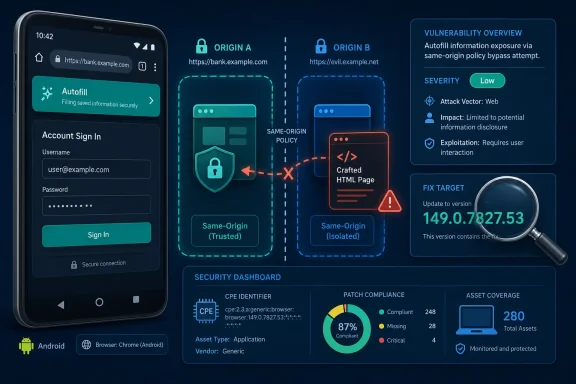
Google Chrome’s CVE-2026-11291 is a low-severity Android Autofill flaw disclosed in June 2026 that affected Chrome for Android before version 149.0.7827.53 and could let a remote attacker bypass same-origin policy with a crafted HTML page. The bug is not the sort of headline-grabbing browser escape that sends every SOC into emergency mode, but it is exactly the kind of small boundary failure that makes modern browser security difficult to inventory. The awkward part is not just the vulnerability; it is the metadata around it. When a Chrome-on-Android flaw shows up with a Chrome CPE joined to an Android operating-system CPE, the database is telling administrators something useful, but not quite the thing they need.
CVE-2026-11291 sits in an unglamorous corner of the browser: Android Autofill. That placement matters because Autofill is one of the places where Chrome is not merely rendering the web but mediating between a website, the browser’s security model, the Android platform, and whatever credential or form-filling provider the user has chosen.
The published description is terse: inappropriate implementation in Android Autofill, Chrome on Android prior to 149.0.7827.53, remote attacker, same-origin policy bypass, crafted HTML page. For anyone who has spent time triaging browser CVEs, the words “same-origin policy” do most of the work. The same-origin policy is one of the browser’s old load-bearing beams, the rulebook that prevents one site from freely reading or manipulating another site’s data just because both are open inside the same browser.
Google rated the Chromium security severity as Low, while CISA’s ADP enrichment assigned a CVSS 3.1 score of 4.3, which lands in Medium. That mismatch is not necessarily a contradiction. Vendor severity often reflects exploitability and product-specific impact, while CVSS tries to describe properties of the vulnerability in a more standardized way. A same-origin policy bypass that requires user interaction and produces limited integrity impact can be serious in principle without being catastrophic in practice.
The important distinction is that CVE-2026-11291 is not described as remote code execution, sandbox escape, account compromise, or active exploitation. It is a policy-bypass bug in a mobile-specific browser feature. That should calm the panic, but not end the patch conversation.
That is why origin validation matters. If the browser or platform component misjudges which origin is entitled to which data or action, the failure can undermine assumptions that web developers and security teams take for granted. Most users do not think about origin boundaries when a keyboard suggestion strip offers a password, an email address, or a shipping field. They think the browser knows where they are.
This does not mean CVE-2026-11291 is secretly a major credential-theft bug. The public record does not support that conclusion. The better reading is narrower and more instructive: even low-severity Autofill bugs deserve attention because they occur at the intersection of browser isolation, platform services, and user consent.
That intersection is especially messy on Android. Chrome on desktop owns much of its own experience, but Chrome on Android lives inside a denser system of OS APIs, Google services, WebView-adjacent assumptions, password managers, keyboards, and app-level behaviors. A flaw there can be “in Chrome” for patching purposes, “Android Autofill” for root-cause purposes, and “web security” for impact purposes.
The NVD change history indicates a vulnerable configuration using an AND relationship: Google Chrome versions before 149.0.7827.53 combined with Google Android. That is a reasonable way to say “Chrome is affected only in its Android context.” A generic Chrome CPE by itself could overstate impact by implying that desktop Chrome on Windows, macOS, or Linux is affected by an Android Autofill vulnerability. An Android CPE by itself would be worse, implying that the operating system is the vulnerable product rather than the platform condition.
This is one of those places where CPE, for all its usefulness, shows its age. CPE works best when the vulnerable thing maps cleanly to a vendor, product, and version. “Chrome for Android” is conceptually a product, but in many vulnerability databases it is often represented as Chrome plus Android rather than as a perfectly distinct CPE line that every scanner and asset database will understand the same way.
So if the question is “should there be a separate CPE for Chrome for Android?” the answer depends on the database’s modeling conventions. If a canonical, widely used CPE exists for Google Chrome on Android and is absent, that would be a metadata-quality issue. If not, the AND configuration is the practical compromise: Chrome is vulnerable when installed on Android, before the fixed version.
For defenders, the operational takeaway is not to wait for the CPE to become aesthetically satisfying. The vulnerability applies to Chrome for Android before 149.0.7827.53. If your scanner fails to represent mobile Chrome accurately, that is an inventory problem to fix locally, not a reason to discount the CVE.
For vulnerability managers, that is frustrating. A desktop release note attached to an Android-only Autofill issue invites the wrong first read: either the bug affects desktop Chrome too, or the reference is wrong. The actual CVE description is more specific than the reference label. It says Chrome on Android prior to 149.0.7827.53.
That specificity should win. In vulnerability triage, the description, affected version, platform condition, vendor advisory, and CPE configuration all need to be reconciled. When they do not line up perfectly, the analyst’s job is to preserve the narrowest accurate impact statement rather than broaden the blast radius for convenience.
This matters for WindowsForum readers because Chrome vulnerability handling in Windows shops is often automated around desktop software inventory. If CVE-2026-11291 appears in a dashboard populated by Chrome CPE matches, it may look like another Chrome endpoint issue. But unless the environment is also managing Android Chrome instances — corporate Android devices, BYOD with managed browser policies, mobile threat defense telemetry, or enterprise mobility management — the Windows desktop fleet is probably not the primary exposure.
That distinction is not pedantry. It is the difference between patching the right devices and filing a false-positive exception that later teaches the team to ignore noisy browser CVEs.
A same-origin policy bypass is rarely the whole story in a mature exploit. It may be a stepping stone, a way to alter state, confuse a user, influence a form, or pierce a small privacy or integrity boundary. If another bug supplies stronger primitives, the low-severity issue can become useful in ways its CVSS score does not capture.
That is not an argument for panic. It is an argument for patch regularity. Chrome’s security model assumes rapid updates because the browser is exposed to hostile content all day. Mobile Chrome adds another wrinkle: users may assume apps update automatically, but enterprise-managed Android devices can lag if update policies, Play Store access, work profiles, or device OEM constraints interfere.
The practical security posture is simple. Treat CVE-2026-11291 as a routine Chrome for Android update item, not as a desktop fire drill. But do not dismiss it solely because the public severity is low. A browser policy bypass in an Autofill path is exactly the sort of bug that should disappear quickly from managed devices.
That sequence is normal, but it creates a timing problem. Many organizations ingest CVEs faster than humans read them. A vulnerability can enter a scanner, SIEM enrichment pipeline, ticketing system, or software bill-of-materials process before the record has fully settled. By the time a CPE is added or revised, the original ticket may already be assigned, suppressed, escalated, or misunderstood.
This is why browser CVEs are a stress test for automated vulnerability management. Chrome is one product name across several platforms, channels, package mechanisms, and embedded contexts. Android is both an operating system and an ecosystem. Autofill is both a browser feature and a platform service. CPE tries to encode all of that in a structure originally designed for cleaner software boundaries.
The answer is not to abandon CPE or CVSS. The answer is to treat them as structured evidence, not gospel. A good triage note for CVE-2026-11291 should say plainly that the affected software is Chrome on Android before 149.0.7827.53, that the weakness is origin validation in Android Autofill, and that the likely remediation is updating Chrome for Android rather than applying a Windows Chrome desktop patch.
If those mobile browsers are unmanaged, the organization’s actual browser exposure is larger than its endpoint dashboard suggests. Desktop Chrome may be beautifully patched by Intune, Group Policy, winget, ConfigMgr, or a third-party patching tool, while Android Chrome depends on Play Store auto-updates and user behavior. That split is where low-drama mobile CVEs become governance problems.
CVE-2026-11291 should therefore prompt a basic inventory question: do you know which Android browsers are allowed to access corporate web resources? If the answer is “only through managed apps,” then this is an EMM compliance check. If the answer is “any user’s phone can open the portal,” then the organization is relying on the public consumer update ecosystem to maintain part of its authentication perimeter.
That is not inherently reckless. Many organizations accept BYOD browser access with conditional access controls, device compliance requirements, phishing-resistant authentication, or app protection policies. But the controls need to be real. A vulnerability like this one is a reminder that browser patch state is not a desktop-only metric.
Users can check Chrome’s version on Android from the app’s settings, and most consumer devices should receive updates through Google Play. Enterprise administrators have more moving parts. Managed Google Play, Android Enterprise policies, work profile restrictions, OEM update behavior, and app update deferrals can all affect how quickly a Chrome update lands.
The most important thing is not to confuse operating-system patching with browser patching. Updating Android security patches is good hygiene, but this CVE is fixed by the Chrome application version. Conversely, updating desktop Chrome on Windows does not remediate an Android-only exposure, even if the same Chrome major version appears in the advisory trail.
Security teams should also resist the urge to overfit the CVSS score. A 4.3 Medium from CISA-ADP with user interaction and low integrity impact is not a board-level incident. It is a routine patch compliance item. The danger is not the individual CVE; it is the accumulation of mobile browser exceptions that nobody owns.
Neither outcome is rare. Vulnerability management tools are only as good as their asset context, and mobile browsers are often underrepresented unless the organization has deliberate EMM integration. The same CVE can be a false positive in one dashboard and a blind spot in another.
The better model is conditional applicability. If the asset is Android and the app is Chrome below 149.0.7827.53, the CVE applies. If the asset is Windows desktop Chrome, the Android Autofill condition does not apply, even if the version number appears related to the broader Chrome 149 security release.
That sounds simple in prose and painful in tooling. But this is where mature vulnerability programs distinguish themselves. They do not merely count CVEs; they preserve product context.
Same-origin policy once sounded like a clean web-platform concept. Autofill once sounded like a convenience feature. On Android, the two can meet in a place where a crafted page, user interaction, and a platform-mediated data flow create a vulnerability record that is hard to classify neatly.
The vulnerability industry still wants neat boxes because neat boxes scale. CPEs feed scanners. CVSS scores feed prioritization. CWEs feed dashboards. Advisory references feed ticket templates. But Chrome’s real architecture is sprawling, and its release engineering is fast. The metadata will sometimes lag behind the product reality.
That does not make the metadata useless. It makes human interpretation more important. The correct lesson from CVE-2026-11291 is not that NVD is wrong or that Chrome advisories are too vague. It is that defenders need to read the applicability statement as carefully as the severity score.
 The Vulnerability Is Small, but the Boundary It Crosses Is Not
CVE-2026-11291 sits in an unglamorous corner of the browser: Android Autofill. That placement matters because Autofill is one of the places where Chrome is not merely rendering the web but mediating between a website, the browser’s security model, the Android platform, and whatever credential or form-filling provider the user has chosen.The published description is terse: inappropriate implementation in Android Autofill, Chrome on Android prior to 149.0.7827.53, remote attacker, same-origin policy bypass, crafted HTML page. For anyone who has spent time triaging browser CVEs, the words “same-origin policy” do most of the work. The same-origin policy is one of the browser’s old load-bearing beams, the rulebook that prevents one site from freely reading or manipulating another site’s data just because both are open inside the same browser.
Google rated the Chromium security severity as Low, while CISA’s ADP enrichment assigned a CVSS 3.1 score of 4.3, which lands in Medium. That mismatch is not necessarily a contradiction. Vendor severity often reflects exploitability and product-specific impact, while CVSS tries to describe properties of the vulnerability in a more standardized way. A same-origin policy bypass that requires user interaction and produces limited integrity impact can be serious in principle without being catastrophic in practice.
The important distinction is that CVE-2026-11291 is not described as remote code execution, sandbox escape, account compromise, or active exploitation. It is a policy-bypass bug in a mobile-specific browser feature. That should calm the panic, but not end the patch conversation.
Autofill Turns a Browser Bug Into a Trust Bug
Autofill is deceptively sensitive because users experience it as convenience while security teams have to treat it as an identity-adjacent interface. A browser can render a login form, Android can suggest saved data, a password manager can participate, and the page can contain crafted markup that tries to confuse the boundary between what the user sees and what the browser believes it is filling.That is why origin validation matters. If the browser or platform component misjudges which origin is entitled to which data or action, the failure can undermine assumptions that web developers and security teams take for granted. Most users do not think about origin boundaries when a keyboard suggestion strip offers a password, an email address, or a shipping field. They think the browser knows where they are.
This does not mean CVE-2026-11291 is secretly a major credential-theft bug. The public record does not support that conclusion. The better reading is narrower and more instructive: even low-severity Autofill bugs deserve attention because they occur at the intersection of browser isolation, platform services, and user consent.
That intersection is especially messy on Android. Chrome on desktop owns much of its own experience, but Chrome on Android lives inside a denser system of OS APIs, Google services, WebView-adjacent assumptions, password managers, keyboards, and app-level behaviors. A flaw there can be “in Chrome” for patching purposes, “Android Autofill” for root-cause purposes, and “web security” for impact purposes.
The CPE Looks Awkward Because the Product Boundary Is Awkward
The user-facing question here is whether the NVD entry is missing a CPE. Based on the information available, the better answer is: probably not in the simple sense, but the configuration is easy to misread.The NVD change history indicates a vulnerable configuration using an AND relationship: Google Chrome versions before 149.0.7827.53 combined with Google Android. That is a reasonable way to say “Chrome is affected only in its Android context.” A generic Chrome CPE by itself could overstate impact by implying that desktop Chrome on Windows, macOS, or Linux is affected by an Android Autofill vulnerability. An Android CPE by itself would be worse, implying that the operating system is the vulnerable product rather than the platform condition.
This is one of those places where CPE, for all its usefulness, shows its age. CPE works best when the vulnerable thing maps cleanly to a vendor, product, and version. “Chrome for Android” is conceptually a product, but in many vulnerability databases it is often represented as Chrome plus Android rather than as a perfectly distinct CPE line that every scanner and asset database will understand the same way.
So if the question is “should there be a separate CPE for Chrome for Android?” the answer depends on the database’s modeling conventions. If a canonical, widely used CPE exists for Google Chrome on Android and is absent, that would be a metadata-quality issue. If not, the AND configuration is the practical compromise: Chrome is vulnerable when installed on Android, before the fixed version.
For defenders, the operational takeaway is not to wait for the CPE to become aesthetically satisfying. The vulnerability applies to Chrome for Android before 149.0.7827.53. If your scanner fails to represent mobile Chrome accurately, that is an inventory problem to fix locally, not a reason to discount the CVE.
The Desktop Release Note Adds Noise to a Mobile Bug
One reason this entry looks odd is that the listed Chrome release reference points to a Stable Channel Update for Desktop. That kind of reference mismatch happens often in Chrome security disclosures because Google batches large numbers of fixes across release channels and platforms, and the public advisory trail does not always produce a neat, per-platform narrative for every individual CVE.For vulnerability managers, that is frustrating. A desktop release note attached to an Android-only Autofill issue invites the wrong first read: either the bug affects desktop Chrome too, or the reference is wrong. The actual CVE description is more specific than the reference label. It says Chrome on Android prior to 149.0.7827.53.
That specificity should win. In vulnerability triage, the description, affected version, platform condition, vendor advisory, and CPE configuration all need to be reconciled. When they do not line up perfectly, the analyst’s job is to preserve the narrowest accurate impact statement rather than broaden the blast radius for convenience.
This matters for WindowsForum readers because Chrome vulnerability handling in Windows shops is often automated around desktop software inventory. If CVE-2026-11291 appears in a dashboard populated by Chrome CPE matches, it may look like another Chrome endpoint issue. But unless the environment is also managing Android Chrome instances — corporate Android devices, BYOD with managed browser policies, mobile threat defense telemetry, or enterprise mobility management — the Windows desktop fleet is probably not the primary exposure.
That distinction is not pedantry. It is the difference between patching the right devices and filing a false-positive exception that later teaches the team to ignore noisy browser CVEs.
Same-Origin Policy Bugs Still Deserve Respect
There is a temptation to treat “Low” severity as a synonym for “ignore.” Browser history argues against that habit. Low-severity bugs often describe constrained impact in isolation, but browsers are systems of systems, and attackers are fond of chains.A same-origin policy bypass is rarely the whole story in a mature exploit. It may be a stepping stone, a way to alter state, confuse a user, influence a form, or pierce a small privacy or integrity boundary. If another bug supplies stronger primitives, the low-severity issue can become useful in ways its CVSS score does not capture.
That is not an argument for panic. It is an argument for patch regularity. Chrome’s security model assumes rapid updates because the browser is exposed to hostile content all day. Mobile Chrome adds another wrinkle: users may assume apps update automatically, but enterprise-managed Android devices can lag if update policies, Play Store access, work profiles, or device OEM constraints interfere.
The practical security posture is simple. Treat CVE-2026-11291 as a routine Chrome for Android update item, not as a desktop fire drill. But do not dismiss it solely because the public severity is low. A browser policy bypass in an Autofill path is exactly the sort of bug that should disappear quickly from managed devices.
NVD Enrichment Is Helpful, but It Is Not a Substitute for Judgment
The NVD record is still in the kind of enrichment phase that has become familiar to vulnerability teams: vendor CVE arrives first, third-party scoring and weakness mapping follow, then CPE applicability gets refined. In this case, CISA-ADP added a CVSS vector and CWE-346, Origin Validation Error. NIST later added the CPE configuration tying Chrome to Android.That sequence is normal, but it creates a timing problem. Many organizations ingest CVEs faster than humans read them. A vulnerability can enter a scanner, SIEM enrichment pipeline, ticketing system, or software bill-of-materials process before the record has fully settled. By the time a CPE is added or revised, the original ticket may already be assigned, suppressed, escalated, or misunderstood.
This is why browser CVEs are a stress test for automated vulnerability management. Chrome is one product name across several platforms, channels, package mechanisms, and embedded contexts. Android is both an operating system and an ecosystem. Autofill is both a browser feature and a platform service. CPE tries to encode all of that in a structure originally designed for cleaner software boundaries.
The answer is not to abandon CPE or CVSS. The answer is to treat them as structured evidence, not gospel. A good triage note for CVE-2026-11291 should say plainly that the affected software is Chrome on Android before 149.0.7827.53, that the weakness is origin validation in Android Autofill, and that the likely remediation is updating Chrome for Android rather than applying a Windows Chrome desktop patch.
Windows Shops Should Read This as a Mobile Management Story
For a Windows-heavy audience, an Android Autofill bug may seem peripheral. It is not, because most Windows environments are no longer Windows-only environments. Employees authenticate to Microsoft 365, Entra ID-backed apps, SaaS dashboards, VPN portals, privileged access tools, and internal web apps from mobile browsers every day.If those mobile browsers are unmanaged, the organization’s actual browser exposure is larger than its endpoint dashboard suggests. Desktop Chrome may be beautifully patched by Intune, Group Policy, winget, ConfigMgr, or a third-party patching tool, while Android Chrome depends on Play Store auto-updates and user behavior. That split is where low-drama mobile CVEs become governance problems.
CVE-2026-11291 should therefore prompt a basic inventory question: do you know which Android browsers are allowed to access corporate web resources? If the answer is “only through managed apps,” then this is an EMM compliance check. If the answer is “any user’s phone can open the portal,” then the organization is relying on the public consumer update ecosystem to maintain part of its authentication perimeter.
That is not inherently reckless. Many organizations accept BYOD browser access with conditional access controls, device compliance requirements, phishing-resistant authentication, or app protection policies. But the controls need to be real. A vulnerability like this one is a reminder that browser patch state is not a desktop-only metric.
The Patch Target Is Clear Even If the Metadata Is Messy
The fixed line in the public record is clear enough: Chrome on Android should be at least 149.0.7827.53 for this CVE. Later Chrome builds should include the fix as well, assuming the device is on the stable update path and not pinned to an older release.Users can check Chrome’s version on Android from the app’s settings, and most consumer devices should receive updates through Google Play. Enterprise administrators have more moving parts. Managed Google Play, Android Enterprise policies, work profile restrictions, OEM update behavior, and app update deferrals can all affect how quickly a Chrome update lands.
The most important thing is not to confuse operating-system patching with browser patching. Updating Android security patches is good hygiene, but this CVE is fixed by the Chrome application version. Conversely, updating desktop Chrome on Windows does not remediate an Android-only exposure, even if the same Chrome major version appears in the advisory trail.
Security teams should also resist the urge to overfit the CVSS score. A 4.3 Medium from CISA-ADP with user interaction and low integrity impact is not a board-level incident. It is a routine patch compliance item. The danger is not the individual CVE; it is the accumulation of mobile browser exceptions that nobody owns.
The Scanner May Be Technically Right and Operationally Useless
This is where the CPE debate becomes practical. A scanner that seesgoogle:chrome before 149.0.7827.53 and flags every Chrome instance may be doing a broad match but producing bad work. A scanner that ignores Chrome on Android because it only inventories Windows and macOS endpoints may produce a clean dashboard while missing the affected asset class entirely.Neither outcome is rare. Vulnerability management tools are only as good as their asset context, and mobile browsers are often underrepresented unless the organization has deliberate EMM integration. The same CVE can be a false positive in one dashboard and a blind spot in another.
The better model is conditional applicability. If the asset is Android and the app is Chrome below 149.0.7827.53, the CVE applies. If the asset is Windows desktop Chrome, the Android Autofill condition does not apply, even if the version number appears related to the broader Chrome 149 security release.
That sounds simple in prose and painful in tooling. But this is where mature vulnerability programs distinguish themselves. They do not merely count CVEs; they preserve product context.
The Real Lesson Is That Browser Security Has Outgrown Neat Boxes
CVE-2026-11291 is a small bug that exposes a larger taxonomy problem. Browser security is no longer just “the browser.” It is a negotiation among rendering engines, JavaScript engines, GPU processes, password managers, form parsers, OS services, mobile keyboards, identity providers, and enterprise policy layers.Same-origin policy once sounded like a clean web-platform concept. Autofill once sounded like a convenience feature. On Android, the two can meet in a place where a crafted page, user interaction, and a platform-mediated data flow create a vulnerability record that is hard to classify neatly.
The vulnerability industry still wants neat boxes because neat boxes scale. CPEs feed scanners. CVSS scores feed prioritization. CWEs feed dashboards. Advisory references feed ticket templates. But Chrome’s real architecture is sprawling, and its release engineering is fast. The metadata will sometimes lag behind the product reality.
That does not make the metadata useless. It makes human interpretation more important. The correct lesson from CVE-2026-11291 is not that NVD is wrong or that Chrome advisories are too vague. It is that defenders need to read the applicability statement as carefully as the severity score.
The Autofill Bug’s Message to Patch Teams Is Narrow but Sharp
CVE-2026-11291 does not demand a dramatic response, but it does demand a precise one. The organizations that handle it well will be the ones that can separate Chrome-on-Android exposure from generic Chrome exposure, patch mobile browsers without waiting for a desktop maintenance window, and keep vulnerability metadata from turning into either panic or complacency.- CVE-2026-11291 affects Google Chrome on Android before version 149.0.7827.53, not every Chrome installation in a Windows desktop fleet.
- The flaw is an Android Autofill origin-validation problem that could allow a same-origin policy bypass through a crafted HTML page.
- The NVD CPE configuration pairing Chrome with Android is a reasonable way to express platform-specific applicability, even if it looks awkward in scanner output.
- The Chrome application update is the remediation path; Android operating-system patch level is not a substitute for the fixed Chrome version.
- Security teams should treat the issue as routine mobile browser patching, while using it to test whether their asset inventory actually sees managed and unmanaged Android Chrome usage.
- Low-severity browser policy bugs should be patched promptly because they can still matter in chains, especially around identity-adjacent features such as Autofill.
References
- Primary source: NVD / Chromium
Published: 2026-06-09T07:00:37-07:00
NVD - CVE-2026-11291
 nvd.nist.gov
- Security advisory: MSRC
Published: 2026-06-09T07:00:37-07:00
Original feed URL
Security Update Guide - Microsoft Security Response Center
 msrc.microsoft.com
- Official source: nist.gov
National Vulnerability Database
NIST maintains the National Vulnerability Database (NVD), a repository of information on software and hardware flaws that can compromise computer security. This is a key piece of the nation’s cybersecurity infrastructure.www.nist.gov - Related coverage: govcert.gov.hk
GovCERT.HK - Security Alert (A26-06-08): Multiple Vulnerabilities in Google Chrome
Security Alert (A26-06-08): Multiple Vulnerabilities in Google Chromewww.govcert.gov.hk
- Related coverage: synscan.net
CVE-2026-11206 — google / chrome | SynScan
CVE-2026-11206 is a medium-severity vulnerability affecting google / chrome (2026). Check if your assets are exposed with SynScan.synscan.net - Related coverage: first.org
The National Vulnerability Database Ms. Tanya Brewer NVD Program Manager June 2024
PDF documentwww.first.org
