

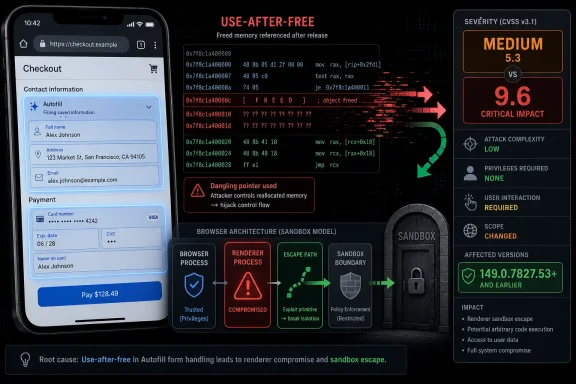
Google’s CVE-2026-11131 is a Chrome-on-Android Autofill use-after-free flaw disclosed June 4, 2026, affecting versions before 149.0.7827.53 and describing a renderer-compromise-to-sandbox-escape path through a crafted HTML page. That is the plain version; the interesting version is messier. A vulnerability Google labels “Medium” can still receive a critical CVSS score once downstream scoring systems model the worst plausible outcome. For WindowsForum readers, the lesson is not that every Chrome CVE is an emergency, but that browser vulnerability metadata is increasingly becoming an argument between product reality, platform scope, and fleet-management machinery.
CVE-2026-11131 lands in one of Chrome’s most sensitive neighborhoods: Autofill, the subsystem that turns stored identity, address, payment, and form data into browser convenience. The flaw is categorized as a use-after-free, a memory-safety class that has haunted Chromium, WebKit, Windows components, GPU drivers, and almost every large C++ codebase for years. In simple terms, software keeps using a piece of memory after it has already released it, giving an attacker a chance to shape what now occupies that memory and potentially redirect execution or corrupt state.
But Google’s description narrows the exploit story considerably. The attacker must already have compromised the renderer process, then use a crafted HTML page to potentially escape the sandbox on Chrome for Android before version 149.0.7827.53. That is not a garden-variety “visit a page and own the phone” claim. It is a chain component: dangerous in combination, less decisive by itself.
That distinction explains why Chromium can call the issue “Medium” while CISA’s ADP scoring assigns a 9.6 critical CVSS 3.1 vector. CVSS is outcome-driven. If the modeled attack reaches confidentiality, integrity, and availability impact across a changed scope, the score climbs rapidly, even when the vendor’s own severity taxonomy accounts for prerequisites, exploit maturity, and real-world chaining constraints.
This is where vulnerability feeds start to confuse more than they clarify. A sysadmin sees “Medium” in the vendor note, “Critical” in a scanner, “Android” in the description, and a desktop Chrome advisory in the references. None of those labels is necessarily wrong. Together, however, they create exactly the kind of ambiguity that leads to either overreaction or missed patching.
Autofill is especially uncomfortable because it sits near a behavioral trust boundary. Users expect it to know private facts; web pages try to coax it into revealing or processing those facts; the browser has to decide what is visible, eligible, framed, focused, permissioned, and safe. That makes it a rich target even when a single flaw does not directly leak passwords or card numbers.
CVE-2026-11131 is not described as a data-theft issue. The published wording points to sandbox escape after renderer compromise, not direct Autofill exfiltration. Still, the component matters because a memory-safety flaw in a privileged or semi-privileged browser path can become the second step in a chain. First the attacker gains renderer execution through JavaScript, HTML, media, graphics, or another web-exposed surface. Then a bug like this helps move beyond the renderer’s prison.
Chrome’s sandbox model is designed around the assumption that renderer compromise is possible. The browser does not treat every renderer bug as total defeat because the sandbox is supposed to contain it. A sandbox escape CVE is therefore not just another bug; it is a challenge to one of the browser’s core risk assumptions.
Chrome’s architecture isolates web content in renderer processes so that a bug in page handling does not automatically become a full browser or device compromise. Site isolation and sandboxing further limit what a compromised renderer can reach. This architecture has raised attacker costs dramatically, but it has also changed the economics of exploitation: valuable browser attacks are now often chains, not single bugs.
A renderer compromise might start with a V8 bug, a graphics parser issue, a WebAssembly corner case, or some other web-facing vulnerability. By itself, that can be constrained. Pair it with a sandbox escape, and the attacker’s position improves substantially. Pair that again with an operating-system privilege escalation, and the chain becomes the kind of thing defenders worry about in targeted attacks.
So the prerequisite matters, but it does not make the bug irrelevant. It tells defenders where this CVE fits. CVE-2026-11131 is best understood as a potential escalation stage, not necessarily the first click-to-code-execution stage.
The practical reading is that the affected platform in the CVE description should carry the most weight. If the record says “Google Chrome on Android,” defenders should not automatically assume every desktop Chrome installation is vulnerable to this specific issue merely because the reference page is a desktop stable-channel post. Chrome’s release notes and CVE records are often imperfectly aligned because one advisory can serve as a public anchor for many bugs across related channels, platforms, and shared code.
That said, shared Chromium code complicates any clean platform boundary. A component may exist across desktop and mobile, but a vulnerability may only be reachable, exploitable, or security-relevant under a particular platform configuration. Android’s process model, UI integration, Autofill plumbing, and OS service boundaries are not identical to Windows, macOS, or Linux. A bug in common code can still become an Android-only CVE if that is where the vulnerable path exists or where the exploit condition is meaningful.
For Windows administrators, this is the point at which scanner output must be interpreted rather than worshipped. A Windows fleet showing CVE-2026-11131 against desktop Chrome deserves investigation, but not panic. The right question is whether the scanner is matching on Chrome version alone, on the NVD CPE, or on an actual platform-specific detection rule.
The user-facing “Are we missing a CPE?” prompt on NVD pages is boilerplate, but in this case the concern is understandable. A vulnerability management system might want a more specific Android package identifier, a mobile Chrome application CPE, or separate Chrome-for-Android naming. The CPE ecosystem has never been especially elegant at modeling software that exists as an app, a browser engine, an operating-system component, and a managed enterprise product all at once.
The current configuration also reflects a larger problem: CVE records are increasingly asked to serve humans, scanners, procurement systems, compliance reports, patch dashboards, and threat-intelligence products. Those audiences do not need the same thing. A human wants to know whether their Android Chrome is old. A scanner wants a deterministic match. A risk team wants a severity and deadline. A compliance auditor wants proof of remediation.
When all of that pressure lands on a CPE block, the result is brittle. The CVE may be technically accurate while still producing noisy operational results. That is not a reason to ignore it; it is a reason to validate how your tools translate it.
The vendor severity is measuring a different thing. Chromium’s “Medium” label is likely reflecting internal exploitability assumptions, bug class, reachability, mitigation layers, and the fact that renderer compromise is a prerequisite. Vendor severity often asks, “How urgent is this relative to the other bugs we fixed?” CVSS asks, “What is the impact if this vulnerability is successfully exploited under the modeled conditions?”
Neither scale is perfect. Vendor ratings can understate downstream operational risk because they are optimized for engineering triage. CVSS can overstate urgency because it compresses exploit chains, prerequisites, and deployment context into a single score. The result is a familiar split-brain moment: one system tells you “medium,” another tells you “critical,” and both can point to the same sentence in the CVE description.
For security teams, the right response is not to pick the label they prefer. It is to map the CVE into the environment. Managed Android devices with Chrome lagging behind 149.0.7827.53 are the real target population. Windows desktops running updated Chrome are adjacent context, not necessarily exposed by this specific Android-scoped record.
Chromium has invested heavily in mitigations, fuzzing, sandboxing, partitioning, MiraclePtr-style protections, and broader memory-safety work. Those efforts matter. They turn many bugs into crashes, make exploitation more expensive, and force attackers into longer chains. But the browser remains a huge C++ project absorbing constant feature work from rendering, JavaScript, media, UI, device APIs, identity, payments, and platform integrations.
Autofill is a good example of why this is hard. The feature looks simple from the user’s side: suggest a name, fill an address, maybe offer a payment method. Under the hood, it crosses document parsing, frame ownership, focus management, heuristics, profile data, sync state, permissions, platform APIs, and UI rendering. Memory lifetime mistakes thrive in exactly those crossings.
The long-term answer is not one patch. It is continued migration toward safer languages where feasible, stronger ownership models in C++, more aggressive isolation between browser subsystems, and a refusal to treat convenience features as low-risk just because they are not flashy.
Chrome 149.0.7827.53 is the key threshold in the CVE description. Anything before that on Android is the affected population. If mobile device management policies already force Chrome updates through managed Google Play, the residual risk window may be short. If users control updates manually, the window depends on user behavior, storage state, network conditions, Play Store policy, and whether automatic updates have silently failed.
This is where browser security diverges from traditional monthly patching. Chrome does not wait for Patch Tuesday. The stable channel moves constantly, and emergency or high-volume security releases can arrive between enterprise maintenance windows. Treating browser updates as a monthly compliance ritual is increasingly out of step with how browser exploitation works.
WindowsForum readers know this pattern from Edge as well. Microsoft Edge inherits much of Chromium’s security rhythm, while adding its own enterprise policies, update channels, and Windows integration. A Chromium CVE may not always map one-to-one to Edge, but the broader operational reality is shared: browser patching is now continuous infrastructure maintenance.
The browser on a phone is not a toy browser. It is an identity surface. It handles single sign-on flows, session cookies, device certificates, password managers, Autofill data, OAuth redirects, and links launched from email, Teams, Slack, SMS, and QR codes. If a mobile browser exploit chain escapes containment, the attacker may not need to “own the domain” to cause serious harm. They may only need to steal sessions, pivot through trusted apps, or abuse the device’s authenticated posture.
That does not mean CVE-2026-11131 is known to be exploited in the wild. The public record provided here does not establish active exploitation. It means the affected platform should not be dismissed merely because Windows administrators do not image it with SCCM or manage it through the same patch dashboard as laptops.
The practical division is simple. Desktop Chrome teams should ensure they are not misclassifying the CVE against Windows assets. Mobile teams should verify Android Chrome update compliance. Security teams should understand that “Android-only” is not synonymous with “consumer-only.”
That sequence is not evidence of scandal. It is evidence that CVE records are living documents. They are published, enriched, normalized, scored, rescored, typed, and sometimes corrected by multiple parties. Anyone who has built vulnerability-management workflows knows the pain: today’s scanner result may differ from yesterday’s not because the software changed, but because the metadata did.
This is especially relevant when ticketing systems create remediation tasks from CVE feeds. A June 6 import might label the issue critical with a particular weakness mapping. A June 8 import might add platform CPE constraints. A later update might alter a field that affects deduplication or reporting. If your tooling treats every metadata change as a new security event, the team drowns.
The answer is to preserve chronology. Record when the vulnerability was published, when enrichment was added, when the affected configuration became clearer, and when assets were checked. That audit trail matters more than pretending the CVE was perfectly formed at birth.
First, is the bug serious in the abstract? Yes, because sandbox escape potential after renderer compromise is a meaningful browser-security concern. Even with user interaction and a prerequisite compromise, the modeled impact can be high.
Second, is the bug broadly applicable to every Chrome installation? The description says no. The affected product context is Chrome on Android before 149.0.7827.53. Desktop references should not override that wording without additional evidence.
Third, does the bug require immediate operational action? For Android Chrome fleets below the fixed version, yes: update. For Windows desktop fleets, the action is more about confirming scanner logic and maintaining current Chrome/Edge patch levels. In both cases, the answer is practical rather than theatrical.
That separation sounds obvious, but it is where many vulnerability programs fail. They turn every high CVSS into the same emergency, then lose credibility when half the tickets are not exploitable in the tagged environment. Or they hide behind vendor “medium” labels and miss the fact that a medium chain component can be devastating when paired with the right first-stage bug.
The issue tracker reference for CVE-2026-11131 is marked with access limitations, which is normal for security bugs. That means public analysis cannot lean on a patch diff or full exploit description unless and until more information becomes available. In the meantime, the safest journalism and the safest administration both avoid overclaiming. We know the component, class, affected platform, fixed version, and modeled impact. We do not know exploit prevalence from the material at hand.
This is why vulnerability write-ups that turn every Chrome CVE into “remote code execution” do readers a disservice. A sandbox escape can be part of a remote code execution chain, but the CVE’s own wording matters. The phrase “who had compromised the renderer process” is not decoration. It is the difference between a standalone initial compromise and a post-renderer escape primitive.
At the same time, vendors benefit from understatement. “Medium” can sound reassuring to a public audience even when the technical path is dangerous in the right chain. Good vulnerability communication should make the chain position clear without burying the risk.
For Windows enthusiasts, this is also a reminder that the browser is now one of the most privileged daily applications on the machine. It mediates banking, work, admin consoles, password vaults, email, remote access, and cloud control planes. The old mental model of “the OS is the platform and the browser is an app” is increasingly backwards for many workflows. The browser is the platform; the OS is the substrate that contains it.
That inversion changes patch priority. A browser update may deserve the same urgency as an OS cumulative update, and sometimes more. A Windows box fully patched at the OS level but running an outdated browser is not a well-maintained endpoint. The same is true of an Android phone with current OS patches but stale Chrome.
CVE-2026-11131 may not be the vulnerability that burns down a Windows fleet. But it is part of the evidence that browser security has become a constant-motion discipline, with platform-specific flaws rippling through shared tooling and shared risk models.
For unmanaged users, the advice is even simpler: open Chrome’s app listing in Google Play or the browser’s about screen and update. Automatic updates are good, but they are not magic. Devices with constrained storage, disabled auto-updates, stale Play services, or long offline periods can remain behind longer than their owners assume.
Administrators should also resist the urge to write a bespoke exception just because the vendor severity says “Medium.” The fixed version exists, the affected product scope is clear enough for action, and browser updates are low-friction compared with many enterprise patches. If a Chrome update breaks a workflow, that workflow was already depending on an unstable foundation.
The more nuanced work belongs in reporting. Mark this as Android Chrome-specific unless your evidence says otherwise. Avoid inflating Windows exposure from a desktop advisory reference alone. Keep the CVSS score in view, but explain why the chain prerequisite matters.
The most concrete conclusions are also the most useful ones:
 The “Medium” Bug That Looks Critical on Paper
CVE-2026-11131 lands in one of Chrome’s most sensitive neighborhoods: Autofill, the subsystem that turns stored identity, address, payment, and form data into browser convenience. The flaw is categorized as a use-after-free, a memory-safety class that has haunted Chromium, WebKit, Windows components, GPU drivers, and almost every large C++ codebase for years. In simple terms, software keeps using a piece of memory after it has already released it, giving an attacker a chance to shape what now occupies that memory and potentially redirect execution or corrupt state.But Google’s description narrows the exploit story considerably. The attacker must already have compromised the renderer process, then use a crafted HTML page to potentially escape the sandbox on Chrome for Android before version 149.0.7827.53. That is not a garden-variety “visit a page and own the phone” claim. It is a chain component: dangerous in combination, less decisive by itself.
That distinction explains why Chromium can call the issue “Medium” while CISA’s ADP scoring assigns a 9.6 critical CVSS 3.1 vector. CVSS is outcome-driven. If the modeled attack reaches confidentiality, integrity, and availability impact across a changed scope, the score climbs rapidly, even when the vendor’s own severity taxonomy accounts for prerequisites, exploit maturity, and real-world chaining constraints.
This is where vulnerability feeds start to confuse more than they clarify. A sysadmin sees “Medium” in the vendor note, “Critical” in a scanner, “Android” in the description, and a desktop Chrome advisory in the references. None of those labels is necessarily wrong. Together, however, they create exactly the kind of ambiguity that leads to either overreaction or missed patching.
Autofill Is Convenience Sitting on a Security Boundary
Autofill bugs feel mundane because Autofill feels like chrome polish rather than attack surface. That is a mistake. Modern browsers are operating environments, and form handling touches parsing, identity, profile storage, payments, sync, permissions, UI surfaces, and web content from untrusted origins.Autofill is especially uncomfortable because it sits near a behavioral trust boundary. Users expect it to know private facts; web pages try to coax it into revealing or processing those facts; the browser has to decide what is visible, eligible, framed, focused, permissioned, and safe. That makes it a rich target even when a single flaw does not directly leak passwords or card numbers.
CVE-2026-11131 is not described as a data-theft issue. The published wording points to sandbox escape after renderer compromise, not direct Autofill exfiltration. Still, the component matters because a memory-safety flaw in a privileged or semi-privileged browser path can become the second step in a chain. First the attacker gains renderer execution through JavaScript, HTML, media, graphics, or another web-exposed surface. Then a bug like this helps move beyond the renderer’s prison.
Chrome’s sandbox model is designed around the assumption that renderer compromise is possible. The browser does not treat every renderer bug as total defeat because the sandbox is supposed to contain it. A sandbox escape CVE is therefore not just another bug; it is a challenge to one of the browser’s core risk assumptions.
The Renderer Prerequisite Is Not Comforting Enough
It is tempting to read “attacker who had compromised the renderer process” and mentally downgrade the threat. After all, if the attacker already compromised something, haven’t we already lost? In browser security, the answer is no. The renderer is precisely the part of the browser expected to process hostile content all day long.Chrome’s architecture isolates web content in renderer processes so that a bug in page handling does not automatically become a full browser or device compromise. Site isolation and sandboxing further limit what a compromised renderer can reach. This architecture has raised attacker costs dramatically, but it has also changed the economics of exploitation: valuable browser attacks are now often chains, not single bugs.
A renderer compromise might start with a V8 bug, a graphics parser issue, a WebAssembly corner case, or some other web-facing vulnerability. By itself, that can be constrained. Pair it with a sandbox escape, and the attacker’s position improves substantially. Pair that again with an operating-system privilege escalation, and the chain becomes the kind of thing defenders worry about in targeted attacks.
So the prerequisite matters, but it does not make the bug irrelevant. It tells defenders where this CVE fits. CVE-2026-11131 is best understood as a potential escalation stage, not necessarily the first click-to-code-execution stage.
Android Scope Makes the Desktop Advisory Look Stranger Than It Is
The CVE description says Chrome on Android prior to 149.0.7827.53. The NVD change history, however, references Google’s Stable Channel Update for Desktop. That mismatch is the kind of thing that makes asset teams ask whether a CPE is missing, whether the vulnerability really affects desktop Chrome, or whether the reference is simply broad because Chrome advisories often bundle many fixes.The practical reading is that the affected platform in the CVE description should carry the most weight. If the record says “Google Chrome on Android,” defenders should not automatically assume every desktop Chrome installation is vulnerable to this specific issue merely because the reference page is a desktop stable-channel post. Chrome’s release notes and CVE records are often imperfectly aligned because one advisory can serve as a public anchor for many bugs across related channels, platforms, and shared code.
That said, shared Chromium code complicates any clean platform boundary. A component may exist across desktop and mobile, but a vulnerability may only be reachable, exploitable, or security-relevant under a particular platform configuration. Android’s process model, UI integration, Autofill plumbing, and OS service boundaries are not identical to Windows, macOS, or Linux. A bug in common code can still become an Android-only CVE if that is where the vulnerable path exists or where the exploit condition is meaningful.
For Windows administrators, this is the point at which scanner output must be interpreted rather than worshipped. A Windows fleet showing CVE-2026-11131 against desktop Chrome deserves investigation, but not panic. The right question is whether the scanner is matching on Chrome version alone, on the NVD CPE, or on an actual platform-specific detection rule.
The CPE Question Is Really a Modeling Question
The NVD entry’s CPE configuration is doing something subtle: it combines Google Chrome versions up to but excluding 149.0.7827.53 with Android as the operating platform. That is a reasonable way to model “Chrome on Android,” though it may look odd to anyone used to product-only CPE matching. It is not simply “Chrome before 149.0.7827.53”; it is Chrome before that version running on or with Android.The user-facing “Are we missing a CPE?” prompt on NVD pages is boilerplate, but in this case the concern is understandable. A vulnerability management system might want a more specific Android package identifier, a mobile Chrome application CPE, or separate Chrome-for-Android naming. The CPE ecosystem has never been especially elegant at modeling software that exists as an app, a browser engine, an operating-system component, and a managed enterprise product all at once.
The current configuration also reflects a larger problem: CVE records are increasingly asked to serve humans, scanners, procurement systems, compliance reports, patch dashboards, and threat-intelligence products. Those audiences do not need the same thing. A human wants to know whether their Android Chrome is old. A scanner wants a deterministic match. A risk team wants a severity and deadline. A compliance auditor wants proof of remediation.
When all of that pressure lands on a CPE block, the result is brittle. The CVE may be technically accurate while still producing noisy operational results. That is not a reason to ignore it; it is a reason to validate how your tools translate it.
CVSS Turns a Chain Component Into a Boardroom Number
CISA-ADP’s 9.6 score is defensible under the vector shown: network attack vector, low complexity, no privileges required, user interaction required, changed scope, and high impact to confidentiality, integrity, and availability. If a remote attacker can use a crafted page, after renderer compromise, to escape the sandbox, the theoretical blast radius is serious. CVSS rewards that worst-case framing.The vendor severity is measuring a different thing. Chromium’s “Medium” label is likely reflecting internal exploitability assumptions, bug class, reachability, mitigation layers, and the fact that renderer compromise is a prerequisite. Vendor severity often asks, “How urgent is this relative to the other bugs we fixed?” CVSS asks, “What is the impact if this vulnerability is successfully exploited under the modeled conditions?”
Neither scale is perfect. Vendor ratings can understate downstream operational risk because they are optimized for engineering triage. CVSS can overstate urgency because it compresses exploit chains, prerequisites, and deployment context into a single score. The result is a familiar split-brain moment: one system tells you “medium,” another tells you “critical,” and both can point to the same sentence in the CVE description.
For security teams, the right response is not to pick the label they prefer. It is to map the CVE into the environment. Managed Android devices with Chrome lagging behind 149.0.7827.53 are the real target population. Windows desktops running updated Chrome are adjacent context, not necessarily exposed by this specific Android-scoped record.
Use-After-Free Bugs Keep Surviving the Memory-Safety Reckoning
The most depressing part of CVE-2026-11131 is not the individual flaw. It is how ordinary the bug class remains. Use-after-free vulnerabilities are old, well understood, heavily hunted, and still productive for attackers because large browser engines contain enormous amounts of memory-unsafe code.Chromium has invested heavily in mitigations, fuzzing, sandboxing, partitioning, MiraclePtr-style protections, and broader memory-safety work. Those efforts matter. They turn many bugs into crashes, make exploitation more expensive, and force attackers into longer chains. But the browser remains a huge C++ project absorbing constant feature work from rendering, JavaScript, media, UI, device APIs, identity, payments, and platform integrations.
Autofill is a good example of why this is hard. The feature looks simple from the user’s side: suggest a name, fill an address, maybe offer a payment method. Under the hood, it crosses document parsing, frame ownership, focus management, heuristics, profile data, sync state, permissions, platform APIs, and UI rendering. Memory lifetime mistakes thrive in exactly those crossings.
The long-term answer is not one patch. It is continued migration toward safer languages where feasible, stronger ownership models in C++, more aggressive isolation between browser subsystems, and a refusal to treat convenience features as low-risk just because they are not flashy.
Patch Cadence Has Become the Real Security Control
For most users, the fix is boring: update Chrome. For organizations, the operational question is whether Chrome on Android is actually governed with the same seriousness as Chrome on Windows. Many enterprises have mature desktop browser patching, but mobile browser visibility can be weaker, especially in bring-your-own-device environments.Chrome 149.0.7827.53 is the key threshold in the CVE description. Anything before that on Android is the affected population. If mobile device management policies already force Chrome updates through managed Google Play, the residual risk window may be short. If users control updates manually, the window depends on user behavior, storage state, network conditions, Play Store policy, and whether automatic updates have silently failed.
This is where browser security diverges from traditional monthly patching. Chrome does not wait for Patch Tuesday. The stable channel moves constantly, and emergency or high-volume security releases can arrive between enterprise maintenance windows. Treating browser updates as a monthly compliance ritual is increasingly out of step with how browser exploitation works.
WindowsForum readers know this pattern from Edge as well. Microsoft Edge inherits much of Chromium’s security rhythm, while adding its own enterprise policies, update channels, and Windows integration. A Chromium CVE may not always map one-to-one to Edge, but the broader operational reality is shared: browser patching is now continuous infrastructure maintenance.
The Mobile Blind Spot in Windows-Centric Shops
A Windows-heavy organization may glance at an Android Chrome CVE and mentally file it under “not our problem.” That may be true for tightly controlled desktop-only environments. It is often false in real business environments where employees read mail, authenticate into SaaS apps, approve MFA prompts, open documents, and access intranet resources from phones.The browser on a phone is not a toy browser. It is an identity surface. It handles single sign-on flows, session cookies, device certificates, password managers, Autofill data, OAuth redirects, and links launched from email, Teams, Slack, SMS, and QR codes. If a mobile browser exploit chain escapes containment, the attacker may not need to “own the domain” to cause serious harm. They may only need to steal sessions, pivot through trusted apps, or abuse the device’s authenticated posture.
That does not mean CVE-2026-11131 is known to be exploited in the wild. The public record provided here does not establish active exploitation. It means the affected platform should not be dismissed merely because Windows administrators do not image it with SCCM or manage it through the same patch dashboard as laptops.
The practical division is simple. Desktop Chrome teams should ensure they are not misclassifying the CVE against Windows assets. Mobile teams should verify Android Chrome update compliance. Security teams should understand that “Android-only” is not synonymous with “consumer-only.”
The NVD Change History Tells Its Own Story
The record’s change history is unusually instructive. The CVE arrived from Chrome on June 4, 2026, with the description, CWE-416, and references. CISA-ADP added a CVSS 3.1 vector on June 6. NIST performed initial analysis on June 8, adding the CPE configuration and reference typing. Later that same day, the CISA-ADP entry removed CWE-416 from its enrichment data, while the Chrome-supplied weakness classification remained visible elsewhere in the record.That sequence is not evidence of scandal. It is evidence that CVE records are living documents. They are published, enriched, normalized, scored, rescored, typed, and sometimes corrected by multiple parties. Anyone who has built vulnerability-management workflows knows the pain: today’s scanner result may differ from yesterday’s not because the software changed, but because the metadata did.
This is especially relevant when ticketing systems create remediation tasks from CVE feeds. A June 6 import might label the issue critical with a particular weakness mapping. A June 8 import might add platform CPE constraints. A later update might alter a field that affects deduplication or reporting. If your tooling treats every metadata change as a new security event, the team drowns.
The answer is to preserve chronology. Record when the vulnerability was published, when enrichment was added, when the affected configuration became clearer, and when assets were checked. That audit trail matters more than pretending the CVE was perfectly formed at birth.
Security Teams Need to Separate Three Questions
CVE-2026-11131 is a useful case study because it forces three different questions that are often collapsed into one.First, is the bug serious in the abstract? Yes, because sandbox escape potential after renderer compromise is a meaningful browser-security concern. Even with user interaction and a prerequisite compromise, the modeled impact can be high.
Second, is the bug broadly applicable to every Chrome installation? The description says no. The affected product context is Chrome on Android before 149.0.7827.53. Desktop references should not override that wording without additional evidence.
Third, does the bug require immediate operational action? For Android Chrome fleets below the fixed version, yes: update. For Windows desktop fleets, the action is more about confirming scanner logic and maintaining current Chrome/Edge patch levels. In both cases, the answer is practical rather than theatrical.
That separation sounds obvious, but it is where many vulnerability programs fail. They turn every high CVSS into the same emergency, then lose credibility when half the tickets are not exploitable in the tagged environment. Or they hide behind vendor “medium” labels and miss the fact that a medium chain component can be devastating when paired with the right first-stage bug.
Browser Advisories Are Becoming Less Human-Readable
Chrome’s security release machinery is built for speed and scale, not narrative clarity. A stable-channel post can include many fixes, limited details, delayed bug visibility, platform variation, and external researcher credits. That restraint is rational: publishing exploit-ready details before the update reaches users would be irresponsible. But it leaves defenders reconstructing the story from CVE wording, version numbers, CPEs, issue-tracker permissions, and scanner interpretations.The issue tracker reference for CVE-2026-11131 is marked with access limitations, which is normal for security bugs. That means public analysis cannot lean on a patch diff or full exploit description unless and until more information becomes available. In the meantime, the safest journalism and the safest administration both avoid overclaiming. We know the component, class, affected platform, fixed version, and modeled impact. We do not know exploit prevalence from the material at hand.
This is why vulnerability write-ups that turn every Chrome CVE into “remote code execution” do readers a disservice. A sandbox escape can be part of a remote code execution chain, but the CVE’s own wording matters. The phrase “who had compromised the renderer process” is not decoration. It is the difference between a standalone initial compromise and a post-renderer escape primitive.
At the same time, vendors benefit from understatement. “Medium” can sound reassuring to a public audience even when the technical path is dangerous in the right chain. Good vulnerability communication should make the chain position clear without burying the risk.
Windows Users Are Still in the Blast Radius of Chromium’s Security Economy
Even when a CVE is Android-scoped, Windows users are part of the same ecosystem. Chrome’s desktop release cadence, Edge’s Chromium base, enterprise policies, password managers, web app reliance, and shared exploit research all bind Windows environments to Chromium’s security health. Attackers do not care which org chart owns the browser. They care which client-side surface gives them code execution, credential access, or a path around isolation.For Windows enthusiasts, this is also a reminder that the browser is now one of the most privileged daily applications on the machine. It mediates banking, work, admin consoles, password vaults, email, remote access, and cloud control planes. The old mental model of “the OS is the platform and the browser is an app” is increasingly backwards for many workflows. The browser is the platform; the OS is the substrate that contains it.
That inversion changes patch priority. A browser update may deserve the same urgency as an OS cumulative update, and sometimes more. A Windows box fully patched at the OS level but running an outdated browser is not a well-maintained endpoint. The same is true of an Android phone with current OS patches but stale Chrome.
CVE-2026-11131 may not be the vulnerability that burns down a Windows fleet. But it is part of the evidence that browser security has become a constant-motion discipline, with platform-specific flaws rippling through shared tooling and shared risk models.
The Real Fix Is Boring, Which Is Why It Works
The operational guidance here does not require drama. Check Chrome on Android. Confirm version 149.0.7827.53 or later for the affected line. Make sure managed devices receive browser updates without waiting for a monthly cycle. Review vulnerability scanner detections that flag this CVE on non-Android systems, and determine whether they are matching the NVD CPE correctly.For unmanaged users, the advice is even simpler: open Chrome’s app listing in Google Play or the browser’s about screen and update. Automatic updates are good, but they are not magic. Devices with constrained storage, disabled auto-updates, stale Play services, or long offline periods can remain behind longer than their owners assume.
Administrators should also resist the urge to write a bespoke exception just because the vendor severity says “Medium.” The fixed version exists, the affected product scope is clear enough for action, and browser updates are low-friction compared with many enterprise patches. If a Chrome update breaks a workflow, that workflow was already depending on an unstable foundation.
The more nuanced work belongs in reporting. Mark this as Android Chrome-specific unless your evidence says otherwise. Avoid inflating Windows exposure from a desktop advisory reference alone. Keep the CVSS score in view, but explain why the chain prerequisite matters.
The Autofill CVE Is Small, but the Metadata Lesson Is Not
CVE-2026-11131 is not just a patch note; it is a compact lesson in how modern vulnerability intelligence behaves under pressure. The bug is platform-scoped, chain-dependent, memory-safety-related, and split between vendor and downstream severity interpretations. That is exactly the kind of CVE that exposes weak asset data and brittle scanner logic.The most concrete conclusions are also the most useful ones:
- Chrome on Android before 149.0.7827.53 is the affected population described by the CVE record.
- The flaw is a use-after-free in Autofill that may enable sandbox escape only after renderer compromise.
- The “Medium” Chromium severity and 9.6 CVSS score reflect different risk models, not necessarily a factual contradiction.
- The NVD CPE configuration appears to model Chrome constrained to Android, so desktop Chrome findings should be validated before being treated as exposed.
- There is no need to wait for exploit drama before patching, because browser updates are the intended mitigation path.
- Vulnerability teams should preserve the record’s change history because enrichment updates can materially alter scanner output and remediation queues.
References
- Primary source: NVD / Chromium
Published: 2026-06-09T07:00:41-07:00

NVD - CVE-2026-11131
nvd.nist.gov
- Security advisory: MSRC
Published: 2026-06-09T07:00:41-07:00
Original feed URL

Security Update Guide - Microsoft Security Response Center
msrc.microsoft.com
- Related coverage: radar.offseq.com
CVE-2026-11131: Use after free in Google Chrome - Live Threat Intelligence - Threat Radar | OffSeq.com
Detailed information about CVE-2026-11131: Use after free in Google Chrome affecting Google Chrome. Get real-time updates, technical details, and mitigation str radar.offseq.com
- Related coverage: vuldb.com
CVE-2026-11131 Google Chrome Autofill use after free (ID 501561)
A vulnerability was detected in Google Chrome on Android. This vulnerability is cataloged as CVE-2026-11131. Upgrading the affected component is recommended.vuldb.com
