

Google Chrome before version 150.0.7871.47 contains CVE-2026-13976, a medium-severity heap buffer overflow in the browser’s Storage component that could let an attacker who already compromised the renderer process attempt a sandbox escape through a crafted HTML page. That phrasing, published in the National Vulnerability Database and sourced to Chrome, makes this a narrower bug than the usual “visit a page and lose the machine” panic cycle. But it also makes the vulnerability more interesting for Windows admins: the danger is not that CVE-2026-13976 is a standalone catastrophe, but that it belongs to the class of browser bugs that becomes dangerous when chained.
The immediate answer to the forum-thread question is: no, the CPE does not appear to be missing in the current NVD record. NIST’s July 2 change history added the affected configuration as
The CPE question matters because enterprise scanners live and die by those strings. A CVE without a usable CPE can disappear from dashboards, fail to match installed software inventories, or show up only as a vague advisory that nobody owns. In this case, however, NVD’s own change history says NIST added the Chrome CPE configuration on July 2, 2026, covering Google Chrome versions up to but not including 150.0.7871.47.
That means the practical boundary is clean: if Chrome is older than 150.0.7871.47 on Windows or macOS, treat it as vulnerable to CVE-2026-13976. Google’s Chrome Releases blog, as reflected in the NVD entry and corroborated by PCWorld and Malwarebytes reporting, tied the desktop Stable Channel update to version 150.0.7871.46/.47 for Windows and Mac and 150.0.7871.46 for Linux. The WindowsForum angle is straightforward: Windows fleets should key off the
The subtlety is that Chrome release numbering is not always pleasingly uniform across platforms. Google often publishes paired build numbers for Windows and macOS, while Linux may receive a nearby but not identical build. Vulnerability managers should resist the temptation to flatten all platforms into a single visual rule unless their tooling understands the vendor’s platform-specific version ranges.
The NVD record is still incomplete in one obvious way: NIST has not yet supplied its own CVSS score. CISA-ADP did add a CVSS 3.1 vector and a medium 5.8 score, but NVD’s primary assessment fields remain blank. That gap does not block remediation; it simply means scoring should not be mistaken for absence of risk.
But the shape of the bug is what security teams should notice. Renderer compromise is not hypothetical in browser exploitation; it is often stage one. The sandbox exists precisely because modern browsers assume parsing hostile web content is a dangerous business, so the renderer is confined and stripped of the authority to do broader damage.
A sandbox escape is stage two. If an attacker can combine a renderer exploit with a bug that crosses the sandbox boundary, the whole threat model changes. A vulnerability that looks constrained on its own can become the difference between a tab crash and meaningful host compromise when paired with another flaw.
That is why “attacker who had compromised the renderer process” is not a comfort blanket. It is a dependency. The CVE is saying, in effect, that this bug was not the front door, but it may have been a hallway door deeper inside the building.
That makes validation failures in storage code more consequential than the component name suggests. Storage is not merely a drawer where websites leave key-value pairs. It is an interface between hostile web content and privileged browser machinery, mediated by process isolation, origin checks, IPC, serialization, and memory safety assumptions.
A heap buffer overflow in that neighborhood raises the classic Chrome-era concern: a mistake in memory handling can become a primitive. The public CVE description does not give exploit details, and Google’s linked Chromium issue is restricted, which is normal while users are still updating. But the broad category, CWE-122, is not exotic; heap overflows are an old and durable way to turn bad input into control over program behavior.
The exploitability constraints matter. CISA’s ADP vector marks attack complexity as high, user interaction as required, and exploitation as not observed. That is meaningfully different from an actively exploited zero-day. Still, for a browser that is routinely exposed to arbitrary web content, “high complexity” is not the same as “irrelevant.”
The size of the update also complicates prioritization. When nearly 400 flaws land in a single browser release, the instinct is to hunt for the worst CVSS score and ignore the rest. That approach misses the way browser exploitation actually works, where chains can combine a renderer bug, a sandbox escape, a GPU or IPC issue, and a logic flaw in surprising ways.
CVE-2026-13976 is not the headline-grabbing critical entry in that pile. It is one of the medium-severity components that administrators may be tempted to wave away once the scanner stops screaming. But medium browser bugs deserve a different reading than medium bugs in an internal utility: the browser is user-facing, internet-facing, always parsing, and frequently granted access to credentials, session cookies, enterprise portals, and cloud consoles.
This is especially true on Windows desktops, where Chrome is often both the user’s primary work surface and the gateway to identity infrastructure. A browser compromise is no longer just a browser compromise when SSO sessions, admin consoles, browser-saved credentials, and endpoint management portals all live one tab away.
For defenders, however, the lag is operationally important. Many organizations still let NVD enrichment drive ticket creation, SLA assignment, and compliance reporting. If a CVE lands before a CPE, scanners may not match it immediately. If the CVSS score is missing, prioritization engines may assign a default, suppress the item, or wait for a later sync.
This is where Windows admins need a sharper habit: vendor release notes are the first patch signal; NVD metadata is the normalization layer. The Chrome Releases blog is the place that tells you a new Stable Channel build exists. NVD is where that information becomes machine-readable for the rest of the ecosystem.
Neither source is sufficient by itself. Vendor advisories can be terse and intentionally withholding on exploit details. NVD can be late, incomplete, or dependent on public information. The defensible workflow is to patch from the vendor channel and validate from vulnerability intelligence, not to wait for every enrichment field to turn green.
Google has long limited access to detailed bug records for vulnerabilities that could help attackers develop exploits. The result is an uncomfortable but necessary asymmetry: defenders often know the affected component, the broad weakness class, and the fixed version before they know the exact code path. In the case of CVE-2026-13976, that means we have enough to patch but not enough to perform meaningful independent exploit analysis.
That is not ideal for transparency, but it is rational for a browser with billions of users and a fast patch cadence. Publishing a precise memory corruption path too early would hand exploit developers a roadmap. The trade-off is that administrators must make decisions with partial information and trust the vendor’s severity classification more than they might like.
Here, the public facts support a measured response. CISA’s SSVC enrichment says exploitation is “none,” automatable is “no,” and technical impact is “partial.” Those are not the words of an internet-wide fire drill. They are the words of a bug that belongs in the next enforced browser update cycle, not in next quarter’s backlog.
That is why a Chrome storage bug belongs on WindowsForum’s radar even when it does not scream “critical.” The Windows endpoint is where the browser, identity token, local profile, EDR agent, and user habit all meet. If a compromised renderer can be paired with a sandbox escape, the attacker is no longer just fighting Chrome’s web security model; they are probing the endpoint boundary.
Managed Chrome environments have a built-in advantage if they use Chrome Browser Cloud Management, Group Policy, Intune, third-party patch management, or enterprise software deployment tools to enforce updates. The important thing is not which control plane wins, but whether the organization can prove version convergence. A patch that is “rolling out over the coming weeks” is not a patch if a vulnerable executive laptop remains parked on an old build.
For unmanaged or lightly managed Windows systems, the advice is simpler and less elegant: open Chrome’s About page, let it check for updates, and restart the browser. Chrome’s auto-update mechanism is good, but it is not magic. Users who never close the browser, VDI images that revert, offline laptops, and machines with broken updater services can all sit behind the release train.
But it does mean administrators should ask the derivative-browser question. Microsoft Edge, Brave, Vivaldi, Opera, and other Chromium-based browsers inherit large amounts of Chromium code, though not always with identical branding, build numbers, or vulnerability mappings. A bug in a Chromium component like Storage may be relevant beyond Google Chrome once the underlying fix lands upstream.
For Windows environments, Microsoft Edge deserves special attention because it is installed broadly, integrated into Windows experiences, and commonly allowed even where Chrome is the official standard. The right operational question is not “does this Chrome CPE match Edge?” It does not. The right question is whether Microsoft has shipped the corresponding Chromium fix in Edge’s own Stable Channel and whether your inventory separately tracks Edge versions.
This is one reason CPE hygiene can mislead executives. A dashboard may show Chrome remediated while leaving Edge, WebView2 runtime, or another Chromium consumer out of the conversation. CVE-2026-13976 itself may be mapped as Chrome in NVD, but the architectural lesson is broader: Chromium vulnerability management is an ecosystem problem, not a single product checkbox.
CVSS is best at describing a vulnerability in isolation. Browser exploitation often punishes isolated thinking. A renderer compromise may come from one flaw, a sandbox escape from another, and post-exploitation value from the user’s live sessions and endpoint context.
That is why “requires prior renderer compromise” should reduce panic, not reduce patching. In a well-run program, medium browser sandbox-adjacent bugs are not ignored; they are batched into aggressive routine patch cycles. The browser’s exposure and exploit-chain potential justify that posture even when a single CVE does not merit emergency war-room treatment.
There is also a timing factor. CVE-2026-13976 was disclosed at the end of June, and by July 4 public vulnerability databases, security vendors, and news outlets had already indexed the basic facts. Once the patch exists and metadata is public, attackers can begin diffing code changes, testing crash conditions, and looking for adjacent patterns. The clock does not wait for NVD’s CVSS field to fill in.
This is the sort of detail that creates false positives and false negatives in vulnerability management systems. If a scanner interprets the boundary incorrectly, it may flag the fixed build or miss older builds. If an asset inventory normalizes Chrome version strings poorly, Windows and macOS paired releases may look inconsistent even when the machine is patched.
The presence of a CPE helps, but it does not solve version comparison. Chrome versions are dotted numeric strings, and comparisons must be component-aware. Treating them as plain text can produce nonsense results, especially across major-version transitions.
Administrators should also verify that the updater itself is functioning. A machine that reports an old Chrome build is one problem; a machine that cannot update because the updater service is broken, blocked, or disabled is a different and more persistent problem. The fix for the first is a restart. The fix for the second is configuration hygiene.
The uncomfortable reality is that the browser is one of the most complex attack surfaces on any Windows machine. It includes JavaScript engines, graphics stacks, media parsers, networking code, storage systems, extension frameworks, PDF handling, font paths, sandbox brokers, and operating-system integrations. A modern browser is closer to an operating system than a document viewer.
That is why the right comparison is not between Chrome and an imaginary bug-free browser. The right comparison is between products that can find, fix, ship, and force-restart users into safer builds quickly and those that cannot. Chrome’s patch volume is noisy, but the machinery behind it is one of the reasons browser compromise is harder today than it was a decade ago.
Still, defenders should not let cadence become complacency. Fast vendor patching only becomes real-world risk reduction when endpoints consume the update. The final mile remains local: policy, restart behavior, inventory accuracy, and user interruption management.
For consumer Windows users, that middle period may be short if Chrome updates automatically and the browser restarts. For enterprises, it can be longer. Change windows, ring deployments, compatibility testing, frozen images, nonpersistent desktops, and user deferrals all stretch the exposure period.
This is where browser updates differ from many traditional Windows patches. The compatibility risk of a Chrome point release is usually lower than a monthly OS cumulative update, though not zero. Reddit chatter around Chrome 150 has included reports of extension and media playback friction, but anecdotal reports should not outweigh a security release unless an organization can reproduce a business-critical breakage.
The better enterprise compromise is staged speed. Push first to IT and pilot rings, watch crash and helpdesk signals, then accelerate to the broad fleet. For Chrome security updates, that process should be measured in days, not weeks.
The boring answer is also the point of modern browser defense. Most organizations will not reverse-engineer a heap overflow in Chrome Storage. They will not inspect the restricted Chromium issue. They will not build an exploit chain in a lab to decide whether a medium CVE is truly medium. They will either run a disciplined browser update program or they will not.
Windows admins should also resist making this a one-off cleanup. Chrome 150’s large security release follows a year of intense Chromium patch activity, including prior zero-day and high-volume security updates reported by security outlets. The operational lesson is continuous: browsers now need the same seriousness once reserved for operating-system patch baselines.
That means dashboarding browser freshness, tracking restart debt, monitoring updater health, and treating unmanaged browsers as shadow infrastructure. If Chrome is allowed on the endpoint, Chrome is part of the endpoint’s security state.
The immediate answer to the forum-thread question is: no, the CPE does not appear to be missing in the current NVD record. NIST’s July 2 change history added the affected configuration as
cpe:2.3:a:google:chrome:*:*:*:*:*:*:*:* for versions earlier than 150.0.7871.47, which is the expected application CPE for Google Chrome. The awkward “Are we missing a CPE?” line is NVD boilerplate, not evidence that the Chrome product mapping failed.
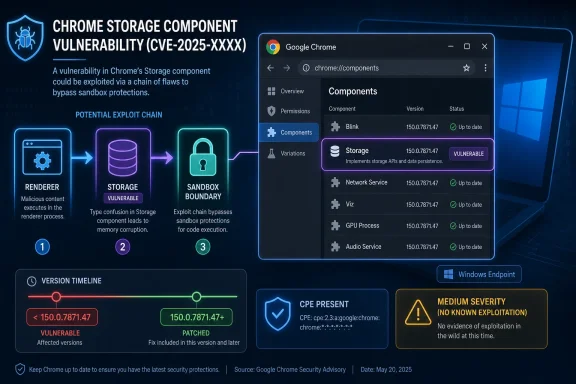 The CPE Is There, but the Real Signal Is in the Version Boundary
The CPE question matters because enterprise scanners live and die by those strings. A CVE without a usable CPE can disappear from dashboards, fail to match installed software inventories, or show up only as a vague advisory that nobody owns. In this case, however, NVD’s own change history says NIST added the Chrome CPE configuration on July 2, 2026, covering Google Chrome versions up to but not including 150.0.7871.47.That means the practical boundary is clean: if Chrome is older than 150.0.7871.47 on Windows or macOS, treat it as vulnerable to CVE-2026-13976. Google’s Chrome Releases blog, as reflected in the NVD entry and corroborated by PCWorld and Malwarebytes reporting, tied the desktop Stable Channel update to version 150.0.7871.46/.47 for Windows and Mac and 150.0.7871.46 for Linux. The WindowsForum angle is straightforward: Windows fleets should key off the
.47 build where Chrome is the managed product.The subtlety is that Chrome release numbering is not always pleasingly uniform across platforms. Google often publishes paired build numbers for Windows and macOS, while Linux may receive a nearby but not identical build. Vulnerability managers should resist the temptation to flatten all platforms into a single visual rule unless their tooling understands the vendor’s platform-specific version ranges.
The NVD record is still incomplete in one obvious way: NIST has not yet supplied its own CVSS score. CISA-ADP did add a CVSS 3.1 vector and a medium 5.8 score, but NVD’s primary assessment fields remain blank. That gap does not block remediation; it simply means scoring should not be mistaken for absence of risk.
A Medium Bug With a Sandbox-Escape Shape
The phrase “medium severity” can lull people into the wrong conclusion. CVE-2026-13976 is described as insufficient data validation in Chrome’s Storage component leading to a heap-based buffer overflow. The attack requires a renderer process that has already been compromised, and user interaction is part of CISA’s vector, which is why the score lands in medium territory rather than in the emergency lane.But the shape of the bug is what security teams should notice. Renderer compromise is not hypothetical in browser exploitation; it is often stage one. The sandbox exists precisely because modern browsers assume parsing hostile web content is a dangerous business, so the renderer is confined and stripped of the authority to do broader damage.
A sandbox escape is stage two. If an attacker can combine a renderer exploit with a bug that crosses the sandbox boundary, the whole threat model changes. A vulnerability that looks constrained on its own can become the difference between a tab crash and meaningful host compromise when paired with another flaw.
That is why “attacker who had compromised the renderer process” is not a comfort blanket. It is a dependency. The CVE is saying, in effect, that this bug was not the front door, but it may have been a hallway door deeper inside the building.
Storage Is Boring Until It Is a Boundary
Browser storage sounds mundane. Local storage, IndexedDB, cache systems, origin-scoped data, quotas, persistence, eviction, and cross-process plumbing are the sort of features users never think about until a web app forgets who they are. But this plumbing sits close to one of the hardest parts of browser security: deciding what a page, an origin, a process, and the browser itself are allowed to know and change.That makes validation failures in storage code more consequential than the component name suggests. Storage is not merely a drawer where websites leave key-value pairs. It is an interface between hostile web content and privileged browser machinery, mediated by process isolation, origin checks, IPC, serialization, and memory safety assumptions.
A heap buffer overflow in that neighborhood raises the classic Chrome-era concern: a mistake in memory handling can become a primitive. The public CVE description does not give exploit details, and Google’s linked Chromium issue is restricted, which is normal while users are still updating. But the broad category, CWE-122, is not exotic; heap overflows are an old and durable way to turn bad input into control over program behavior.
The exploitability constraints matter. CISA’s ADP vector marks attack complexity as high, user interaction as required, and exploitation as not observed. That is meaningfully different from an actively exploited zero-day. Still, for a browser that is routinely exposed to arbitrary web content, “high complexity” is not the same as “irrelevant.”
Chrome 150 Was Not a One-Bug Patch
CVE-2026-13976 arrived inside a much larger Chrome 150 security release. PCWorld reported that Chrome 150 fixed 382 security vulnerabilities, including 15 categorized as critical, while Malwarebytes separately highlighted the scale of the update and the desktop versions shipped by Google. That context matters because enterprises rarely patch one Chrome CVE at a time; they patch the whole browser train.The size of the update also complicates prioritization. When nearly 400 flaws land in a single browser release, the instinct is to hunt for the worst CVSS score and ignore the rest. That approach misses the way browser exploitation actually works, where chains can combine a renderer bug, a sandbox escape, a GPU or IPC issue, and a logic flaw in surprising ways.
CVE-2026-13976 is not the headline-grabbing critical entry in that pile. It is one of the medium-severity components that administrators may be tempted to wave away once the scanner stops screaming. But medium browser bugs deserve a different reading than medium bugs in an internal utility: the browser is user-facing, internet-facing, always parsing, and frequently granted access to credentials, session cookies, enterprise portals, and cloud consoles.
This is especially true on Windows desktops, where Chrome is often both the user’s primary work surface and the gateway to identity infrastructure. A browser compromise is no longer just a browser compromise when SSO sessions, admin consoles, browser-saved credentials, and endpoint management portals all live one tab away.
NVD Lag Is a Workflow Problem, Not a Risk Signal
The NVD entry’s timing tells a familiar story. Chrome supplied the CVE on June 30, CISA-ADP enriched it on July 1, and NIST added the CPE configuration and reference typing on July 2. That is not unusual, and it is not evidence of confusion about the affected product. It is the normal asynchronous machinery of public vulnerability metadata catching up with vendor disclosure.For defenders, however, the lag is operationally important. Many organizations still let NVD enrichment drive ticket creation, SLA assignment, and compliance reporting. If a CVE lands before a CPE, scanners may not match it immediately. If the CVSS score is missing, prioritization engines may assign a default, suppress the item, or wait for a later sync.
This is where Windows admins need a sharper habit: vendor release notes are the first patch signal; NVD metadata is the normalization layer. The Chrome Releases blog is the place that tells you a new Stable Channel build exists. NVD is where that information becomes machine-readable for the rest of the ecosystem.
Neither source is sufficient by itself. Vendor advisories can be terse and intentionally withholding on exploit details. NVD can be late, incomplete, or dependent on public information. The defensible workflow is to patch from the vendor channel and validate from vulnerability intelligence, not to wait for every enrichment field to turn green.
The “Permissions Required” Reference Is Not a Dead End
The NVD record links to a Chromium issue marked as requiring permissions. That can frustrate researchers and administrators who want to inspect the root cause before deciding how much urgency to assign. But restricted Chromium bug links are standard practice for security issues while the installed base is still moving to a safe version.Google has long limited access to detailed bug records for vulnerabilities that could help attackers develop exploits. The result is an uncomfortable but necessary asymmetry: defenders often know the affected component, the broad weakness class, and the fixed version before they know the exact code path. In the case of CVE-2026-13976, that means we have enough to patch but not enough to perform meaningful independent exploit analysis.
That is not ideal for transparency, but it is rational for a browser with billions of users and a fast patch cadence. Publishing a precise memory corruption path too early would hand exploit developers a roadmap. The trade-off is that administrators must make decisions with partial information and trust the vendor’s severity classification more than they might like.
Here, the public facts support a measured response. CISA’s SSVC enrichment says exploitation is “none,” automatable is “no,” and technical impact is “partial.” Those are not the words of an internet-wide fire drill. They are the words of a bug that belongs in the next enforced browser update cycle, not in next quarter’s backlog.
Windows Fleets Should Treat Chrome as Infrastructure
The old model treated browsers as user applications. The modern model should treat them as infrastructure. Chrome is not merely something employees use to read the web; it is the runtime for SaaS, identity, remote admin portals, internal dashboards, password managers, helpdesk tools, webmail, endpoint consoles, and sometimes line-of-business applications that should have been retired years ago.That is why a Chrome storage bug belongs on WindowsForum’s radar even when it does not scream “critical.” The Windows endpoint is where the browser, identity token, local profile, EDR agent, and user habit all meet. If a compromised renderer can be paired with a sandbox escape, the attacker is no longer just fighting Chrome’s web security model; they are probing the endpoint boundary.
Managed Chrome environments have a built-in advantage if they use Chrome Browser Cloud Management, Group Policy, Intune, third-party patch management, or enterprise software deployment tools to enforce updates. The important thing is not which control plane wins, but whether the organization can prove version convergence. A patch that is “rolling out over the coming weeks” is not a patch if a vulnerable executive laptop remains parked on an old build.
For unmanaged or lightly managed Windows systems, the advice is simpler and less elegant: open Chrome’s About page, let it check for updates, and restart the browser. Chrome’s auto-update mechanism is good, but it is not magic. Users who never close the browser, VDI images that revert, offline laptops, and machines with broken updater services can all sit behind the release train.
Edge and Chromium Derivatives Live in the Blast Radius Conversation
CVE-2026-13976 is a Google Chrome CVE, and the NVD CPE listed for it is Google Chrome. That does not automatically mean every Chromium-based browser has the same exposure on the same day. Chromium derivatives maintain their own release schedules, patch integration processes, feature flags, and component choices.But it does mean administrators should ask the derivative-browser question. Microsoft Edge, Brave, Vivaldi, Opera, and other Chromium-based browsers inherit large amounts of Chromium code, though not always with identical branding, build numbers, or vulnerability mappings. A bug in a Chromium component like Storage may be relevant beyond Google Chrome once the underlying fix lands upstream.
For Windows environments, Microsoft Edge deserves special attention because it is installed broadly, integrated into Windows experiences, and commonly allowed even where Chrome is the official standard. The right operational question is not “does this Chrome CPE match Edge?” It does not. The right question is whether Microsoft has shipped the corresponding Chromium fix in Edge’s own Stable Channel and whether your inventory separately tracks Edge versions.
This is one reason CPE hygiene can mislead executives. A dashboard may show Chrome remediated while leaving Edge, WebView2 runtime, or another Chromium consumer out of the conversation. CVE-2026-13976 itself may be mapped as Chrome in NVD, but the architectural lesson is broader: Chromium vulnerability management is an ecosystem problem, not a single product checkbox.
The Medium Score Hides the Chain Risk
CISA-ADP’s CVSS 3.1 vector for CVE-2026-13976 is revealing: network attack vector, high attack complexity, no privileges required, user interaction required, changed scope, and low impacts to confidentiality, integrity, and availability. The resulting 5.8 medium score is defensible under the scoring system. It is also an incomplete expression of the risk browser teams actually manage.CVSS is best at describing a vulnerability in isolation. Browser exploitation often punishes isolated thinking. A renderer compromise may come from one flaw, a sandbox escape from another, and post-exploitation value from the user’s live sessions and endpoint context.
That is why “requires prior renderer compromise” should reduce panic, not reduce patching. In a well-run program, medium browser sandbox-adjacent bugs are not ignored; they are batched into aggressive routine patch cycles. The browser’s exposure and exploit-chain potential justify that posture even when a single CVE does not merit emergency war-room treatment.
There is also a timing factor. CVE-2026-13976 was disclosed at the end of June, and by July 4 public vulnerability databases, security vendors, and news outlets had already indexed the basic facts. Once the patch exists and metadata is public, attackers can begin diffing code changes, testing crash conditions, and looking for adjacent patterns. The clock does not wait for NVD’s CVSS field to fill in.
Scanner Owners Should Tune for “Less Than,” Not Just Exact Versions
The affected version notation in the CVE data deserves careful reading. The meaningful condition is less than 150.0.7871.47, not “version 150.0.7871.47 is affected.” The JSON-style affected data in CVE records can look awkward because it uses a version boundary to describe a range. Human readers should translate it into the ordinary rule: update to 150.0.7871.47 or later.This is the sort of detail that creates false positives and false negatives in vulnerability management systems. If a scanner interprets the boundary incorrectly, it may flag the fixed build or miss older builds. If an asset inventory normalizes Chrome version strings poorly, Windows and macOS paired releases may look inconsistent even when the machine is patched.
The presence of a CPE helps, but it does not solve version comparison. Chrome versions are dotted numeric strings, and comparisons must be component-aware. Treating them as plain text can produce nonsense results, especially across major-version transitions.
Administrators should also verify that the updater itself is functioning. A machine that reports an old Chrome build is one problem; a machine that cannot update because the updater service is broken, blocked, or disabled is a different and more persistent problem. The fix for the first is a restart. The fix for the second is configuration hygiene.
The Release Cadence Is Doing Its Job, Even When It Feels Absurd
Chrome’s security cadence now produces update posts that can read like a vulnerability firehose. Hundreds of fixes in a single release are startling, and headlines about “nearly 400” bugs understandably draw attention. But a large patch count is not automatically a sign of collapse; it is also a sign of active fuzzing, internal discovery, external reporting, and an update pipeline capable of shipping fixes at scale.The uncomfortable reality is that the browser is one of the most complex attack surfaces on any Windows machine. It includes JavaScript engines, graphics stacks, media parsers, networking code, storage systems, extension frameworks, PDF handling, font paths, sandbox brokers, and operating-system integrations. A modern browser is closer to an operating system than a document viewer.
That is why the right comparison is not between Chrome and an imaginary bug-free browser. The right comparison is between products that can find, fix, ship, and force-restart users into safer builds quickly and those that cannot. Chrome’s patch volume is noisy, but the machinery behind it is one of the reasons browser compromise is harder today than it was a decade ago.
Still, defenders should not let cadence become complacency. Fast vendor patching only becomes real-world risk reduction when endpoints consume the update. The final mile remains local: policy, restart behavior, inventory accuracy, and user interruption management.
The Patch Window Is Where the Attack Surface Lives
CVE-2026-13976 is most dangerous during the gap between disclosure and deployment. Before disclosure, only the vendor, reporters, and perhaps a small circle know the details. After broad deployment, the vulnerable population shrinks. In the middle, defenders have just enough information to patch, and attackers have just enough information to start looking.For consumer Windows users, that middle period may be short if Chrome updates automatically and the browser restarts. For enterprises, it can be longer. Change windows, ring deployments, compatibility testing, frozen images, nonpersistent desktops, and user deferrals all stretch the exposure period.
This is where browser updates differ from many traditional Windows patches. The compatibility risk of a Chrome point release is usually lower than a monthly OS cumulative update, though not zero. Reddit chatter around Chrome 150 has included reports of extension and media playback friction, but anecdotal reports should not outweigh a security release unless an organization can reproduce a business-critical breakage.
The better enterprise compromise is staged speed. Push first to IT and pilot rings, watch crash and helpdesk signals, then accelerate to the broad fleet. For Chrome security updates, that process should be measured in days, not weeks.
The Answer for This CVE Is Boring, and That Is the Point
For all the interesting mechanics behind CVE-2026-13976, the remediation is deliberately boring. Update Chrome. Confirm the version. Restart the browser. Make sure management tooling sees the fixed build. Then look sideways at Chromium-based browsers and embedded runtimes that may not be covered by the same CPE or the same dashboard rule.The boring answer is also the point of modern browser defense. Most organizations will not reverse-engineer a heap overflow in Chrome Storage. They will not inspect the restricted Chromium issue. They will not build an exploit chain in a lab to decide whether a medium CVE is truly medium. They will either run a disciplined browser update program or they will not.
Windows admins should also resist making this a one-off cleanup. Chrome 150’s large security release follows a year of intense Chromium patch activity, including prior zero-day and high-volume security updates reported by security outlets. The operational lesson is continuous: browsers now need the same seriousness once reserved for operating-system patch baselines.
That means dashboarding browser freshness, tracking restart debt, monitoring updater health, and treating unmanaged browsers as shadow infrastructure. If Chrome is allowed on the endpoint, Chrome is part of the endpoint’s security state.
What This One Storage Bug Says About the Patch Queue
CVE-2026-13976 is not the scariest Chrome bug of the year, but it is a useful test of whether an organization understands browser risk at all. The facts are specific, the fix is available, and the CPE mapping appears present. The remaining question is whether the update has actually landed where users work.- Chrome installations older than 150.0.7871.47 should be treated as vulnerable to CVE-2026-13976 on Windows and macOS fleets where that build is the applicable Stable Channel fix.
- The NVD record does include the expected Google Chrome CPE configuration for versions earlier than 150.0.7871.47, so the “missing CPE” prompt appears to be generic NVD interface text rather than a defect in this entry.
- The vulnerability is medium severity because it requires a previously compromised renderer process and user interaction, but its sandbox-escape role makes it relevant in exploit-chain thinking.
- CISA-ADP reported no known exploitation and marked the issue as not automatable, which supports rapid routine patching rather than emergency incident response.
- Vulnerability scanners should check version ranges carefully, because the meaningful condition is “less than 150.0.7871.47,” not the fixed build itself.
- Chrome patching should be verified by inventory and restart state, not merely assumed because Google has published a Stable Channel update.
References
- Primary source: NVD / Chromium
Published: 2026-07-03T07:00:19-07:00
NVD - CVE-2026-13976
 nvd.nist.gov
- Security advisory: MSRC
Published: 2026-07-03T07:00:19-07:00
Original feed URL
Security Update Guide - Microsoft Security Response Center
 msrc.microsoft.com
- Related coverage: cvefeed.io
CVE-2026-13976 - Google Chrome Storage Sandbox Escape
Insufficient data validation in Storage in Google Chrome prior to 150.0.7871.47 allowed a remote attacker who had compromised the renderer process to potentially perform a sandbox escape via a crafted HTML page. (Chromium security severity: Medium)cvefeed.io
