

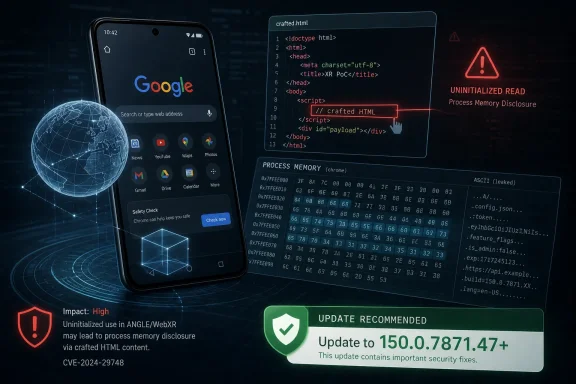
Google Chrome for Android before version 150.0.7871.47 contains CVE-2026-14008, a medium-severity WebXR uninitialized-use flaw disclosed on June 30, 2026, that can let a remote attacker read potentially sensitive process memory when a user opens a crafted HTML page. Google’s Chrome Releases blog and the NVD record describe the same core bug, while CISA’s ADP enrichment assigns it a 6.5 CVSS 3.1 score. The uncomfortable part is not that this is the scariest Chrome vulnerability of the month; it is that a browser feature many users never knowingly touch still widens the attack surface of the phone they use for banking, work chat, identity prompts, and password recovery. CVE-2026-14008 is a reminder that modern browser risk increasingly lives in the seams between rich device APIs, mobile update lag, and vulnerability databases that are still catching up after disclosure.
Chrome’s security taxonomy can make this flaw sound less urgent than it is. Chromium rates CVE-2026-14008 as medium severity, and CISA’s ADP vector requires user interaction, meaning the victim has to load a malicious page rather than be compromised by a fully autonomous network worm. That is a meaningful distinction, but it is not much comfort in a browser world where loading attacker-controlled HTML is the default operating condition.
The vulnerability sits in WebXR, the browser technology family that exposes virtual-reality and augmented-reality capabilities to web content. On Android, that means the bug is attached to a mobile browser that already mediates camera-adjacent experiences, sensors, graphics pipelines, device state, and user sessions. A crafted HTML page does not need to look like an exploit kit from 2012; it can be an ad landing page, a QR-code destination, a malicious link in a chat app, or a compromised site that the user already trusts.
The NVD entry describes the impact as obtaining “potentially sensitive information from process memory.” That phrase is doing a lot of work. Information disclosure bugs rarely produce the cinematic effect of instant device takeover, but they can reveal data that helps chain an attack, defeat mitigations, expose tokens, or leak fragments that should never have crossed a trust boundary.
That is why medium does not mean minor. In Chrome, memory disclosure can be the reconnaissance step that makes a later sandbox escape or renderer exploit more reliable. Even when no public exploit is known, the security value of patching is not merely theoretical; it is about denying attackers one more primitive in a browser that is already among the most heavily targeted applications on any endpoint.
The design challenge is not that WebXR is inherently reckless. The web has spent decades absorbing hardware capabilities that once belonged only to native apps, and much of that work has been done with permission prompts, origin isolation, and sandboxing in mind. The risk is cumulative. Every new API family brings parsing logic, state transitions, graphics hooks, device abstractions, and edge cases that attackers can explore faster than most administrators can inventory.
CVE-2026-14008 is classified as CWE-457, use of an uninitialized variable. That category is old, familiar, and deeply unglamorous: software reads memory before it has been properly set to a known value. In a security-sensitive process, the result can be leakage of stale memory contents, undefined behavior, or a stepping stone toward a more complex exploit.
The notable detail is not that Chrome contains a memory-safety bug; large C++ codebases do. The notable detail is that such a bug appears in a browser subsystem designed to connect web content to immersive device experiences. The more the browser becomes the operating system’s front door to hardware, the less useful it is to think of “web bugs” as somehow separate from endpoint security.
That condition lowers the severity score, but it maps neatly onto everyday mobile behavior. Android users open links from SMS, messaging apps, email, social networks, QR codes, captive portals, search results, and in-app browsers. In many organizations, the mobile browser is where employees authenticate to cloud apps, approve identity challenges, and retrieve documents that were never designed for a hostile rendering engine.
The confidentiality impact is rated high in CISA’s CVSS 3.1 vector, with no direct integrity or availability impact. That split matters. CVE-2026-14008 is not being described as a bug that lets an attacker rewrite files or crash the phone at will; it is being described as a bug that may expose sensitive memory. In browser exploitation, however, confidentiality is often the quiet half of the kill chain.
Memory disclosure can undermine address-space layout randomization, leak object layout details, or expose fragments of data from a privileged context. Whether CVE-2026-14008 can do any of those things in practice is not established publicly, and Google’s linked Chromium issue is permission-restricted, as is common immediately after security fixes. But defenders do not need a full exploit write-up to understand the patch priority: the vulnerability affects pre-150.0.7871.47 Chrome on Android, and the fix line is clear.
The confusion is that Google’s Chrome Releases post cited in the NVD entry is framed around the stable desktop channel, while the CVE description explicitly says Chrome on Android. Google’s Chrome Releases index notes that Android releases contain the same security fixes as corresponding desktop releases unless otherwise stated, which helps explain why the same release train can show up in multiple platform contexts. Still, this is exactly the kind of cross-platform advisory structure that causes asset-management tools to wobble.
The NVD change history is also worth reading closely. NIST’s initial analysis added a CPE configuration that combines a Chrome application CPE up to, but excluding, 150.0.7871.47 with an Android operating-system CPE. That is a reasonable attempt to model “Chrome on Android,” but it can produce awkward results in scanners that treat CPE logic too literally or inventory Chrome and Android as separate assets.
This is where security teams need to resist the false precision of a green dashboard. The question is not merely whether an NVD CPE exists. The question is whether your mobile fleet inventory can identify installed Chrome versions on Android devices, compare them against 150.0.7871.47, and confirm that managed devices actually received the update.
But “a CPE exists” is not the same as “your tool will match it correctly.” Mobile Chrome lives at the intersection of OS version, app version, Play Store rollout state, managed Google Play policy, OEM behavior, and enterprise mobility management reporting. A vulnerability scanner built around server-style package inventories may recognize Android as a device platform without reliably seeing the installed Chrome application version.
The version data in the CVE record also contains a small oddity: the affected array lists version 150.0.7871.47 with a less-than condition of 150.0.7871.47. Security people have learned to read through this kind of machine-readable awkwardness, but machines do not always share that judgment. If a vulnerability-management platform ingests the record too rigidly, it may misstate the affected range or fail to attach the CVE to mobile assets.
That makes CVE-2026-14008 a useful test case for NVD-era vulnerability operations. The database entry is not empty, CISA has added useful scoring, and Google has provided the fixed version. Yet the final mile still depends on whether enterprise inventory can answer a blunt question: which Android devices are running Chrome below 150.0.7871.47 today?
For security teams, that staggered workflow creates a dangerous temptation: wait until all the fields are filled in. That may be administratively tidy, but it is operationally backwards for browsers. Chrome updates move fast, attackers reverse patches, and the exploitability of a bug is often clarified after the fix ships, not before.
CISA’s SSVC data for CVE-2026-14008 lists no known exploitation, not automatable, and partial technical impact. That is helpful context. It suggests this is not being treated as an active mass-exploitation emergency at publication time. But it should not be read as a reason to let Android browsers drift for weeks.
The browser patching model is built on release velocity. Google ships fixes, keeps bug details restricted until a majority of users are updated, and expects auto-update to collapse the exposure window. Enterprises that disable or delay mobile app updates have opted out of the model while still keeping the risk.
A memory leak can provide addresses, pointers, object contents, or state that turns a fragile exploit into a reliable one. It can also expose user data directly, depending on process architecture and what memory becomes reachable. Chrome’s multi-process architecture and sandboxing are designed to constrain damage, but no serious defender assumes those boundaries make memory disclosure irrelevant.
This is especially true on mobile. A phone is a dense bundle of identity: browser sessions, account cookies, enterprise single sign-on flows, password managers, device-bound prompts, and personal communications. Even a partial leak can have consequences that are disproportionate to the neat “medium” label in a vulnerability table.
None of this means CVE-2026-14008 should be inflated into a catastrophic zero-day. Google has not said it is exploited in the wild, and the public description does not claim code execution. The correct posture is more disciplined: treat it as a real confidentiality bug in a high-value application, patch it promptly, and do not wait for proof-of-concept code to make the decision for you.
Chrome on Android is often assumed to be self-maintaining because Google Play updates are generally automatic. That assumption breaks down on devices with restricted networks, stale Play services, limited storage, battery-saving policies, user-disabled updates, regional rollout timing, or enterprise policies that pin app versions. The browser may be the most exposed app on the phone, yet it can be one of the least audited if mobile security posture focuses mainly on OS patch level.
The version threshold gives IT a simple compliance rule: Chrome must be 150.0.7871.47 or later where that build applies. If an EMM console cannot express that rule, export the app inventory and check it elsewhere. If Android devices are allowed to use alternate Chromium-based browsers, administrators should verify whether those vendors have pulled in the relevant Chromium fix rather than assuming Chrome’s version number applies.
There is also a user-education angle, though it should not be oversold. Because exploitation requires opening crafted HTML, users should be reminded that QR codes, shortened links, and unexpected mobile prompts are still web attack paths. But the burden should not sit on users to detect memory-corruption triggers in a page. The real control is patch velocity.
Security advisories increasingly describe components rather than products in the old boxed-software sense. WebXR code may be shared, conditioned, or built differently across platforms; fixes may land in a release train that spans desktop and Android; and the public issue tracker may remain locked until update adoption is high. The result is a paper trail that is accurate enough for experts but awkward for everyone else.
For WindowsForum readers, the lesson extends beyond Android. Chromium is the substrate for Chrome, Edge, Brave, Vivaldi, Opera, and many embedded web views, even though update timing and exposure vary by product. A Chrome for Android CVE does not automatically mean Edge on Windows is vulnerable in the same way, but it does mean administrators should understand where Chromium components enter their environment.
Microsoft Edge users should watch Microsoft’s own release notes and security guidance rather than blindly applying Chrome version numbers. The same principle holds for other Chromium derivatives. The upstream bug matters, but the downstream fix boundary is vendor-specific.
Waiting for active exploitation changes the economics. Once attackers know a bug is useful, defenders shift from orderly rollout to incident response. Browser vulnerabilities are particularly unforgiving because the attack surface is public, reachable, and constantly exercised by normal user behavior.
Google’s practice of restricting bug details until users are updated is meant to slow that race. It does not eliminate it. Attackers can diff patches, study changed code, and infer vulnerable paths long before a polished exploit appears in public.
The security industry tends to reserve urgency language for critical remote-code-execution flaws, and that makes sense for triage. But the operational habit should be broader: browsers should not sit unpatched across version boundaries that contain memory-safety fixes. CVE-2026-14008 is not the loudest alarm in Chrome 150, but it is still part of the reason Chrome 150 needs to land.
The fix does not require a workaround, a registry change, or a compensating control with caveats. It requires updating Chrome. That simplicity is useful, but it can also breed complacency because teams assume auto-update has already handled the problem.
A credible response should include verification. Security teams should confirm the installed Chrome version on Android devices, check whether any managed policies delay app updates, and make sure vulnerability tools are not missing the issue because of CPE matching quirks. Where Chrome is not the default browser, teams should still examine Chromium-derived browsers and embedded web surfaces that may follow separate update channels.
The broader lesson is that browser patch management is no longer just a desktop concern. Mobile browsers are first-class enterprise endpoints because they carry authentication, data access, and user identity. A medium WebXR memory disclosure bug belongs in the same operational workflow as any other endpoint exposure.
 A Medium Chrome Bug Still Has a Long Reach on Android
Chrome’s security taxonomy can make this flaw sound less urgent than it is. Chromium rates CVE-2026-14008 as medium severity, and CISA’s ADP vector requires user interaction, meaning the victim has to load a malicious page rather than be compromised by a fully autonomous network worm. That is a meaningful distinction, but it is not much comfort in a browser world where loading attacker-controlled HTML is the default operating condition.The vulnerability sits in WebXR, the browser technology family that exposes virtual-reality and augmented-reality capabilities to web content. On Android, that means the bug is attached to a mobile browser that already mediates camera-adjacent experiences, sensors, graphics pipelines, device state, and user sessions. A crafted HTML page does not need to look like an exploit kit from 2012; it can be an ad landing page, a QR-code destination, a malicious link in a chat app, or a compromised site that the user already trusts.
The NVD entry describes the impact as obtaining “potentially sensitive information from process memory.” That phrase is doing a lot of work. Information disclosure bugs rarely produce the cinematic effect of instant device takeover, but they can reveal data that helps chain an attack, defeat mitigations, expose tokens, or leak fragments that should never have crossed a trust boundary.
That is why medium does not mean minor. In Chrome, memory disclosure can be the reconnaissance step that makes a later sandbox escape or renderer exploit more reliable. Even when no public exploit is known, the security value of patching is not merely theoretical; it is about denying attackers one more primitive in a browser that is already among the most heavily targeted applications on any endpoint.
WebXR Is Niche Until the Browser Makes It Universal
WebXR has always lived in an odd place in the security conversation. It is marketed as an enabling layer for immersive web experiences, but it ships inside general-purpose browsers used by people who may never put on a headset or launch an AR demo. That is the bargain of the modern web platform: experimental and specialized APIs become ambient attack surface once they are available to ordinary pages.The design challenge is not that WebXR is inherently reckless. The web has spent decades absorbing hardware capabilities that once belonged only to native apps, and much of that work has been done with permission prompts, origin isolation, and sandboxing in mind. The risk is cumulative. Every new API family brings parsing logic, state transitions, graphics hooks, device abstractions, and edge cases that attackers can explore faster than most administrators can inventory.
CVE-2026-14008 is classified as CWE-457, use of an uninitialized variable. That category is old, familiar, and deeply unglamorous: software reads memory before it has been properly set to a known value. In a security-sensitive process, the result can be leakage of stale memory contents, undefined behavior, or a stepping stone toward a more complex exploit.
The notable detail is not that Chrome contains a memory-safety bug; large C++ codebases do. The notable detail is that such a bug appears in a browser subsystem designed to connect web content to immersive device experiences. The more the browser becomes the operating system’s front door to hardware, the less useful it is to think of “web bugs” as somehow separate from endpoint security.
The Exploit Path Is Ordinary, Which Is the Problem
The described attack path is simple: a remote attacker serves a crafted HTML page, and the victim’s vulnerable Chrome for Android instance processes it. The CVSS vector published by CISA’s ADP enrichment lists network attack vector, low attack complexity, no privileges required, and required user interaction. In plain English, the attacker does not need an account on the target system, but they do need the user to open something.That condition lowers the severity score, but it maps neatly onto everyday mobile behavior. Android users open links from SMS, messaging apps, email, social networks, QR codes, captive portals, search results, and in-app browsers. In many organizations, the mobile browser is where employees authenticate to cloud apps, approve identity challenges, and retrieve documents that were never designed for a hostile rendering engine.
The confidentiality impact is rated high in CISA’s CVSS 3.1 vector, with no direct integrity or availability impact. That split matters. CVE-2026-14008 is not being described as a bug that lets an attacker rewrite files or crash the phone at will; it is being described as a bug that may expose sensitive memory. In browser exploitation, however, confidentiality is often the quiet half of the kill chain.
Memory disclosure can undermine address-space layout randomization, leak object layout details, or expose fragments of data from a privileged context. Whether CVE-2026-14008 can do any of those things in practice is not established publicly, and Google’s linked Chromium issue is permission-restricted, as is common immediately after security fixes. But defenders do not need a full exploit write-up to understand the patch priority: the vulnerability affects pre-150.0.7871.47 Chrome on Android, and the fix line is clear.
The Version Number Is the Security Boundary
For administrators, the actionable line is Chrome on Android prior to 150.0.7871.47. That is the version boundary supplied in the CVE record and reinforced by third-party vulnerability trackers such as Tenable and SentinelOne’s vulnerability database. Anything below that version should be treated as exposed to CVE-2026-14008 unless vendor packaging or downstream Chromium builds provide a separately documented fix.The confusion is that Google’s Chrome Releases post cited in the NVD entry is framed around the stable desktop channel, while the CVE description explicitly says Chrome on Android. Google’s Chrome Releases index notes that Android releases contain the same security fixes as corresponding desktop releases unless otherwise stated, which helps explain why the same release train can show up in multiple platform contexts. Still, this is exactly the kind of cross-platform advisory structure that causes asset-management tools to wobble.
The NVD change history is also worth reading closely. NIST’s initial analysis added a CPE configuration that combines a Chrome application CPE up to, but excluding, 150.0.7871.47 with an Android operating-system CPE. That is a reasonable attempt to model “Chrome on Android,” but it can produce awkward results in scanners that treat CPE logic too literally or inventory Chrome and Android as separate assets.
This is where security teams need to resist the false precision of a green dashboard. The question is not merely whether an NVD CPE exists. The question is whether your mobile fleet inventory can identify installed Chrome versions on Android devices, compare them against 150.0.7871.47, and confirm that managed devices actually received the update.
The CPE Is There, but It May Not Save Your Scanner
The user-facing NVD page includes the familiar prompt asking whether a CPE is missing, and for CVE-2026-14008 that question is more interesting than usual. The change log indicates that NIST did add a vulnerable software configuration: Google Chrome versions up to but excluding 150.0.7871.47, combined with Android. So in the narrow sense, no, this does not appear to be a CVE with no CPE enrichment at all.But “a CPE exists” is not the same as “your tool will match it correctly.” Mobile Chrome lives at the intersection of OS version, app version, Play Store rollout state, managed Google Play policy, OEM behavior, and enterprise mobility management reporting. A vulnerability scanner built around server-style package inventories may recognize Android as a device platform without reliably seeing the installed Chrome application version.
The version data in the CVE record also contains a small oddity: the affected array lists version 150.0.7871.47 with a less-than condition of 150.0.7871.47. Security people have learned to read through this kind of machine-readable awkwardness, but machines do not always share that judgment. If a vulnerability-management platform ingests the record too rigidly, it may misstate the affected range or fail to attach the CVE to mobile assets.
That makes CVE-2026-14008 a useful test case for NVD-era vulnerability operations. The database entry is not empty, CISA has added useful scoring, and Google has provided the fixed version. Yet the final mile still depends on whether enterprise inventory can answer a blunt question: which Android devices are running Chrome below 150.0.7871.47 today?
NVD Enrichment Is No Longer a Complete Comfort Blanket
The CVE record shows NVD had not yet provided its own CVSS 4.0 or CVSS 3.x assessment at the time reflected in the supplied data, while CISA-ADP supplied a CVSS 3.1 score and SSVC details. This is increasingly normal in a world where vulnerability metadata arrives in layers. MITRE or the CNA publishes the CVE, vendors publish advisories, CISA may enrich operational risk, and NVD may add or refine CPEs and scoring later.For security teams, that staggered workflow creates a dangerous temptation: wait until all the fields are filled in. That may be administratively tidy, but it is operationally backwards for browsers. Chrome updates move fast, attackers reverse patches, and the exploitability of a bug is often clarified after the fix ships, not before.
CISA’s SSVC data for CVE-2026-14008 lists no known exploitation, not automatable, and partial technical impact. That is helpful context. It suggests this is not being treated as an active mass-exploitation emergency at publication time. But it should not be read as a reason to let Android browsers drift for weeks.
The browser patching model is built on release velocity. Google ships fixes, keeps bug details restricted until a majority of users are updated, and expects auto-update to collapse the exposure window. Enterprises that disable or delay mobile app updates have opted out of the model while still keeping the risk.
Memory Disclosure Is the Kind of Bug Attackers Like to Pair
Information disclosure vulnerabilities often suffer from a public-relations problem. They sound passive. They do not encrypt files, pop shells, or deface screens. But exploit developers value them because modern mitigations have made blind exploitation harder.A memory leak can provide addresses, pointers, object contents, or state that turns a fragile exploit into a reliable one. It can also expose user data directly, depending on process architecture and what memory becomes reachable. Chrome’s multi-process architecture and sandboxing are designed to constrain damage, but no serious defender assumes those boundaries make memory disclosure irrelevant.
This is especially true on mobile. A phone is a dense bundle of identity: browser sessions, account cookies, enterprise single sign-on flows, password managers, device-bound prompts, and personal communications. Even a partial leak can have consequences that are disproportionate to the neat “medium” label in a vulnerability table.
None of this means CVE-2026-14008 should be inflated into a catastrophic zero-day. Google has not said it is exploited in the wild, and the public description does not claim code execution. The correct posture is more disciplined: treat it as a real confidentiality bug in a high-value application, patch it promptly, and do not wait for proof-of-concept code to make the decision for you.
Android Fleet Management Is the Real Patch Test
For individual users, the fix is mundane: update Chrome from Google Play and verify the version. For administrators, the work is less glamorous and more important. Managed Android fleets need app-version compliance, update enforcement, and reporting that distinguishes “device checked in” from “browser patched.”Chrome on Android is often assumed to be self-maintaining because Google Play updates are generally automatic. That assumption breaks down on devices with restricted networks, stale Play services, limited storage, battery-saving policies, user-disabled updates, regional rollout timing, or enterprise policies that pin app versions. The browser may be the most exposed app on the phone, yet it can be one of the least audited if mobile security posture focuses mainly on OS patch level.
The version threshold gives IT a simple compliance rule: Chrome must be 150.0.7871.47 or later where that build applies. If an EMM console cannot express that rule, export the app inventory and check it elsewhere. If Android devices are allowed to use alternate Chromium-based browsers, administrators should verify whether those vendors have pulled in the relevant Chromium fix rather than assuming Chrome’s version number applies.
There is also a user-education angle, though it should not be oversold. Because exploitation requires opening crafted HTML, users should be reminded that QR codes, shortened links, and unexpected mobile prompts are still web attack paths. But the burden should not sit on users to detect memory-corruption triggers in a page. The real control is patch velocity.
The Desktop Advisory Trail Shows How Browser Security Has Outgrown Platform Labels
One confusing aspect of CVE-2026-14008 is the reference trail. The NVD record points to Google’s Chrome Releases stable desktop update, while the vulnerability description names Chrome on Android. That is not necessarily contradictory, but it reflects how Chromium security fixes travel through a shared codebase and release machinery that does not always map cleanly to end-user platform categories.Security advisories increasingly describe components rather than products in the old boxed-software sense. WebXR code may be shared, conditioned, or built differently across platforms; fixes may land in a release train that spans desktop and Android; and the public issue tracker may remain locked until update adoption is high. The result is a paper trail that is accurate enough for experts but awkward for everyone else.
For WindowsForum readers, the lesson extends beyond Android. Chromium is the substrate for Chrome, Edge, Brave, Vivaldi, Opera, and many embedded web views, even though update timing and exposure vary by product. A Chrome for Android CVE does not automatically mean Edge on Windows is vulnerable in the same way, but it does mean administrators should understand where Chromium components enter their environment.
Microsoft Edge users should watch Microsoft’s own release notes and security guidance rather than blindly applying Chrome version numbers. The same principle holds for other Chromium derivatives. The upstream bug matters, but the downstream fix boundary is vendor-specific.
The “No Known Exploitation” Window Is When Patching Works Best
The best time to patch a browser bug is before it becomes famous. CVE-2026-14008 currently sits in that quieter category: disclosed, scored by CISA-ADP, not known to be exploited according to the SSVC data in the supplied record, and fixed in the relevant Chrome release. That is precisely when routine patch management can do its job without drama.Waiting for active exploitation changes the economics. Once attackers know a bug is useful, defenders shift from orderly rollout to incident response. Browser vulnerabilities are particularly unforgiving because the attack surface is public, reachable, and constantly exercised by normal user behavior.
Google’s practice of restricting bug details until users are updated is meant to slow that race. It does not eliminate it. Attackers can diff patches, study changed code, and infer vulnerable paths long before a polished exploit appears in public.
The security industry tends to reserve urgency language for critical remote-code-execution flaws, and that makes sense for triage. But the operational habit should be broader: browsers should not sit unpatched across version boundaries that contain memory-safety fixes. CVE-2026-14008 is not the loudest alarm in Chrome 150, but it is still part of the reason Chrome 150 needs to land.
The Practical Meaning of CVE-2026-14008 Is Version Discipline
CVE-2026-14008 tells a modest technical story and a larger operational one. The technical story is a WebXR uninitialized-use flaw that can disclose process memory through crafted HTML on vulnerable Chrome for Android versions. The operational story is about how quickly defenders can translate that sentence into actual device compliance.The fix does not require a workaround, a registry change, or a compensating control with caveats. It requires updating Chrome. That simplicity is useful, but it can also breed complacency because teams assume auto-update has already handled the problem.
A credible response should include verification. Security teams should confirm the installed Chrome version on Android devices, check whether any managed policies delay app updates, and make sure vulnerability tools are not missing the issue because of CPE matching quirks. Where Chrome is not the default browser, teams should still examine Chromium-derived browsers and embedded web surfaces that may follow separate update channels.
The broader lesson is that browser patch management is no longer just a desktop concern. Mobile browsers are first-class enterprise endpoints because they carry authentication, data access, and user identity. A medium WebXR memory disclosure bug belongs in the same operational workflow as any other endpoint exposure.
The Chrome 150 WebXR Bug Leaves Administrators With a Short Checklist
The story of CVE-2026-14008 is not complicated enough to justify panic, but it is concrete enough to justify action. The affected product, attack condition, impact class, and fixed version are all visible. The remaining uncertainty is mostly in local environments: whether devices have updated, whether scanners match the CPE correctly, and whether alternative Chromium-based browsers are being tracked with the same discipline.- Chrome for Android installations below 150.0.7871.47 should be treated as vulnerable to CVE-2026-14008.
- The bug requires user interaction, but opening attacker-controlled HTML is routine browser behavior rather than a rare edge case.
- The primary impact is confidentiality, because the flaw can expose potentially sensitive process memory rather than directly modifying data or causing availability loss.
- The NVD record includes CPE enrichment combining Chrome with Android, but enterprise tools may still miss affected devices if they lack accurate mobile app inventory.
- CISA’s enrichment indicates no known exploitation in the supplied record, which makes this a patch-now-before-it-is-interesting vulnerability rather than a confirmed emergency.
- Organizations using Chromium-derived browsers should verify each vendor’s fixed build instead of assuming Google Chrome’s Android version boundary applies universally.
References
- Primary source: NVD / Chromium
Published: 2026-07-03T07:00:44-07:00
NVD - CVE-2026-14008
 nvd.nist.gov
- Security advisory: MSRC
Published: 2026-07-03T07:00:44-07:00
Original feed URL
Security Update Guide - Microsoft Security Response Center
 msrc.microsoft.com
- Related coverage: labs.cloudsecurityalliance.org
NVD Enrichment Triage: Enterprise Vulnerability Programs Must Adapt
PDF documentlabs.cloudsecurityalliance.org
