

Google Chrome before 150.0.7871.47 is affected by CVE-2026-14017, a Navigation implementation flaw disclosed on June 30, 2026, that could let an attacker who already compromised Chrome’s renderer potentially escape the sandbox through a crafted HTML page. The short answer to the CPE question is: no, the obvious Google Chrome application CPE is not missing anymore; NVD’s July 1 change record added the Chrome CPE for versions before 150.0.7871.47. The more interesting answer is that this CVE exposes a familiar weakness in vulnerability tracking: the database entry is tidy, but the real-world risk depends on browser build, platform packaging, Chromium downstreams, and whether defenders understand the phrase “had compromised the renderer process.” As Google’s Chrome Releases blog and NVD’s change history frame it, this is less a drive-by bug by itself than a second-stage escape route in the browser attack chain.
The NVD record for CVE-2026-14017 now includes a CPE configuration for Google Chrome with versions up to, but excluding, 150.0.7871.47. That is the expected canonical product mapping:
But CPE completeness is not the same thing as exposure completeness. Chrome is the named product, yet the underlying code lives in Chromium, and Chromium’s reach extends well beyond Google’s browser. Microsoft Edge, Brave, Vivaldi, Opera, Electron applications, embedded WebView-like components, and appliance UIs can all inherit classes of Chromium bugs on different schedules and through different advisory systems.
That does not mean defenders should invent CPEs for every Chromium-derived product in the Chrome CVE record. It means they should treat the Chrome CPE as the first reliable anchor, not the whole asset story. NVD’s job is to describe known affected software configurations; enterprise IT’s job is to decide where the affected code actually runs.
There is also a small oddity in the CVE’s affected-version text as reproduced in some feeds: the listed version object names 150.0.7871.47 while also saying “lessThan 150.0.7871.47.” In practice, the description and Google’s release channel wording resolve the ambiguity. Chrome prior to 150.0.7871.47 is vulnerable; 150.0.7871.47 or later is the target state for Windows and macOS stable users.
The disagreement is not necessarily a contradiction. Chrome’s internal severity often reflects exploit prerequisites, bug class, exploitability, and context inside the browser’s security model. CVSS, by contrast, can score the consequences of a successful sandbox escape very harshly once the preconditions are satisfied.
The key phrase is “who had compromised the renderer process.” CVE-2026-14017 is not described as a one-click remote code execution bug that starts from a clean browser state and immediately lands in the operating system. It is described as a sandbox escape opportunity after renderer compromise, triggered through a crafted HTML page.
That distinction matters. A renderer compromise is already serious, but Chrome’s sandbox exists specifically to contain that damage. A sandbox escape is the bridge from “code running in a constrained browser process” toward broader system access, data theft, persistence attempts, or lateral movement. In modern browser exploitation, that bridge is often the expensive part.
So the operational answer is not “ignore it because Google said Medium” or “panic because CVSS says Critical.” The better answer is to prioritize it as part of the Chrome 150 security update, especially in environments where browsers touch privileged workflows, identity portals, admin consoles, SaaS dashboards, and sensitive internal applications.
That context changes how administrators should read the CVE. The question is not whether one medium-rated Navigation flaw justifies a change window on its own. The question is whether an already-published browser update containing a large security payload should be allowed to wait because no single CVE has yet become famous.
Browser patching has become a rhythm problem. Google, Microsoft, Mozilla, Apple, and the wider Chromium ecosystem ship fixes so frequently that defenders can become numb to the advisories. Yet attackers do not need every bug in a release; they need one usable chain, one delayed update population, and one target set worth burning capability on.
CVE-2026-14017 is especially relevant because it sits in the browser’s navigation machinery. Navigation is not an obscure corner of the product. It is the act of moving between documents, origins, frames, histories, permissions, and process boundaries. When that machinery misapplies a protection mechanism, the bug can become a lever against assumptions that the sandbox depends on.
A malicious page may exploit a memory corruption issue, a type confusion bug, a logic flaw, or another vulnerability to gain code execution inside that renderer process. If the sandbox holds, the attacker is trapped inside a restricted environment with limited access. If a second bug allows escape, the attack starts to look much more like traditional endpoint compromise.
That is why sandbox escapes receive so much attention even when their standalone severity appears lower. They are force multipliers. They turn a renderer exploit from a contained browser event into something that can interact more dangerously with the host system.
The CVE description does not say that CVE-2026-14017 is known to be exploited in the wild. CISA’s SSVC entry, as included in the NVD change history, marks exploitation as “none” and automatable as “no.” That should calm one kind of alarm while leaving the patching argument intact. Absence of known exploitation is not a reason to preserve a vulnerable browser build.
The user sees a page load. The browser sees a security boundary negotiation.
An “inappropriate implementation” in Navigation is vague by design because Google often restricts bug details until most users have updated. That embargo is sensible. Publishing a reproduction recipe too early can help attackers more than defenders. But the category still tells us something: this was not merely a cosmetic issue in page rendering. It involved behavior close enough to navigation and protection enforcement that a compromised renderer could potentially use it to break containment.
CISA’s enrichment maps the weakness to CWE-693, Protection Mechanism Failure. That is a broad bucket, but it fits the story. The sandbox is a protection mechanism; navigation and process isolation rules are part of the enforcement surface; the CVE describes a path by which that protection could fail after a renderer is already under attacker control.
This is where Chrome’s architecture becomes both impressive and fragile. The browser is full of mutually reinforcing defenses: site isolation, sandboxing, permission prompts, process boundaries, broker processes, and mitigations in the JavaScript engine and graphics stack. A bug in one layer may be survivable. A chain across layers is what defenders fear.
The practical patch target for Windows is Chrome 150.0.7871.47 or later. For consumer systems, Chrome’s automatic update flow usually handles this quickly, provided the browser is restarted. For managed fleets, administrators should check Google Update policy, enterprise browser reporting, endpoint management telemetry, and any controls that delay major-version rollouts.
The restart problem remains underrated. Chrome can download an update and still keep users on a vulnerable build until the browser relaunches. In environments where users keep dozens of tabs open for weeks, “update available” is not the same as “patched.” Admins who track process uptime often get a truer picture of exposure than admins who only track package availability.
Microsoft Edge deserves separate attention. This CVE is sourced to Chrome, not Edge, but Edge inherits Chromium code and Microsoft ships its own advisories and versioning. A Chrome CPE match will not necessarily tell you whether Edge, WebView2 Runtime, or Electron-based applications are fixed. That is not an NVD failure; it is the cost of the Chromium monoculture.
Electron is the classic enterprise blind spot. Many desktop applications are effectively browser shells around web technologies, and their Chromium versions may lag behind Chrome stable. Collaboration tools, developer tools, password vaults, note-taking apps, support clients, and internal line-of-business applications can carry embedded Chromium code without showing up as Chrome in an asset scan.
That does not mean CVE-2026-14017 automatically applies to every Electron app. Exploitability depends on whether the affected code is present, reachable, and exposed to attacker-controlled content. But it does mean security teams should have a way to inventory Chromium runtime versions outside the browser icon users recognize.
The same logic applies to browsers that market themselves as privacy-first, gamer-friendly, enterprise-managed, or niche power-user alternatives. If they ride Chromium, their patch latency matters. A vendor’s branding does not isolate it from the upstream codebase.
This is the quiet governance problem behind every Chromium CVE. The public advisory names one product because that is where the fix lands first. The enterprise exposure model must name every place the code travels.
For vulnerability managers, that timing can be frustrating. Many tools depend on NVD enrichment to light up detections cleanly. When CVSS, CPEs, or references lag, automation can under-prioritize or misclassify a new issue.
But in this case, the decisive patch signal did not require waiting for NVD’s final scoring. Google’s release notes identified the fixed version. The CVE description identified the affected range. CISA’s enrichment supplied a severity interpretation and SSVC context. A mature browser patch process should not be blocked on the last field in a database record.
The database still matters, especially for compliance reporting and scanner normalization. A missing or delayed CPE can create blind spots in asset-based vulnerability management. But Chrome is not obscure software. If an organization needs NVD to discover that Chrome stable moved and should be patched, the larger problem is not CVE-2026-14017.
The better audit question is whether your tool maps that CPE to actual installations. Chrome may be installed per-machine, per-user, through enterprise installers, bundled in golden images, or present on unmanaged endpoints that only partially report software inventory. On Windows, that means registry evidence, executable version checks, browser management telemetry, and EDR software inventory may disagree.
Another useful question is whether the fixed build differs by platform. The desktop release moved Windows and macOS to 150.0.7871.46/.47, while Linux received 150.0.7871.46 according to Google’s release-channel wording. CVE descriptions often cite the highest or most relevant fixed build number, but fleet operators should follow vendor release notes for each platform rather than mechanically applying one version string everywhere.
Then there is the downstream question: which non-Google products need their own advisories, CPEs, or package updates? That cannot be answered solely from the Chrome CVE. It requires vendor-specific tracking for Edge, Chromium packages in Linux distributions, Electron applications, and other Chromium-based browsers.
For administrators, the patch is only the first layer of assurance. They need to know which endpoints remain on older builds, which devices have downloaded but not activated the update, and which users are running unmanaged browser channels outside policy. Canary, Beta, Dev, Extended Stable, and portable builds can complicate otherwise clean reporting.
Security teams should also resist overfitting on CVE-2026-14017 alone. Chrome 150’s security payload included many fixes, and attackers typically chain whatever works. If a fleet is behind on this release, the organization is not exposed to one neat CVE; it is exposed to the combined patch delta between its deployed build and current stable.
The stronger operational posture is boring but effective: shorten browser update latency, enforce relaunch deadlines, inventory Chromium-based applications, and treat browser posture as part of identity security. The browser is where users authenticate to everything else. A sandbox escape in that context is not merely a browser bug.
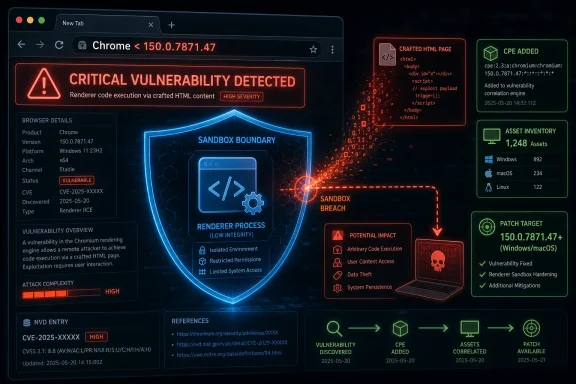 The CPE Was Added, but the Inventory Problem Remains
The NVD record for CVE-2026-14017 now includes a CPE configuration for Google Chrome with versions up to, but excluding, 150.0.7871.47. That is the expected canonical product mapping: cpe:2.3:a:google:chrome:*:*:*:*:*:*:*:*, constrained to vulnerable versions before the fixed release. For a scanner, CMDB, or SBOM pipeline looking only for “is Google Chrome below 150.0.7871.47 present,” that is enough to make the match.But CPE completeness is not the same thing as exposure completeness. Chrome is the named product, yet the underlying code lives in Chromium, and Chromium’s reach extends well beyond Google’s browser. Microsoft Edge, Brave, Vivaldi, Opera, Electron applications, embedded WebView-like components, and appliance UIs can all inherit classes of Chromium bugs on different schedules and through different advisory systems.
That does not mean defenders should invent CPEs for every Chromium-derived product in the Chrome CVE record. It means they should treat the Chrome CPE as the first reliable anchor, not the whole asset story. NVD’s job is to describe known affected software configurations; enterprise IT’s job is to decide where the affected code actually runs.
There is also a small oddity in the CVE’s affected-version text as reproduced in some feeds: the listed version object names 150.0.7871.47 while also saying “lessThan 150.0.7871.47.” In practice, the description and Google’s release channel wording resolve the ambiguity. Chrome prior to 150.0.7871.47 is vulnerable; 150.0.7871.47 or later is the target state for Windows and macOS stable users.
A Medium Chromium Bug Can Still Look Critical in a Triage Queue
Google labels CVE-2026-14017 as Chromium security severity “Medium.” CISA’s ADP enrichment, meanwhile, assigns a CVSS 3.1 score of 9.6, with high confidentiality, integrity, and availability impact and changed scope. That mismatch will look jarring to anyone who lives inside dashboards where red boxes drive patch urgency.The disagreement is not necessarily a contradiction. Chrome’s internal severity often reflects exploit prerequisites, bug class, exploitability, and context inside the browser’s security model. CVSS, by contrast, can score the consequences of a successful sandbox escape very harshly once the preconditions are satisfied.
The key phrase is “who had compromised the renderer process.” CVE-2026-14017 is not described as a one-click remote code execution bug that starts from a clean browser state and immediately lands in the operating system. It is described as a sandbox escape opportunity after renderer compromise, triggered through a crafted HTML page.
That distinction matters. A renderer compromise is already serious, but Chrome’s sandbox exists specifically to contain that damage. A sandbox escape is the bridge from “code running in a constrained browser process” toward broader system access, data theft, persistence attempts, or lateral movement. In modern browser exploitation, that bridge is often the expensive part.
So the operational answer is not “ignore it because Google said Medium” or “panic because CVSS says Critical.” The better answer is to prioritize it as part of the Chrome 150 security update, especially in environments where browsers touch privileged workflows, identity portals, admin consoles, SaaS dashboards, and sensitive internal applications.
Chrome 150 Was Not a Small Security Release
CVE-2026-14017 arrived inside Chrome 150’s late-June stable-channel release, not as a lonely out-of-band advisory. Google’s Chrome Releases blog announced the desktop stable update on June 30, 2026, with Windows and macOS builds moving to 150.0.7871.46/.47 and Linux to 150.0.7871.46. Third-party coverage from Malwarebytes and other security outlets described the release as unusually large, with hundreds of security fixes.That context changes how administrators should read the CVE. The question is not whether one medium-rated Navigation flaw justifies a change window on its own. The question is whether an already-published browser update containing a large security payload should be allowed to wait because no single CVE has yet become famous.
Browser patching has become a rhythm problem. Google, Microsoft, Mozilla, Apple, and the wider Chromium ecosystem ship fixes so frequently that defenders can become numb to the advisories. Yet attackers do not need every bug in a release; they need one usable chain, one delayed update population, and one target set worth burning capability on.
CVE-2026-14017 is especially relevant because it sits in the browser’s navigation machinery. Navigation is not an obscure corner of the product. It is the act of moving between documents, origins, frames, histories, permissions, and process boundaries. When that machinery misapplies a protection mechanism, the bug can become a lever against assumptions that the sandbox depends on.
Renderer Compromise Is the Part Users Never See
For normal users, “compromised renderer” sounds like jargon from a crash report. For exploit developers, it is a familiar stage in the browser kill chain. The renderer is where web content is processed; Chrome tries to isolate it because the web is hostile by design.A malicious page may exploit a memory corruption issue, a type confusion bug, a logic flaw, or another vulnerability to gain code execution inside that renderer process. If the sandbox holds, the attacker is trapped inside a restricted environment with limited access. If a second bug allows escape, the attack starts to look much more like traditional endpoint compromise.
That is why sandbox escapes receive so much attention even when their standalone severity appears lower. They are force multipliers. They turn a renderer exploit from a contained browser event into something that can interact more dangerously with the host system.
The CVE description does not say that CVE-2026-14017 is known to be exploited in the wild. CISA’s SSVC entry, as included in the NVD change history, marks exploitation as “none” and automatable as “no.” That should calm one kind of alarm while leaving the patching argument intact. Absence of known exploitation is not a reason to preserve a vulnerable browser build.
Navigation Bugs Strike at the Browser’s Contract With the User
Navigation is one of the browser’s oldest ideas and one of its hardest modern engineering problems. A browser must decide what page owns what process, which origin is active, which history entry is valid, what permissions persist, whether a frame can navigate another frame, and how all of that maps to the visible address bar.The user sees a page load. The browser sees a security boundary negotiation.
An “inappropriate implementation” in Navigation is vague by design because Google often restricts bug details until most users have updated. That embargo is sensible. Publishing a reproduction recipe too early can help attackers more than defenders. But the category still tells us something: this was not merely a cosmetic issue in page rendering. It involved behavior close enough to navigation and protection enforcement that a compromised renderer could potentially use it to break containment.
CISA’s enrichment maps the weakness to CWE-693, Protection Mechanism Failure. That is a broad bucket, but it fits the story. The sandbox is a protection mechanism; navigation and process isolation rules are part of the enforcement surface; the CVE describes a path by which that protection could fail after a renderer is already under attacker control.
This is where Chrome’s architecture becomes both impressive and fragile. The browser is full of mutually reinforcing defenses: site isolation, sandboxing, permission prompts, process boundaries, broker processes, and mitigations in the JavaScript engine and graphics stack. A bug in one layer may be survivable. A chain across layers is what defenders fear.
Windows Administrators Should Treat Chrome Like Core Infrastructure
On Windows networks, Chrome is often installed like an app but used like infrastructure. It carries identity sessions, admin portals, password managers, device enrollment flows, helpdesk tooling, remote management consoles, and cloud control planes. When Chrome is behind, the risk is not just “a user might visit a bad website.” It is that a compromised browser session may sit adjacent to the most privileged workflows in the organization.The practical patch target for Windows is Chrome 150.0.7871.47 or later. For consumer systems, Chrome’s automatic update flow usually handles this quickly, provided the browser is restarted. For managed fleets, administrators should check Google Update policy, enterprise browser reporting, endpoint management telemetry, and any controls that delay major-version rollouts.
The restart problem remains underrated. Chrome can download an update and still keep users on a vulnerable build until the browser relaunches. In environments where users keep dozens of tabs open for weeks, “update available” is not the same as “patched.” Admins who track process uptime often get a truer picture of exposure than admins who only track package availability.
Microsoft Edge deserves separate attention. This CVE is sourced to Chrome, not Edge, but Edge inherits Chromium code and Microsoft ships its own advisories and versioning. A Chrome CPE match will not necessarily tell you whether Edge, WebView2 Runtime, or Electron-based applications are fixed. That is not an NVD failure; it is the cost of the Chromium monoculture.
The Chromium Monoculture Makes One Bug Everybody’s Homework
Chromium’s dominance gives the web a fast security response machine. It also gives defenders a dependency graph that is easy to underestimate. A fixed Chrome build is the beginning of remediation, not the end.Electron is the classic enterprise blind spot. Many desktop applications are effectively browser shells around web technologies, and their Chromium versions may lag behind Chrome stable. Collaboration tools, developer tools, password vaults, note-taking apps, support clients, and internal line-of-business applications can carry embedded Chromium code without showing up as Chrome in an asset scan.
That does not mean CVE-2026-14017 automatically applies to every Electron app. Exploitability depends on whether the affected code is present, reachable, and exposed to attacker-controlled content. But it does mean security teams should have a way to inventory Chromium runtime versions outside the browser icon users recognize.
The same logic applies to browsers that market themselves as privacy-first, gamer-friendly, enterprise-managed, or niche power-user alternatives. If they ride Chromium, their patch latency matters. A vendor’s branding does not isolate it from the upstream codebase.
This is the quiet governance problem behind every Chromium CVE. The public advisory names one product because that is where the fix lands first. The enterprise exposure model must name every place the code travels.
NVD’s Delay Is Annoying, but Not the Bottleneck
The user-supplied NVD record shows a familiar sequence: the CVE was received from Chrome on June 30, CISA-ADP added enrichment on July 1, and NIST’s initial analysis added the Chrome CPE and Chrome release-note reference later that day. At the time reflected in the record, NVD had not yet provided its own CVSS vector.For vulnerability managers, that timing can be frustrating. Many tools depend on NVD enrichment to light up detections cleanly. When CVSS, CPEs, or references lag, automation can under-prioritize or misclassify a new issue.
But in this case, the decisive patch signal did not require waiting for NVD’s final scoring. Google’s release notes identified the fixed version. The CVE description identified the affected range. CISA’s enrichment supplied a severity interpretation and SSVC context. A mature browser patch process should not be blocked on the last field in a database record.
The database still matters, especially for compliance reporting and scanner normalization. A missing or delayed CPE can create blind spots in asset-based vulnerability management. But Chrome is not obscure software. If an organization needs NVD to discover that Chrome stable moved and should be patched, the larger problem is not CVE-2026-14017.
The Right Question Is Not Just Whether the CPE Exists
So, are we missing a CPE? For Google Chrome itself, based on the NVD change record, the answer is no. The Chrome application CPE was added for versions before 150.0.7871.47. If a tool still says there is no affected software configuration, it may be caching old NVD data, failing to ingest the July 1 modification, or waiting for a downstream vulnerability-feed refresh.The better audit question is whether your tool maps that CPE to actual installations. Chrome may be installed per-machine, per-user, through enterprise installers, bundled in golden images, or present on unmanaged endpoints that only partially report software inventory. On Windows, that means registry evidence, executable version checks, browser management telemetry, and EDR software inventory may disagree.
Another useful question is whether the fixed build differs by platform. The desktop release moved Windows and macOS to 150.0.7871.46/.47, while Linux received 150.0.7871.46 according to Google’s release-channel wording. CVE descriptions often cite the highest or most relevant fixed build number, but fleet operators should follow vendor release notes for each platform rather than mechanically applying one version string everywhere.
Then there is the downstream question: which non-Google products need their own advisories, CPEs, or package updates? That cannot be answered solely from the Chrome CVE. It requires vendor-specific tracking for Edge, Chromium packages in Linux distributions, Electron applications, and other Chromium-based browsers.
The Patch Is Simple; the Assurance Is Not
For individual users, the fix is straightforward: update Chrome and restart it. The browser’s Help page remains the simplest visible check. If Chrome reports 150.0.7871.47 or later on Windows or macOS, the direct Chrome exposure described by this CVE should be addressed.For administrators, the patch is only the first layer of assurance. They need to know which endpoints remain on older builds, which devices have downloaded but not activated the update, and which users are running unmanaged browser channels outside policy. Canary, Beta, Dev, Extended Stable, and portable builds can complicate otherwise clean reporting.
Security teams should also resist overfitting on CVE-2026-14017 alone. Chrome 150’s security payload included many fixes, and attackers typically chain whatever works. If a fleet is behind on this release, the organization is not exposed to one neat CVE; it is exposed to the combined patch delta between its deployed build and current stable.
The stronger operational posture is boring but effective: shorten browser update latency, enforce relaunch deadlines, inventory Chromium-based applications, and treat browser posture as part of identity security. The browser is where users authenticate to everything else. A sandbox escape in that context is not merely a browser bug.
This CVE Rewards the Teams That Already Know Their Browser Estate
The concrete lessons from CVE-2026-14017 are less exotic than the phrase “sandbox escape” suggests. The teams in the best position today are not the ones with the most dramatic alerting; they are the ones that already know which browser builds are running, where Chromium hides, and how quickly updates become active.- The NVD Chrome CPE for CVE-2026-14017 has been added for Google Chrome versions before 150.0.7871.47.
- The fixed Chrome target for Windows and macOS users is 150.0.7871.47 or later, with platform-specific release notes still worth checking for exact channel behavior.
- The bug matters because it could help an attacker escape Chrome’s sandbox after a renderer compromise, not because it is described as a standalone one-click takeover.
- CISA’s critical CVSS enrichment and Google’s medium Chromium severity can coexist because they emphasize different parts of the risk model.
- Organizations should verify browser restart completion, not merely update availability.
- Chromium-derived browsers and Electron applications need separate inventory attention because the Chrome CPE alone will not describe the entire downstream exposure.
References
- Primary source: NVD / Chromium
Published: 2026-07-03T07:00:55-07:00
NVD - CVE-2026-14017
 nvd.nist.gov
- Security advisory: MSRC
Published: 2026-07-03T07:00:55-07:00
Original feed URL
Security Update Guide - Microsoft Security Response Center
 msrc.microsoft.com
- Related coverage: cvefeed.io
CVE-2026-14017 - Google Chrome Navigation Sandbox Escape
Inappropriate implementation in Navigation in Google Chrome prior to 150.0.7871.47 allowed a remote attacker who had compromised the renderer process to potentially perform a sandbox escape via a crafted HTML page. (Chromium security severity: Medium)cvefeed.io
