

Google Chrome’s CVE-2026-14120 was published on June 30, 2026, for a DevTools flaw fixed before Chrome 150.0.7871.47 that could let an attacker who had already compromised the renderer process attempt a sandbox escape through a crafted HTML page. The short operational answer is that NVD does list a Chrome CPE, but the entry still exposes a familiar naming problem: “Chromium” is the ecosystem, “Google Chrome” is the affected product named by the vendor, and downstream Chromium-based browsers should not be inferred as vulnerable without their own advisories. That distinction matters because vulnerability scanners, patch dashboards, and risk reports tend to treat CPEs as hard truth when, in browser security, they are often only the beginning of the story.
The NVD record says Google Chrome versions before 150.0.7871.47 are vulnerable, and its change history shows NIST added the
The user-facing confusion starts with the word “Chromium.” Security databases, headlines, and vulnerability feeds often use “Chromium” as shorthand for the open-source browser engine family, but the CVE source here is Chrome, and the vendor/product pair in the affected configuration is Google Chrome. That is why the CPE NVD added is for
That is probably the right narrow answer for the NVD entry. The affected software configuration in the record is Chrome before 150.0.7871.47, and the release note reference points to Google’s Chrome stable channel update for desktop. If a scanner is asking whether a Chrome CPE is missing, the answer is no: NIST added one in the July 2 initial analysis.
But if the question is whether the record fully captures the practical blast radius of a Chromium bug, the answer is less tidy. Microsoft Edge, Brave, Vivaldi, Opera, Electron-based applications, embedded Chromium frameworks, and Linux distribution builds may share code ancestry, but they do not automatically share an identical vulnerability window, patch version, feature exposure, or CPE mapping. The CVE record does not become an inventory of every downstream consumer merely because the bug lives in a Chromium component.
That is not bureaucratic hair-splitting. In enterprise vulnerability management, a CPE match is the line between “this device is red on the dashboard” and “this device is invisible unless another detection rule catches it.” If an organization runs Chrome everywhere, the NVD CPE is enough to drive patch urgency. If it runs a fleet of Chromium-derived browsers or embedded webviews, the CPE tells only one part of the story.
The tension comes from the attack precondition. The description says the remote attacker must already have compromised the renderer process. That is a major gating condition in real-world exploitability, because the bug is not described as a standalone drive-by code execution flaw from a clean browser state. It is a second-stage escape opportunity after another vulnerability, misconfiguration, or exploit chain has already pierced the renderer.
CVSS, however, is not always elegant at expressing “this is devastating only after something else has gone wrong.” The vector listed by NVD and CISA-ADP — network attack vector, low complexity, no privileges required, user interaction required, changed scope, and high confidentiality, integrity, and availability impact — rewards the possible sandbox-escape outcome. Google’s internal severity appears to discount the bug because the attacker begins from an already-compromised renderer.
Both readings are useful, but for different audiences. A browser exploit developer sees a sandbox escape primitive and pays attention. A patch manager sees no evidence of exploitation and a required renderer compromise, then schedules it according to the normal Chrome update cadence. A scanner that only shows “Critical 9.6” without the precondition is technically telling the truth while still encouraging the wrong kind of panic.
That is why DevTools vulnerabilities keep surfacing in Chrome advisories with surprisingly varied impact. Some are information disclosure bugs. Some involve cross-origin leakage. Others, like this one, sit closer to the boundary between compromised web content and the browser’s protection mechanisms. The name of the component does not mean the attacker must convince a victim to debug a page in the ordinary sense unless the advisory explicitly says so.
The CVE text for CVE-2026-14120 does not say the victim must open DevTools manually. It says a crafted HTML page could be used after renderer compromise to potentially perform a sandbox escape. That wording leaves many technical details deliberately unstated, which is normal for Chrome vulnerabilities while patches are still rolling out and bug tracker access remains restricted.
For defenders, the conservative reading is simple: do not dismiss the issue because the affected component is DevTools. The browser security boundary is not drawn around the UI panel users recognize. It is drawn around a web of features, protocols, debugging hooks, and sandbox policies that become interesting precisely when an attacker is trying to move from renderer code execution into something more powerful.
A sandbox escape changes the equation. It is the second move in the classic modern browser exploit chain: first gain code execution or significant control inside the renderer, then use another flaw to escape the sandbox and reach broader privileges. CVE-2026-14120, as described, belongs to that second category.
That is also why a Low internal severity can coexist with serious consequences. A sandbox escape without a renderer-entry bug is like a locked door behind another locked door. But if attackers already have a renderer exploit — or can pair this flaw with a separate bug patched in the same or nearby Chrome releases — then the second door becomes extremely important.
There is no public evidence in the NVD or CISA-ADP record that CVE-2026-14120 is being exploited in the wild. CISA’s SSVC enrichment explicitly lists exploitation as none. That should temper alarm, but it should not slow patching much, because Chrome’s update model is built around rapid replacement rather than prolonged risk debates over individual CVEs.
That sounds simple until it collides with the way Chrome versions appear across platforms and channels. Desktop Chrome version strings can differ slightly across Windows, macOS, and Linux builds, and Chrome’s staged rollout behavior means not every endpoint sees the update at the same instant. Enterprises that pin versions or delay updates through policy can also remain behind long after consumer Chrome has silently moved on.
The “prior to 150.0.7871.47” wording is therefore more useful than the marketing phrase “latest Chrome.” Security teams should inventory the actual installed version, not simply assume auto-update has done its job. On Windows, Chrome’s own update page, enterprise browser reporting, endpoint management agents, and software inventory tools should all converge on that number.
For unmanaged users, the advice is more familiar: open Chrome’s About page and let it check for updates, then restart the browser. Chrome often downloads the fix before users realize it, but the browser usually needs a restart before the patched version is actually running. That last step is where “auto-update” often fails in practice, especially on machines that remain open for days.
That staggered enrichment process is normal, but it can create a dangerous window for automated tools. A CVE may exist before the CPE configuration appears. A scanner that depends heavily on NVD CPEs may miss or underrepresent a brand-new browser issue until enrichment catches up. Conversely, once a critical CVSS score lands, dashboards may light up even though the vendor has characterized the underlying Chromium severity as Low.
This is not a reason to distrust NVD. It is a reason to understand what NVD is and is not. NVD is a normalization and enrichment layer, not the original vendor advisory, and its records evolve as analysts attach metadata. The change history is not trivia; it is an audit trail for why your tooling behaved differently on Tuesday than it did on Thursday.
For WindowsForum readers who administer patch pipelines, that matters. If your vulnerability management system ingested CVE-2026-14120 on June 30, it may have had the description but not the final CPE mapping. If it reprocessed the entry after July 2, it should now recognize Google Chrome versions below 150.0.7871.47 as vulnerable. If it still does not, the problem is likely in your scanner’s feed timing, local plugin logic, or product inventory normalization rather than in the absence of a Chrome CPE in NVD.
This is why “are we missing a CPE?” is often really a question about whether scanners should flag Microsoft Edge, Chromium packages on Linux, or embedded Chromium components. The NVD entry provided by the user does not show those products as affected. It shows Google Chrome. That is the defensible mapping based on the source material.
Edge is a particularly tempting case because it tracks Chromium closely, ships through Microsoft’s own channels, and has its own enterprise footprint on Windows. But Microsoft normally publishes Edge-specific security release notes and version guidance. Without an Edge advisory tying CVE-2026-14120 to a Microsoft Edge build, adding Edge CPEs to the Chrome CVE would be an inference, not a verified affected configuration.
The same caution applies to Electron applications. A vulnerable Chromium commit may eventually matter to an Electron-based desktop app, but the app’s exposure depends on its Electron version, enabled features, sandbox configuration, remote content model, and whether the relevant code path is reachable. Treating every Chromium consumer as automatically vulnerable may create noise that drowns out the systems that urgently need patching.
For Chrome itself, the CPE mapping should be enough for many scanners: vendor Google, product Chrome, versions below 150.0.7871.47. But accuracy still depends on the scanner seeing the installed version correctly. On Windows, that can mean reading installed application metadata, checking per-user installs, recognizing enterprise MSI deployments, or detecting portable and side-loaded copies.
Per-user Chrome installs remain an old nuisance. A machine can look compliant from the system-wide software inventory while an individual profile runs a different browser binary under the user context. In tightly managed environments, administrators usually block or standardize this. In looser environments, it is one reason browser vulnerability reports sometimes disagree with endpoint reality.
Then there is the problem of stale browser processes. Updating the binary on disk does not guarantee the running process has been replaced. A user with 47 tabs and a month-old browser session can carry risk longer than the update dashboard suggests. That is why some enterprises enforce browser relaunch deadlines after updates, an unglamorous policy that often matters more than another severity debate.
The right posture is not panic; it is disciplined speed. Chrome updates should already be among the fastest-moving patches in a Windows environment, often ahead of traditional monthly patch cycles. If your organization treats browser updates like ordinary desktop application updates that can wait weeks, CVE-2026-14120 is another reminder that the web browser is closer to an operating-system component than a productivity app.
The July 2026 Chrome 150 stable release appears to have carried a large batch of security fixes, not just this DevTools issue. That context matters because patching to 150.0.7871.47 or later is not only about closing one sandbox-escape path. It is about staying aligned with the current browser security baseline after a dense cluster of memory-safety, UI, DevTools, and sandbox-related fixes.
For home users, the answer is simpler: update Chrome and restart it. For IT teams, the answer is to verify fleet compliance, confirm that update policies are not pinning an older build, and check whether any line-of-business constraints have caused Chrome to lag. The hard part is not understanding this CVE; it is making sure the browser estate is boringly current.
That may feel conservative, but it preserves trust. Overbroad CPE mappings create false positives that vulnerability teams learn to ignore. Underbroad mappings create blind spots. The only way through is to distinguish confirmed affected products from plausible downstream impact.
For WindowsForum’s audience, that distinction is especially important because Edge is everywhere on Windows. A Chrome CVE does not automatically equal an Edge CVE in the data layer, even if both browsers share Chromium ancestry. Administrators should monitor Microsoft’s Edge release notes separately and let Microsoft’s advisory language drive Edge-specific compliance reporting.
There is also a subtle communication issue here. Calling the bug “Chromium: CVE-2026-14120” may be understandable shorthand, but it nudges readers toward expecting a Chromium CPE or a cross-browser affected-product list. Calling it “Google Chrome DevTools sandbox escape fixed in 150.0.7871.47” is less sweeping and more operationally accurate.
Sandbox escapes are especially valuable because attackers can pair them with other bugs. A renderer exploit that only gets code execution inside a sandbox is damaging but constrained. Add an escape, and the path toward credential theft, persistence, lateral movement, or host compromise becomes more plausible.
That does not mean CVE-2026-14120 is a confirmed weapon in active campaigns. The available record says the opposite: CISA-ADP lists no exploitation. But defenders do not patch only because a bug is already burning. They patch because exploit chains are assembled opportunistically, and browser chains age badly for defenders once technical details become public.
Google’s restriction on Chromium issue details is part of this rhythm. Chrome bug links often remain locked until enough users are updated, precisely because the patch can reveal the vulnerability to attackers. By the time full details emerge, the responsible assumption is that lagging systems have become easier targets.
Administrators should also check whether their vulnerability platform has ingested the July 2 NVD enrichment. If a dashboard still says the CPE is missing, the local feed may be stale, or the product normalization layer may not be reading the NVD configuration added by NIST. The change history in the NVD record is the evidence to use when troubleshooting that discrepancy.
For organizations with multiple browsers, do not stop at Chrome. Track Edge through Microsoft’s release channel, track Chromium packages through the operating system vendor, and track embedded Chromium through the application vendor. But keep those as separate verification paths, not as assumptions grafted onto the Chrome CPE.
The best patch programs already work this way. They combine vendor advisories, NVD enrichment, endpoint inventory, and real installed-version checks. CVE-2026-14120 is not an argument for abandoning CPEs; it is an argument for refusing to treat them as the whole truth.
The NVD record says Google Chrome versions before 150.0.7871.47 are vulnerable, and its change history shows NIST added the
cpe:2.3:a:google:chrome:*:*:*:*:*:*:*:* configuration on July 2, 2026. CISA’s ADP enrichment also assigned a 9.6 CVSS 3.1 score while marking exploitation as “none” and automatable as “no.” Google’s own Chrome Releases advisory, meanwhile, describes the underlying Chromium severity as Low — a mismatch that looks odd until you remember that CVSS is scoring the theoretical impact path, not Google’s internal exploitability judgment.
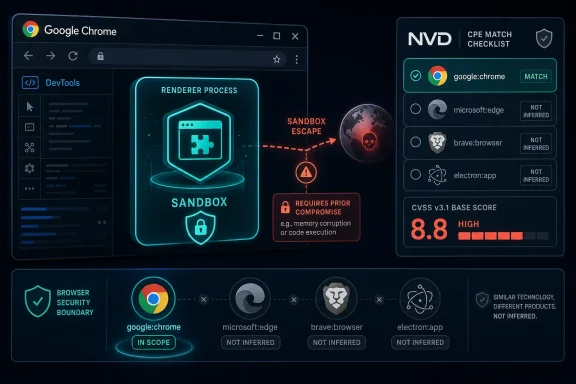 The CPE Is There, but It Does Not Say Everything Administrators Want It to Say
The user-facing confusion starts with the word “Chromium.” Security databases, headlines, and vulnerability feeds often use “Chromium” as shorthand for the open-source browser engine family, but the CVE source here is Chrome, and the vendor/product pair in the affected configuration is Google Chrome. That is why the CPE NVD added is for google:chrome, not a generic Chromium ecosystem bucket.That is probably the right narrow answer for the NVD entry. The affected software configuration in the record is Chrome before 150.0.7871.47, and the release note reference points to Google’s Chrome stable channel update for desktop. If a scanner is asking whether a Chrome CPE is missing, the answer is no: NIST added one in the July 2 initial analysis.
But if the question is whether the record fully captures the practical blast radius of a Chromium bug, the answer is less tidy. Microsoft Edge, Brave, Vivaldi, Opera, Electron-based applications, embedded Chromium frameworks, and Linux distribution builds may share code ancestry, but they do not automatically share an identical vulnerability window, patch version, feature exposure, or CPE mapping. The CVE record does not become an inventory of every downstream consumer merely because the bug lives in a Chromium component.
That is not bureaucratic hair-splitting. In enterprise vulnerability management, a CPE match is the line between “this device is red on the dashboard” and “this device is invisible unless another detection rule catches it.” If an organization runs Chrome everywhere, the NVD CPE is enough to drive patch urgency. If it runs a fleet of Chromium-derived browsers or embedded webviews, the CPE tells only one part of the story.
A Low-Severity Label Meets a Critical Score
CVE-2026-14120 is an almost perfect example of why browser vulnerability ratings can look contradictory without anyone necessarily being wrong. Google labels the Chromium security severity as Low, while NVD and CISA-ADP show a CVSS 3.1 base score of 9.6, which lands squarely in Critical territory. At first glance, that looks like a database inflating a vendor’s modest bug.The tension comes from the attack precondition. The description says the remote attacker must already have compromised the renderer process. That is a major gating condition in real-world exploitability, because the bug is not described as a standalone drive-by code execution flaw from a clean browser state. It is a second-stage escape opportunity after another vulnerability, misconfiguration, or exploit chain has already pierced the renderer.
CVSS, however, is not always elegant at expressing “this is devastating only after something else has gone wrong.” The vector listed by NVD and CISA-ADP — network attack vector, low complexity, no privileges required, user interaction required, changed scope, and high confidentiality, integrity, and availability impact — rewards the possible sandbox-escape outcome. Google’s internal severity appears to discount the bug because the attacker begins from an already-compromised renderer.
Both readings are useful, but for different audiences. A browser exploit developer sees a sandbox escape primitive and pays attention. A patch manager sees no evidence of exploitation and a required renderer compromise, then schedules it according to the normal Chrome update cadence. A scanner that only shows “Critical 9.6” without the precondition is technically telling the truth while still encouraging the wrong kind of panic.
DevTools Is Not Just a Developer Toy
The component name may also understate the risk for people who do not live inside browser internals. DevTools sounds like something only web developers open with F12, but browser developer tooling is deeply wired into inspection, debugging, protocol handling, page instrumentation, and privileged browser-side plumbing. A flaw there can matter even if the average user never intentionally launches the DevTools panel.That is why DevTools vulnerabilities keep surfacing in Chrome advisories with surprisingly varied impact. Some are information disclosure bugs. Some involve cross-origin leakage. Others, like this one, sit closer to the boundary between compromised web content and the browser’s protection mechanisms. The name of the component does not mean the attacker must convince a victim to debug a page in the ordinary sense unless the advisory explicitly says so.
The CVE text for CVE-2026-14120 does not say the victim must open DevTools manually. It says a crafted HTML page could be used after renderer compromise to potentially perform a sandbox escape. That wording leaves many technical details deliberately unstated, which is normal for Chrome vulnerabilities while patches are still rolling out and bug tracker access remains restricted.
For defenders, the conservative reading is simple: do not dismiss the issue because the affected component is DevTools. The browser security boundary is not drawn around the UI panel users recognize. It is drawn around a web of features, protocols, debugging hooks, and sandbox policies that become interesting precisely when an attacker is trying to move from renderer code execution into something more powerful.
The Renderer Compromise Is the Missing Half of the Exploit Chain
A renderer compromise is not a small assumption. Chrome’s multi-process architecture is designed so that untrusted web content runs in a constrained renderer process, separated from the browser process and the operating system by sandboxing and site isolation defenses. The whole point is that even if a web page triggers memory corruption or script-engine weirdness inside a renderer, the attacker should still be boxed in.A sandbox escape changes the equation. It is the second move in the classic modern browser exploit chain: first gain code execution or significant control inside the renderer, then use another flaw to escape the sandbox and reach broader privileges. CVE-2026-14120, as described, belongs to that second category.
That is also why a Low internal severity can coexist with serious consequences. A sandbox escape without a renderer-entry bug is like a locked door behind another locked door. But if attackers already have a renderer exploit — or can pair this flaw with a separate bug patched in the same or nearby Chrome releases — then the second door becomes extremely important.
There is no public evidence in the NVD or CISA-ADP record that CVE-2026-14120 is being exploited in the wild. CISA’s SSVC enrichment explicitly lists exploitation as none. That should temper alarm, but it should not slow patching much, because Chrome’s update model is built around rapid replacement rather than prolonged risk debates over individual CVEs.
The Version Boundary Is Clearer Than the Risk Boundary
The cleanest operational fact in the record is the version line: Chrome before 150.0.7871.47 is affected. Google’s stable-channel update fixed the issue for desktop Chrome, and NVD’s CPE configuration follows that same threshold. For Windows administrators, the practical check is whether managed endpoints have moved to 150.0.7871.47 or later.That sounds simple until it collides with the way Chrome versions appear across platforms and channels. Desktop Chrome version strings can differ slightly across Windows, macOS, and Linux builds, and Chrome’s staged rollout behavior means not every endpoint sees the update at the same instant. Enterprises that pin versions or delay updates through policy can also remain behind long after consumer Chrome has silently moved on.
The “prior to 150.0.7871.47” wording is therefore more useful than the marketing phrase “latest Chrome.” Security teams should inventory the actual installed version, not simply assume auto-update has done its job. On Windows, Chrome’s own update page, enterprise browser reporting, endpoint management agents, and software inventory tools should all converge on that number.
For unmanaged users, the advice is more familiar: open Chrome’s About page and let it check for updates, then restart the browser. Chrome often downloads the fix before users realize it, but the browser usually needs a restart before the patched version is actually running. That last step is where “auto-update” often fails in practice, especially on machines that remain open for days.
The NVD Change Log Shows the Vulnerability Machine at Work
The chronology is worth pausing over because it shows how modern CVE records are assembled in layers. The CVE was received from Chrome on June 30, 2026, with the vendor description, affected version boundary, and references. CISA-ADP modified the entry on July 1 with CVSS, CWE, and SSVC enrichment. NIST followed on July 2 with its initial analysis, adding the Chrome CPE configuration and a CWE-20 classification.That staggered enrichment process is normal, but it can create a dangerous window for automated tools. A CVE may exist before the CPE configuration appears. A scanner that depends heavily on NVD CPEs may miss or underrepresent a brand-new browser issue until enrichment catches up. Conversely, once a critical CVSS score lands, dashboards may light up even though the vendor has characterized the underlying Chromium severity as Low.
This is not a reason to distrust NVD. It is a reason to understand what NVD is and is not. NVD is a normalization and enrichment layer, not the original vendor advisory, and its records evolve as analysts attach metadata. The change history is not trivia; it is an audit trail for why your tooling behaved differently on Tuesday than it did on Thursday.
For WindowsForum readers who administer patch pipelines, that matters. If your vulnerability management system ingested CVE-2026-14120 on June 30, it may have had the description but not the final CPE mapping. If it reprocessed the entry after July 2, it should now recognize Google Chrome versions below 150.0.7871.47 as vulnerable. If it still does not, the problem is likely in your scanner’s feed timing, local plugin logic, or product inventory normalization rather than in the absence of a Chrome CPE in NVD.
“Chromium” Is the Word That Makes Asset Owners Nervous
The open-source nature of Chromium is a gift to the web and a headache for vulnerability databases. Chrome is a Google product with a clean update channel and a recognizable CPE. Chromium is a project, a codebase, a package name in some ecosystems, and the upstream base for a small galaxy of browsers and application runtimes. The same bug can move through that galaxy unevenly.This is why “are we missing a CPE?” is often really a question about whether scanners should flag Microsoft Edge, Chromium packages on Linux, or embedded Chromium components. The NVD entry provided by the user does not show those products as affected. It shows Google Chrome. That is the defensible mapping based on the source material.
Edge is a particularly tempting case because it tracks Chromium closely, ships through Microsoft’s own channels, and has its own enterprise footprint on Windows. But Microsoft normally publishes Edge-specific security release notes and version guidance. Without an Edge advisory tying CVE-2026-14120 to a Microsoft Edge build, adding Edge CPEs to the Chrome CVE would be an inference, not a verified affected configuration.
The same caution applies to Electron applications. A vulnerable Chromium commit may eventually matter to an Electron-based desktop app, but the app’s exposure depends on its Electron version, enabled features, sandbox configuration, remote content model, and whether the relevant code path is reachable. Treating every Chromium consumer as automatically vulnerable may create noise that drowns out the systems that urgently need patching.
Scanner Accuracy Depends on More Than NVD
CPEs are a blunt instrument trying to describe messy software reality. They work best for packaged products with stable names, vendors, and version numbers. Browsers strain that model because they update rapidly, embed components deeply, and share code across products that release on different schedules.For Chrome itself, the CPE mapping should be enough for many scanners: vendor Google, product Chrome, versions below 150.0.7871.47. But accuracy still depends on the scanner seeing the installed version correctly. On Windows, that can mean reading installed application metadata, checking per-user installs, recognizing enterprise MSI deployments, or detecting portable and side-loaded copies.
Per-user Chrome installs remain an old nuisance. A machine can look compliant from the system-wide software inventory while an individual profile runs a different browser binary under the user context. In tightly managed environments, administrators usually block or standardize this. In looser environments, it is one reason browser vulnerability reports sometimes disagree with endpoint reality.
Then there is the problem of stale browser processes. Updating the binary on disk does not guarantee the running process has been replaced. A user with 47 tabs and a month-old browser session can carry risk longer than the update dashboard suggests. That is why some enterprises enforce browser relaunch deadlines after updates, an unglamorous policy that often matters more than another severity debate.
The Patch Priority Is Boring, Which Is the Point
For most organizations, CVE-2026-14120 should not trigger an emergency war room by itself. There is no public exploitation signal in the record, the attack requires prior renderer compromise, and Google’s Chromium severity label is Low. But it should absolutely be swept into the normal rapid Chrome patch process, because browsers are high-exposure software and exploit chains are built out of precisely these pieces.The right posture is not panic; it is disciplined speed. Chrome updates should already be among the fastest-moving patches in a Windows environment, often ahead of traditional monthly patch cycles. If your organization treats browser updates like ordinary desktop application updates that can wait weeks, CVE-2026-14120 is another reminder that the web browser is closer to an operating-system component than a productivity app.
The July 2026 Chrome 150 stable release appears to have carried a large batch of security fixes, not just this DevTools issue. That context matters because patching to 150.0.7871.47 or later is not only about closing one sandbox-escape path. It is about staying aligned with the current browser security baseline after a dense cluster of memory-safety, UI, DevTools, and sandbox-related fixes.
For home users, the answer is simpler: update Chrome and restart it. For IT teams, the answer is to verify fleet compliance, confirm that update policies are not pinning an older build, and check whether any line-of-business constraints have caused Chrome to lag. The hard part is not understanding this CVE; it is making sure the browser estate is boringly current.
The CPE Question Becomes a Governance Question
If you maintain a vulnerability feed, asset database, or forum advisory, the safest wording is precise: NVD lists Google Chrome before 150.0.7871.47 as affected via the Google Chrome CPE. Do not write that “Chromium” broadly is affected unless you are specifically referring to the upstream project or have a source that maps the bug to a Chromium package. Do not add downstream browser CPEs unless those vendors publish matching affected-version guidance.That may feel conservative, but it preserves trust. Overbroad CPE mappings create false positives that vulnerability teams learn to ignore. Underbroad mappings create blind spots. The only way through is to distinguish confirmed affected products from plausible downstream impact.
For WindowsForum’s audience, that distinction is especially important because Edge is everywhere on Windows. A Chrome CVE does not automatically equal an Edge CVE in the data layer, even if both browsers share Chromium ancestry. Administrators should monitor Microsoft’s Edge release notes separately and let Microsoft’s advisory language drive Edge-specific compliance reporting.
There is also a subtle communication issue here. Calling the bug “Chromium: CVE-2026-14120” may be understandable shorthand, but it nudges readers toward expecting a Chromium CPE or a cross-browser affected-product list. Calling it “Google Chrome DevTools sandbox escape fixed in 150.0.7871.47” is less sweeping and more operationally accurate.
The Real Signal Is the Sandbox Boundary
The most important part of the CVE is not the component name, the CPE string, or even the 9.6 score. It is the phrase “sandbox escape.” Browser security is built around the assumption that web content is hostile and must be contained. Anything that weakens containment deserves attention, even when it is not independently exploitable.Sandbox escapes are especially valuable because attackers can pair them with other bugs. A renderer exploit that only gets code execution inside a sandbox is damaging but constrained. Add an escape, and the path toward credential theft, persistence, lateral movement, or host compromise becomes more plausible.
That does not mean CVE-2026-14120 is a confirmed weapon in active campaigns. The available record says the opposite: CISA-ADP lists no exploitation. But defenders do not patch only because a bug is already burning. They patch because exploit chains are assembled opportunistically, and browser chains age badly for defenders once technical details become public.
Google’s restriction on Chromium issue details is part of this rhythm. Chrome bug links often remain locked until enough users are updated, precisely because the patch can reveal the vulnerability to attackers. By the time full details emerge, the responsible assumption is that lagging systems have become easier targets.
The Chrome 150 Line Is the One to Enforce
The immediate remediation target is straightforward: Chrome should be at 150.0.7871.47 or later where that build line applies. If an organization’s tooling reports Chrome below that threshold, it should be updated. If a scanner reports CVE-2026-14120 against a system already running a newer build, investigate stale detection data, multiple installs, or a plugin that has not reconciled the version correctly.Administrators should also check whether their vulnerability platform has ingested the July 2 NVD enrichment. If a dashboard still says the CPE is missing, the local feed may be stale, or the product normalization layer may not be reading the NVD configuration added by NIST. The change history in the NVD record is the evidence to use when troubleshooting that discrepancy.
For organizations with multiple browsers, do not stop at Chrome. Track Edge through Microsoft’s release channel, track Chromium packages through the operating system vendor, and track embedded Chromium through the application vendor. But keep those as separate verification paths, not as assumptions grafted onto the Chrome CPE.
The best patch programs already work this way. They combine vendor advisories, NVD enrichment, endpoint inventory, and real installed-version checks. CVE-2026-14120 is not an argument for abandoning CPEs; it is an argument for refusing to treat them as the whole truth.
The Answer Hiding in the Version String
The concrete takeaways are narrower than the Critical score suggests, but more important than the Low vendor label implies. CVE-2026-14120 is a sandbox-boundary bug with a clear Chrome fix line, a Chrome CPE in NVD, and a still-uncertain downstream story for Chromium-based software.- NVD has added the Google Chrome CPE for versions before 150.0.7871.47, so the Chrome CPE is not missing from the current record.
- The CVE description supports Google Chrome as the confirmed affected product, not every Chromium-based browser by default.
- The Critical CVSS score reflects the potential impact of a sandbox escape, while Google’s Low severity reflects the prerequisite renderer compromise.
- CISA-ADP’s enrichment lists no known exploitation, which lowers immediate emergency pressure but does not change the need to patch.
- Administrators should verify actual installed Chrome versions and enforce browser restarts, because updated binaries do not always mean updated running sessions.
- Edge, Electron, Linux Chromium builds, and other downstream consumers should be tracked through their own vendor advisories rather than assumed from the Chrome CPE alone.
References
- Primary source: NVD / Chromium
Published: 2026-07-03T07:00:49-07:00
NVD - CVE-2026-14120
 nvd.nist.gov
- Security advisory: MSRC
Published: 2026-07-03T07:00:49-07:00
Original feed URL
Security Update Guide - Microsoft Security Response Center
 msrc.microsoft.com
- Related coverage: cvefeed.io
CVE-2026-14120 - Google Chrome DevTools Sandbox Escape
Inappropriate implementation in DevTools in Google Chrome prior to 150.0.7871.47 allowed a remote attacker who had compromised the renderer process to potentially perform a sandbox escape via a crafted HTML page. (Chromium security severity: Low)cvefeed.io - Related coverage: windowsforum.com
Chrome CVE-2026-14116 DevTools Fix: Patch Before 150.0.7871.47 | Windows Forum
Google fixed CVE-2026-14116 in Chrome 150.0.7871.47 for Windows and Mac as part of the June 30, 2026 stable desktop release, after documenting a...windowsforum.com
