

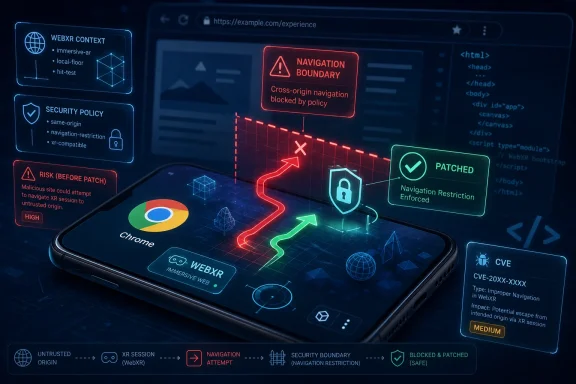
Google Chrome on Android before version 150.0.7871.47 is affected by CVE-2026-14034, a low-severity Chromium WebXR flaw disclosed on June 30, 2026, that can let a remote attacker bypass navigation restrictions through a crafted HTML page. The important word there is not “low.” It is “navigation,” because browser security often fails at the seams where a web page, a permission model, and a platform-specific feature all believe someone else is enforcing the boundary. As documented by NVD, CISA-ADP, and Google’s Chrome release notes, this is not a panic-grade bug — but it is exactly the sort of small browser defect that enterprise patching programs ignore at their peril.
CVE-2026-14034 lives in WebXR, the browser technology stack that lets web content interact with augmented reality and virtual reality experiences. On Android, that puts Chrome in a particularly awkward position: the browser is not merely rendering a document, but brokering a richer interaction between web content, device sensors, immersive presentation modes, and navigation controls.
The published description is spare, as Chrome CVE descriptions often are. “Inappropriate implementation in WebXR” is not a satisfying technical root-cause analysis, and the linked Chromium issue remains restricted at the time of writing. But the public record is still enough to understand the risk shape: a crafted HTML page could bypass navigation restrictions in Chrome on Android before 150.0.7871.47.
That makes this less like a classic memory-corruption emergency and more like a policy-enforcement failure. The browser was supposed to prevent a certain kind of navigation behavior, and under WebXR-specific conditions it apparently did not. CISA-ADP mapped the issue to CWE-284, Improper Access Control, which is a broad category but a useful one here: something crossed a boundary it should not have crossed.
The Chromium project rated the bug Low. CISA-ADP’s CVSS 3.1 vector gives it a 4.3 Medium score, with network attack vector, low attack complexity, no privileges required, user interaction required, and limited integrity impact. That difference is not a contradiction so much as a reminder that severity systems are lenses, not law.
User interaction is required for CVE-2026-14034, according to the CISA-ADP scoring. That usually means the victim must visit or interact with malicious web content rather than being compromised passively from across the network. In consumer terms, that lowers the urgency. In enterprise terms, it only lowers the urgency if the organization has solved phishing, malicious ads, compromised websites, QR-code lures, and unmanaged mobile browsing — which is to say, almost nobody has.
The practical concern is not that this specific bug is known to deliver code execution. The public data does not say that it exposes confidentiality, causes availability loss, or escapes the browser sandbox. Its scored impact is integrity-only and limited.
But integrity matters in browsers because navigation is a trust signal. Users and administrators rely on where the browser says it is going, what frame or immersive context it is in, and whether a transition is allowed. A navigation restriction bypass can become more interesting when chained with deceptive UI, permission prompts, enterprise single sign-on flows, or app-like web experiences.
That framing is too narrow on Android. Mobile browsers increasingly act as bridges between web content and device capabilities, whether through camera access, motion sensors, fullscreen experiences, installable web apps, or immersive APIs. Even if few users think of themselves as “using WebXR,” the component still sits inside the browser’s permission and navigation architecture.
The risk with these newer or less frequently used browser subsystems is not always raw exploitability. It is complexity. Each new API adds states, transitions, prompts, frames, origins, and assumptions about what the browser chrome is allowed to do and what web content is forbidden to do.
That is why a Low-severity WebXR navigation bug deserves more than a shrug. It hints at a class of problems security teams have seen repeatedly: the dangerous behavior is not in the obvious exploit primitive, but in the mismatch between a specialized feature and the browser’s general-purpose security model.
That context matters because CVE-2026-14034 is unlikely to be the sole driver of anyone’s patch priority. A single low-severity WebXR issue might be deferred in a vacuum. A Chrome release containing a large bundle of security fixes is different. Browser updates are cumulative risk events; organizations do not get to cherry-pick only the CVEs that sound dramatic.
Chrome’s release cadence also complicates vulnerability management. By the time NVD enriches a record, CISA-ADP adds a score, third-party scanners ingest the CPEs, and mobile devices report their versions back to management tools, Google may already be rolling the next update. That speed is a strength for security, but it can make enterprise visibility feel perpetually late.
This is especially true on Android, where patch state can depend on Play Store update behavior, managed Google Play policy, user settings, device ownership mode, OEM constraints, and whether Chrome is being treated as a managed app or just another consumer application.
For WindowsForum readers, this is where the story intersects with day-to-day administration. CVE matching depends on names, versions, platforms, and package identifiers lining up cleanly. Browser reality is less clean. Chrome stable, Chrome for Android, Chromium-derived browsers, embedded WebView components, OEM browser builds, and managed mobile app inventories do not always present themselves in the same language a scanner expects.
CVE-2026-14034 is specifically described as affecting Google Chrome on Android. That should prevent Windows desktop administrators from misreading it as a direct Windows Chrome exposure. But mixed fleets rarely divide so neatly. The same Microsoft 365 tenant, identity provider, conditional access policy, and SaaS estate may be accessed from Windows laptops, Android phones, personal tablets, and contractor devices.
The CPE question therefore becomes practical rather than academic. If a vulnerability scanner cannot confidently identify Chrome on Android, the security team may falsely conclude the issue is absent. If it overmatches every Chromium-based browser everywhere, the team may generate noise that teaches administrators to ignore browser CVEs altogether.
That sounds mundane because it is. Browser security is now mostly operational discipline, not heroic incident response. The organizations that handle these bugs well are not the ones that debate every CVSS decimal place; they are the ones that keep browser auto-update channels healthy and verify exceptions quickly.
The “user interaction required” factor should not be dismissed either. On mobile devices, user interaction is the default state of compromise. People tap links in messaging apps, scan QR codes, open links from personal email, and move between business and consumer contexts constantly. A crafted HTML page is not a high bar in a world where the browser is the universal document viewer.
Nor should administrators assume that a low-severity browser navigation bug is harmless because it does not directly disclose data. Integrity-impact bugs can support phishing, redirect abuse, prompt confusion, or policy bypasses. They may also become more valuable when attackers combine them with other browser or web-application weaknesses.
The risk for IT teams is treating “NVD score unavailable” as “risk unavailable.” The more accurate reading is that the vulnerability record is still being enriched. In this case, the vendor description, affected version boundary, weakness mapping, CISA-ADP score, and fix version are already enough to make a patching decision.
CISA-ADP’s SSVC values are also clarifying. The record indicates no known exploitation, not automatable, and partial technical impact. That is a strong argument against alarmism. It is not an argument against updating.
This distinction matters because vulnerability management programs are drowning in browser CVEs. If everything is urgent, nothing is urgent. CVE-2026-14034 belongs in the “update through normal accelerated browser maintenance” bucket, not the “drop everything” bucket.
That opacity is particularly frustrating for bugs like CVE-2026-14034, where the difference between “minor navigation weirdness” and “useful phishing primitive” may depend on implementation details. What restriction was bypassed? Was it tied to top-level navigation, iframe behavior, immersive-mode transitions, external intents, or origin handling? The public record does not answer those questions.
Security teams should resist filling the gap with speculation. The safe conclusion is narrower: Chrome on Android before 150.0.7871.47 had a WebXR navigation restriction bypass, and Google fixed it. Anything beyond that should be treated as provisional until Chromium issue details become public or additional researcher analysis appears.
Still, the absence of detail should not paralyze patching. Browser vendors ship fixes faster than public exploit write-ups for a reason. Waiting for a full technical autopsy before updating Chrome is a luxury most environments do not have.
This is especially relevant for organizations using conditional access policies that treat mobile device compliance as a gateway to corporate resources. A managed Android phone with an outdated Chrome browser is not just a personal browsing risk. It may be a path into business email, SharePoint, Teams links, intranet portals, and identity flows.
There is also a user-education angle. Many employees understand that Windows Update matters. Fewer understand that mobile browser updates can be equally important. Chrome on Android updates through a different channel, with different visibility, and often with less administrator attention unless the device is enrolled and policies are enforced.
For Windows administrators, the lesson is not to manually hunt one WebXR bug. It is to stop treating mobile browsers as outside the patch-management story. The browser has become the cross-platform operating layer users actually touch.
When a release contains hundreds of fixes, individual CVEs blur together. Security teams may focus on the critical memory-corruption entries and ignore lower-severity platform-specific bugs. Users may see yet another browser restart prompt and postpone it. Administrators may tolerate lag because the last dozen Chrome updates seemed uneventful.
Attackers benefit from that fatigue. They do not need every vulnerability to be critical if they can count on a population of devices that trails stable by weeks. A Low-severity bug fixed today can become a useful ingredient tomorrow if it remains unpatched on enough endpoints.
The browser patch backlog is therefore the adversary’s friend. CVE-2026-14034 is one more reason to measure update latency, not just vulnerability presence. The question is not merely whether Chrome eventually updates, but how long vulnerable versions remain common in the fleet.
For administrators, the useful conclusions are concrete:
 A Low-Severity Chrome Bug Still Has a Boundary Story to Tell
CVE-2026-14034 lives in WebXR, the browser technology stack that lets web content interact with augmented reality and virtual reality experiences. On Android, that puts Chrome in a particularly awkward position: the browser is not merely rendering a document, but brokering a richer interaction between web content, device sensors, immersive presentation modes, and navigation controls.The published description is spare, as Chrome CVE descriptions often are. “Inappropriate implementation in WebXR” is not a satisfying technical root-cause analysis, and the linked Chromium issue remains restricted at the time of writing. But the public record is still enough to understand the risk shape: a crafted HTML page could bypass navigation restrictions in Chrome on Android before 150.0.7871.47.
That makes this less like a classic memory-corruption emergency and more like a policy-enforcement failure. The browser was supposed to prevent a certain kind of navigation behavior, and under WebXR-specific conditions it apparently did not. CISA-ADP mapped the issue to CWE-284, Improper Access Control, which is a broad category but a useful one here: something crossed a boundary it should not have crossed.
The Chromium project rated the bug Low. CISA-ADP’s CVSS 3.1 vector gives it a 4.3 Medium score, with network attack vector, low attack complexity, no privileges required, user interaction required, and limited integrity impact. That difference is not a contradiction so much as a reminder that severity systems are lenses, not law.
The Crafted Page Remains the Browser’s Oldest Trap
The attack path described by NVD is familiar: a remote attacker uses a crafted HTML page. That phrase appears so often in browser advisories that it can feel like boilerplate, but it is the core of why browser vulnerabilities remain operationally important. The browser is the one application users are expected to point at untrusted code all day.User interaction is required for CVE-2026-14034, according to the CISA-ADP scoring. That usually means the victim must visit or interact with malicious web content rather than being compromised passively from across the network. In consumer terms, that lowers the urgency. In enterprise terms, it only lowers the urgency if the organization has solved phishing, malicious ads, compromised websites, QR-code lures, and unmanaged mobile browsing — which is to say, almost nobody has.
The practical concern is not that this specific bug is known to deliver code execution. The public data does not say that it exposes confidentiality, causes availability loss, or escapes the browser sandbox. Its scored impact is integrity-only and limited.
But integrity matters in browsers because navigation is a trust signal. Users and administrators rely on where the browser says it is going, what frame or immersive context it is in, and whether a transition is allowed. A navigation restriction bypass can become more interesting when chained with deceptive UI, permission prompts, enterprise single sign-on flows, or app-like web experiences.
WebXR Is Still a Small Surface With Big Assumptions
WebXR has never had the same security mindshare as V8, Blink, Skia, or WebRTC. That is understandable. JavaScript engine bugs and graphics memory issues are easier to fit into the familiar story of remote code execution and sandbox escape. WebXR, by comparison, sounds like a niche feature for headsets, demos, and experimental apps.That framing is too narrow on Android. Mobile browsers increasingly act as bridges between web content and device capabilities, whether through camera access, motion sensors, fullscreen experiences, installable web apps, or immersive APIs. Even if few users think of themselves as “using WebXR,” the component still sits inside the browser’s permission and navigation architecture.
The risk with these newer or less frequently used browser subsystems is not always raw exploitability. It is complexity. Each new API adds states, transitions, prompts, frames, origins, and assumptions about what the browser chrome is allowed to do and what web content is forbidden to do.
That is why a Low-severity WebXR navigation bug deserves more than a shrug. It hints at a class of problems security teams have seen repeatedly: the dangerous behavior is not in the obvious exploit primitive, but in the mismatch between a specialized feature and the browser’s general-purpose security model.
Chrome 150 Was Not a One-Bug Release
CVE-2026-14034 arrived as part of the broader Chrome 150 stable-channel update published by Google at the end of June. Google’s Chrome Releases blog listed desktop versions 150.0.7871.46 and 150.0.7871.47 for Windows and macOS, 150.0.7871.46 for Linux, and a later Android build line referenced in subsequent reporting. Malwarebytes described the release as a very large security update, noting hundreds of fixes across the Chrome codebase.That context matters because CVE-2026-14034 is unlikely to be the sole driver of anyone’s patch priority. A single low-severity WebXR issue might be deferred in a vacuum. A Chrome release containing a large bundle of security fixes is different. Browser updates are cumulative risk events; organizations do not get to cherry-pick only the CVEs that sound dramatic.
Chrome’s release cadence also complicates vulnerability management. By the time NVD enriches a record, CISA-ADP adds a score, third-party scanners ingest the CPEs, and mobile devices report their versions back to management tools, Google may already be rolling the next update. That speed is a strength for security, but it can make enterprise visibility feel perpetually late.
This is especially true on Android, where patch state can depend on Play Store update behavior, managed Google Play policy, user settings, device ownership mode, OEM constraints, and whether Chrome is being treated as a managed app or just another consumer application.
The CPE Footnote Is Really an Inventory Problem
The NVD record’s configuration is worth pausing over. NIST’s initial analysis added a vulnerable CPE for Google Chrome versions before 150.0.7871.47 and paired it with Android as the operating system. The page also displays the familiar “Are we missing a CPE here?” prompt, the quiet admission that product matching is always messier than the clean rows in a vulnerability database suggest.For WindowsForum readers, this is where the story intersects with day-to-day administration. CVE matching depends on names, versions, platforms, and package identifiers lining up cleanly. Browser reality is less clean. Chrome stable, Chrome for Android, Chromium-derived browsers, embedded WebView components, OEM browser builds, and managed mobile app inventories do not always present themselves in the same language a scanner expects.
CVE-2026-14034 is specifically described as affecting Google Chrome on Android. That should prevent Windows desktop administrators from misreading it as a direct Windows Chrome exposure. But mixed fleets rarely divide so neatly. The same Microsoft 365 tenant, identity provider, conditional access policy, and SaaS estate may be accessed from Windows laptops, Android phones, personal tablets, and contractor devices.
The CPE question therefore becomes practical rather than academic. If a vulnerability scanner cannot confidently identify Chrome on Android, the security team may falsely conclude the issue is absent. If it overmatches every Chromium-based browser everywhere, the team may generate noise that teaches administrators to ignore browser CVEs altogether.
Low Does Not Mean Optional on Managed Android
A sensible enterprise response to CVE-2026-14034 is not an emergency bridge call. It is a check that managed Android devices are receiving Chrome updates promptly, that minimum browser versions are enforced where possible, and that mobile threat or endpoint-management tooling can see the app version accurately.That sounds mundane because it is. Browser security is now mostly operational discipline, not heroic incident response. The organizations that handle these bugs well are not the ones that debate every CVSS decimal place; they are the ones that keep browser auto-update channels healthy and verify exceptions quickly.
The “user interaction required” factor should not be dismissed either. On mobile devices, user interaction is the default state of compromise. People tap links in messaging apps, scan QR codes, open links from personal email, and move between business and consumer contexts constantly. A crafted HTML page is not a high bar in a world where the browser is the universal document viewer.
Nor should administrators assume that a low-severity browser navigation bug is harmless because it does not directly disclose data. Integrity-impact bugs can support phishing, redirect abuse, prompt confusion, or policy bypasses. They may also become more valuable when attackers combine them with other browser or web-application weaknesses.
NVD’s Missing Score Is a Signal, Not a Reprieve
At the time reflected in the public record, NVD had not provided its own CVSS 4.0 or CVSS 3.x assessment for CVE-2026-14034, while CISA-ADP had supplied a CVSS 3.1 score and SSVC data. That is not unusual in the modern vulnerability ecosystem. NVD enrichment often lags disclosure, and downstream tools increasingly blend data from CVE Program sources, CISA, vendor advisories, and commercial intelligence feeds.The risk for IT teams is treating “NVD score unavailable” as “risk unavailable.” The more accurate reading is that the vulnerability record is still being enriched. In this case, the vendor description, affected version boundary, weakness mapping, CISA-ADP score, and fix version are already enough to make a patching decision.
CISA-ADP’s SSVC values are also clarifying. The record indicates no known exploitation, not automatable, and partial technical impact. That is a strong argument against alarmism. It is not an argument against updating.
This distinction matters because vulnerability management programs are drowning in browser CVEs. If everything is urgent, nothing is urgent. CVE-2026-14034 belongs in the “update through normal accelerated browser maintenance” bucket, not the “drop everything” bucket.
Google’s Restricted Bug Details Cut Both Ways
Google’s practice of restricting access to bug details until most users are updated is standard browser-vendor hygiene. It prevents public advisories from doubling as exploit-development guides. For defenders, though, it means the most interesting technical details often arrive too late to shape the first patch decision.That opacity is particularly frustrating for bugs like CVE-2026-14034, where the difference between “minor navigation weirdness” and “useful phishing primitive” may depend on implementation details. What restriction was bypassed? Was it tied to top-level navigation, iframe behavior, immersive-mode transitions, external intents, or origin handling? The public record does not answer those questions.
Security teams should resist filling the gap with speculation. The safe conclusion is narrower: Chrome on Android before 150.0.7871.47 had a WebXR navigation restriction bypass, and Google fixed it. Anything beyond that should be treated as provisional until Chromium issue details become public or additional researcher analysis appears.
Still, the absence of detail should not paralyze patching. Browser vendors ship fixes faster than public exploit write-ups for a reason. Waiting for a full technical autopsy before updating Chrome is a luxury most environments do not have.
The Windows Angle Is Indirect but Real
A Chrome-on-Android CVE may look out of place on a Windows-focused site, but modern Windows administration no longer stops at the desktop. Windows shops manage Entra ID sign-ins, Microsoft 365 access, Defender telemetry, Intune compliance, SaaS authentication, and browser-based workflows across multiple operating systems. Android browsers are part of that perimeter.This is especially relevant for organizations using conditional access policies that treat mobile device compliance as a gateway to corporate resources. A managed Android phone with an outdated Chrome browser is not just a personal browsing risk. It may be a path into business email, SharePoint, Teams links, intranet portals, and identity flows.
There is also a user-education angle. Many employees understand that Windows Update matters. Fewer understand that mobile browser updates can be equally important. Chrome on Android updates through a different channel, with different visibility, and often with less administrator attention unless the device is enrolled and policies are enforced.
For Windows administrators, the lesson is not to manually hunt one WebXR bug. It is to stop treating mobile browsers as outside the patch-management story. The browser has become the cross-platform operating layer users actually touch.
The Real Risk Is the Browser Patch Backlog
CVE-2026-14034 is small. The Chrome update train around it is not. Recent Chrome releases have carried very large numbers of security fixes, and third-party reporting on Chrome 150 emphasized the scale of the June 30 release. That volume changes the psychology of browser patching.When a release contains hundreds of fixes, individual CVEs blur together. Security teams may focus on the critical memory-corruption entries and ignore lower-severity platform-specific bugs. Users may see yet another browser restart prompt and postpone it. Administrators may tolerate lag because the last dozen Chrome updates seemed uneventful.
Attackers benefit from that fatigue. They do not need every vulnerability to be critical if they can count on a population of devices that trails stable by weeks. A Low-severity bug fixed today can become a useful ingredient tomorrow if it remains unpatched on enough endpoints.
The browser patch backlog is therefore the adversary’s friend. CVE-2026-14034 is one more reason to measure update latency, not just vulnerability presence. The question is not merely whether Chrome eventually updates, but how long vulnerable versions remain common in the fleet.
The Chrome 150 Lesson Fits in a Smaller Box Than the CVE Feed
CVE-2026-14034 should be handled with proportion. It is neither a zero-day crisis nor a nothingburger. It is a mobile Chrome boundary bug with a clear fixed version, a user-interaction requirement, no public indication of active exploitation, and a practical patch path.For administrators, the useful conclusions are concrete:
- Chrome on Android should be updated to a version at or beyond the fixed build line identified by Google and NVD for this issue.
- Vulnerability tools should be checked to ensure they correctly distinguish Chrome on Android from desktop Chrome and from unrelated Chromium-based products.
- Managed Android policies should treat browser version drift as a compliance concern, not merely an app-maintenance detail.
- Security teams should avoid escalating CVE-2026-14034 as a standalone emergency unless additional exploitation evidence appears.
- The broader Chrome 150 security bundle is the stronger reason to accelerate rollout than this individual Low-severity WebXR flaw alone.
- User-interaction requirements should reduce panic, not justify ignoring browser bugs that can be reached through ordinary web browsing.
References
- Primary source: NVD / Chromium
Published: 2026-07-03T07:00:14-07:00
NVD - CVE-2026-14034
 nvd.nist.gov
- Security advisory: MSRC
Published: 2026-07-03T07:00:14-07:00
Original feed URL
Security Update Guide - Microsoft Security Response Center
 msrc.microsoft.com
- Related coverage: cvefeed.io
CVE-2026-14034 - Google Chrome WebXR Navigation Restriction Bypass
Inappropriate implementation in WebXR in Google Chrome on Android prior to 150.0.7871.47 allowed a remote attacker to bypass navigation restrictions via a crafted HTML page. (Chromium security severity: Low)cvefeed.io - Official source: nist.gov
National Vulnerability Database
NIST maintains the National Vulnerability Database (NVD), a repository of information on software and hardware flaws that can compromise computer security. This is a key piece of the nation’s cybersecurity infrastructure.www.nist.gov - Related coverage: labs.cloudsecurityalliance.org
NVD Enrichment Triage: Guidance for AI Security Programs
PDF documentlabs.cloudsecurityalliance.org
- Official source: nvlpubs.nist.gov
Technical Specification for the Security Content Automation Protocol (SCAP): SCAP Version 1.4
The Security Content Automation Protocol (SCAP) is a suite of specifications that standardize the format and nomenclature by which software flaw and security configuration information is communicated, both to machines and humans. This publication, along with its annex (NIST Special Publication...nvlpubs.nist.gov
