

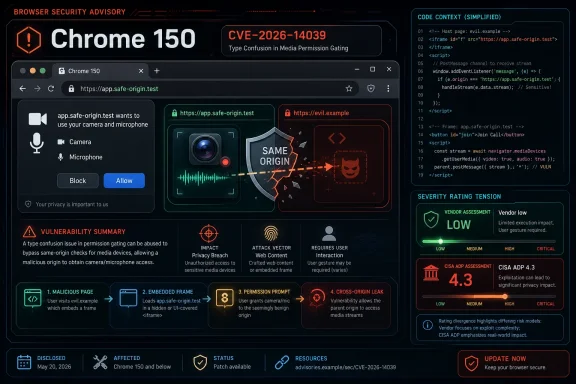
Google disclosed CVE-2026-14039 on June 30, 2026, as a low-severity Chrome flaw in GetUserMedia that affected builds before 150.0.7871.47 and could let a remote attacker bypass same-origin policy with a crafted HTML page. The National Vulnerability Database later enriched the entry with a CISA ADP CVSS 3.1 score of 4.3, marking it medium despite Chromium’s own low rating. That tension is the story: not a panic-button browser bug, but a reminder that modern web permissions are only as strong as the policy checks behind them.
CVE-2026-14039 sits in an awkward place in the Chrome security ledger. Google’s Chrome Releases blog lists it among the low-severity fixes in the June 30 Stable Channel update for Chrome 150, specifically as “Insufficient policy enforcement in GetUserMedia,” reported by Google on March 29. NVD’s entry, sourced from Chrome and last modified on July 2, says versions prior to 150.0.7871.47 are affected.
The phrase GetUserMedia may sound like plumbing, but it is not ordinary plumbing. It is the browser API that lets web applications request access to microphones, cameras, and media streams, which places it close to one of the most sensitive trust boundaries on a user’s machine. A bug there does not need to be a remote-code-execution monster to deserve attention.
The reported impact is narrower than the scariest webcam headlines suggest. The public description says a crafted HTML page could bypass same-origin policy, not silently turn every laptop into a surveillance device. CISA’s ADP vector also requires user interaction, meaning the attacker must get the victim to open or interact with a malicious page rather than exploit the browser without any human step.
That is why this is not a “drop everything” emergency for most users. But it is also why dismissing it as “only low” misses the deeper lesson. Chrome’s security model is a layered system of origin checks, permission prompts, process isolation, sandboxing, and user gestures; CVE-2026-14039 is a failure in one of those layers.
Modern browsers have complicated that once-simple bargain. Today’s web pages are not just documents; they are applications that ask for hardware access, run real-time communications, embed third-party frames, invoke storage APIs, and negotiate identity flows across domains. Every new capability requires a new set of policy checks.
GetUserMedia is a particularly delicate example because it lives at the intersection of origin, permission, and hardware access. A browser has to know which site is asking, whether the user granted permission, whether the context is secure, whether embedded frames are allowed, and whether a previous grant applies. A small error in that chain can produce a vulnerability even when the underlying media stack is not catastrophically broken.
That is why “origin validation error,” the CWE classification added by CISA ADP, matters. It points to the who is allowed to do this? part of the browser, not merely the can this code crash? part. In security engineering, authorization bugs are often less dramatic than memory corruption bugs, but they can be more revealing about how complex the product has become.
That scale changes how administrators should read CVE-2026-14039. In isolation, it is a medium-scored, low-severity policy bug requiring user interaction. In context, it is one item inside a sprawling browser update that also included critical and high-severity flaws across areas such as Extensions, GPU, ANGLE, Dawn, Skia, Bluetooth, and other browser components.
The practical conclusion is boring but important: update Chrome, and do not cherry-pick your concern by CVE name. Browser patching has become less like fixing a single door lock and more like resurfacing an entire airport runway while flights continue to land. A low-rated GetUserMedia bug is not necessarily the reason to accelerate deployment, but it is one more reason not to delay it.
For WindowsForum readers, the downstream implication also extends beyond Google Chrome. Chromium is the common substrate for Microsoft Edge, Brave, Vivaldi, Opera, and other browsers, though each vendor ships its own build, schedule, and security advisories. A Chrome CVE does not automatically prove exploitability in every Chromium-based browser, but it should trigger the familiar admin reflex: check vendor release notes, verify deployed versions, and do not assume “not Chrome” means “not affected.”
That distinction matters because severity systems answer slightly different questions. A vendor severity rating often reflects product-specific exploitability, available mitigations, real-world attack usefulness, and internal knowledge of the bug. CVSS tries to normalize impact across products, using a vector that, in this case, says network attack vector, low attack complexity, no privileges required, user interaction required, unchanged scope, no confidentiality impact, low integrity impact, and no availability impact.
The resulting 4.3 score is not an alarm bell. It is a way of saying: this can be triggered remotely, it does not require authentication, but it does require a user and produces limited technical impact. That is a sane middle ground for a browser policy bypass whose public details remain constrained.
Google’s own release note also says access to bug details may stay restricted until most users are updated. That is standard browser-vendor hygiene, but it leaves defenders with an uncomfortable amount of inference. We know the affected component, the broad weakness class, the fixed version, and the attack shape; we do not know the exact exploit primitive from public material.
This is where good patch management beats speculative exploit analysis. Security teams do not need to reverse-engineer the bug to decide whether Chrome before 150.0.7871.47 should remain in production. The answer is no, especially when the same update contains hundreds of other fixes.
Behind that prompt, Chrome has to track origins, permissions, frames, redirects, device identifiers, capture sessions, and policy restrictions. Enterprise deployments add another layer: admins may preconfigure camera and microphone behavior, block prompts, allow specific sites, or use group policy to manage user choices. The more policy logic exists, the more places there are for insufficient enforcement to creep in.
CVE-2026-14039 appears to live in that less visible territory. The public record does not say that attackers could directly seize a camera feed without a prompt. It says they could bypass same-origin policy through crafted HTML. That narrower description still matters because same-origin boundaries are the browser’s way of keeping one web identity from impersonating or interfering with another.
The lesson for users is not to panic over every video-call site. It is to treat browser permission prompts as part of security, not all of it. If a malicious page can exploit a browser policy bug, the fact that Chrome has generally strong permission UX does not eliminate the risk; it merely shapes it.
That is where a CVE like this becomes operationally relevant. Its individual severity may be modest, but the remediation path is binary: either the installed browser is at or beyond the fixed build, or it is not. The longer machines sit on pre-150.0.7871.47 Chrome builds, the more the organization depends on luck and obscurity rather than patch discipline.
There is also a reporting wrinkle. NVD’s affected configuration lists Google Chrome versions up to, but excluding, 150.0.7871.47. The user-submitted NVD text notes the “Are we missing a CPE?” prompt, which is common on NVD pages and not, by itself, evidence that the Chrome CPE is absent. In fact, the change history says NIST added a CPE configuration for Google Chrome during initial analysis on July 2.
That matters for vulnerability scanners. If a scanner flags this CVE without recognizing installed Chrome versions accurately, admins may see false positives or lingering findings after updates. Conversely, if Chromium-derived browsers are in the fleet but not modeled cleanly, teams may miss related vendor advisories. The right response is to verify both the scanner logic and the actual browser build, not to argue with the CVE title.
The careful wording is important. CVE-2026-14039’s NVD entry names Google Chrome, not Microsoft Edge. Microsoft typically publishes its own Edge security release notes when Chromium fixes are incorporated, and Edge’s version numbers do not match Chrome’s version numbers one-to-one. Treating Chrome’s fixed version as an Edge fixed version would be sloppy.
But treating Edge as unrelated would be worse. If the vulnerable code path is in shared Chromium media-capture logic, Edge may need the corresponding Chromium patch once Microsoft integrates it. If the issue is Chrome-specific glue around that API, Edge may be unaffected or differently affected. Admins should check Microsoft’s Edge security release notes and update catalogs rather than infer either outcome from the Chrome CVE alone.
This is one of the practical annoyances of the Chromium monoculture. A shared engine improves standards compatibility and concentrates engineering muscle, but it also means browser security news moves in waves. Enterprises have to track Google’s disclosures, Microsoft’s packaging, and the behavior of whatever third-party Chromium browsers users have installed.
The safer pattern is to minimize where media permissions are requested. A video app should request camera and microphone access from a predictable, top-level, secure origin rather than scattering capture logic across embedded flows. Developers should also audit permission policy headers, iframe
There is a temptation to say that if the browser had a bug, the app developer is innocent. In the narrow sense, yes. In the operational sense, robust web apps reduce blast radius by avoiding unnecessary cross-origin complexity, especially around privileged APIs.
Security-minded developers should also resist treating user interaction as a comforting mitigation. Many browser attacks require a click, a navigation, or a page visit; phishing has proved for decades that user interaction is not a high wall. If a crafted page can trigger a policy bypass after plausible interaction, the exploitability question becomes one of social engineering and timing, not just code.
That restraint leaves room for overstatement. Some vulnerability databases label the bug as an authentication bypass, others as a same-origin policy bypass, and the CVE text itself uses the narrower browser-security language. The most defensible reading is that this is a web-origin enforcement flaw in GetUserMedia, not a general account-login bypass.
It also leaves room for understatement. “Low” severity can sound harmless, but browser policy bugs often become more interesting when chained with other issues. A low-severity origin bypass may provide a foothold, a confusing UI state, or a way to weaken assumptions that another bug depends on. The public CVE does not say such a chain exists here, and CISA ADP marked exploitation as none in its SSVC data, but defenders should avoid treating low as synonymous with impossible.
The best security writing in this space is humble about what is not known. We know the version boundary. We know the affected component. We know the official description. We know the broad scoring. We do not know the private proof of concept, and until the bug opens publicly, claims about exactly what could be stolen or controlled should be treated skeptically.
 A Low-Severity Chrome Bug Still Lands in a High-Trust Part of the Browser
CVE-2026-14039 sits in an awkward place in the Chrome security ledger. Google’s Chrome Releases blog lists it among the low-severity fixes in the June 30 Stable Channel update for Chrome 150, specifically as “Insufficient policy enforcement in GetUserMedia,” reported by Google on March 29. NVD’s entry, sourced from Chrome and last modified on July 2, says versions prior to 150.0.7871.47 are affected.The phrase GetUserMedia may sound like plumbing, but it is not ordinary plumbing. It is the browser API that lets web applications request access to microphones, cameras, and media streams, which places it close to one of the most sensitive trust boundaries on a user’s machine. A bug there does not need to be a remote-code-execution monster to deserve attention.
The reported impact is narrower than the scariest webcam headlines suggest. The public description says a crafted HTML page could bypass same-origin policy, not silently turn every laptop into a surveillance device. CISA’s ADP vector also requires user interaction, meaning the attacker must get the victim to open or interact with a malicious page rather than exploit the browser without any human step.
That is why this is not a “drop everything” emergency for most users. But it is also why dismissing it as “only low” misses the deeper lesson. Chrome’s security model is a layered system of origin checks, permission prompts, process isolation, sandboxing, and user gestures; CVE-2026-14039 is a failure in one of those layers.
The Same-Origin Policy Is the Browser’s Oldest Promise
The same-origin policy is one of the web’s foundational rules: a page from one origin should not freely read or manipulate sensitive content from another. It is the reason a malicious page cannot simply open your bank’s session in another frame and harvest its contents. It is also the rule that keeps the web’s chaos barely governable.Modern browsers have complicated that once-simple bargain. Today’s web pages are not just documents; they are applications that ask for hardware access, run real-time communications, embed third-party frames, invoke storage APIs, and negotiate identity flows across domains. Every new capability requires a new set of policy checks.
GetUserMedia is a particularly delicate example because it lives at the intersection of origin, permission, and hardware access. A browser has to know which site is asking, whether the user granted permission, whether the context is secure, whether embedded frames are allowed, and whether a previous grant applies. A small error in that chain can produce a vulnerability even when the underlying media stack is not catastrophically broken.
That is why “origin validation error,” the CWE classification added by CISA ADP, matters. It points to the who is allowed to do this? part of the browser, not merely the can this code crash? part. In security engineering, authorization bugs are often less dramatic than memory corruption bugs, but they can be more revealing about how complex the product has become.
Chrome 150 Was a Patch Avalanche, and This Was One Snowflake
Google’s June 30 Stable Channel update promoted Chrome 150 to stable for Windows, Mac, and Linux. The release moved Windows and Mac users to 150.0.7871.46/.47 and Linux users to 150.0.7871.46, with rollout over the following days and weeks. Google said the release included 433 security fixes, an unusually large number even by Chrome’s increasingly busy standards.That scale changes how administrators should read CVE-2026-14039. In isolation, it is a medium-scored, low-severity policy bug requiring user interaction. In context, it is one item inside a sprawling browser update that also included critical and high-severity flaws across areas such as Extensions, GPU, ANGLE, Dawn, Skia, Bluetooth, and other browser components.
The practical conclusion is boring but important: update Chrome, and do not cherry-pick your concern by CVE name. Browser patching has become less like fixing a single door lock and more like resurfacing an entire airport runway while flights continue to land. A low-rated GetUserMedia bug is not necessarily the reason to accelerate deployment, but it is one more reason not to delay it.
For WindowsForum readers, the downstream implication also extends beyond Google Chrome. Chromium is the common substrate for Microsoft Edge, Brave, Vivaldi, Opera, and other browsers, though each vendor ships its own build, schedule, and security advisories. A Chrome CVE does not automatically prove exploitability in every Chromium-based browser, but it should trigger the familiar admin reflex: check vendor release notes, verify deployed versions, and do not assume “not Chrome” means “not affected.”
“Low” and “Medium” Are Not Contradictions So Much as Different Lenses
The severity mismatch is not a clerical scandal. Chromium rated the issue low, while CISA ADP attached a CVSS 3.1 base score of 4.3, which falls in the medium band. NVD itself had not provided its own CVSS score when the entry was updated, instead displaying the contributed CISA ADP assessment.That distinction matters because severity systems answer slightly different questions. A vendor severity rating often reflects product-specific exploitability, available mitigations, real-world attack usefulness, and internal knowledge of the bug. CVSS tries to normalize impact across products, using a vector that, in this case, says network attack vector, low attack complexity, no privileges required, user interaction required, unchanged scope, no confidentiality impact, low integrity impact, and no availability impact.
The resulting 4.3 score is not an alarm bell. It is a way of saying: this can be triggered remotely, it does not require authentication, but it does require a user and produces limited technical impact. That is a sane middle ground for a browser policy bypass whose public details remain constrained.
Google’s own release note also says access to bug details may stay restricted until most users are updated. That is standard browser-vendor hygiene, but it leaves defenders with an uncomfortable amount of inference. We know the affected component, the broad weakness class, the fixed version, and the attack shape; we do not know the exact exploit primitive from public material.
This is where good patch management beats speculative exploit analysis. Security teams do not need to reverse-engineer the bug to decide whether Chrome before 150.0.7871.47 should remain in production. The answer is no, especially when the same update contains hundreds of other fixes.
Permission Prompts Were Never a Complete Security Boundary
Users tend to think of webcam and microphone security as a prompt: the browser asks, the user says yes or no, and the story ends. That mental model is useful, but incomplete. The prompt is only the visible ceremony at the edge of a larger enforcement system.Behind that prompt, Chrome has to track origins, permissions, frames, redirects, device identifiers, capture sessions, and policy restrictions. Enterprise deployments add another layer: admins may preconfigure camera and microphone behavior, block prompts, allow specific sites, or use group policy to manage user choices. The more policy logic exists, the more places there are for insufficient enforcement to creep in.
CVE-2026-14039 appears to live in that less visible territory. The public record does not say that attackers could directly seize a camera feed without a prompt. It says they could bypass same-origin policy through crafted HTML. That narrower description still matters because same-origin boundaries are the browser’s way of keeping one web identity from impersonating or interfering with another.
The lesson for users is not to panic over every video-call site. It is to treat browser permission prompts as part of security, not all of it. If a malicious page can exploit a browser policy bug, the fact that Chrome has generally strong permission UX does not eliminate the risk; it merely shapes it.
The Real Admin Risk Is Inventory Drift
For home users, Chrome’s auto-update machinery usually turns this kind of CVE into a race between rollout and restart. For administrators, the problem is less elegant. Managed browsers live behind change windows, compatibility testing, virtual desktop images, golden master templates, application control policies, and sometimes users who keep browser windows open for weeks.That is where a CVE like this becomes operationally relevant. Its individual severity may be modest, but the remediation path is binary: either the installed browser is at or beyond the fixed build, or it is not. The longer machines sit on pre-150.0.7871.47 Chrome builds, the more the organization depends on luck and obscurity rather than patch discipline.
There is also a reporting wrinkle. NVD’s affected configuration lists Google Chrome versions up to, but excluding, 150.0.7871.47. The user-submitted NVD text notes the “Are we missing a CPE?” prompt, which is common on NVD pages and not, by itself, evidence that the Chrome CPE is absent. In fact, the change history says NIST added a CPE configuration for Google Chrome during initial analysis on July 2.
That matters for vulnerability scanners. If a scanner flags this CVE without recognizing installed Chrome versions accurately, admins may see false positives or lingering findings after updates. Conversely, if Chromium-derived browsers are in the fleet but not modeled cleanly, teams may miss related vendor advisories. The right response is to verify both the scanner logic and the actual browser build, not to argue with the CVE title.
Windows Shops Should Watch Edge Without Assuming Edge Is Chrome
Windows administrators live in a Chromium world even when Chrome is not the default browser. Microsoft Edge is built on Chromium, ships through its own channel, and is deeply present on Windows 10 and Windows 11 systems. That makes every Chromium security wave relevant to Windows fleets, even when the initial CVE entry names Google Chrome.The careful wording is important. CVE-2026-14039’s NVD entry names Google Chrome, not Microsoft Edge. Microsoft typically publishes its own Edge security release notes when Chromium fixes are incorporated, and Edge’s version numbers do not match Chrome’s version numbers one-to-one. Treating Chrome’s fixed version as an Edge fixed version would be sloppy.
But treating Edge as unrelated would be worse. If the vulnerable code path is in shared Chromium media-capture logic, Edge may need the corresponding Chromium patch once Microsoft integrates it. If the issue is Chrome-specific glue around that API, Edge may be unaffected or differently affected. Admins should check Microsoft’s Edge security release notes and update catalogs rather than infer either outcome from the Chrome CVE alone.
This is one of the practical annoyances of the Chromium monoculture. A shared engine improves standards compatibility and concentrates engineering muscle, but it also means browser security news moves in waves. Enterprises have to track Google’s disclosures, Microsoft’s packaging, and the behavior of whatever third-party Chromium browsers users have installed.
Developers Should Read This as a Warning About Embedded Contexts
Web developers do not patch Chrome, but they do build the conditions in which browser policy bugs become useful. Applications that embed cross-origin content, request camera or microphone access, or depend on complex iframe permission policies should pay attention to this class of vulnerability. It is a reminder that the browser enforces the boundary, but the application designs the terrain around it.The safer pattern is to minimize where media permissions are requested. A video app should request camera and microphone access from a predictable, top-level, secure origin rather than scattering capture logic across embedded flows. Developers should also audit permission policy headers, iframe
allow attributes, and cross-origin assumptions around media features.There is a temptation to say that if the browser had a bug, the app developer is innocent. In the narrow sense, yes. In the operational sense, robust web apps reduce blast radius by avoiding unnecessary cross-origin complexity, especially around privileged APIs.
Security-minded developers should also resist treating user interaction as a comforting mitigation. Many browser attacks require a click, a navigation, or a page visit; phishing has proved for decades that user interaction is not a high wall. If a crafted page can trigger a policy bypass after plausible interaction, the exploitability question becomes one of social engineering and timing, not just code.
The Public Record Leaves Technical Gaps, and That Is Deliberate
The Chromium issue link associated with CVE-2026-14039 is marked as requiring permissions, and Google’s release note explains why details may remain restricted while users update. This is normal for browser vulnerabilities. The public does not get a full exploit recipe on day one because attackers would benefit from it before defenders finish patching.That restraint leaves room for overstatement. Some vulnerability databases label the bug as an authentication bypass, others as a same-origin policy bypass, and the CVE text itself uses the narrower browser-security language. The most defensible reading is that this is a web-origin enforcement flaw in GetUserMedia, not a general account-login bypass.
It also leaves room for understatement. “Low” severity can sound harmless, but browser policy bugs often become more interesting when chained with other issues. A low-severity origin bypass may provide a foothold, a confusing UI state, or a way to weaken assumptions that another bug depends on. The public CVE does not say such a chain exists here, and CISA ADP marked exploitation as none in its SSVC data, but defenders should avoid treating low as synonymous with impossible.
The best security writing in this space is humble about what is not known. We know the version boundary. We know the affected component. We know the official description. We know the broad scoring. We do not know the private proof of concept, and until the bug opens publicly, claims about exactly what could be stolen or controlled should be treated skeptically.
The Sensible Reading of CVE-2026-14039 Fits on One Admin Checklist
CVE-2026-14039 is not the headline-grabbing Chrome bug in the 150 release, but it is a useful test of whether an organization’s browser security process is mature enough to handle nuance. The correct response is measured urgency: patch promptly, verify versions, and avoid inventing either catastrophe or complacency.- Chrome installations should be updated to 150.0.7871.47 or later on Windows and Mac where that fixed build applies.
- Linux Chrome users should follow Google’s Chrome 150 Stable Channel packaging for their distribution and confirm the vendor-provided fixed build.
- Vulnerability teams should verify that scanners recognize the NVD CPE configuration for Google Chrome versions before 150.0.7871.47.
- Microsoft Edge administrators should track Microsoft’s own Edge security release notes rather than mapping Chrome version numbers directly onto Edge.
- Developers building camera, microphone, or video-conferencing workflows should reduce cross-origin complexity around GetUserMedia and related permission policies.
- Users should restart the browser after updating, because a downloaded browser update does not fully protect a still-running old process.
References
- Primary source: NVD / Chromium
Published: 2026-07-03T07:00:48-07:00
NVD - CVE-2026-14039
 nvd.nist.gov
- Security advisory: MSRC
Published: 2026-07-03T07:00:48-07:00
Original feed URL
Security Update Guide - Microsoft Security Response Center
 msrc.microsoft.com
- Related coverage: cvefeed.io
CVE-2026-14039 - Google Chrome GetUserMedia Same Origin Policy Bypass
Insufficient policy enforcement in GetUserMedia in Google Chrome prior to 150.0.7871.47 allowed a remote attacker to bypass same origin policy via a crafted HTML page. (Chromium security severity: Low)cvefeed.io
