

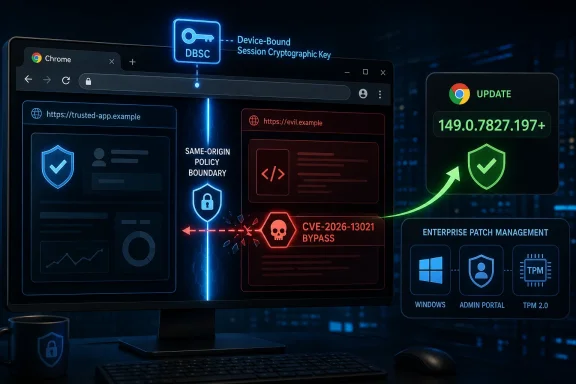
Google fixed CVE-2026-13021 in Chrome before version 149.0.7827.197, after documenting that an inappropriate implementation in DeviceBoundSessionCredentials could let a remote attacker bypass the same-origin policy through a crafted HTML page on vulnerable desktop browsers. That is the plain answer, but not the interesting one. The more important story is that a security feature designed to harden web sessions against cookie theft has now become part of the browser attack surface it was meant to defend. Chrome’s update is therefore both a patch notice and a reminder that authentication security is moving deeper into the browser, with all the complexity that implies.
Device Bound Session Credentials, usually shortened to DBSC, are Google’s answer to one of the ugliest realities of modern account theft: stealing a password is no longer necessary if malware can steal a live session cookie. Infostealers have turned browser profiles into loot boxes, and long-lived cookies have made that business model brutally efficient. DBSC tries to change the economics by tying a web session to a device-held cryptographic key, ideally protected by hardware such as a TPM.
That makes CVE-2026-13021 awkward in a very specific way. This was not a random rendering bug or another memory safety flaw buried in a media parser. It sat in the machinery of a feature designed to make session persistence safer, and the described outcome was a same-origin policy bypass — a violation of one of the browser’s oldest and most important boundaries.
Google classified the Chromium issue as high severity, while CISA’s ADP scoring put it at a medium CVSS 3.1 base score of 4.3, with user interaction required and a confidentiality impact marked as low. That difference is not necessarily a contradiction. Browser vendors often weigh exploitability and architectural implications differently from generalized scoring systems, especially when a bug touches core web security assumptions.
The same-origin policy is not glamorous, but it is the border checkpoint of the web. It is what prevents one site from freely reading or interfering with another site’s data simply because both are open in the same browser. A bypass in that model is rarely something administrators should shrug off, even when the published score does not scream emergency.
But the browser security model is compositional. Attackers do not need every bug to be catastrophic on its own; they need bugs that can be chained. A crafted HTML page that crosses an origin boundary may become more interesting when paired with a user already authenticated into valuable services, a compromised ad placement, a malicious link in a chat app, or another browser vulnerability that supplies a foothold.
That is why the “remote attacker” phrasing matters. This is web-deliverable territory: a page, a browser, and a victim who can be convinced or routed into loading content. The listed attack vector does not require local privileges or prior authentication, but it does require user interaction. In browser land, that is a modest barrier, not a moat.
For IT teams, the right interpretation is neither panic nor complacency. The patch should move through normal emergency-browser-update channels, especially on machines used for privileged administration, finance, identity management, or developer access. If a workstation’s browser is the front door to SaaS, cloud consoles, and internal dashboards, a same-origin policy flaw is not “just a browser bug.”
The DBSC design changes the replay equation. Instead of relying only on bearer cookies — tokens that work for whoever possesses them — a site can ask Chrome to prove that the session is still tied to the same device that established it. Chrome creates a key pair during login, stores the private key locally, and later uses proof of possession to refresh short-lived cookies. A stolen cookie should expire quickly, while the non-exportable key remains on the original machine.
That is the theory, and it is a sensible one. It does not magically remove malware risk, and it does not mean account security becomes “solved.” It does, however, push attackers away from simple cookie replay and toward more difficult techniques such as live device compromise, browser manipulation, or attacks during session registration.
The trade-off is that browsers become more deeply involved in authentication state. Chrome is no longer merely storing a cookie and sending it back. It is mediating a cryptographic session lifecycle between a site and a device. That creates stronger defenses, but it also creates new implementation paths where origin handling, registration endpoints, refresh flows, and fallback behavior must all be correct.
That matters because DBSC adoption will not be uniform. Some organizations will have it enabled by default as Chrome rolls it out. Others will test and gate it through policy. Some web applications will integrate DBSC directly, while many will continue relying on conventional cookies and identity-provider controls for the foreseeable future.
The result is a familiar enterprise browser problem: a security feature can be both beneficial and operationally uneven. Help desks need to know when authentication breakage is a browser behavior, a site configuration issue, a TPM-related problem, or a policy mismatch. Security teams need to know whether DBSC is actually active for the services they care about, not merely present in Chrome’s codebase.
CVE-2026-13021 does not mean DBSC is a bad idea. It means DBSC is real enough to attract the same scrutiny as every other consequential browser subsystem. The first wave of a defensive feature often includes this kind of hardening cycle, where assumptions made in design meet hostile web content, strange enterprise environments, and the unforgiving edge cases of the open web.
For WindowsForum readers, the Windows angle is still important. Chrome on Windows sits on machines joined to Entra ID, managed by Intune, controlled through Group Policy, protected by EDR, and used to reach everything from Microsoft 365 to admin portals. A browser update can be just as operationally important as a Patch Tuesday cumulative update, even when it arrives outside Microsoft’s cadence.
The update also matters for Chromium-derived browsers, though the timing is less uniform. Edge, Brave, Vivaldi, Opera, and other Chromium-based browsers consume the upstream Chromium codebase but ship on their own schedules. Administrators should not assume that “Chromium fixed” means every Chromium-based browser in the fleet has already consumed the fix.
That distinction is especially relevant when organizations allow multiple browsers for compatibility reasons. Inventory should answer three separate questions: which browsers are installed, which Chromium version they embed, and whether their vendor has shipped the corresponding security update. The answer is often messier than a single Chrome version report.
Browser flaws are where that habit becomes dangerous. A medium browser bug can be a useful link in an attack chain, particularly when it affects confidentiality or isolation. The browser is not just another desktop app; it is the runtime for email, document editing, password resets, identity prompts, device enrollment, admin consoles, code repositories, ticketing systems, and remote access portals.
This does not mean every Chrome medium deserves the same treatment as an exploited zero-day. It does mean severity should be contextual. A kiosk browser used for public web content, a developer workstation signed into production cloud accounts, and a privileged admin laptop all have different risk profiles even when the CVE score is identical.
Security teams have spent years learning this lesson with Office macros, PDF readers, and scripting engines. The browser is the newest old problem: ubiquitous, privileged by usage rather than operating-system rights, and constantly exposed to untrusted content. When a bug crosses origin boundaries, the business impact depends less on the CVSS score than on what the user can access in that browser session.
What we can say is limited but useful. The vulnerability affected Chrome before 149.0.7827.197. It involved inappropriate implementation in DeviceBoundSessionCredentials. It could be triggered through a crafted HTML page. It was categorized by Chromium as high severity, assigned CWE-346 for origin validation error, and had no exploitation indicated in CISA’s SSVC record at the time reflected in the data.
What we cannot honestly say is just as important. We do not know from the public record whether the flaw exposed Google account data specifically, whether it affected all DBSC-enabled sites equally, whether the bug required DBSC to be actively in use by a target site, or whether it could be exploited meaningfully in default configurations that had not completed DBSC rollout. Those are exactly the kinds of details that may emerge later through Chromium bug unsealing, researcher write-ups, or vendor postmortems.
This uncertainty should shape the response. Patch first, speculate later. Browser vulnerability details often become more useful to defenders after the exposure window has already passed, but the update itself is actionable now.
The right operational response is to verify, not assume. Chrome’s own update mechanism is fast for consumer devices, but enterprise fleets need telemetry from management tooling. Admins should check installed versions, update channel, restart status, and whether pending browser relaunches are preventing the fixed build from taking effect.
This is the part users often miss: Chrome can download an update and still be running the old vulnerable code until it restarts. On machines that stay logged in for weeks, the browser’s cheerful “relaunch to update” button is not a security control. It is a polite suggestion.
For Windows admins, this should feed into endpoint hygiene. Browser restart enforcement, update deadlines, and user notification policies are not cosmetic settings. They determine how quickly a vulnerability like CVE-2026-13021 disappears from the fleet after the vendor ships a fix.
That does not argue against adopting DBSC. The security case remains strong for high-value services, especially those facing account takeover via infostealers. But developers should treat DBSC as part of a layered identity design, not a replacement for careful session handling, CSRF defenses, strict cookie attributes, phishing-resistant authentication, device posture checks, and anomaly detection.
The fallback story also deserves attention. Chrome documentation has described fallback behavior for cases where secure hardware is unavailable, refresh endpoints fail, TPM operations encounter issues, or third-party cookie restrictions interfere. Those edge cases matter because attackers often look for the less protected path rather than defeating the strongest one.
A good deployment plan should answer boring questions before production rollout. What happens when the refresh endpoint is down? How short is the short-lived cookie? Which operations require a DBSC-managed cookie? How are unsupported devices handled? How will security teams tell the difference between a legitimate fallback and suspicious session behavior?
This is where Windows environments can be surprisingly exposed. A company may standardize on Edge but still have Chrome installed for testing, Brave installed by developers, Vivaldi installed by power users, and Electron-based applications carrying their own Chromium runtimes. The web platform does not live in one executable.
CVE-2026-13021 is specifically described as a Chrome vulnerability, and administrators should avoid overextending the claim without vendor advisories from each downstream project. Still, the sensible inventory posture is broad. If software embeds Chromium, it deserves attention whenever origin validation, session handling, or browser-exposed attack surfaces are patched upstream.
The hard part is that enterprise tooling often tracks browsers better than embedded runtimes. That gap has become more visible as Electron and Chromium-based shells spread through productivity, development, chat, and management tools. Browser security is no longer confined to the icon users click to search the web.
Sandboxing had bugs. Site isolation had bugs. Password managers have had bugs. WebAuthn and passkeys have faced implementation mistakes and ecosystem confusion. The lesson was not to abandon those defenses; it was to harden them through deployment, research, telemetry, and adversarial testing.
DBSC belongs in that same category. It changes the attacker’s cost model by making stolen cookies less portable. That is valuable, particularly for enterprises drowning in session theft and token replay incidents. But any mechanism that reaches into login state, origin boundaries, and browser-controlled refresh behavior must be judged by implementation quality as much as architectural elegance.
CVE-2026-13021 is therefore a credibility test, not a disqualification. Google shipped a fix, the public record names the affected version boundary, and the ecosystem now gets to do what mature platforms must do: patch, measure, and keep improving the design under pressure.
 Chrome’s Session-Shielding Bet Gets Its First Bruise
Device Bound Session Credentials, usually shortened to DBSC, are Google’s answer to one of the ugliest realities of modern account theft: stealing a password is no longer necessary if malware can steal a live session cookie. Infostealers have turned browser profiles into loot boxes, and long-lived cookies have made that business model brutally efficient. DBSC tries to change the economics by tying a web session to a device-held cryptographic key, ideally protected by hardware such as a TPM.That makes CVE-2026-13021 awkward in a very specific way. This was not a random rendering bug or another memory safety flaw buried in a media parser. It sat in the machinery of a feature designed to make session persistence safer, and the described outcome was a same-origin policy bypass — a violation of one of the browser’s oldest and most important boundaries.
Google classified the Chromium issue as high severity, while CISA’s ADP scoring put it at a medium CVSS 3.1 base score of 4.3, with user interaction required and a confidentiality impact marked as low. That difference is not necessarily a contradiction. Browser vendors often weigh exploitability and architectural implications differently from generalized scoring systems, especially when a bug touches core web security assumptions.
The same-origin policy is not glamorous, but it is the border checkpoint of the web. It is what prevents one site from freely reading or interfering with another site’s data simply because both are open in the same browser. A bypass in that model is rarely something administrators should shrug off, even when the published score does not scream emergency.
Same-Origin Policy Bugs Are Small Doors Into Big Rooms
The phrase “bypass same-origin policy” tends to flatten very different classes of bugs into the same bland sentence. In practice, it can mean anything from a narrow information leak to a dangerous cross-site data exposure primitive. The public CVE text does not establish that CVE-2026-13021 enabled full account takeover, arbitrary code execution, or broad data theft, and there is no public indication in the provided record that exploitation was observed in the wild.But the browser security model is compositional. Attackers do not need every bug to be catastrophic on its own; they need bugs that can be chained. A crafted HTML page that crosses an origin boundary may become more interesting when paired with a user already authenticated into valuable services, a compromised ad placement, a malicious link in a chat app, or another browser vulnerability that supplies a foothold.
That is why the “remote attacker” phrasing matters. This is web-deliverable territory: a page, a browser, and a victim who can be convinced or routed into loading content. The listed attack vector does not require local privileges or prior authentication, but it does require user interaction. In browser land, that is a modest barrier, not a moat.
For IT teams, the right interpretation is neither panic nor complacency. The patch should move through normal emergency-browser-update channels, especially on machines used for privileged administration, finance, identity management, or developer access. If a workstation’s browser is the front door to SaaS, cloud consoles, and internal dashboards, a same-origin policy flaw is not “just a browser bug.”
DBSC Was Built for the Infostealer Era
DBSC exists because the old session model has aged badly. Users sign in once, sites issue durable cookies, and browsers quietly preserve those tokens so people do not have to authenticate every few minutes. That convenience became a gift to malware authors, who learned to exfiltrate browser cookies and replay them elsewhere.The DBSC design changes the replay equation. Instead of relying only on bearer cookies — tokens that work for whoever possesses them — a site can ask Chrome to prove that the session is still tied to the same device that established it. Chrome creates a key pair during login, stores the private key locally, and later uses proof of possession to refresh short-lived cookies. A stolen cookie should expire quickly, while the non-exportable key remains on the original machine.
That is the theory, and it is a sensible one. It does not magically remove malware risk, and it does not mean account security becomes “solved.” It does, however, push attackers away from simple cookie replay and toward more difficult techniques such as live device compromise, browser manipulation, or attacks during session registration.
The trade-off is that browsers become more deeply involved in authentication state. Chrome is no longer merely storing a cookie and sending it back. It is mediating a cryptographic session lifecycle between a site and a device. That creates stronger defenses, but it also creates new implementation paths where origin handling, registration endpoints, refresh flows, and fallback behavior must all be correct.
The Patch Lands Where Policy, Identity, and Browser Plumbing Meet
The affected component name, DeviceBoundSessionCredentials, tells administrators where to focus their mental model. This is not only a consumer Chrome issue; it intersects with enterprise identity, browser policy, and the growing desire to make stolen session artifacts less valuable. Google has already provided enterprise policy controls around bound session credentials, and the feature has been positioned as part of Chrome’s gradual rollout process.That matters because DBSC adoption will not be uniform. Some organizations will have it enabled by default as Chrome rolls it out. Others will test and gate it through policy. Some web applications will integrate DBSC directly, while many will continue relying on conventional cookies and identity-provider controls for the foreseeable future.
The result is a familiar enterprise browser problem: a security feature can be both beneficial and operationally uneven. Help desks need to know when authentication breakage is a browser behavior, a site configuration issue, a TPM-related problem, or a policy mismatch. Security teams need to know whether DBSC is actually active for the services they care about, not merely present in Chrome’s codebase.
CVE-2026-13021 does not mean DBSC is a bad idea. It means DBSC is real enough to attract the same scrutiny as every other consequential browser subsystem. The first wave of a defensive feature often includes this kind of hardening cycle, where assumptions made in design meet hostile web content, strange enterprise environments, and the unforgiving edge cases of the open web.
Version Numbers Are the Only Safe Shortcut
The practical remediation line is straightforward: Chrome prior to 149.0.7827.197 is the vulnerable range identified for CVE-2026-13021, and desktop users should update beyond that threshold. The NVD change record also references platform CPEs for Windows, Linux, and macOS in combination with Chrome, which reflects the cross-platform nature of the browser package rather than a Windows-only flaw.For WindowsForum readers, the Windows angle is still important. Chrome on Windows sits on machines joined to Entra ID, managed by Intune, controlled through Group Policy, protected by EDR, and used to reach everything from Microsoft 365 to admin portals. A browser update can be just as operationally important as a Patch Tuesday cumulative update, even when it arrives outside Microsoft’s cadence.
The update also matters for Chromium-derived browsers, though the timing is less uniform. Edge, Brave, Vivaldi, Opera, and other Chromium-based browsers consume the upstream Chromium codebase but ship on their own schedules. Administrators should not assume that “Chromium fixed” means every Chromium-based browser in the fleet has already consumed the fix.
That distinction is especially relevant when organizations allow multiple browsers for compatibility reasons. Inventory should answer three separate questions: which browsers are installed, which Chromium version they embed, and whether their vendor has shipped the corresponding security update. The answer is often messier than a single Chrome version report.
CVSS Undersells the Browser’s Real Job
CISA’s ADP vector for CVE-2026-13021 describes a network-reachable issue with low attack complexity, no privileges required, user interaction required, unchanged scope, low confidentiality impact, and no integrity or availability impact. On paper, that lands in medium territory. In a vulnerability management dashboard, medium often means “next cycle.”Browser flaws are where that habit becomes dangerous. A medium browser bug can be a useful link in an attack chain, particularly when it affects confidentiality or isolation. The browser is not just another desktop app; it is the runtime for email, document editing, password resets, identity prompts, device enrollment, admin consoles, code repositories, ticketing systems, and remote access portals.
This does not mean every Chrome medium deserves the same treatment as an exploited zero-day. It does mean severity should be contextual. A kiosk browser used for public web content, a developer workstation signed into production cloud accounts, and a privileged admin laptop all have different risk profiles even when the CVE score is identical.
Security teams have spent years learning this lesson with Office macros, PDF readers, and scripting engines. The browser is the newest old problem: ubiquitous, privileged by usage rather than operating-system rights, and constantly exposed to untrusted content. When a bug crosses origin boundaries, the business impact depends less on the CVSS score than on what the user can access in that browser session.
The Public Record Leaves Important Gaps
The available CVE description is brief, and the Chromium issue tracker entry is permission-restricted. That is normal for fresh browser vulnerabilities. Vendors often keep bug details private until most users have updated, especially when disclosure could give attackers a recipe before patch coverage is high.What we can say is limited but useful. The vulnerability affected Chrome before 149.0.7827.197. It involved inappropriate implementation in DeviceBoundSessionCredentials. It could be triggered through a crafted HTML page. It was categorized by Chromium as high severity, assigned CWE-346 for origin validation error, and had no exploitation indicated in CISA’s SSVC record at the time reflected in the data.
What we cannot honestly say is just as important. We do not know from the public record whether the flaw exposed Google account data specifically, whether it affected all DBSC-enabled sites equally, whether the bug required DBSC to be actively in use by a target site, or whether it could be exploited meaningfully in default configurations that had not completed DBSC rollout. Those are exactly the kinds of details that may emerge later through Chromium bug unsealing, researcher write-ups, or vendor postmortems.
This uncertainty should shape the response. Patch first, speculate later. Browser vulnerability details often become more useful to defenders after the exposure window has already passed, but the update itself is actionable now.
Enterprise Chrome Management Has Less Room for Drift
Managed Chrome environments have improved significantly, but update drift remains common. Some organizations pin versions for application compatibility, others slow-roll updates through rings, and some endpoints simply sit offline long enough to miss the normal cadence. With browser security, those exceptions accumulate quickly.The right operational response is to verify, not assume. Chrome’s own update mechanism is fast for consumer devices, but enterprise fleets need telemetry from management tooling. Admins should check installed versions, update channel, restart status, and whether pending browser relaunches are preventing the fixed build from taking effect.
This is the part users often miss: Chrome can download an update and still be running the old vulnerable code until it restarts. On machines that stay logged in for weeks, the browser’s cheerful “relaunch to update” button is not a security control. It is a polite suggestion.
For Windows admins, this should feed into endpoint hygiene. Browser restart enforcement, update deadlines, and user notification policies are not cosmetic settings. They determine how quickly a vulnerability like CVE-2026-13021 disappears from the fleet after the vendor ships a fix.
Web Developers Should Read This as a Design Warning
For developers building authentication systems, CVE-2026-13021 is a reminder that browser-assisted session hardening is not fire-and-forget. DBSC can reduce risk from stolen cookies, but it adds protocol choreography between login endpoints, registration headers, short-lived cookies, refresh endpoints, and browser-held keys. Every new security mechanism inherits the old web’s unforgiving origin rules.That does not argue against adopting DBSC. The security case remains strong for high-value services, especially those facing account takeover via infostealers. But developers should treat DBSC as part of a layered identity design, not a replacement for careful session handling, CSRF defenses, strict cookie attributes, phishing-resistant authentication, device posture checks, and anomaly detection.
The fallback story also deserves attention. Chrome documentation has described fallback behavior for cases where secure hardware is unavailable, refresh endpoints fail, TPM operations encounter issues, or third-party cookie restrictions interfere. Those edge cases matter because attackers often look for the less protected path rather than defeating the strongest one.
A good deployment plan should answer boring questions before production rollout. What happens when the refresh endpoint is down? How short is the short-lived cookie? Which operations require a DBSC-managed cookie? How are unsupported devices handled? How will security teams tell the difference between a legitimate fallback and suspicious session behavior?
The Chromium Ecosystem Inherits the Blast Radius
Chrome is the headline because Google owns the advisory, but Chromium is the substrate for a large share of the desktop browser market. That makes every upstream security issue a coordination problem. The patch may exist in Chromium before downstream browsers have packaged, tested, and shipped it.This is where Windows environments can be surprisingly exposed. A company may standardize on Edge but still have Chrome installed for testing, Brave installed by developers, Vivaldi installed by power users, and Electron-based applications carrying their own Chromium runtimes. The web platform does not live in one executable.
CVE-2026-13021 is specifically described as a Chrome vulnerability, and administrators should avoid overextending the claim without vendor advisories from each downstream project. Still, the sensible inventory posture is broad. If software embeds Chromium, it deserves attention whenever origin validation, session handling, or browser-exposed attack surfaces are patched upstream.
The hard part is that enterprise tooling often tracks browsers better than embedded runtimes. That gap has become more visible as Electron and Chromium-based shells spread through productivity, development, chat, and management tools. Browser security is no longer confined to the icon users click to search the web.
The Security Feature Is Still Worth Defending
It would be easy to turn this bug into a simplistic “security feature has security bug” punchline. That misses the bigger picture. DBSC addresses a real and worsening problem, and the fact that it needs patches should not surprise anyone who has watched browser security evolve.Sandboxing had bugs. Site isolation had bugs. Password managers have had bugs. WebAuthn and passkeys have faced implementation mistakes and ecosystem confusion. The lesson was not to abandon those defenses; it was to harden them through deployment, research, telemetry, and adversarial testing.
DBSC belongs in that same category. It changes the attacker’s cost model by making stolen cookies less portable. That is valuable, particularly for enterprises drowning in session theft and token replay incidents. But any mechanism that reaches into login state, origin boundaries, and browser-controlled refresh behavior must be judged by implementation quality as much as architectural elegance.
CVE-2026-13021 is therefore a credibility test, not a disqualification. Google shipped a fix, the public record names the affected version boundary, and the ecosystem now gets to do what mature platforms must do: patch, measure, and keep improving the design under pressure.
The Update Is Small; the Lesson Is Not
The immediate advice is concrete, but the broader lesson is strategic. Chrome’s security model is becoming more identity-aware, while enterprise identity is becoming more browser-dependent. Those two trends are converging faster than many organizations’ patch processes.- Chrome installations should be updated to a version newer than the vulnerable pre-149.0.7827.197 range identified for CVE-2026-13021.
- Administrators should verify actual running browser versions, because a downloaded update does not protect users until Chrome restarts into the fixed build.
- Chromium-based browsers should be checked separately, since downstream vendors do not always ship upstream security fixes on the same schedule.
- DBSC remains a useful defense against cookie theft, but it should be deployed as one layer in a broader session-security strategy.
- Same-origin policy bypasses deserve contextual prioritization, especially on workstations used for privileged SaaS, cloud, development, or administrative access.
- Developers adopting DBSC should test fallback behavior and failure modes as carefully as the happy-path cryptographic flow.
References
- Primary source: NVD / Chromium
Published: 2026-06-26T17:46:29-07:00
NVD - CVE-2026-13021
 nvd.nist.gov
- Security advisory: MSRC
Published: 2026-06-26T17:46:29-07:00
Original feed URL
Security Update Guide - Microsoft Security Response Center
 msrc.microsoft.com
