

Google disclosed CVE-2026-14058 on June 30, 2026, as a low-severity Chrome Parser flaw fixed before version 150.0.7871.47, allowing a remote attacker to bypass Content Security Policy protections with a crafted HTML page if a user visited it. The National Vulnerability Database later added the affected Chrome CPE range, while CISA’s ADP enrichment scored it as a medium CVSS 3.1 issue. That split tells the real story: this is not a screaming emergency by Chrome standards, but it is exactly the sort of browser weakness that matters more inside modern web security architecture than its “Low” label suggests.
CVE-2026-14058 is not a memory corruption bug, not a sandbox escape, and not an actively exploited zero-day according to the public record available so far. It sits in a quieter category: insufficient policy enforcement in Chrome’s Parser component, resulting in a Content Security Policy bypass.
That may sound narrow, but CSP is one of the web’s most important blast-radius controls. Site operators use it to restrict where scripts, frames, images, styles, and other resources may load from. It is not supposed to be a magic shield against all web attacks, but it is supposed to make many injection and content-loading failures less useful to an attacker.
A parser-level CSP bypass therefore lands in an awkward place. The bug may not let an attacker take over a machine directly, but it can weaken assumptions made by developers, defenders, and enterprise security teams. Chrome’s own severity rating of Low is understandable in isolation; CISA’s medium CVSS score better captures the uncomfortable practical reality.
The difference is not a contradiction so much as a lens problem. Browser vendors grade bugs against exploit chains and component impact. Enterprise defenders grade bugs against what breaks in their control model.
That context matters because most users should not treat this CVE as an isolated one-off decision. If Chrome is below 150.0.7871.47 on Windows or Mac, the practical answer is not to debate whether a CSP bypass deserves a special emergency window. The answer is to move to the current stable build, because the browser update contains many other fixes with broader or more severe implications.
For Windows users, the version boundary is especially clean. Chrome prior to 150.0.7871.47 is listed as affected in the NVD change history, and the CPE later added by NIST covers Google Chrome versions up to, but excluding, 150.0.7871.47. That makes compliance checking straightforward: if managed Chrome installations are still behind that line, they remain in the vulnerable range.
The bug’s public Chromium issue remains permission-restricted, which is normal for recently fixed browser vulnerabilities. Google routinely limits details until a majority of users have received the patch, precisely because parsing and policy bugs can become more useful once researchers and attackers can compare before-and-after behavior.
That machinery is hostile territory for security boundaries. Web pages are messy by design, and browsers are expected to handle documents that are malformed, nested strangely, dynamically rewritten, or generated by frameworks that treat HTML as a compilation target. A “crafted HTML page” is not exotic in that environment. It is the basic unit of attack.
A CSP bypass in parsing suggests a gap between what the browser’s policy engine believed should happen and what the parsing pipeline actually allowed to happen. Public advisories do not yet provide enough detail to say whether this involved script execution, resource loading, document structure confusion, or policy inheritance. The responsible reading is narrower: a remote attacker could cause Chrome to bypass CSP through specially constructed HTML before the fixed version.
That still matters because CSP is most useful when every layer honors it consistently. If the parser creates a path around enforcement, the policy may exist on paper while being incomplete in practice.
But CSP has always been dependent on exact browser behavior. A policy that works in one browser release may have edge-case differences in another. Developers must contend with legacy allowances, nonces, hashes, strict-dynamic behavior, redirects, workers, modules, and a growing list of resource types.
That is why parser enforcement matters. If a page author says “only load script from here,” but the browser’s parsing behavior permits a crafted document to route around that restriction, the site’s defensive model has been weakened. The attacker still needs a viable scenario, but one layer of the defender’s strategy has lost integrity.
This is also why “Low” can be misleading to non-specialists. The bug may not produce direct code execution. It may require a victim to open a malicious page. It may affect only certain CSP patterns. Yet the control it undermines is one that many security programs rely on to make web application bugs less catastrophic.
The key field is integrity. A CSP bypass usually matters because it may let content load or execute in a way the site owner explicitly tried to prohibit. That does not necessarily expose secrets or crash systems, but it can alter page behavior, weaken anti-injection protections, or make a separate flaw more exploitable.
CISA’s SSVC data reportedly marked exploitation as “none,” automatable as “no,” and technical impact as “partial.” That combination should shape response. This is not the kind of vulnerability that justifies tearing up a weekend change calendar by itself, but it absolutely belongs in routine browser patch enforcement.
For enterprises, the risk calculation is cumulative. Chrome is not patched only because one CVE looks scary. It is patched because the browser is a fast-moving execution environment exposed to untrusted content every day. A medium-scored policy bypass becomes more important when it rides alongside hundreds of other fixes in the same stable release.
The “Are we missing a CPE?” language on NVD pages is a standing invitation, not necessarily evidence that this vulnerability lacks an affected product mapping. In this case, the change history indicates that the Chrome CPE was added during NIST’s initial analysis. The relevant vulnerable software configuration is therefore present in the record as of July 2.
That matters for scanners. Many vulnerability management platforms depend on CPE mappings, vendor advisories, or both. If a scanner ingested the CVE before NIST enrichment completed, it may have temporarily lacked a clean product/version match. A later sync should correct that, but security teams should not assume all dashboards update at the same pace.
The safest operational interpretation is simple: Chrome below 150.0.7871.47 should be treated as vulnerable on platforms where that build line applies. For Chromium-based browsers, the answer depends on when each vendor imported the relevant Chromium patch.
That does not mean every Chromium-based browser was automatically vulnerable in exactly the same way at the same moment. Vendors may carry different branches, patches, feature flags, and release cadences. But it does mean defenders should check more than Chrome if they manage a mixed browser fleet.
Microsoft Edge administrators should verify the Edge stable version through their normal management tooling rather than assume Chrome’s version number maps directly. Edge has its own release notes, enterprise policies, and update channels. The important question is whether the Chromium patch corresponding to the fixed Chrome release has landed in the deployed Edge build.
The same logic applies to embedded Chromium runtimes. Electron apps, WebView-based applications, kiosk software, and internal tools may lag behind desktop Chrome. A low-severity parser policy bypass is less alarming in an isolated internal app than in a general-purpose browser, but stale Chromium runtimes remain a persistent blind spot in enterprise inventories.
The correct response is boring and disciplined. Chrome should update automatically for most consumer users. Managed environments should confirm that update policies are working, that restart prompts are not being ignored indefinitely, and that reporting tools show devices past the fixed version.
The most dangerous Chrome installations are often not the ones missing a patch for a day. They are the ones where auto-update is broken, restarts are deferred for weeks, or virtual desktop images are refreshed from stale gold masters. CVE-2026-14058 is another reminder that browser patching is only as good as the last mile.
For WindowsForum readers, that last mile is familiar. Chrome can download an update quietly, but the fixed browser may not be active until the process restarts. On shared workstations, lab machines, and remote desktops, that gap can stretch longer than administrators expect.
A strong CSP can turn a serious XSS flaw into a less useful bug. It can also fail because a browser has a policy enforcement issue, because a site whitelists too many domains, because a trusted script endpoint is compromised, or because a framework requires unsafe allowances. The lesson is not that CSP is broken. The lesson is that CSP is a layer.
This is especially relevant for enterprise web apps that use CSP to compensate for legacy code. If an internal application assumes that CSP will catch dangerous markup forever, a parser bypass exposes the fragility of that assumption. The more sensitive the application, the less acceptable it is to rely on browser-side policy alone.
Security teams should also examine reporting. CSP violation reports can be noisy, but they often reveal unexpected script dependencies and attempted abuse. A policy bypass bug may not always generate the expected reports, but mature CSP deployment still gives defenders visibility they would otherwise lack.
The second step is to verify restart behavior. Browser updates that sit pending are a classic compliance trap. Users often keep dozens of tabs alive for days, and IT departments sometimes avoid force-restarting browsers because they do not want to interrupt work. That convenience becomes technical debt in a browser-driven workday.
The third step is to look for exceptions. Servers with Chrome installed for testing, developer workstations with multiple channels, kiosk devices, VDI images, and machines running portable or user-installed browser copies are common sources of drift. Vulnerability reports often look clean until those edge cases are inventoried.
The fourth step is to remember Edge. Windows shops that standardize on Microsoft Edge may still have Chrome installed for compatibility or user preference. Conversely, Chrome-centric shops may forget that Edge’s Chromium base needs the same vigilance. Browser monocultures are rare in real environments, whatever the policy says.
A CSP bypass can be low severity in a vacuum and still meaningful in a chain. Imagine a web app with a minor injection sink that is considered low risk because CSP blocks script execution. If the browser’s parser allows a bypass for a crafted document pattern, the original app bug may become more interesting. That is how web security often fails: not through one spectacular mistake, but through several “not critical” assumptions lining up.
This does not mean teams should inflate every low Chrome CVE into a crisis. Alert fatigue is real, and security programs lose credibility when every advisory is treated as catastrophic. The right lesson is prioritization with context.
CVE-2026-14058 deserves routine acceleration, not theatrical emergency response. Patch it because Chrome 150 fixed it, because the update includes many other security fixes, and because browsers are too exposed to let policy bypasses linger.
That is enough to act. The restricted Chromium issue may eventually reveal more technical detail, but waiting for exploit mechanics is the wrong instinct for a browser vulnerability. By the time details are public, attackers and researchers have the same diff to study.
For home users, the fix path is simple: update Chrome and relaunch it. For managed Windows environments, the fix path is verification: make sure update policies are functioning, make sure users cannot defer restarts indefinitely, and make sure inventory reflects actual running versions.
The most important number is not the CVSS score. It is 150.0.7871.47.
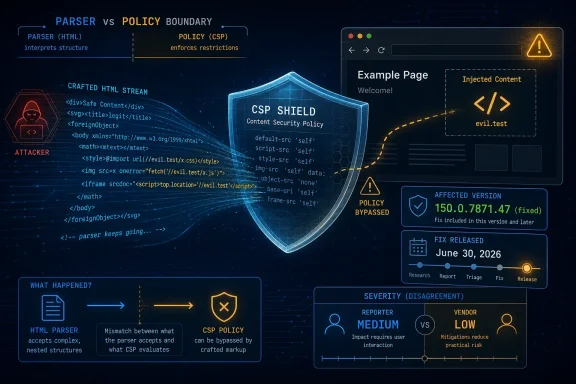 A Low-Severity Chrome Bug Still Cuts Across a High-Value Boundary
CVE-2026-14058 is not a memory corruption bug, not a sandbox escape, and not an actively exploited zero-day according to the public record available so far. It sits in a quieter category: insufficient policy enforcement in Chrome’s Parser component, resulting in a Content Security Policy bypass.That may sound narrow, but CSP is one of the web’s most important blast-radius controls. Site operators use it to restrict where scripts, frames, images, styles, and other resources may load from. It is not supposed to be a magic shield against all web attacks, but it is supposed to make many injection and content-loading failures less useful to an attacker.
A parser-level CSP bypass therefore lands in an awkward place. The bug may not let an attacker take over a machine directly, but it can weaken assumptions made by developers, defenders, and enterprise security teams. Chrome’s own severity rating of Low is understandable in isolation; CISA’s medium CVSS score better captures the uncomfortable practical reality.
The difference is not a contradiction so much as a lens problem. Browser vendors grade bugs against exploit chains and component impact. Enterprise defenders grade bugs against what breaks in their control model.
Chrome 150 Was the Real Patch Event
Google’s Chrome Releases blog tied the fix to the Stable Channel update for desktop issued on June 30, 2026. That update moved Windows and macOS builds into the 150.0.7871.46/.47 range and Linux to 150.0.7871.46, with rollout over the usual staged period. Malwarebytes and other security outlets noted the same release carried hundreds of security fixes, making CVE-2026-14058 one item in a much larger patch train.That context matters because most users should not treat this CVE as an isolated one-off decision. If Chrome is below 150.0.7871.47 on Windows or Mac, the practical answer is not to debate whether a CSP bypass deserves a special emergency window. The answer is to move to the current stable build, because the browser update contains many other fixes with broader or more severe implications.
For Windows users, the version boundary is especially clean. Chrome prior to 150.0.7871.47 is listed as affected in the NVD change history, and the CPE later added by NIST covers Google Chrome versions up to, but excluding, 150.0.7871.47. That makes compliance checking straightforward: if managed Chrome installations are still behind that line, they remain in the vulnerable range.
The bug’s public Chromium issue remains permission-restricted, which is normal for recently fixed browser vulnerabilities. Google routinely limits details until a majority of users have received the patch, precisely because parsing and policy bugs can become more useful once researchers and attackers can compare before-and-after behavior.
The Parser Is Where Web Intent Becomes Browser Behavior
The word “Parser” is easy to skip past, but it is central to why this bug is interesting. Browsers do not merely display HTML; they interpret a stream of markup, repair malformed input, build a document tree, apply policies, fetch resources, execute scripts, and reconcile decades of web compatibility rules.That machinery is hostile territory for security boundaries. Web pages are messy by design, and browsers are expected to handle documents that are malformed, nested strangely, dynamically rewritten, or generated by frameworks that treat HTML as a compilation target. A “crafted HTML page” is not exotic in that environment. It is the basic unit of attack.
A CSP bypass in parsing suggests a gap between what the browser’s policy engine believed should happen and what the parsing pipeline actually allowed to happen. Public advisories do not yet provide enough detail to say whether this involved script execution, resource loading, document structure confusion, or policy inheritance. The responsible reading is narrower: a remote attacker could cause Chrome to bypass CSP through specially constructed HTML before the fixed version.
That still matters because CSP is most useful when every layer honors it consistently. If the parser creates a path around enforcement, the policy may exist on paper while being incomplete in practice.
CSP Is a Seatbelt, Not the Brakes
Content Security Policy is often misunderstood as an exploit prevention system rather than a damage reduction system. A strong CSP can stop inline scripts, restrict third-party script sources, prevent unwanted framing, limit form submission targets, and reduce the usefulness of some cross-site scripting bugs. It can also produce reports that help developers detect policy violations.But CSP has always been dependent on exact browser behavior. A policy that works in one browser release may have edge-case differences in another. Developers must contend with legacy allowances, nonces, hashes, strict-dynamic behavior, redirects, workers, modules, and a growing list of resource types.
That is why parser enforcement matters. If a page author says “only load script from here,” but the browser’s parsing behavior permits a crafted document to route around that restriction, the site’s defensive model has been weakened. The attacker still needs a viable scenario, but one layer of the defender’s strategy has lost integrity.
This is also why “Low” can be misleading to non-specialists. The bug may not produce direct code execution. It may require a victim to open a malicious page. It may affect only certain CSP patterns. Yet the control it undermines is one that many security programs rely on to make web application bugs less catastrophic.
CISA’s Medium Score Says More About Enterprise Risk Than Browser Drama
CISA’s ADP enrichment assigned CVE-2026-14058 a CVSS 3.1 base score of 4.3, with network attack vector, low attack complexity, no privileges required, user interaction required, unchanged scope, no confidentiality impact, low integrity impact, and no availability impact. That is a sober score, not a panic score.The key field is integrity. A CSP bypass usually matters because it may let content load or execute in a way the site owner explicitly tried to prohibit. That does not necessarily expose secrets or crash systems, but it can alter page behavior, weaken anti-injection protections, or make a separate flaw more exploitable.
CISA’s SSVC data reportedly marked exploitation as “none,” automatable as “no,” and technical impact as “partial.” That combination should shape response. This is not the kind of vulnerability that justifies tearing up a weekend change calendar by itself, but it absolutely belongs in routine browser patch enforcement.
For enterprises, the risk calculation is cumulative. Chrome is not patched only because one CVE looks scary. It is patched because the browser is a fast-moving execution environment exposed to untrusted content every day. A medium-scored policy bypass becomes more important when it rides alongside hundreds of other fixes in the same stable release.
The CPE Delay Is Annoying, but Not Mysterious
The user-facing NVD page initially showed enrichment still in progress, then NIST added a CPE configuration on July 2, 2026: Google Chrome versions up to, but excluding, 150.0.7871.47. That timing is typical of modern vulnerability processing. CVEs often arrive first from the CNA, then receive CVSS, CWE, CPE, and reference enrichment in stages.The “Are we missing a CPE?” language on NVD pages is a standing invitation, not necessarily evidence that this vulnerability lacks an affected product mapping. In this case, the change history indicates that the Chrome CPE was added during NIST’s initial analysis. The relevant vulnerable software configuration is therefore present in the record as of July 2.
That matters for scanners. Many vulnerability management platforms depend on CPE mappings, vendor advisories, or both. If a scanner ingested the CVE before NIST enrichment completed, it may have temporarily lacked a clean product/version match. A later sync should correct that, but security teams should not assume all dashboards update at the same pace.
The safest operational interpretation is simple: Chrome below 150.0.7871.47 should be treated as vulnerable on platforms where that build line applies. For Chromium-based browsers, the answer depends on when each vendor imported the relevant Chromium patch.
Chromium’s Shared Codebase Makes This Bigger Than Chrome
Chrome is the named product in the CVE record, but Chromium is the upstream reality for much of the browser market. Microsoft Edge, Brave, Vivaldi, Opera, and other Chromium-derived browsers inherit large portions of the same rendering and parsing architecture, though release timing and patch status vary by vendor.That does not mean every Chromium-based browser was automatically vulnerable in exactly the same way at the same moment. Vendors may carry different branches, patches, feature flags, and release cadences. But it does mean defenders should check more than Chrome if they manage a mixed browser fleet.
Microsoft Edge administrators should verify the Edge stable version through their normal management tooling rather than assume Chrome’s version number maps directly. Edge has its own release notes, enterprise policies, and update channels. The important question is whether the Chromium patch corresponding to the fixed Chrome release has landed in the deployed Edge build.
The same logic applies to embedded Chromium runtimes. Electron apps, WebView-based applications, kiosk software, and internal tools may lag behind desktop Chrome. A low-severity parser policy bypass is less alarming in an isolated internal app than in a general-purpose browser, but stale Chromium runtimes remain a persistent blind spot in enterprise inventories.
This Is a Patch Management Story, Not a Zero-Day Story
There is no public indication from Google, NVD, or CISA that CVE-2026-14058 is being exploited in the wild. That distinction matters. Browser security coverage often collapses every new CVE into the same “update now” template, but defenders need to know the difference between active exploitation and routine hardening.The correct response is boring and disciplined. Chrome should update automatically for most consumer users. Managed environments should confirm that update policies are working, that restart prompts are not being ignored indefinitely, and that reporting tools show devices past the fixed version.
The most dangerous Chrome installations are often not the ones missing a patch for a day. They are the ones where auto-update is broken, restarts are deferred for weeks, or virtual desktop images are refreshed from stale gold masters. CVE-2026-14058 is another reminder that browser patching is only as good as the last mile.
For WindowsForum readers, that last mile is familiar. Chrome can download an update quietly, but the fixed browser may not be active until the process restarts. On shared workstations, lab machines, and remote desktops, that gap can stretch longer than administrators expect.
Developers Should Treat CSP as Defense in Depth, Not a Contract With the Universe
For web developers, this CVE should not cause a rethink of CSP. It should cause a more realistic understanding of CSP. The policy remains valuable, but it is not a substitute for eliminating injection bugs, validating data, encoding output correctly, and minimizing risky script patterns.A strong CSP can turn a serious XSS flaw into a less useful bug. It can also fail because a browser has a policy enforcement issue, because a site whitelists too many domains, because a trusted script endpoint is compromised, or because a framework requires unsafe allowances. The lesson is not that CSP is broken. The lesson is that CSP is a layer.
This is especially relevant for enterprise web apps that use CSP to compensate for legacy code. If an internal application assumes that CSP will catch dangerous markup forever, a parser bypass exposes the fragility of that assumption. The more sensitive the application, the less acceptable it is to rely on browser-side policy alone.
Security teams should also examine reporting. CSP violation reports can be noisy, but they often reveal unexpected script dependencies and attempted abuse. A policy bypass bug may not always generate the expected reports, but mature CSP deployment still gives defenders visibility they would otherwise lack.
Windows Admins Need Version Truth, Not Vulnerability Theater
The practical Windows admin workflow is refreshingly unsentimental. Open Chrome’s About page on unmanaged systems, or query version inventory through Intune, Configuration Manager, Group Policy reporting, endpoint management agents, or vulnerability scanners. Confirm that deployed Chrome builds are at or above the fixed version.The second step is to verify restart behavior. Browser updates that sit pending are a classic compliance trap. Users often keep dozens of tabs alive for days, and IT departments sometimes avoid force-restarting browsers because they do not want to interrupt work. That convenience becomes technical debt in a browser-driven workday.
The third step is to look for exceptions. Servers with Chrome installed for testing, developer workstations with multiple channels, kiosk devices, VDI images, and machines running portable or user-installed browser copies are common sources of drift. Vulnerability reports often look clean until those edge cases are inventoried.
The fourth step is to remember Edge. Windows shops that standardize on Microsoft Edge may still have Chrome installed for compatibility or user preference. Conversely, Chrome-centric shops may forget that Edge’s Chromium base needs the same vigilance. Browser monocultures are rare in real environments, whatever the policy says.
The Severity Label Is Not the Decision
Chrome’s Low severity rating is useful, but it should not be treated as the whole answer. Vendor severity usually reflects the direct impact of the vulnerability as understood by the browser team. Enterprise severity must account for exposure, asset value, compensating controls, and how the bug could compose with other weaknesses.A CSP bypass can be low severity in a vacuum and still meaningful in a chain. Imagine a web app with a minor injection sink that is considered low risk because CSP blocks script execution. If the browser’s parser allows a bypass for a crafted document pattern, the original app bug may become more interesting. That is how web security often fails: not through one spectacular mistake, but through several “not critical” assumptions lining up.
This does not mean teams should inflate every low Chrome CVE into a crisis. Alert fatigue is real, and security programs lose credibility when every advisory is treated as catastrophic. The right lesson is prioritization with context.
CVE-2026-14058 deserves routine acceleration, not theatrical emergency response. Patch it because Chrome 150 fixed it, because the update includes many other security fixes, and because browsers are too exposed to let policy bypasses linger.
The Fixed Version Is the Only Number That Really Matters
The public record around CVE-2026-14058 gives defenders a clean threshold. Google Chrome prior to 150.0.7871.47 is affected. Google’s June 30 stable update contains the fix. NVD published the CVE on June 30 and last modified it on July 2 after adding affected configuration data.That is enough to act. The restricted Chromium issue may eventually reveal more technical detail, but waiting for exploit mechanics is the wrong instinct for a browser vulnerability. By the time details are public, attackers and researchers have the same diff to study.
For home users, the fix path is simple: update Chrome and relaunch it. For managed Windows environments, the fix path is verification: make sure update policies are functioning, make sure users cannot defer restarts indefinitely, and make sure inventory reflects actual running versions.
The most important number is not the CVSS score. It is 150.0.7871.47.
Chrome’s Parser Bug Leaves a Short Checklist for a Long Tail
CVE-2026-14058 is small enough to manage without drama, but broad enough to expose weak browser governance. The useful response is not alarm; it is closure.- Google fixed CVE-2026-14058 in Chrome 150.0.7871.47 after disclosing the Parser-related Content Security Policy bypass on June 30, 2026.
- NIST added the Chrome CPE range on July 2, marking versions before 150.0.7871.47 as vulnerable.
- CISA’s enrichment scored the flaw as CVSS 4.3 medium, with user interaction required and partial technical impact.
- Public advisories do not indicate known exploitation in the wild, so the bug should be handled as routine browser patch enforcement rather than a zero-day incident.
- Administrators should verify not only Chrome updates, but also Chromium-based browsers and embedded runtimes that may lag behind upstream fixes.
- Developers should keep using CSP, but should treat it as defense in depth rather than a replacement for fixing injection and content-handling flaws.
References
- Primary source: NVD / Chromium
Published: 2026-07-03T07:00:42-07:00
NVD - CVE-2026-14058
 nvd.nist.gov
- Security advisory: MSRC
Published: 2026-07-03T07:00:42-07:00
Original feed URL
Security Update Guide - Microsoft Security Response Center
 msrc.microsoft.com
- Related coverage: cvefeed.io
CVE-2026-14058 - Google Chrome Content Security Policy Bypass
Insufficient policy enforcement in Parser in Google Chrome prior to 150.0.7871.47 allowed a remote attacker to bypass content security policy via a crafted HTML page. (Chromium security severity: Low)cvefeed.io - Related coverage: encyb.com
