

Microsoft disclosed CVE-2026-48569 on June 9, 2026, as an Important Visual Studio Code security feature bypass vulnerability caused by improper input validation, allowing an unauthorized attacker to bypass a security feature locally, with no public exploitation or prior disclosure reported at publication time. The awkward phrase “security feature bypass” can make a bug sound less urgent than remote code execution, but that is exactly why this one deserves attention. VS Code is not merely an editor on many Windows systems; it is the front door to source code, secrets, terminals, extensions, containers, and cloud credentials. A local bypass in that environment is a reminder that developer tooling now sits inside the enterprise attack surface, not beside it.
Visual Studio Code’s success has always rested on a useful contradiction: it feels lightweight, but it reaches deeply into almost everything a developer touches. It opens untrusted repositories, launches terminals, loads extensions, renders previews, syncs settings, authenticates to GitHub and Azure, and often runs with access to secrets that would make a production server blush.
That makes any VS Code security bypass more interesting than the words first suggest. A bypass does not necessarily give an attacker a shell by itself, and Microsoft has not said this CVE is being exploited in the wild. But a bypass can weaken the very warning, restriction, or trust mechanism that keeps a hostile workspace from becoming an incident.
The official description is terse: improper input validation allows an unauthorized attacker to bypass a security feature locally. The bug is rated Important, and third-party vulnerability trackers list it in the medium-to-high band, with a CVSS base score reported around 7.1 by SANS Internet Storm Center and 6.3 by VulDB. Those numbers are not identical, but they point in the same direction: this is not a theoretical footnote, and it is not the top emergency on the June calendar either.
The more useful framing is practical. If your organization treats VS Code as a benign productivity tool rather than a privileged development environment, CVE-2026-48569 is another data point arguing that the model is obsolete.
That restraint is visible here. The public language confirms the vulnerability class and local attack shape, but it does not spell out the exact VS Code feature being bypassed. There is no public proof-of-concept attached to the advisory, and as of the June 9 disclosure, the bug was not marked as publicly disclosed or actively exploited.
That absence should temper panic, not action. A bug can be worth patching quickly without being worth declaring a fire drill. In fact, most enterprise patch management lives in that middle space: not every Important vulnerability is an emergency, but every unpatched developer workstation is a tempting place to wait for the next chain.
The user-supplied metric text about confidence is useful here because it points to an under-discussed part of vulnerability triage. Confidence is not the same as severity. In this case, Microsoft’s acknowledgement gives administrators high confidence that the issue exists, while the lack of technical detail limits confidence about how easily it can be weaponized in real environments.
That creates a familiar asymmetry. Defenders must patch based on incomplete information, while attackers can spend time diffing changes, testing edge cases, and probing the feature area once updates ship. When a vendor fixes a bug in widely deployed developer tooling, the patch itself can become a map.
Developers routinely import local attacker-controlled content by design. A cloned repository, downloaded sample project, malicious extension, poisoned dependency, crafted workspace file, or compromised internal template can all cross the boundary from “remote source” to “local material” in seconds. The adversary does not always need to sit at the keyboard; they need to place content where the developer will open it.
VS Code is particularly exposed to that workflow because it is built around trust transitions. Opening a folder is not a passive act. Depending on configuration and extensions, the editor may inspect files, load workspace settings, render previews, activate language services, prompt for tasks, or expose integrated terminal workflows.
Microsoft’s description does not confirm that CVE-2026-48569 involves any one of those mechanisms. But the broader lesson does not depend on guessing the exact component. A local security feature bypass in an editor used to open semi-trusted code should be treated as a developer workstation risk, not as a narrow desktop nuisance.
This is where the term unauthorized attacker becomes important. It suggests the attacker does not need legitimate user privileges in the application context to benefit from the bypass, even if the exploitation path is local. For administrators, that is enough to move the issue out of the “ignore until next quarter” pile.
Workspace Trust is a sensible answer to a difficult problem. It lets users treat unknown folders differently from trusted ones, restricting certain behaviors until a project is approved. But trust systems are only as strong as the validation paths around them, and bypass vulnerabilities tend to live in those seams.
The phrase “improper input validation” is broad enough to cover many sins. It may mean malformed metadata, unexpected file paths, ambiguous encodings, unsafe parameters, or a logic path that accepts something it should reject. In security feature bypass cases, the dangerous part is not always that the input crashes software; it is that the input looks acceptable to the guardrail while meaning something else to the component behind it.
That class of bug is especially painful in developer tools because developers work with adversarial input as a normal part of the job. Security researchers open malware samples. Maintainers review pull requests from strangers. Enterprise developers inspect third-party code. Students and hobbyists clone whatever a tutorial tells them to clone.
A trust prompt cannot carry all of that risk. If the validation layer makes a mistake, the prompt may never appear, the restriction may not apply, or a protected path may be reached through an alternate form. CVE-2026-48569 appears to sit in precisely that conceptual neighborhood, even though Microsoft has not publicly published the full route through the product.
That is the operational danger. Patch Tuesday prioritization often starts with critical remote code execution, known exploitation, internet exposure, and domain infrastructure. That ordering is rational. It is also biased toward servers and Windows components, which can leave developer tools lagging behind even when they are sitting on crown-jewel endpoints.
A compromised developer workstation can be more valuable than a compromised random server. It may have access to source repositories, signing material, package registries, CI/CD tokens, internal documentation, cloud consoles, and production-adjacent secrets. It may also be trusted by other systems because developers are expected to push code, approve builds, and manage infrastructure.
That is why VS Code vulnerabilities deserve a different triage lens. The question is not only “Can this bug be exploited remotely?” It is “What can an attacker do if they can influence what a developer opens?” In many organizations, the answer is uncomfortable.
CVE-2026-48569 was not the only VS Code-related issue in the June batch. SANS also listed a Visual Studio Code tampering vulnerability, CVE-2026-47287, as Important. The pairing reinforces the point: the editor ecosystem has enough security-relevant behavior that it now produces enterprise patch obligations of its own.
Recent reporting has repeatedly shown how extension vulnerabilities and malicious or poorly maintained extensions can expose local files, execute commands, or undermine developer environments. Some of those problems are not Microsoft vulnerabilities at all. They are marketplace, maintainer, configuration, and user-behavior problems that happen to converge inside the editor.
That distinction matters, but it does not comfort administrators. From the user’s perspective, the attack happens “in VS Code.” From the defender’s perspective, the process tree, network traffic, credential access, and repository impact all land on the same endpoint.
Security feature bypasses are dangerous in this ecosystem because they may erode assumptions that other layers depend on. If an extension, workspace, or local workflow expects VS Code to enforce a boundary, a bypass can make otherwise tolerable behaviors risky. The vulnerability may not need to be a complete exploit kit; it may only need to remove one guardrail in a chain.
The practical response is not to ban extensions wholesale. That is fantasy in most developer organizations. The better response is to manage extensions like software supply chain components: inventory them, restrict publishers where possible, remove abandoned packages, and watch for unexpected activation or network behavior.
Organizations often have multiple VS Code footprints. Some users install the system-wide build, others the user-level build. Some use Insiders. Some run VS Code Server components through remote development workflows. Some use portable copies, dev containers, WSL integrations, or managed images that drift from the standard baseline.
That fragmentation turns a simple patch into an asset question. Do you know where VS Code is installed? Do you know which channel is running? Do you know which extensions are present? Do you know whether developers can postpone updates indefinitely? If the answers are vague, CVE-2026-48569 is less a one-off bug than a test of endpoint governance.
Windows administrators should also remember that developer machines are often exempted from controls that apply elsewhere. Developers get local admin rights. They install tooling. They test prerelease components. They disable controls that break builds. Every one of those exceptions may be justified, but together they create a softer target than the average corporate laptop.
A local bypass on a locked-down kiosk is one thing. A local bypass on a senior engineer’s workstation with repository write access and cloud credentials is another. Patch prioritization should reflect the role of the machine, not just the CVSS score.
But defenders should be careful with the word “low.” Low exploitation probability is not zero exploitation probability, and it can change once attackers inspect patches. Developer tools are attractive targets precisely because the path to initial interaction is socially and operationally plausible: “please review this repo,” “try this sample,” “open this workspace,” “test this extension,” or “look at this bug reproduction.”
The vulnerability’s classification as a security feature bypass also suggests it may be most useful when chained. Many real attacks are not single-CVE events. They are sequences: social lure, local parsing flaw, trust bypass, extension behavior, credential access, repository modification, CI/CD abuse.
That is the scenario defenders should model. Not because Microsoft has described such a chain for CVE-2026-48569, but because this is how developer workstation compromises tend to matter. The editor is rarely the final objective. It is the place where code, credentials, and trust converge.
This is also why exploit code maturity and report confidence metrics deserve attention. A confirmed vendor advisory with limited public detail is a different risk state from a vague rumor, and a different risk state again from a weaponized exploit. CVE-2026-48569 currently appears to sit in the confirmed-but-not-publicly-weaponized category, which calls for prompt patching and measured monitoring rather than theatrics.
This matters for VS Code because update adoption is uneven. Hobbyist machines may update quickly. Enterprise images may lag. Offline or semi-managed systems may sit on old versions for months. Build workstations and lab machines may be deliberately frozen to avoid disrupting toolchains.
The longer those machines remain unpatched, the more time attackers have to study the fix. Patch diffing is not magic, but it is routine. When the affected product is open source or distributed frequently, attackers can often compare changes and infer what class of input became dangerous.
That dynamic does not mean Microsoft should publish less. It means organizations should stop treating developer tooling as optional patching. If a product can open untrusted code and reach sensitive credentials, it belongs in the same operational conversation as browsers, Office, shells, and remote access tools.
There is a cultural barrier here. Developers are often trusted to manage their own tools because they are technically capable. But technical capability is not the same as fleet security. The question is not whether a developer can click Update; it is whether the organization can prove that the update happened before a bypass becomes a chain.
A mature Windows endpoint baseline should therefore include VS Code version control. This does not have to be heavy-handed. It can involve Intune or Configuration Manager detection rules, winget governance, enterprise software inventory, Defender for Endpoint hunting queries, or third-party endpoint management. The point is to make editor patch state visible.
Administrators should also revisit extension control. VS Code supports enterprise management patterns, but many organizations have not invested in them because the editor grew from individual preference rather than centralized procurement. That history now works against security teams.
There is also a secrets-management lesson. If a local editor bypass can materially increase risk because credentials are lying around in settings, terminals,
Reducing that blast radius means using short-lived credentials, least-privilege repository access, protected branches, signed commits where appropriate, secret scanning, conditional access, and alerting around unusual developer activity. Patching closes the known hole. Architecture decides how bad the next hole can be.
For users, the recommendation is refreshingly mundane. Let VS Code update, restart it, and avoid opening untrusted workspaces casually. For administrators, the job is to verify rather than assume. Check the installed versions, identify unmanaged copies, and look closely at developer machines with privileged access to repositories or deployment systems.
The June Patch Tuesday flood makes triage harder, but it also makes prioritization more important. Critical Windows server flaws may deserve the front of the line, but VS Code should not be left at the back simply because it is “just an editor.” That phrase expired years ago.
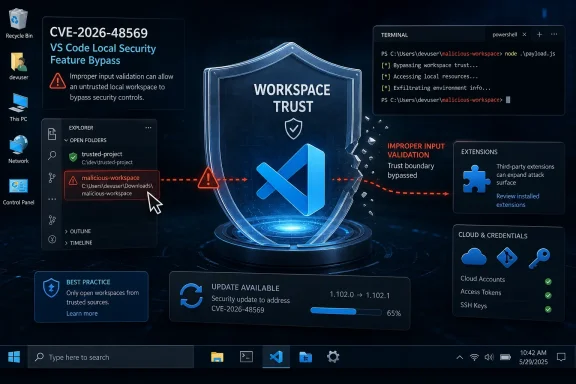 The Editor Has Become a Security Boundary
Visual Studio Code’s success has always rested on a useful contradiction: it feels lightweight, but it reaches deeply into almost everything a developer touches. It opens untrusted repositories, launches terminals, loads extensions, renders previews, syncs settings, authenticates to GitHub and Azure, and often runs with access to secrets that would make a production server blush.That makes any VS Code security bypass more interesting than the words first suggest. A bypass does not necessarily give an attacker a shell by itself, and Microsoft has not said this CVE is being exploited in the wild. But a bypass can weaken the very warning, restriction, or trust mechanism that keeps a hostile workspace from becoming an incident.
The official description is terse: improper input validation allows an unauthorized attacker to bypass a security feature locally. The bug is rated Important, and third-party vulnerability trackers list it in the medium-to-high band, with a CVSS base score reported around 7.1 by SANS Internet Storm Center and 6.3 by VulDB. Those numbers are not identical, but they point in the same direction: this is not a theoretical footnote, and it is not the top emergency on the June calendar either.
The more useful framing is practical. If your organization treats VS Code as a benign productivity tool rather than a privileged development environment, CVE-2026-48569 is another data point arguing that the model is obsolete.
Microsoft’s Sparse Advisory Says More Than It Seems
Microsoft’s Security Update Guide entries are often written for patch orchestration more than storytelling. They usually tell administrators the affected product, severity, exploitation status, and remediation path; they do not always explain the precise exploit chain, especially when extra detail would help attackers.That restraint is visible here. The public language confirms the vulnerability class and local attack shape, but it does not spell out the exact VS Code feature being bypassed. There is no public proof-of-concept attached to the advisory, and as of the June 9 disclosure, the bug was not marked as publicly disclosed or actively exploited.
That absence should temper panic, not action. A bug can be worth patching quickly without being worth declaring a fire drill. In fact, most enterprise patch management lives in that middle space: not every Important vulnerability is an emergency, but every unpatched developer workstation is a tempting place to wait for the next chain.
The user-supplied metric text about confidence is useful here because it points to an under-discussed part of vulnerability triage. Confidence is not the same as severity. In this case, Microsoft’s acknowledgement gives administrators high confidence that the issue exists, while the lack of technical detail limits confidence about how easily it can be weaponized in real environments.
That creates a familiar asymmetry. Defenders must patch based on incomplete information, while attackers can spend time diffing changes, testing edge cases, and probing the feature area once updates ship. When a vendor fixes a bug in widely deployed developer tooling, the patch itself can become a map.
The Word “Local” Should Not Be a Sedative
Many security teams instinctively downgrade local vulnerabilities because they appear to require a foothold. That instinct is understandable in server patching, where remote pre-authentication code execution can dwarf almost everything else. On developer machines, the distinction is messier.Developers routinely import local attacker-controlled content by design. A cloned repository, downloaded sample project, malicious extension, poisoned dependency, crafted workspace file, or compromised internal template can all cross the boundary from “remote source” to “local material” in seconds. The adversary does not always need to sit at the keyboard; they need to place content where the developer will open it.
VS Code is particularly exposed to that workflow because it is built around trust transitions. Opening a folder is not a passive act. Depending on configuration and extensions, the editor may inspect files, load workspace settings, render previews, activate language services, prompt for tasks, or expose integrated terminal workflows.
Microsoft’s description does not confirm that CVE-2026-48569 involves any one of those mechanisms. But the broader lesson does not depend on guessing the exact component. A local security feature bypass in an editor used to open semi-trusted code should be treated as a developer workstation risk, not as a narrow desktop nuisance.
This is where the term unauthorized attacker becomes important. It suggests the attacker does not need legitimate user privileges in the application context to benefit from the bypass, even if the exploitation path is local. For administrators, that is enough to move the issue out of the “ignore until next quarter” pile.
VS Code’s Trust Model Is Doing Too Much Work
VS Code’s Workspace Trust model was introduced because the old assumption — that a code editor merely displays files — stopped matching reality. Modern editors execute helpers, infer project structure, run build tools, load extensions, and behave more like programmable operations consoles than text boxes.Workspace Trust is a sensible answer to a difficult problem. It lets users treat unknown folders differently from trusted ones, restricting certain behaviors until a project is approved. But trust systems are only as strong as the validation paths around them, and bypass vulnerabilities tend to live in those seams.
The phrase “improper input validation” is broad enough to cover many sins. It may mean malformed metadata, unexpected file paths, ambiguous encodings, unsafe parameters, or a logic path that accepts something it should reject. In security feature bypass cases, the dangerous part is not always that the input crashes software; it is that the input looks acceptable to the guardrail while meaning something else to the component behind it.
That class of bug is especially painful in developer tools because developers work with adversarial input as a normal part of the job. Security researchers open malware samples. Maintainers review pull requests from strangers. Enterprise developers inspect third-party code. Students and hobbyists clone whatever a tutorial tells them to clone.
A trust prompt cannot carry all of that risk. If the validation layer makes a mistake, the prompt may never appear, the restriction may not apply, or a protected path may be reached through an alternate form. CVE-2026-48569 appears to sit in precisely that conceptual neighborhood, even though Microsoft has not publicly published the full route through the product.
The June Patch Tuesday Context Makes This Easy to Miss
June 2026 was not a quiet Microsoft patch cycle. SANS Internet Storm Center counted 204 Microsoft vulnerabilities addressed on June 9, including 38 considered critical, along with hundreds of Chromium issues incorporated into Edge. Against that backdrop, a single Important VS Code bypass can disappear into the spreadsheet fog.That is the operational danger. Patch Tuesday prioritization often starts with critical remote code execution, known exploitation, internet exposure, and domain infrastructure. That ordering is rational. It is also biased toward servers and Windows components, which can leave developer tools lagging behind even when they are sitting on crown-jewel endpoints.
A compromised developer workstation can be more valuable than a compromised random server. It may have access to source repositories, signing material, package registries, CI/CD tokens, internal documentation, cloud consoles, and production-adjacent secrets. It may also be trusted by other systems because developers are expected to push code, approve builds, and manage infrastructure.
That is why VS Code vulnerabilities deserve a different triage lens. The question is not only “Can this bug be exploited remotely?” It is “What can an attacker do if they can influence what a developer opens?” In many organizations, the answer is uncomfortable.
CVE-2026-48569 was not the only VS Code-related issue in the June batch. SANS also listed a Visual Studio Code tampering vulnerability, CVE-2026-47287, as Important. The pairing reinforces the point: the editor ecosystem has enough security-relevant behavior that it now produces enterprise patch obligations of its own.
Extension Sprawl Is the Multiplier Microsoft Cannot Fully Control
VS Code’s extension ecosystem is the product’s superpower and its biggest security complication. Microsoft can patch the editor, but the real deployment on a developer’s machine is a composite of Microsoft code, first-party extensions, third-party extensions, language servers, project settings, package scripts, and local tools.Recent reporting has repeatedly shown how extension vulnerabilities and malicious or poorly maintained extensions can expose local files, execute commands, or undermine developer environments. Some of those problems are not Microsoft vulnerabilities at all. They are marketplace, maintainer, configuration, and user-behavior problems that happen to converge inside the editor.
That distinction matters, but it does not comfort administrators. From the user’s perspective, the attack happens “in VS Code.” From the defender’s perspective, the process tree, network traffic, credential access, and repository impact all land on the same endpoint.
Security feature bypasses are dangerous in this ecosystem because they may erode assumptions that other layers depend on. If an extension, workspace, or local workflow expects VS Code to enforce a boundary, a bypass can make otherwise tolerable behaviors risky. The vulnerability may not need to be a complete exploit kit; it may only need to remove one guardrail in a chain.
The practical response is not to ban extensions wholesale. That is fantasy in most developer organizations. The better response is to manage extensions like software supply chain components: inventory them, restrict publishers where possible, remove abandoned packages, and watch for unexpected activation or network behavior.
The Patch Is the Easy Part; Proving Coverage Is Harder
For individual users, updating VS Code is straightforward. The editor’s update channel is built for regular releases, and many installations will prompt or update automatically. The harder problem is enterprise visibility.Organizations often have multiple VS Code footprints. Some users install the system-wide build, others the user-level build. Some use Insiders. Some run VS Code Server components through remote development workflows. Some use portable copies, dev containers, WSL integrations, or managed images that drift from the standard baseline.
That fragmentation turns a simple patch into an asset question. Do you know where VS Code is installed? Do you know which channel is running? Do you know which extensions are present? Do you know whether developers can postpone updates indefinitely? If the answers are vague, CVE-2026-48569 is less a one-off bug than a test of endpoint governance.
Windows administrators should also remember that developer machines are often exempted from controls that apply elsewhere. Developers get local admin rights. They install tooling. They test prerelease components. They disable controls that break builds. Every one of those exceptions may be justified, but together they create a softer target than the average corporate laptop.
A local bypass on a locked-down kiosk is one thing. A local bypass on a senior engineer’s workstation with repository write access and cloud credentials is another. Patch prioritization should reflect the role of the machine, not just the CVSS score.
Exploitability Is Low Today, but the Attack Surface Is Familiar
The public exploitation signal for CVE-2026-48569 is reassuring for now. Microsoft did not mark it as exploited, and public sources did not show a widely circulated proof-of-concept at disclosure time. EPSS-style predictions also appear low in early listings, which is typical for many fresh client-side or local issues before technical detail emerges.But defenders should be careful with the word “low.” Low exploitation probability is not zero exploitation probability, and it can change once attackers inspect patches. Developer tools are attractive targets precisely because the path to initial interaction is socially and operationally plausible: “please review this repo,” “try this sample,” “open this workspace,” “test this extension,” or “look at this bug reproduction.”
The vulnerability’s classification as a security feature bypass also suggests it may be most useful when chained. Many real attacks are not single-CVE events. They are sequences: social lure, local parsing flaw, trust bypass, extension behavior, credential access, repository modification, CI/CD abuse.
That is the scenario defenders should model. Not because Microsoft has described such a chain for CVE-2026-48569, but because this is how developer workstation compromises tend to matter. The editor is rarely the final objective. It is the place where code, credentials, and trust converge.
This is also why exploit code maturity and report confidence metrics deserve attention. A confirmed vendor advisory with limited public detail is a different risk state from a vague rumor, and a different risk state again from a weaponized exploit. CVE-2026-48569 currently appears to sit in the confirmed-but-not-publicly-weaponized category, which calls for prompt patching and measured monitoring rather than theatrics.
Security Feature Bypass Bugs Age Badly
Some vulnerabilities lose value quickly after patching because they require fragile timing or a narrow environmental condition. Security feature bypass bugs can age differently. If the bypass reveals a pattern in how a product validates trust, attackers may search for adjacent mistakes, variant inputs, or older installations that remain exposed.This matters for VS Code because update adoption is uneven. Hobbyist machines may update quickly. Enterprise images may lag. Offline or semi-managed systems may sit on old versions for months. Build workstations and lab machines may be deliberately frozen to avoid disrupting toolchains.
The longer those machines remain unpatched, the more time attackers have to study the fix. Patch diffing is not magic, but it is routine. When the affected product is open source or distributed frequently, attackers can often compare changes and infer what class of input became dangerous.
That dynamic does not mean Microsoft should publish less. It means organizations should stop treating developer tooling as optional patching. If a product can open untrusted code and reach sensitive credentials, it belongs in the same operational conversation as browsers, Office, shells, and remote access tools.
There is a cultural barrier here. Developers are often trusted to manage their own tools because they are technically capable. But technical capability is not the same as fleet security. The question is not whether a developer can click Update; it is whether the organization can prove that the update happened before a bypass becomes a chain.
Windows Shops Should Treat VS Code as Part of the Endpoint Baseline
The Windows angle is straightforward: VS Code is one of the most common developer applications on Windows, and it often coexists with WSL, Git, PowerShell, Node.js, Python, Docker Desktop, Azure tooling, and browser-based authentication. That combination is productive, flexible, and rich with post-compromise opportunity.A mature Windows endpoint baseline should therefore include VS Code version control. This does not have to be heavy-handed. It can involve Intune or Configuration Manager detection rules, winget governance, enterprise software inventory, Defender for Endpoint hunting queries, or third-party endpoint management. The point is to make editor patch state visible.
Administrators should also revisit extension control. VS Code supports enterprise management patterns, but many organizations have not invested in them because the editor grew from individual preference rather than centralized procurement. That history now works against security teams.
There is also a secrets-management lesson. If a local editor bypass can materially increase risk because credentials are lying around in settings, terminals,
.env files, SSH agents, and cloud CLIs, the problem is not only the CVE. It is the amount of trust concentrated on the workstation.Reducing that blast radius means using short-lived credentials, least-privilege repository access, protected branches, signed commits where appropriate, secret scanning, conditional access, and alerting around unusual developer activity. Patching closes the known hole. Architecture decides how bad the next hole can be.
The Real Signal in CVE-2026-48569 Is Developer Workstation Risk
The narrow reading of CVE-2026-48569 is simple: update Visual Studio Code and move on. The broader reading is more consequential. Microsoft’s editor is now a security boundary for a large share of the software industry, and every bypass in that boundary is a reminder that development environments need the same discipline long applied to browsers and email clients.For users, the recommendation is refreshingly mundane. Let VS Code update, restart it, and avoid opening untrusted workspaces casually. For administrators, the job is to verify rather than assume. Check the installed versions, identify unmanaged copies, and look closely at developer machines with privileged access to repositories or deployment systems.
The June Patch Tuesday flood makes triage harder, but it also makes prioritization more important. Critical Windows server flaws may deserve the front of the line, but VS Code should not be left at the back simply because it is “just an editor.” That phrase expired years ago.
The June VS Code Bypass Leaves a Short To-Do List
CVE-2026-48569 is not a reason to panic, but it is a reason to tighten a part of the Windows estate that too often escapes disciplined patching. The organizations best positioned here are not the ones with the most dramatic incident response playbooks. They are the ones that already know where their developer tools are, who controls them, and how quickly they can be updated.- Update Visual Studio Code promptly across user-level, system-level, portable, Insiders, and remote-development installations where they exist.
- Treat developer workstations with repository, signing, package-publishing, or cloud-administration access as higher-priority endpoints for this fix.
- Verify patch coverage through endpoint inventory instead of relying on developers to self-report successful updates.
- Review extension inventories and remove abandoned, unnecessary, or untrusted extensions from managed development environments.
- Keep Workspace Trust and similar safeguards enabled, but do not assume they can replace cautious handling of unknown repositories.
- Monitor for unusual developer-machine behavior after repository opens, extension activations, terminal launches, or unexpected credential access.
References
- Primary source: MSRC
Published: 2026-06-09T07:00:00-07:00
Security Update Guide - Microsoft Security Response Center
 msrc.microsoft.com
- Related coverage: datacomm.com
- Related coverage: netservicesgroup.com
CVE-2026-21518 GitHub Copilot and Visual Studio Code Security Feature Bypass Vulnerability - Network Services Group
Improper neutralization of special elements used in a command ('command injection') in GitHub Copilot and Visual Studio Code allows an unauthorized attacker to bypass a security feature over a network.www.netservicesgroup.com - Related coverage: cve.circl.lu
Vulnerability-Lookup
Vulnerability-Lookup - Fast vulnerability lookup correlation from different sources.cve.circl.lu - Official source: github.com
Security Feature Bypass Vulnerability · Advisory · microsoft/vscode · GitHub
GitHub is where people build software. More than 150 million people use GitHub to discover, fork, and contribute to over 420 million projects. github.com
- Related coverage: threats.kaspersky.com
Kaspersky Threats — KLA90875
threats.kaspersky.com
- Related coverage: itpro.com
Millions of developers could be impacted by flaws in Visual Studio Code extensions – here's what you need to know, and how to protect yourself | IT Pro
Three newly discovered flaws in Visual Studio Code (VS Code) extensions enable local file exfiltration and remote code execution, researchers have warned.www.itpro.com - Related coverage: sra.io
- Related coverage: support.bull.com
- Related coverage: buildings.honeywell.com
The purpose of this document is to identify the patches that have been delivered by Microsoft® which have been tested against Pro-Watch
PDF documentbuildings.honeywell.com
