

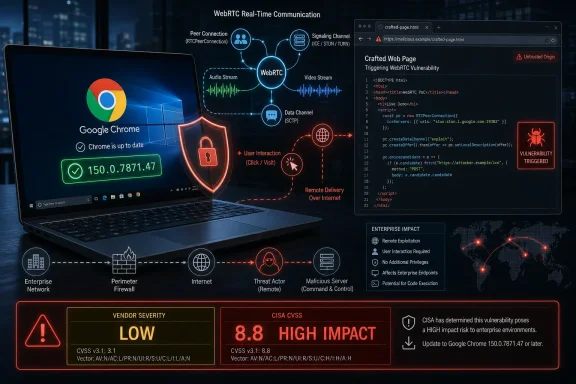
Google Chrome CVE-2026-14078 is a WebRTC input-validation flaw fixed in Chrome 150.0.7871.47, published by Chrome on June 30, 2026, and later enriched by NVD and CISA as a remotely reachable privilege-escalation issue triggered through a crafted HTML page. The uncomfortable part is not that Chrome had another WebRTC bug; it is that the public metadata around the bug tells two different risk stories at once. Google labels the Chromium severity as Low, while CISA’s ADP enrichment assigns a high CVSS 3.1 score of 8.8 with high confidentiality, integrity, and availability impact.
That split is exactly where IT teams should pay attention. Browser vulnerability management increasingly lives in the gap between vendor severity, downstream scoring, and the practical fact that a malicious web page remains one of the easiest delivery mechanisms in enterprise computing. CVE-2026-14078 may not be the loudest Chrome flaw of the summer, but it is a useful reminder that “low severity” in a browser component can still become high priority when the component is WebRTC, the trigger is HTML, and the deployment surface is every unmanaged browser tab in the company.
Google’s Chrome Releases blog announced the Stable Channel update for desktop on June 30, 2026, moving Windows and macOS to 150.0.7871.46/.47 and Linux to 150.0.7871.46. Malwarebytes, covering the same release, counted 382 security fixes in the update, which is the sort of number that makes individual CVEs blur into background noise even for teams that follow Chrome closely.
CVE-2026-14078 is one of those bugs that can disappear inside the avalanche. The NVD entry describes it plainly: insufficient validation of untrusted input in WebRTC in Google Chrome before 150.0.7871.47 allowed a remote attacker to perform privilege escalation through a crafted HTML page. The vulnerability is mapped to CWE-20, the broad but meaningful category of improper input validation.
The bug’s public Chromium issue remains permission-restricted, which is normal for fresh Chrome security fixes. Google routinely limits access to bug details until most users have received the patch, especially when the weakness touches shared Chromium code that could affect downstream browsers. That leaves defenders with metadata rather than exploit mechanics, which is frustrating but not unusual.
The immediate remediation is simple: update Chrome to 150.0.7871.47 or later on Windows and macOS, and to the corresponding patched build on other platforms. The more complicated question is how much urgency to assign when Google’s own severity field says Low while CISA’s enrichment says High.
In this case, CISA’s ADP enrichment gives the vulnerability a CVSS 3.1 vector of AV:N/AC:L/PR:N/UI:R/S:U/C:H/I:H/A:H. Translated out of scoring language, that means the attack is network-reachable, low-complexity, requires no privileges, requires user interaction, and could have high impact on confidentiality, integrity, and availability. That is a very different operational signal from the phrase “Chromium security severity: Low.”
The user-interaction requirement matters, but it should not be over-comforting. In browser security, “requires user interaction” often means the victim must visit or be directed to a crafted web page. That is not a hard bar in a world of phishing, malvertising, compromised legitimate sites, poisoned search results, and collaboration tools full of links.
At the same time, Google’s Low rating should not be ignored. It may indicate that the privilege escalation is constrained, difficult to weaponize beyond a narrow browser context, mitigated by other layers, or not equivalent to full sandbox escape. Without public technical details, the honest position is that defenders should treat the CVSS score as a deployment-priority signal and Google’s severity as a clue that this is not currently being presented as a top-tier emergency.
That is the broader lesson. Browser CVEs no longer arrive with a single clean truth attached. They arrive as a bundle of vendor language, NVD records, CISA enrichment, exploit-status fields, release cadence, and sometimes third-party reporting. Security teams have to read the bundle, not just the headline.
It also means WebRTC sits near sensitive edges of the browser. It handles media devices, network negotiation, codecs, permissions, identity assumptions, and real-time session state. A WebRTC bug does not automatically mean microphone or camera compromise, but the component’s job is inherently more privileged than rendering static HTML.
That is why input validation matters so much here. A browser is built to consume hostile input all day, but the danger rises when untrusted input crosses into complex subsystems with state machines, negotiated capabilities, and platform integration. WebRTC has to parse, validate, and act on data from pages, peers, and network paths; mistakes in those boundaries are where policy bypass and privilege escalation bugs tend to live.
The NVD wording for CVE-2026-14078 does not say the attacker needs a malicious extension, a local foothold, or a compromised renderer process. It says a remote attacker can use a crafted HTML page, with user interaction implied by CISA’s vector. That phrasing places it squarely in the category sysadmins recognize: a user browsing to the wrong page can become the first step in a compromise chain.
Still, the absence of confirmed exploitation matters. CISA’s SSVC data lists exploitation as “none,” and the vulnerability is not being described as a zero-day in the public records provided. That should reduce panic, not reduce patching.
For vulnerability scanners, CPE metadata is the bridge between a CVE and assets in inventory. If that bridge is late, incomplete, or too narrow, exposure reporting can lag behind reality. In this case, the direct affected product is Google Chrome, but the underlying code lives in Chromium’s WebRTC stack, which is why administrators naturally ask about Microsoft Edge, Brave, Vivaldi, Opera, Electron apps, embedded Chromium runtimes, and Linux distribution builds.
That does not mean every Chromium-based product is automatically vulnerable in the same way or on the same timeline. Vendors can carry patches at different speeds, disable features, backport fixes, or ship divergent branches. But from an operational standpoint, the right question is not “does the NVD page show every CPE yet?” It is “which Chromium-derived runtimes in my environment contain the affected WebRTC code path, and have they absorbed the fix?”
Microsoft Edge is the obvious WindowsForum.com concern. Edge inherits much of Chromium’s browser engine and typically tracks Chromium security fixes quickly, but Edge versioning and release notes need to be checked separately rather than inferred from Chrome’s build number. Enterprise admins using Edge Stable or Extended Stable should verify the installed Edge build and Microsoft’s release notes before closing the ticket.
The same goes for third-party browsers and desktop applications built on Chromium frameworks. Vulnerability management programs often have clean visibility into Chrome and Edge, then poor visibility into embedded browser controls, unmanaged portable browsers, and developer tools that bundle Chromium. CVE-2026-14078 may be “a Chrome CVE” in the database, but Chromium security work rarely stays neatly inside one product name.
Chrome can download updates quietly, but vulnerable code may remain in use until the browser restarts. On shared workstations, kiosks, call-center desktops, and machines with weeks-long uptime, “updated” can be a more slippery state than dashboards imply. The browser may have the patch staged while the old executable continues serving tabs.
This is why mature endpoint programs increasingly treat browser restarts as a security control, not a user-experience annoyance. A policy that installs updates within hours but allows indefinite relaunch deferral is only half a control. CVE-2026-14078 is not currently known to be exploited, but the same mechanics apply when the next Chrome WebRTC, V8, GPU, or sandbox bug is.
There is also a calendar problem. Google’s June 30 release arrived after earlier June Chrome updates that included other high-impact flaws, and Malwarebytes’ coverage of the 150 release emphasized the sheer scale of fixes. For administrators, the browser patch cycle now resembles a rolling operating-system patch cycle, except the attack surface is exposed every time a user opens a link.
That changes the old desktop-management rhythm. Monthly patch windows are too slow for modern browsers. The realistic posture is continuous browser updating with staged rings, crash monitoring, rapid rollback plans, and enforced restart deadlines measured in days or hours depending on exploit status.
That is not comforting. The browser is the universal document viewer, application runtime, meeting client, identity portal, password-manager front end, admin console, and SaaS shell. A vulnerability triggered by a crafted HTML page sits exactly where users are trained to spend their day.
The risk is sharper in organizations that allow broad WebRTC use. Browser-based meeting platforms, customer-support screen-share tools, voice applications, and internal media workflows create a reason for users to grant or tolerate real-time communication features. Even if CVE-2026-14078 does not directly imply camera or microphone theft, a flaw in the subsystem behind those workflows deserves more attention than a cosmetic UI bug.
Admins should also think about isolation. Chrome’s sandbox, site isolation, permission prompts, enterprise policies, and endpoint controls all reduce the blast radius of browser bugs. But privilege escalation language is a warning that a flaw may help an attacker cross a boundary that defenders rely on.
That boundary might not be the operating-system boundary. It could be a browser policy boundary, a WebRTC permission boundary, or a privilege distinction inside the renderer or browser process architecture. Without public technical details, defenders should avoid inventing a precise exploit chain, but they should also avoid downgrading the issue merely because the vendor severity says Low.
Browsers punish that habit. A single Chrome release can include memory-safety bugs, UI spoofing flaws, policy bypasses, extension issues, media bugs, and WebRTC problems at once. Some are individually modest, but together they represent a fast-moving attack surface that cannot be managed by waiting for perfect exploit intelligence.
The better operational unit is the browser build, not the CVE. If Chrome 150.0.7871.47 fixes CVE-2026-14078 plus hundreds of other issues, then the deployment objective should be to get to the fixed build, not to debate whether this one WebRTC CVE deserves emergency status in isolation. That is especially true when public details are intentionally withheld.
This is also why asset teams should resist false precision. A scanner that flags CVE-2026-14078 because Chrome is at 150.0.7871.46 on one machine and not another is useful, but the larger question is whether the update pipeline reliably converges. A healthy browser-patching program should make this CVE disappear quickly across the fleet without a special war room.
For consumers and enthusiasts, the advice is even simpler. If Chrome says it needs a relaunch, relaunch it. If a Chromium-based browser lags behind upstream security fixes, consider whether convenience is worth the delay.
WebView2 deserves particular attention because it is easy to forget. Many enterprise apps use Microsoft’s WebView2 runtime to render web content inside desktop software. It follows Microsoft’s servicing model, not Google Chrome’s visible update UI, so a Chrome update does not automatically prove every embedded web surface is current.
Electron is messier. Applications such as collaboration tools, developer utilities, chat clients, note apps, and internal line-of-business software may carry their own Chromium versions. Some update aggressively; others lag badly. If a vulnerable WebRTC code path is present and reachable inside such an app, the exposure may not show up under the neat label “Google Chrome.”
That does not mean every Windows admin needs to launch a full emergency audit for CVE-2026-14078 specifically. The public record does not show exploitation in the wild, and Chrome’s own severity is Low. But it does mean this CVE should reinforce a broader inventory task: know where Chromium exists, not just where Chrome is installed.
For organizations with application control, the answer may be policy. Restrict unapproved browsers, monitor versions of approved ones, update WebView2 through standard channels, and pressure vendors that ship stale Chromium in desktop apps. For organizations without that control, browser CVEs will keep surfacing as unpleasant surprises in vulnerability reports.
During that window, tools may disagree. One scanner may show no score, another may ingest CISA’s 8.8, another may wait for NVD, and another may key off vendor severity. Security teams that treat scanner output as absolute truth will see inconsistency; teams that understand the enrichment pipeline will see normal motion.
The absence of an NVD score at publication time does not mean the vulnerability is unimportant. NVD assessment frequently lags initial CVE publication, and third-party enrichment can appear earlier. Conversely, a high CISA-ADP CVSS score does not automatically mean the bug is being exploited or deserves the same response as a confirmed zero-day.
SSVC helps here because it separates exploitation status from technical impact. For CVE-2026-14078, CISA’s SSVC fields indicate no known exploitation, no automatable exploitation, and total technical impact. That combination says “patch promptly because the potential impact is high, but do not behave as if widespread active exploitation has been confirmed.”
This distinction is exactly what browser patching policy should encode. Known exploited Chrome zero-days deserve immediate interruption. High-impact but not-known-exploited flaws deserve rapid scheduled enforcement. Low-impact cosmetic fixes can ride normal update rings. CVE-2026-14078 sits in the middle: not panic, but not procrastination.
CVE-2026-14078 appears to be a policy-bypass or privilege-escalation flaw rooted in insufficient input validation, which is the kind of bug that undermines those boundaries quietly. It does not need the drama of remote code execution to matter. If a crafted page can cause the browser to treat untrusted input as more authoritative than it should, a security promise has already bent.
The frustrating part is that defenders cannot yet inspect the exact failure. Google’s restricted issue limits premature exploit replication but also leaves administrators reading tea leaves from severity labels and vectors. That trade-off is defensible, but it makes timely patching more important because compensating controls cannot be tailored to details that are not public.
There is a cultural lesson for users too. Browser permission prompts, site settings, and suspicious links are not separate topics from CVEs; they are part of the same trust system. A WebRTC vulnerability triggered through HTML has a better chance of becoming useful to an attacker when users are habituated to granting access, ignoring relaunch prompts, and treating every web app as equally trustworthy.
The concrete response is straightforward:
That split is exactly where IT teams should pay attention. Browser vulnerability management increasingly lives in the gap between vendor severity, downstream scoring, and the practical fact that a malicious web page remains one of the easiest delivery mechanisms in enterprise computing. CVE-2026-14078 may not be the loudest Chrome flaw of the summer, but it is a useful reminder that “low severity” in a browser component can still become high priority when the component is WebRTC, the trigger is HTML, and the deployment surface is every unmanaged browser tab in the company.
 Chrome’s Quiet WebRTC Fix Lands Inside a Noisy Security Release
Google’s Chrome Releases blog announced the Stable Channel update for desktop on June 30, 2026, moving Windows and macOS to 150.0.7871.46/.47 and Linux to 150.0.7871.46. Malwarebytes, covering the same release, counted 382 security fixes in the update, which is the sort of number that makes individual CVEs blur into background noise even for teams that follow Chrome closely.CVE-2026-14078 is one of those bugs that can disappear inside the avalanche. The NVD entry describes it plainly: insufficient validation of untrusted input in WebRTC in Google Chrome before 150.0.7871.47 allowed a remote attacker to perform privilege escalation through a crafted HTML page. The vulnerability is mapped to CWE-20, the broad but meaningful category of improper input validation.
The bug’s public Chromium issue remains permission-restricted, which is normal for fresh Chrome security fixes. Google routinely limits access to bug details until most users have received the patch, especially when the weakness touches shared Chromium code that could affect downstream browsers. That leaves defenders with metadata rather than exploit mechanics, which is frustrating but not unusual.
The immediate remediation is simple: update Chrome to 150.0.7871.47 or later on Windows and macOS, and to the corresponding patched build on other platforms. The more complicated question is how much urgency to assign when Google’s own severity field says Low while CISA’s enrichment says High.
The Severity Split Is the Story, Not a Clerical Error
The apparent contradiction around CVE-2026-14078 is not just a database oddity. Chrome’s internal severity rating reflects Google’s assessment inside Chromium’s security model, while CVSS attempts to score potential impact in a standardized way across products. Those systems are related, but they are not interchangeable.In this case, CISA’s ADP enrichment gives the vulnerability a CVSS 3.1 vector of AV:N/AC:L/PR:N/UI:R/S:U/C:H/I:H/A:H. Translated out of scoring language, that means the attack is network-reachable, low-complexity, requires no privileges, requires user interaction, and could have high impact on confidentiality, integrity, and availability. That is a very different operational signal from the phrase “Chromium security severity: Low.”
The user-interaction requirement matters, but it should not be over-comforting. In browser security, “requires user interaction” often means the victim must visit or be directed to a crafted web page. That is not a hard bar in a world of phishing, malvertising, compromised legitimate sites, poisoned search results, and collaboration tools full of links.
At the same time, Google’s Low rating should not be ignored. It may indicate that the privilege escalation is constrained, difficult to weaponize beyond a narrow browser context, mitigated by other layers, or not equivalent to full sandbox escape. Without public technical details, the honest position is that defenders should treat the CVSS score as a deployment-priority signal and Google’s severity as a clue that this is not currently being presented as a top-tier emergency.
That is the broader lesson. Browser CVEs no longer arrive with a single clean truth attached. They arrive as a bundle of vendor language, NVD records, CISA enrichment, exploit-status fields, release cadence, and sometimes third-party reporting. Security teams have to read the bundle, not just the headline.
WebRTC Makes “Just a Web Page” a More Complicated Threat Model
WebRTC is one of the browser’s most powerful convenience layers. It enables real-time audio, video, and peer-to-peer data communications in web applications without forcing users into a separate native client. That makes it indispensable for meetings, support tools, telehealth portals, browser-based call centers, gaming, remote collaboration, and a long tail of internal web apps.It also means WebRTC sits near sensitive edges of the browser. It handles media devices, network negotiation, codecs, permissions, identity assumptions, and real-time session state. A WebRTC bug does not automatically mean microphone or camera compromise, but the component’s job is inherently more privileged than rendering static HTML.
That is why input validation matters so much here. A browser is built to consume hostile input all day, but the danger rises when untrusted input crosses into complex subsystems with state machines, negotiated capabilities, and platform integration. WebRTC has to parse, validate, and act on data from pages, peers, and network paths; mistakes in those boundaries are where policy bypass and privilege escalation bugs tend to live.
The NVD wording for CVE-2026-14078 does not say the attacker needs a malicious extension, a local foothold, or a compromised renderer process. It says a remote attacker can use a crafted HTML page, with user interaction implied by CISA’s vector. That phrasing places it squarely in the category sysadmins recognize: a user browsing to the wrong page can become the first step in a compromise chain.
Still, the absence of confirmed exploitation matters. CISA’s SSVC data lists exploitation as “none,” and the vulnerability is not being described as a zero-day in the public records provided. That should reduce panic, not reduce patching.
The CPE Question Is Really About Inventory, Not Just NVD Hygiene
The NVD change history says NIST added a CPE configuration for Google Chrome versions up to, but excluding, 150.0.7871.47. The user-facing “Are we missing a CPE?” prompt on NVD pages often appears while affected-product metadata is still settling, and it should not be read as proof that Chrome is the only Chromium-family browser anyone needs to think about.For vulnerability scanners, CPE metadata is the bridge between a CVE and assets in inventory. If that bridge is late, incomplete, or too narrow, exposure reporting can lag behind reality. In this case, the direct affected product is Google Chrome, but the underlying code lives in Chromium’s WebRTC stack, which is why administrators naturally ask about Microsoft Edge, Brave, Vivaldi, Opera, Electron apps, embedded Chromium runtimes, and Linux distribution builds.
That does not mean every Chromium-based product is automatically vulnerable in the same way or on the same timeline. Vendors can carry patches at different speeds, disable features, backport fixes, or ship divergent branches. But from an operational standpoint, the right question is not “does the NVD page show every CPE yet?” It is “which Chromium-derived runtimes in my environment contain the affected WebRTC code path, and have they absorbed the fix?”
Microsoft Edge is the obvious WindowsForum.com concern. Edge inherits much of Chromium’s browser engine and typically tracks Chromium security fixes quickly, but Edge versioning and release notes need to be checked separately rather than inferred from Chrome’s build number. Enterprise admins using Edge Stable or Extended Stable should verify the installed Edge build and Microsoft’s release notes before closing the ticket.
The same goes for third-party browsers and desktop applications built on Chromium frameworks. Vulnerability management programs often have clean visibility into Chrome and Edge, then poor visibility into embedded browser controls, unmanaged portable browsers, and developer tools that bundle Chromium. CVE-2026-14078 may be “a Chrome CVE” in the database, but Chromium security work rarely stays neatly inside one product name.
Patch Cadence Has Become the Browser’s Real Security Boundary
The practical fix for CVE-2026-14078 is not exotic. Chrome users should open the About Chrome page or rely on managed update policies to reach 150.0.7871.47 or later, then relaunch the browser. In managed Windows environments, that last step remains the part that breaks the illusion of automatic safety.Chrome can download updates quietly, but vulnerable code may remain in use until the browser restarts. On shared workstations, kiosks, call-center desktops, and machines with weeks-long uptime, “updated” can be a more slippery state than dashboards imply. The browser may have the patch staged while the old executable continues serving tabs.
This is why mature endpoint programs increasingly treat browser restarts as a security control, not a user-experience annoyance. A policy that installs updates within hours but allows indefinite relaunch deferral is only half a control. CVE-2026-14078 is not currently known to be exploited, but the same mechanics apply when the next Chrome WebRTC, V8, GPU, or sandbox bug is.
There is also a calendar problem. Google’s June 30 release arrived after earlier June Chrome updates that included other high-impact flaws, and Malwarebytes’ coverage of the 150 release emphasized the sheer scale of fixes. For administrators, the browser patch cycle now resembles a rolling operating-system patch cycle, except the attack surface is exposed every time a user opens a link.
That changes the old desktop-management rhythm. Monthly patch windows are too slow for modern browsers. The realistic posture is continuous browser updating with staged rings, crash monitoring, rapid rollback plans, and enforced restart deadlines measured in days or hours depending on exploit status.
Enterprise Risk Starts With the User Interaction Clause
CISA’s vector says user interaction is required. In a spreadsheet, that can look like mitigation. In the real world, it means the attacker has to get someone to load a page.That is not comforting. The browser is the universal document viewer, application runtime, meeting client, identity portal, password-manager front end, admin console, and SaaS shell. A vulnerability triggered by a crafted HTML page sits exactly where users are trained to spend their day.
The risk is sharper in organizations that allow broad WebRTC use. Browser-based meeting platforms, customer-support screen-share tools, voice applications, and internal media workflows create a reason for users to grant or tolerate real-time communication features. Even if CVE-2026-14078 does not directly imply camera or microphone theft, a flaw in the subsystem behind those workflows deserves more attention than a cosmetic UI bug.
Admins should also think about isolation. Chrome’s sandbox, site isolation, permission prompts, enterprise policies, and endpoint controls all reduce the blast radius of browser bugs. But privilege escalation language is a warning that a flaw may help an attacker cross a boundary that defenders rely on.
That boundary might not be the operating-system boundary. It could be a browser policy boundary, a WebRTC permission boundary, or a privilege distinction inside the renderer or browser process architecture. Without public technical details, defenders should avoid inventing a precise exploit chain, but they should also avoid downgrading the issue merely because the vendor severity says Low.
The June 30 Release Shows Why Single-CVE Triage Is Failing
CVE-2026-14078 did not ship alone. The Chrome 150 stable update was part of a large security train, and public reporting by Malwarebytes described hundreds of fixes in the release. That matters because enterprise triage often tries to elevate one CVE at a time: the zero-day, the critical, the known exploited, the one in the scanner report with the highest score.Browsers punish that habit. A single Chrome release can include memory-safety bugs, UI spoofing flaws, policy bypasses, extension issues, media bugs, and WebRTC problems at once. Some are individually modest, but together they represent a fast-moving attack surface that cannot be managed by waiting for perfect exploit intelligence.
The better operational unit is the browser build, not the CVE. If Chrome 150.0.7871.47 fixes CVE-2026-14078 plus hundreds of other issues, then the deployment objective should be to get to the fixed build, not to debate whether this one WebRTC CVE deserves emergency status in isolation. That is especially true when public details are intentionally withheld.
This is also why asset teams should resist false precision. A scanner that flags CVE-2026-14078 because Chrome is at 150.0.7871.46 on one machine and not another is useful, but the larger question is whether the update pipeline reliably converges. A healthy browser-patching program should make this CVE disappear quickly across the fleet without a special war room.
For consumers and enthusiasts, the advice is even simpler. If Chrome says it needs a relaunch, relaunch it. If a Chromium-based browser lags behind upstream security fixes, consider whether convenience is worth the delay.
Windows Admins Need to Look Past the Chrome Icon
On Windows endpoints, Chrome is rarely alone. Edge is present by default, WebView2 powers many Windows desktop applications, Electron apps bundle Chromium components, and users may install alternative Chromium-based browsers for workarounds, testing, or personal preference. A Chrome CVE can therefore become an inventory exercise across multiple product families.WebView2 deserves particular attention because it is easy to forget. Many enterprise apps use Microsoft’s WebView2 runtime to render web content inside desktop software. It follows Microsoft’s servicing model, not Google Chrome’s visible update UI, so a Chrome update does not automatically prove every embedded web surface is current.
Electron is messier. Applications such as collaboration tools, developer utilities, chat clients, note apps, and internal line-of-business software may carry their own Chromium versions. Some update aggressively; others lag badly. If a vulnerable WebRTC code path is present and reachable inside such an app, the exposure may not show up under the neat label “Google Chrome.”
That does not mean every Windows admin needs to launch a full emergency audit for CVE-2026-14078 specifically. The public record does not show exploitation in the wild, and Chrome’s own severity is Low. But it does mean this CVE should reinforce a broader inventory task: know where Chromium exists, not just where Chrome is installed.
For organizations with application control, the answer may be policy. Restrict unapproved browsers, monitor versions of approved ones, update WebView2 through standard channels, and pressure vendors that ship stale Chromium in desktop apps. For organizations without that control, browser CVEs will keep surfacing as unpleasant surprises in vulnerability reports.
NVD Lag and CISA Enrichment Are Now Part of the Patch Story
The CVE timeline for CVE-2026-14078 is instructive. Chrome submitted the CVE on June 30, 2026. CISA-ADP added CVSS, CWE, and SSVC data on July 1. NIST’s initial analysis added the CPE configuration and references later that day, and CISA modified SSVC timestamp metadata on July 2. That is a fast but still multi-stage enrichment process.During that window, tools may disagree. One scanner may show no score, another may ingest CISA’s 8.8, another may wait for NVD, and another may key off vendor severity. Security teams that treat scanner output as absolute truth will see inconsistency; teams that understand the enrichment pipeline will see normal motion.
The absence of an NVD score at publication time does not mean the vulnerability is unimportant. NVD assessment frequently lags initial CVE publication, and third-party enrichment can appear earlier. Conversely, a high CISA-ADP CVSS score does not automatically mean the bug is being exploited or deserves the same response as a confirmed zero-day.
SSVC helps here because it separates exploitation status from technical impact. For CVE-2026-14078, CISA’s SSVC fields indicate no known exploitation, no automatable exploitation, and total technical impact. That combination says “patch promptly because the potential impact is high, but do not behave as if widespread active exploitation has been confirmed.”
This distinction is exactly what browser patching policy should encode. Known exploited Chrome zero-days deserve immediate interruption. High-impact but not-known-exploited flaws deserve rapid scheduled enforcement. Low-impact cosmetic fixes can ride normal update rings. CVE-2026-14078 sits in the middle: not panic, but not procrastination.
The WebRTC Bug Is a Small Case Study in Browser Trust
Every browser security bug is, in some sense, a trust failure. Users trust the browser to safely render hostile content. Enterprises trust it to enforce policy. Developers trust powerful APIs like WebRTC to expose modern capabilities without turning every page into a native attack surface.CVE-2026-14078 appears to be a policy-bypass or privilege-escalation flaw rooted in insufficient input validation, which is the kind of bug that undermines those boundaries quietly. It does not need the drama of remote code execution to matter. If a crafted page can cause the browser to treat untrusted input as more authoritative than it should, a security promise has already bent.
The frustrating part is that defenders cannot yet inspect the exact failure. Google’s restricted issue limits premature exploit replication but also leaves administrators reading tea leaves from severity labels and vectors. That trade-off is defensible, but it makes timely patching more important because compensating controls cannot be tailored to details that are not public.
There is a cultural lesson for users too. Browser permission prompts, site settings, and suspicious links are not separate topics from CVEs; they are part of the same trust system. A WebRTC vulnerability triggered through HTML has a better chance of becoming useful to an attacker when users are habituated to granting access, ignoring relaunch prompts, and treating every web app as equally trustworthy.
The Chrome 150.0.7871.47 Fix Should Close the Ticket, Not the Lesson
CVE-2026-14078 is not, on the public evidence available now, a Chrome apocalypse. It is a patched WebRTC input-validation flaw with no known exploitation listed by CISA’s SSVC data and a Chromium severity of Low. But the CISA-ADP CVSS vector assigns high impact, and the attack path described by NVD is the one defenders least enjoy: a remote attacker, a crafted HTML page, and a user interaction requirement that maps cleanly onto normal browsing.The concrete response is straightforward:
- Chrome installations should be updated to 150.0.7871.47 or later on Windows and macOS, with relaunch enforcement rather than passive update staging.
- Linux, Android, ChromeOS, and downstream Chromium-based browsers should be checked against their own vendor release channels rather than assumed safe from Chrome’s version number.
- Microsoft Edge, WebView2, Electron applications, and alternative Chromium browsers should be included in inventory reviews because Chromium exposure is broader than the Chrome desktop icon.
- Vulnerability teams should expect temporary disagreement among NVD, CISA, vendor severity, and scanner output during the first days after publication.
- The absence of known exploitation should lower panic, but it should not justify waiting through a monthly patch cycle for a browser flaw reachable through web content.
References
- Primary source: NVD / Chromium
Published: 2026-07-03T07:00:03-07:00
NVD - CVE-2026-14078
 nvd.nist.gov
- Security advisory: MSRC
Published: 2026-07-03T07:00:03-07:00
Original feed URL
Security Update Guide - Microsoft Security Response Center
 msrc.microsoft.com
- Related coverage: cvefeed.io
CVE-2026-14078 - Chrome WebRTC Privilege Escalation
Insufficient validation of untrusted input in WebRTC in Google Chrome prior to 150.0.7871.47 allowed a remote attacker to perform privilege escalation via a crafted HTML page. (Chromium security severity: Low)cvefeed.io
