

Google Chrome on macOS before version 150.0.7871.47 is affected by CVE-2026-14101. The flaw could allow a sandbox escape through crafted HTML, but the published description requires that Chrome’s renderer process already be compromised. Mac users should update, relaunch Chrome, and verify that the browser reports version 150.0.7871.47 or later.
Chromium rates the issue Low, while NIST NVD and CISA-ADP assign it a 9.6 CRITICAL CVSS 3.1 score. The direct conclusion is straightforward: patch promptly, but do not characterize this as a publicly documented standalone drive-by Mac takeover.
CVE-2026-14101 is described as insufficient policy enforcement in the Chrome sandbox on Mac. According to the NVD entry, a remote attacker could potentially escape the sandbox through crafted HTML after compromising Chrome’s renderer process.
That prerequisite defines the responsible way to communicate the issue. “Sandbox escape” identifies a failure of a security boundary, but “after compromising the renderer process” means the flaw is not publicly described as the initial compromise. The supplied record does not identify the renderer vulnerability or other technique that would provide the first stage of a complete attack chain.
The distinctive issue for security teams is the mismatch between the published severity assessments:
The public evidence establishes that these assessments differ, but it does not fully explain the reasoning behind Chromium’s Low designation or each metric selected for the CVSS score. The CVSS vector and score can be reported as published without turning them into a speculative account of how a real-world exploit would operate.
In particular, the score does not remove the renderer-compromise prerequisite. The record does not establish that CVE-2026-14101 independently compromises the renderer, supplies code execution, or provides every step from visiting a page to taking control of a Mac.
At the same time, Chromium’s Low rating does not remove the affected-version boundary. A sandbox enforcement flaw can remain operationally relevant even when it depends on an earlier stage of compromise.
This WindowsForum feature is a triage guide for security teams dealing with conflicting vendor and CVSS severity labels, anchored to the version boundary and the renderer-compromise prerequisite.
A remote attacker who had already compromised Chrome’s renderer process could potentially use crafted HTML to escape the Chrome sandbox on affected Mac versions.
This formulation preserves the material elements of the record:
The linked Chromium issue is access-restricted. That prevents independent review of implementation details that may be recorded there, but the restricted status should not be treated as evidence of what the issue contains or why access is limited.
NVD and CISA-ADP publish the following CVSS 3.1 vector:
The resulting published base score is 9.6, categorized as CRITICAL. Because the supplied evidence does not include a metric-by-metric rationale, the vector should be reported without attributing an unverified exploitation narrative to the assessors.
The CISA Coordinator’s SSVC assessment provides separate decision context:
NIST associates the vulnerability with CWE-269, Improper Privilege Management, while CISA-ADP associates it with CWE-693, Protection Mechanism Failure. These are two analytical classifications of the same CVE, not evidence of two separate flaws. Neither classification reveals the missing implementation detail from the restricted Chromium issue.
Based on that record, the CVE is not documented here as affecting Chrome on Windows or Linux. Findings for those platforms require separate product-specific evidence before they are treated as confirmed exposure to CVE-2026-14101.
The same caution applies to other Chromium-based browsers. Shared Chromium code does not, by itself, prove that another browser shipped the affected component, used the same sandbox policy, or shares Chrome’s version boundary. Administrators should use advisories from the vendor responsible for each browser rather than automatically assigning the Chrome CVE to every Chromium-derived product.
The normalization fields for triage are:
For example, a scanner may identify “Chromium,” omit the operating system, report an enterprise package version instead of the browser’s displayed version, or retain information collected before an update. Those conditions call for normalization and verification, not an absolute declaration that the finding is valid or invalid.
Those additions enrich the record without removing the original prerequisite. Later scoring and classification data should therefore be read alongside the statement that successful use of the sandbox escape requires an already-compromised renderer.
The Chrome release page is identified in the supplied material as a vendor advisory and release-notes reference. Without additional verified text from that page, it should not be used to make detailed claims about enterprise rollout timing, endpoint-management behavior, restart enforcement, or update-channel availability.
Google Chrome Help documents Chrome menu > About Google Chrome as the common desktop path for checking the installed version and applying an available Chrome update, followed by relaunching when prompted. The exact experience may vary on managed Macs, where organizational policy or administrative tooling can control how updates are delivered.
A practical user procedure is:
The verified result is the important part. Merely opening the update page or initiating a check does not establish that the running browser has crossed the documented version boundary.
Scanner prioritization should begin with four checks:
Confirmed affected installations warrant prompt remediation. The renderer-compromise prerequisite, the supplied SSVC finding of no observed exploitation, and the “not automatable” value provide context for scheduling and communications. They do not justify leaving known affected installations below the version boundary indefinitely.
Internal advisories should avoid claiming that every vulnerable Mac is compromised or that ordinary HTML alone provides a complete system takeover. They should also avoid dismissing the issue solely because Chromium labels it Low. A concise internal description could read:
Security communications should therefore distinguish between potential impact and documented exploitability. The 9.6 CVSS score records a critical base-score assessment. The Chrome description records a prerequisite. The SSVC data records no observed exploitation, no automation, and total technical impact. Each item addresses a different part of the risk picture.
The most defensible operational position is to remediate confirmed exposure while keeping the description proportional to the available evidence.
The response can remain evidence-based:
Chromium rates the issue Low, while NIST NVD and CISA-ADP assign it a 9.6 CRITICAL CVSS 3.1 score. The direct conclusion is straightforward: patch promptly, but do not characterize this as a publicly documented standalone drive-by Mac takeover.
Operational summary
Scope: Google Chrome on macOS before version 150.0.7871.47.
Risk context: A potential sandbox escape after compromise of the renderer process.
Action: Update Chrome, relaunch it, and confirm that the displayed or inventoried version is 150.0.7871.47 or later.
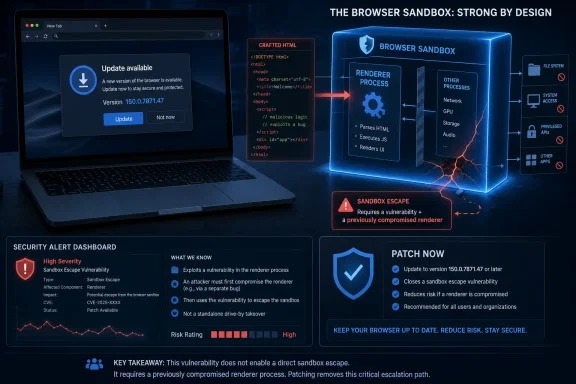 One Vulnerability, Two Very Different Severity Labels
CVE-2026-14101 is described as insufficient policy enforcement in the Chrome sandbox on Mac. According to the NVD entry, a remote attacker could potentially escape the sandbox through crafted HTML after compromising Chrome’s renderer process.That prerequisite defines the responsible way to communicate the issue. “Sandbox escape” identifies a failure of a security boundary, but “after compromising the renderer process” means the flaw is not publicly described as the initial compromise. The supplied record does not identify the renderer vulnerability or other technique that would provide the first stage of a complete attack chain.
The distinctive issue for security teams is the mismatch between the published severity assessments:
| Assessment source | Framework | Published result | Relevant context |
|---|---|---|---|
| Chromium | Internal severity | Low | The vulnerability description includes an already-compromised-renderer prerequisite |
| NIST NVD | CVSS 3.1 | 9.6 CRITICAL | Publishes AV:N/AC:L/PR:N/UI:R/S:C/C:H/I:H/A:H |
| CISA-ADP | CVSS 3.1 | 9.6 CRITICAL | Publishes the same CVSS 3.1 vector and score |
| CISA Coordinator | SSVC 2.0.3 | No exploitation observed | Records automatable as no and technical impact as total |
| NIST NVD | CVSS 4.0 | Not assessed | No CVSS 4.0 assessment appears in the supplied record |
In particular, the score does not remove the renderer-compromise prerequisite. The record does not establish that CVE-2026-14101 independently compromises the renderer, supplies code execution, or provides every step from visiting a page to taking control of a Mac.
At the same time, Chromium’s Low rating does not remove the affected-version boundary. A sandbox enforcement flaw can remain operationally relevant even when it depends on an earlier stage of compromise.
This WindowsForum feature is a triage guide for security teams dealing with conflicting vendor and CVSS severity labels, anchored to the version boundary and the renderer-compromise prerequisite.
What the Public Record Establishes
The narrow technical description is the most useful one:A remote attacker who had already compromised Chrome’s renderer process could potentially use crafted HTML to escape the Chrome sandbox on affected Mac versions.
This formulation preserves the material elements of the record:
- The attacker is described as remote.
- The renderer must already have been compromised.
- Crafted HTML is the reported delivery content for the sandbox-escape step.
- The reported result is a potential escape from the Chrome sandbox.
- The documented scope is Google Chrome on macOS before version 150.0.7871.47.
The linked Chromium issue is access-restricted. That prevents independent review of implementation details that may be recorded there, but the restricted status should not be treated as evidence of what the issue contains or why access is limited.
NVD and CISA-ADP publish the following CVSS 3.1 vector:
AV:N/AC:L/PR:N/UI:R/S:C/C:H/I:H/A:HThe resulting published base score is 9.6, categorized as CRITICAL. Because the supplied evidence does not include a metric-by-metric rationale, the vector should be reported without attributing an unverified exploitation narrative to the assessors.
The CISA Coordinator’s SSVC assessment provides separate decision context:
- Exploitation: None
- Automatable: No
- Technical impact: Total
NIST associates the vulnerability with CWE-269, Improper Privilege Management, while CISA-ADP associates it with CWE-693, Protection Mechanism Failure. These are two analytical classifications of the same CVE, not evidence of two separate flaws. Neither classification reveals the missing implementation detail from the restricted Chromium issue.
Scope and Version Boundaries Matter More Than the Badge
The documented affected configuration pairs Google Chrome with Apple macOS. Chrome versions earlier than 150.0.7871.47 fall within the supplied affected range.Based on that record, the CVE is not documented here as affecting Chrome on Windows or Linux. Findings for those platforms require separate product-specific evidence before they are treated as confirmed exposure to CVE-2026-14101.
The same caution applies to other Chromium-based browsers. Shared Chromium code does not, by itself, prove that another browser shipped the affected component, used the same sandbox policy, or shares Chrome’s version boundary. Administrators should use advisories from the vendor responsible for each browser rather than automatically assigning the Chrome CVE to every Chromium-derived product.
The normalization fields for triage are:
- CVE: CVE-2026-14101
- Product: Google Chrome
- Platform: macOS
- Affected range: Versions earlier than 150.0.7871.47
- Remediation target: Version 150.0.7871.47 or later
- Exploit prerequisite: Prior compromise of the Chrome renderer process
For example, a scanner may identify “Chromium,” omit the operating system, report an enterprise package version instead of the browser’s displayed version, or retain information collected before an update. Those conditions call for normalization and verification, not an absolute declaration that the finding is valid or invalid.
The Public-Record Timeline
The supplied record provides exact dates for the vulnerability’s public analysis:- June 30, 2026: NVD published the CVE record.
- July 1, 2026: CISA-ADP modified its assessment.
- July 2, 2026: NIST performed its initial analysis.
Those additions enrich the record without removing the original prerequisite. Later scoring and classification data should therefore be read alongside the statement that successful use of the sandbox escape requires an already-compromised renderer.
The Chrome release page is identified in the supplied material as a vendor advisory and release-notes reference. Without additional verified text from that page, it should not be used to make detailed claims about enterprise rollout timing, endpoint-management behavior, restart enforcement, or update-channel availability.
What to Do
For Mac users
The remediation target is Chrome version 150.0.7871.47 or later.Google Chrome Help documents Chrome menu > About Google Chrome as the common desktop path for checking the installed version and applying an available Chrome update, followed by relaunching when prompted. The exact experience may vary on managed Macs, where organizational policy or administrative tooling can control how updates are delivered.
A practical user procedure is:
- Open Google Chrome on the Mac.
- Open the Chrome menu and select About Google Chrome.
- Allow the browser to perform its available update check.
- Follow any displayed update instructions.
- Relaunch Chrome if prompted.
- Return to About Google Chrome and verify that the browser reports version 150.0.7871.47 or later.
The verified result is the important part. Merely opening the update page or initiating a check does not establish that the running browser has crossed the documented version boundary.
For security and IT administrators
Administrators should focus on validated product, platform, and version data:- Identify managed macOS systems.
- Determine which systems have Google Chrome installed.
- Collect the installed or running Chrome version.
- Review systems reporting versions earlier than 150.0.7871.47.
- Use the organization’s approved update process to move affected installations to version 150.0.7871.47 or later.
- Re-query or otherwise verify the resulting browser version.
- Investigate devices with missing, stale, malformed, or conflicting inventory data.
- Validate findings for other operating systems or Chromium-based products against product-specific advisories.
- Record exceptions for systems that cannot immediately cross the version boundary.
- Monitor the official Chrome, NVD, and CISA records for changes in scope or exploitation status.
Scanner prioritization should begin with four checks:
- Does the asset run macOS?
- Is the identified product Google Chrome?
- Does the reported version normalize to a version earlier than 150.0.7871.47?
- Is the inventory sufficiently current and complete to support that conclusion?
Confirmed affected installations warrant prompt remediation. The renderer-compromise prerequisite, the supplied SSVC finding of no observed exploitation, and the “not automatable” value provide context for scheduling and communications. They do not justify leaving known affected installations below the version boundary indefinitely.
Internal advisories should avoid claiming that every vulnerable Mac is compromised or that ordinary HTML alone provides a complete system takeover. They should also avoid dismissing the issue solely because Chromium labels it Low. A concise internal description could read:
CVE-2026-14101 affects Google Chrome on macOS before version 150.0.7871.47. It is a potential sandbox escape that requires prior compromise of Chrome’s renderer process. Update affected installations and verify that Chrome reports version 150.0.7871.47 or later.
Exploitation and Claims to Avoid
The supplied SSVC assessment records no observed exploitation. The available public material also does not identify:- A malicious campaign using CVE-2026-14101
- A publicly affected organization
- A public proof of concept
- A circulating exploit kit
- A complete exploit chain
- The renderer vulnerability needed for the prerequisite compromise
- Evidence that CVE-2026-14101 itself compromises the renderer
- A confirmed standalone path from visiting a page to taking control of macOS
Security communications should therefore distinguish between potential impact and documented exploitability. The 9.6 CVSS score records a critical base-score assessment. The Chrome description records a prerequisite. The SSVC data records no observed exploitation, no automation, and total technical impact. Each item addresses a different part of the risk picture.
The most defensible operational position is to remediate confirmed exposure while keeping the description proportional to the available evidence.
A Version-Based Response Is Available
CVE-2026-14101 presents an unusual but manageable triage problem: Chromium publishes a Low internal rating, while NVD and CISA-ADP publish a 9.6 CRITICAL CVSS 3.1 score. Security teams do not need to resolve the scoring disagreement before acting.The response can remain evidence-based:
- Limit confirmed scope to Google Chrome on macOS unless product-specific evidence expands it.
- Treat versions earlier than 150.0.7871.47 as affected under the supplied record.
- Preserve the already-compromised-renderer prerequisite in advisories and tickets.
- Update affected installations.
- Verify version 150.0.7871.47 or later after the update process is complete.
- Reassess if official records later change the scope, technical description, or exploitation status.
References
- Primary source: NVD / Chromium
Published: 2026-07-11T15:39:49-07:00
Loading…
nvd.nist.gov - Security advisory: MSRC
Published: 2026-07-11T15:39:49-07:00
Original feed URL
Loading…
msrc.microsoft.com - Related coverage: security.snyk.io
Loading…
security.snyk.io - Related coverage: cvefeed.io
Loading…
cvefeed.io