

CVE-2026-14407 is a Google Chrome V8 flaw affecting versions before 150.0.7871.46 that can allow a remote attacker to execute arbitrary code inside the browser sandbox through a crafted HTML page. Google rates the Chromium vulnerability Medium, while the CISA-ADP CVSS 3.1 assessment is 8.8 HIGH. Those labels describe different aspects of the risk, but the operational answer is straightforward: update Google Chrome to version 150.0.7871.46 or later and verify the full version after relaunching the browser.
The public description is short but consequential. An “inappropriate implementation” in V8, Chrome’s JavaScript engine, allows a remote attacker to execute arbitrary code inside a sandbox by placing crafted content in an HTML page and getting a user to load it.
That establishes several important parts of the attack model. The vulnerable surface is network-reachable, the attacker does not need existing privileges, user interaction is required, and the affected component processes active content encountered during web browsing. The supplied record does not require the attacker to have an account on the target computer or persuade an administrator to install an application.
The record identifies crafted HTML as the delivery object but does not document the precise delivery method used in testing or any known campaign. A malicious website, compromised page, embedded content, advertising route, or message link would be generic examples of how hostile web content can sometimes reach a browser; they should not be presented as confirmed delivery routes for this specific CVE.
The underlying Chromium issue is access-restricted, so the available evidence does not provide a public proof of concept, detailed root-cause analysis, or step-by-step exploitation method. What the evidence does establish is the affected component, the crafted-HTML condition, the sandboxed code-execution result, and the fixed-version boundary.
That last boundary is critical. The CVE says an attacker can execute arbitrary code inside the browser sandbox. It does not say that CVE-2026-14407 independently escapes that sandbox, gains Windows system privileges, establishes persistence, disables endpoint protections, reaches the kernel, or provides unrestricted control of the host.
The correct reading is therefore neither dismissive nor alarmist. Arbitrary code execution in a browser process is a serious security failure, but the disclosed impact must not be expanded into a confirmed Windows compromise without evidence of an additional security-boundary escape.
The public description does not identify the precise V8 mechanism involved. “Inappropriate implementation” is a broad classification, not a root-cause explanation. It does not establish whether the problem arose in optimization, compilation, object handling, memory management, runtime behavior, or another internal subsystem.
CISA-ADP associated the vulnerability with CWE-94, Improper Control of Generation of Code, and CWE-119, Improper Restriction of Operations within the Bounds of a Memory Buffer. Those mappings should be reported as analyst classifications rather than reverse-engineered into a more specific technical narrative.
In particular, the mappings do not by themselves prove the sequence of internal operations that leads to exploitation. They also do not establish a particular memory-corruption primitive, attacker-controlled instruction path, or intermediate stage. Without the restricted issue record, a more detailed technical account would be speculative.
What defenders can say confidently is that ordinary web content reaches the affected engine. Browsers routinely process input from external sites, web applications, search results, collaboration services, customer portals, and other web-connected systems. That persistent exposure is why a clear version-based fix should take priority over attempts to infer an exploit signature from the limited public description.
The available evidence supports patching the affected engine. It does not support claims that a particular filter, endpoint rule, or network control can reliably identify every page capable of triggering the flaw.
NVD displays the CISA-ADP assessment, but that does not make 8.8 an NVD-authored score. The distinction matters when vulnerability reports identify the source of a rating.
The CISA-ADP vector is AV:N/AC:L/PR:N/UI:R/S:U/C:H/I:H/A:H. It models a network-reachable vulnerability with low attack complexity, no required privileges, required user interaction, unchanged scope, and high potential effects on confidentiality, integrity, and availability within the assessed scope.
The UI:R element establishes that the CVSS assessment requires user interaction. The supplied evidence does not define the exact action used in that model, so it should not be stated categorically that merely loading the page is, by itself, the complete CVSS interaction condition. The vulnerability description separately says the attacker must get the user to load crafted HTML.
Scope: Unchanged should also be handled carefully. It means the CVSS assessment does not model the vulnerable component’s compromise as crossing into a different security authority. That may be consistent with the description of execution inside a sandbox, but it is not an independent confirmation of Chrome’s complete process or sandbox architecture.
Google’s Medium label should not be read as permission to defer remediation indefinitely. Conversely, the 8.8 score should not be presented as proof that one crafted page automatically gives an attacker complete control of Windows. The supported conclusion lies between those claims: the vulnerability can produce significant code-execution impact within the assessed browser scope, while a separate escape from that scope is not established.
For administrators, severity labels are prioritization inputs rather than substitutes for remediation. Here, the presence of a clear fixed-version threshold makes the practical decision simpler: identify Chrome installations below that threshold, deploy the corrected build, and verify the resulting version.
At the same time, sandboxed code execution should not be treated as harmless. It means the attacker may be able to move beyond supplying ordinary web input and execute code in the compromised browser context. The exact data, operations, or resources reachable from that position are not detailed in the supplied record and should not be assumed.
A browser-engine vulnerability can sometimes serve as one stage of a larger exploit chain, but CVE-2026-14407 does not establish a second-stage sandbox escape or privilege-escalation vulnerability. Any claim that the flaw provides host-level control would therefore require separate evidence.
This distinction supports a measured response. Organizations should remove the vulnerable browser build promptly, but they should not describe every affected endpoint as already compromised. The public evidence establishes a vulnerable condition and a code-execution consequence inside the sandbox, not an observed intrusion into every system running an affected version.
“Exploitation: none” means the cited assessment did not identify exploitation at the time represented by that record. It does not prove that exploitation is impossible, that no private exploit could exist, or that the status cannot change.
“Automatable: no” means the vulnerability was not categorized as readily automatable under that SSVC assessment. It should not be rewritten as a guarantee that hostile content cannot be distributed broadly or that exploitation can never be scaled.
“Technical impact: total” indicates severe potential consequences within the affected scope. That is compatible with the description of arbitrary code execution, but it does not expand the affected scope to the entire Windows host.
Taken together, these fields describe a vulnerability with serious technical impact but no exploitation identified in the supplied assessment and no indication that exploitation is readily automatable. That supports prompt, accelerated remediation through normal browser-management procedures. It does not, by itself, require an organization to declare that an active compromise is underway.
Emergency response and vulnerability remediation are related but different activities. The evidence supports closing the vulnerable version gap. Incident-response escalation should be based on actual indicators, suspicious endpoint behavior, confirmed exploitation intelligence, or other evidence beyond the existence of the CVE alone.
For vulnerability management, the minimum supported fixed threshold is therefore:
Google Chrome 150.0.7871.46 or later
The evidence supplied for this article does not establish separate Windows, macOS, and Linux build numbers beyond that fixed boundary. It also does not support claims about a particular Stable Channel promotion date or a rollout lasting a specified number of days or weeks. Those details should not be used in compliance rules without a separate vendor source.
Administrators should compare the complete Chrome version string rather than relying only on the major-version label. Reporting “Chrome 150” is not precise enough to prove that the installation has reached 150.0.7871.46.
Managed devices may use organization-controlled deployment and browser policies instead of a user-initiated update. The same evidence standard still applies: the device should report Chrome 150.0.7871.46 or later after the deployment and relaunch process has completed.
The supplied CVE record names Google Chrome. It does not establish that Microsoft Edge, Brave, Opera, Vivaldi, or every other Chromium-derived browser uses the same affected code in the same release, shares Chrome’s version numbering, or became fixed at Chrome’s threshold.
Windows administrators should therefore avoid copying
The correct workflow is:
CISA-ADP enrichment — CISA-ADP added the CVSS 3.1 vector, CWE-94 and CWE-119 classifications, and the SSVC assessment reflected in the public record.
NIST analysis — NIST added the Google Chrome affected configuration, including the fixed boundary at 150.0.7871.46, along with the associated references.
Later record maintenance — The SSVC timestamp representation was subsequently modified without changing the stated exploitation, automatable, and technical-impact selections.
This sequence preserves the useful record history without relying on unsupported release dates, publication dates, platform-specific build numbers, or rollout claims.
Organizations may have devices that are offline, infrequently connected, excluded by policy, held in test groups, restricted from update services, or missing from current inventory. Chrome may also be installed on systems where it is not the default browser, including application-compatibility workstations, test devices, shared systems, and administrator machines.
Inventory should therefore search for installed Chrome instances rather than infer exposure from the default-browser setting. The result must include the full version, device identity, inventory timestamp, and enough deployment context to distinguish a current reading from stale data.
Prioritization can account for endpoint role and browsing exposure, but those factors should not complicate the basic compliance rule. Any managed Chrome installation below 150.0.7871.46 remains within the affected range stated in the record.
Generic endpoint monitoring remains valuable. Unusual browser crashes, unexpected process activity, suspicious network connections, credential-access behavior, or persistence following a browsing event may warrant investigation. Such activity would not, on its own, prove exploitation of CVE-2026-14407.
Likewise, an absence of alerts does not prove that a vulnerable installation is safe. Detection tools may not have enough public technical detail to distinguish an attempted exploit from other browser behavior, especially when the disclosed result remains inside the browser sandbox.
Content filtering and network protections can reduce exposure to known threats, but the supplied record does not establish a domain, script pattern, network signature, or delivery infrastructure that administrators can block. Those controls should remain layered defenses rather than replacements for the fixed browser version.
Version-based remediation offers the clearest available control. The vulnerable range is known, the fixed threshold is known, and the result can be verified directly on each endpoint.
That evidence supports a disciplined response: update Chrome, relaunch it, verify the full version, investigate failed deployments, and keep product boundaries intact. The most useful security outcome is not a louder interpretation of the severity labels—it is a defensible inventory showing that no managed Google Chrome installation remains below 150.0.7871.46.
Evidence boundary: This CVE record names Google Chrome only; do not automatically apply the Chrome threshold to Edge or other Chromium browsers without that vendor’s advisory.
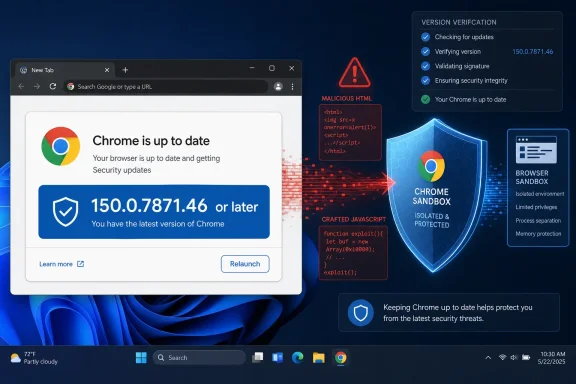 A Medium Chromium Bug With a High-Impact Shape
The public description is short but consequential. An “inappropriate implementation” in V8, Chrome’s JavaScript engine, allows a remote attacker to execute arbitrary code inside a sandbox by placing crafted content in an HTML page and getting a user to load it.That establishes several important parts of the attack model. The vulnerable surface is network-reachable, the attacker does not need existing privileges, user interaction is required, and the affected component processes active content encountered during web browsing. The supplied record does not require the attacker to have an account on the target computer or persuade an administrator to install an application.
The record identifies crafted HTML as the delivery object but does not document the precise delivery method used in testing or any known campaign. A malicious website, compromised page, embedded content, advertising route, or message link would be generic examples of how hostile web content can sometimes reach a browser; they should not be presented as confirmed delivery routes for this specific CVE.
The underlying Chromium issue is access-restricted, so the available evidence does not provide a public proof of concept, detailed root-cause analysis, or step-by-step exploitation method. What the evidence does establish is the affected component, the crafted-HTML condition, the sandboxed code-execution result, and the fixed-version boundary.
That last boundary is critical. The CVE says an attacker can execute arbitrary code inside the browser sandbox. It does not say that CVE-2026-14407 independently escapes that sandbox, gains Windows system privileges, establishes persistence, disables endpoint protections, reaches the kernel, or provides unrestricted control of the host.
The correct reading is therefore neither dismissive nor alarmist. Arbitrary code execution in a browser process is a serious security failure, but the disclosed impact must not be expanded into a confirmed Windows compromise without evidence of an additional security-boundary escape.
V8 Turns Web Content Into the Attack Surface
V8 is Chrome’s JavaScript engine and is responsible for processing code supplied by web pages. That makes it a security-sensitive component: it must handle content from untrusted or previously unknown sites while enforcing the browser’s security boundaries.The public description does not identify the precise V8 mechanism involved. “Inappropriate implementation” is a broad classification, not a root-cause explanation. It does not establish whether the problem arose in optimization, compilation, object handling, memory management, runtime behavior, or another internal subsystem.
CISA-ADP associated the vulnerability with CWE-94, Improper Control of Generation of Code, and CWE-119, Improper Restriction of Operations within the Bounds of a Memory Buffer. Those mappings should be reported as analyst classifications rather than reverse-engineered into a more specific technical narrative.
In particular, the mappings do not by themselves prove the sequence of internal operations that leads to exploitation. They also do not establish a particular memory-corruption primitive, attacker-controlled instruction path, or intermediate stage. Without the restricted issue record, a more detailed technical account would be speculative.
What defenders can say confidently is that ordinary web content reaches the affected engine. Browsers routinely process input from external sites, web applications, search results, collaboration services, customer portals, and other web-connected systems. That persistent exposure is why a clear version-based fix should take priority over attempts to infer an exploit signature from the limited public description.
The available evidence supports patching the affected engine. It does not support claims that a particular filter, endpoint rule, or network control can reliably identify every page capable of triggering the flaw.
“Medium” and 8.8 HIGH Are Measuring Different Things
The most confusing feature of CVE-2026-14407 is the apparent disagreement over severity. Google’s Chromium security classification is Medium, while the CISA-ADP CVSS 3.1 vector produces a base score of 8.8 and a HIGH rating.NVD displays the CISA-ADP assessment, but that does not make 8.8 an NVD-authored score. The distinction matters when vulnerability reports identify the source of a rating.
| Assessment origin | Method | Result | Supported interpretation |
|---|---|---|---|
| Google Chromium | Vendor security severity | Medium | Google’s product-specific severity classification |
| CISA-ADP | CVSS 3.1 | 8.8 HIGH | Standardized scoring based on the published vector |
| NIST NVD | Independent NVD CVSS assessment | Not provided in the supplied record | NVD displays the contributed CISA-ADP score but did not supply a separate score |
The UI:R element establishes that the CVSS assessment requires user interaction. The supplied evidence does not define the exact action used in that model, so it should not be stated categorically that merely loading the page is, by itself, the complete CVSS interaction condition. The vulnerability description separately says the attacker must get the user to load crafted HTML.
Scope: Unchanged should also be handled carefully. It means the CVSS assessment does not model the vulnerable component’s compromise as crossing into a different security authority. That may be consistent with the description of execution inside a sandbox, but it is not an independent confirmation of Chrome’s complete process or sandbox architecture.
Google’s Medium label should not be read as permission to defer remediation indefinitely. Conversely, the 8.8 score should not be presented as proof that one crafted page automatically gives an attacker complete control of Windows. The supported conclusion lies between those claims: the vulnerability can produce significant code-execution impact within the assessed browser scope, while a separate escape from that scope is not established.
For administrators, severity labels are prioritization inputs rather than substitutes for remediation. Here, the presence of a clear fixed-version threshold makes the practical decision simpler: identify Chrome installations below that threshold, deploy the corrected build, and verify the resulting version.
The Sandbox Limits the Disclosed Scope
The public record places the arbitrary code execution inside Chrome’s sandbox. That is materially different from confirmed code execution as the logged-in Windows user, as an administrator, or in the operating-system kernel.At the same time, sandboxed code execution should not be treated as harmless. It means the attacker may be able to move beyond supplying ordinary web input and execute code in the compromised browser context. The exact data, operations, or resources reachable from that position are not detailed in the supplied record and should not be assumed.
A browser-engine vulnerability can sometimes serve as one stage of a larger exploit chain, but CVE-2026-14407 does not establish a second-stage sandbox escape or privilege-escalation vulnerability. Any claim that the flaw provides host-level control would therefore require separate evidence.
This distinction supports a measured response. Organizations should remove the vulnerable browser build promptly, but they should not describe every affected endpoint as already compromised. The public evidence establishes a vulnerable condition and a code-execution consequence inside the sandbox, not an observed intrusion into every system running an affected version.
The Exploitation Record Supports Prompt Patching, Not Panic
CISA-ADP’s Stakeholder-Specific Vulnerability Categorization assessment lists exploitation as “none,” automatable as “no,” and technical impact as “total.”“Exploitation: none” means the cited assessment did not identify exploitation at the time represented by that record. It does not prove that exploitation is impossible, that no private exploit could exist, or that the status cannot change.
“Automatable: no” means the vulnerability was not categorized as readily automatable under that SSVC assessment. It should not be rewritten as a guarantee that hostile content cannot be distributed broadly or that exploitation can never be scaled.
“Technical impact: total” indicates severe potential consequences within the affected scope. That is compatible with the description of arbitrary code execution, but it does not expand the affected scope to the entire Windows host.
Taken together, these fields describe a vulnerability with serious technical impact but no exploitation identified in the supplied assessment and no indication that exploitation is readily automatable. That supports prompt, accelerated remediation through normal browser-management procedures. It does not, by itself, require an organization to declare that an active compromise is underway.
Emergency response and vulnerability remediation are related but different activities. The evidence supports closing the vulnerable version gap. Incident-response escalation should be based on actual indicators, suspicious endpoint behavior, confirmed exploitation intelligence, or other evidence beyond the existence of the CVE alone.
Chrome 150.0.7871.46 Is the Fixed Boundary
The affected-version rule is straightforward: Google Chrome versions before 150.0.7871.46 are affected. The supplied NVD information identifies 150.0.7871.46 as the exclusive upper boundary of the vulnerable range.For vulnerability management, the minimum supported fixed threshold is therefore:
Google Chrome 150.0.7871.46 or later
The evidence supplied for this article does not establish separate Windows, macOS, and Linux build numbers beyond that fixed boundary. It also does not support claims about a particular Stable Channel promotion date or a rollout lasting a specified number of days or weeks. Those details should not be used in compliance rules without a separate vendor source.
Administrators should compare the complete Chrome version string rather than relying only on the major-version label. Reporting “Chrome 150” is not precise enough to prove that the installation has reached 150.0.7871.46.
Exact update procedure for end users
- Open Google Chrome.
- Select the three-dot menu (⋮) in the upper-right corner.
- Select Help.
- Select About Google Chrome.
- Wait for the update check to finish.
- If Chrome presents the option, select Relaunch.
- Return to ⋮ > Help > About Google Chrome after the relaunch.
- Verify that the displayed version is 150.0.7871.46 or later.
Managed devices may use organization-controlled deployment and browser policies instead of a user-initiated update. The same evidence standard still applies: the device should report Chrome 150.0.7871.46 or later after the deployment and relaunch process has completed.
The Record Applies to Chrome, Not Every Chromium Browser by Assumption
Because V8 and other components are used throughout the Chromium ecosystem, defenders may reasonably investigate whether related browsers contain the same vulnerable code. That investigation must remain product-specific.The supplied CVE record names Google Chrome. It does not establish that Microsoft Edge, Brave, Opera, Vivaldi, or every other Chromium-derived browser uses the same affected code in the same release, shares Chrome’s version numbering, or became fixed at Chrome’s threshold.
Windows administrators should therefore avoid copying
150.0.7871.46 into compliance rules for unrelated browsers. A version that is meaningful for Chrome may have no direct operational meaning for Edge or another Chromium product.The correct workflow is:
- Apply the CVE’s affected range directly to Google Chrome.
- Inventory other Chromium-based browsers separately.
- Review each browser vendor’s advisory or release information.
- Use that vendor’s affected and fixed versions for product-specific compliance.
- Avoid marking another browser vulnerable solely because it uses Chromium or V8.
Evidence timeline
Initial CVE receipt — The Chrome CVE record was received at 7:16:49 p.m. The receipt timestamp should not be described as proof that Chrome or Google performed a particular submission action.CISA-ADP enrichment — CISA-ADP added the CVSS 3.1 vector, CWE-94 and CWE-119 classifications, and the SSVC assessment reflected in the public record.
NIST analysis — NIST added the Google Chrome affected configuration, including the fixed boundary at 150.0.7871.46, along with the associated references.
Later record maintenance — The SSVC timestamp representation was subsequently modified without changing the stated exploitation, automatable, and technical-impact selections.
This sequence preserves the useful record history without relying on unsupported release dates, publication dates, platform-specific build numbers, or rollout claims.
Enterprise Remediation Should Focus on Version Proof
For an individual user, remediation is a guided update, relaunch, and version check. In a managed Windows environment, the core problem is proving that every relevant installation reached the vendor-fixed threshold.Organizations may have devices that are offline, infrequently connected, excluded by policy, held in test groups, restricted from update services, or missing from current inventory. Chrome may also be installed on systems where it is not the default browser, including application-compatibility workstations, test devices, shared systems, and administrator machines.
Inventory should therefore search for installed Chrome instances rather than infer exposure from the default-browser setting. The result must include the full version, device identity, inventory timestamp, and enough deployment context to distinguish a current reading from stale data.
Prioritization can account for endpoint role and browsing exposure, but those factors should not complicate the basic compliance rule. Any managed Chrome installation below 150.0.7871.46 remains within the affected range stated in the record.
Compact Windows admin verification workflow
- Inventory the full Chrome version. Query managed Windows endpoints for the complete installed version rather than the major release alone.
- Identify versions below 150.0.7871.46. Treat those installations as affected under the supplied Chrome configuration.
- Deploy the vendor-fixed build. Use the organization’s approved browser-management, software-deployment, or endpoint-management process.
- Force or request a relaunch. Notify users or use approved administrative controls to complete the required browser relaunch.
- Re-query after relaunch. Collect a new version result and confirm that Chrome reports 150.0.7871.46 or later.
- Investigate exceptions. Review stale devices, failed deployments, policy conflicts, disconnected endpoints, and contradictory inventory results.
- Close only on verified evidence. Assignment status, deployment initiation, or an old inventory timestamp is not equivalent to a confirmed fixed version.
Detection Cannot Substitute for Removing the Vulnerable Build
The restricted issue and limited public technical description leave defenders without a disclosed proof of concept or CVE-specific indicators in the supplied evidence. That limits the reliability of exploit-specific hunting.Generic endpoint monitoring remains valuable. Unusual browser crashes, unexpected process activity, suspicious network connections, credential-access behavior, or persistence following a browsing event may warrant investigation. Such activity would not, on its own, prove exploitation of CVE-2026-14407.
Likewise, an absence of alerts does not prove that a vulnerable installation is safe. Detection tools may not have enough public technical detail to distinguish an attempted exploit from other browser behavior, especially when the disclosed result remains inside the browser sandbox.
Content filtering and network protections can reduce exposure to known threats, but the supplied record does not establish a domain, script pattern, network signature, or delivery infrastructure that administrators can block. Those controls should remain layered defenses rather than replacements for the fixed browser version.
Version-based remediation offers the clearest available control. The vulnerable range is known, the fixed threshold is known, and the result can be verified directly on each endpoint.
Action checklist for admins
- Inventory every managed Google Chrome installation, including systems where Chrome is not the default browser.
- Collect and compare complete version strings against 150.0.7871.46.
- Deploy Chrome 150.0.7871.46 or later through the organization’s approved update process.
- Force or request a browser relaunch after deployment.
- Re-query the complete Chrome version after relaunch.
- Treat missing, stale, or contradictory inventory data as unresolved rather than compliant.
- Investigate update-policy conflicts, deployment failures, disconnected devices, and restricted-network systems.
- Review privileged workstations, shared systems, kiosks, and heavily used browsing endpoints early in the deployment.
- Apply the Chrome threshold only to Google Chrome.
- Check Microsoft Edge and other Chromium browsers against their own vendors’ advisories and version guidance.
- Do not describe the vulnerability as a confirmed sandbox escape, Windows privilege escalation, or actively exploited zero-day without separate evidence.
- Close findings only when current endpoint evidence confirms Chrome 150.0.7871.46 or later, instead of repeatedly assigning the same update without verifying the result.
That evidence supports a disciplined response: update Chrome, relaunch it, verify the full version, investigate failed deployments, and keep product boundaries intact. The most useful security outcome is not a louder interpretation of the severity labels—it is a defensible inventory showing that no managed Google Chrome installation remains below 150.0.7871.46.
References
- Primary source: NVD / Chromium
Published: 2026-07-11T15:37:53-07:00
NVD - CVE-2026-14407
 nvd.nist.gov
- Security advisory: MSRC
Published: 2026-07-11T15:37:53-07:00
Original feed URL
Security Update Guide - Microsoft Security Response Center
 msrc.microsoft.com
- Official source: nvlpubs.nist.gov
Technical Specification for the Security Content Automation Protocol (SCAP): SCAP Version 1.4
The Security Content Automation Protocol (SCAP) is a suite of specifications that standardize the format and nomenclature by which software flaw and security configuration information is communicated, both to machines and humans. This publication, along with its annex (NIST Special Publication...nvlpubs.nist.gov
- Related coverage: labs.cloudsecurityalliance.org
CSA research note nist nvd riskbased enrichment governance 20260426 csa styled
PDF documentlabs.cloudsecurityalliance.org
