

Google’s Chrome security update to version 150.0.7871.46 fixes CVE-2026-14423, a High-severity type-confusion flaw in Tint. The public vulnerability record says a remote attacker could use a crafted HTML page to potentially escape the browser sandbox on a vulnerable installation.What changed / who is affected / what to do now
- What changed: Google fixed CVE-2026-14423, a High-severity type-confusion vulnerability in Tint that could potentially permit a sandbox escape through a crafted HTML page.
- Who is affected: Google Chrome versions earlier than 150.0.7871.46.
- What to do now: Update Chrome to 150.0.7871.46 or later, relaunch the browser, and verify the version of the running installation.
- Windows verification: Open Chrome menu > Help > About Google Chrome, allow Chrome to check for and apply the update, and then select Relaunch when prompted. After Chrome restarts, open chrome://version and confirm that the displayed version is 150.0.7871.46 or later.
The word potentially matters. The advisory does not establish that visiting a malicious page automatically compromises Windows, nor does it document a complete attack chain. It identifies a vulnerability that could potentially permit a sandbox escape, making prompt and verifiable browser updating the appropriate response without supporting claims of confirmed end-to-end machine compromise.
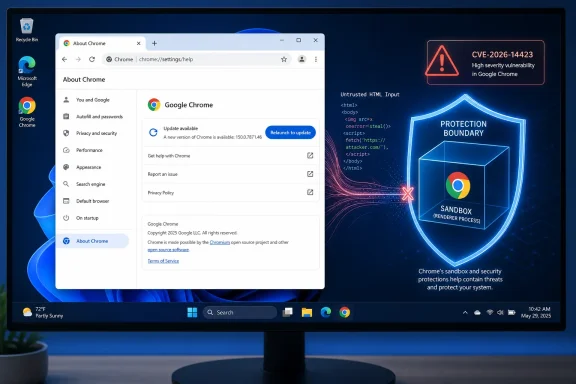 The Sandbox-Escape Wording Changes the Risk Calculation
Browser advisories frequently use similar language: remote attacker, crafted content, user interaction and memory-safety weakness. Those descriptions can begin to look interchangeable when they appear together in vulnerability-management dashboards.CVE-2026-14423 should be read more precisely. Google’s description identifies a type confusion in Tint and says exploitation could potentially enable a sandbox escape. That places an important browser security boundary within the vulnerability’s stated potential effect.
A sandbox is intended to restrict untrusted browser activity and limit the consequences of a flaw in a contained context. A potential sandbox escape threatens that containment boundary. It does not, by itself, prove that an attacker can access Windows files, credentials, processes or other resources. Those outcomes would depend on the actual exploit, the surrounding browser architecture, the operating-system environment and whether additional weaknesses or attack stages were required.
The public record does not disclose a proof of concept or explain the precise exploitation sequence. It also does not establish how reliable exploitation would be across different Windows systems. Administrators should preserve those uncertainties rather than converting the phrase sandbox escape into a claim of inevitable or complete endpoint compromise.
The confirmed conclusion is narrower but still serious: a malicious HTML page could potentially exploit a type confusion and permit escape from a Chrome sandbox on affected versions. That is sufficient reason to update quickly, particularly because web browsing routinely places users in contact with content outside an organization’s control.
What the Public Record Confirms About Tint
The weakness is categorized as CWE-843, “Access of Resource Using Incompatible Type,” commonly described as type confusion. At a general level, type confusion occurs when software accesses or interprets a resource under assumptions that do not match its actual type.The security consequences depend on the implementation and the operations performed after the mismatch. The restricted Chromium issue means the public materials do not provide enough detail to identify the vulnerable function, the relevant data structures, the resulting memory operations or the amount of control an attacker might obtain.
That lack of detail should constrain reporting. The available NVD material confirms a type confusion in Tint, but it does not establish the specific browser feature through which the vulnerability is exposed. It therefore would be premature to attribute this CVE to a particular graphics API, shading-language path or web platform feature without additional authoritative documentation directly connecting that path to CVE-2026-14423.
The reliable public description is that Chrome before 150.0.7871.46 contains a type-confusion vulnerability in Tint that a remote attacker could exploit through a crafted HTML page to potentially perform a sandbox escape.
This distinction matters operationally. Security teams need the affected product, fixed version and required remediation immediately. They do not need an unverified theory about the internal attack path presented as established fact.
“High” and “9.6 Critical” Are Different Assessments
The record contains two severity characterizations that should remain separately attributed:- Chromium classifies CVE-2026-14423 as High severity.
- CISA-ADP contributed a 9.6 Critical CVSS 3.1 assessment.
- NVD had not supplied an independent CVSS score in the material reviewed for this article.
| Assessment source | Method | Rating | Score | How to interpret it |
|---|---|---|---|---|
| Chromium | Vendor security severity | High | Not stated | Google’s product-specific classification |
| CISA-ADP | CVSS 3.1 | Critical | 9.6 | A standardized assessment of the vulnerability’s potential technical characteristics |
| NVD | Independent CVSS assessment | Not provided in the reviewed record | N/A | No separate NVD base score was available in the supplied material |
CVSS:3.1/AV:N/AC:L/PR:N/UI:R/S:C/C:H/I:H/A:H. It characterizes the vulnerability as network-reachable, requiring low attack complexity and no prior privileges, while still requiring user interaction.The scope-change metric is consistent with the possibility of crossing a security boundary. It should not be interpreted as proof that a public exploit already achieves unrestricted Windows access. CVSS describes potential technical impact under its scoring assumptions; it does not prove the existence, reliability or current use of a complete real-world exploit chain.
The high confidentiality, integrity and availability impact values are likewise worst-case scoring judgments. They do not establish that every successful trigger would produce all three effects or that those effects have been demonstrated against Windows systems.
Chromium’s severity process and CVSS also serve different purposes. A vendor rating can reflect product-specific knowledge and internal analysis, while CVSS converts selected characteristics into a standardized score. The values are related, but they are not interchangeable grades from one universal scale.
Administrators should retain both attributions in their records. The correct summary is that Chromium rated the issue High, CISA-ADP contributed a 9.6 Critical CVSS assessment, and NVD had not provided its own score in the reviewed information.
A Crafted HTML Page Still Creates a Practical Exposure Path
The CISA-ADP vector includes user interaction, and the vulnerability description identifies a crafted HTML page as the delivery mechanism. CVE-2026-14423 therefore should not be characterized as a zero-click attack against every computer merely running Chrome.User interaction, however, can be as routine as opening a link or visiting a page. The public description does not say that a victim must install an extension, download and execute a separate program, or approve an operating-system security prompt.
The advisory also does not state whether page load alone is sufficient. Additional conditions may be involved, but the restricted technical details do not establish what they are. Reports should avoid claiming either effortless exploitation or reassuring prerequisites that Google has not documented.
For defenders, the useful point is straightforward: ordinary browser use can bring an affected Chrome installation into contact with attacker-controlled HTML. That makes the browser’s running version more important than whether an update package has merely been approved or downloaded.
“No Exploitation” Is Not the Same as “No Risk”
The CISA-ADP Stakeholder-Specific Vulnerability Categorization information in the reviewed record listed exploitation as none, automatable as no, and technical impact as total.Those fields support a measured conclusion.
First, the record does not identify active exploitation. CVE-2026-14423 should not be called an exploited zero-day or associated with an active campaign unless new, authoritative evidence supports that description.
Second, an exploitation value of none is an assessment status, not a guarantee that exploitation is impossible or will never occur. Vulnerability intelligence can change as vendors, researchers and defenders obtain additional evidence.
Third, automatable: no does not mean that an attacker could never deliver malicious pages to multiple users. It reflects CISA-ADP’s SSVC classification rather than a promise that the vulnerability cannot be incorporated into a broader campaign.
Finally, technical impact: total describes potential consequence within the assessment framework. It does not prove that a publicly available exploit can achieve complete control of a Windows device.
The defensible operational message is therefore:
The reviewed record did not identify exploitation, but the potential boundary-crossing consequence and available 9.6 CISA-ADP assessment support prompt remediation.
That phrasing avoids both extremes. It does not turn a severe technical assessment into an unsupported breach warning, and it does not treat the absence of identified exploitation as a reason to leave vulnerable browsers in service.
The Fixed-Version Boundary Is Clear
The affected range is Google Chrome earlier than 150.0.7871.46. Version 150.0.7871.46 is the fixed boundary identified in the public record.Administrators should configure vulnerability detections and remediation reports around that simple comparison:
| Running Chrome version | Status for CVE-2026-14423 | Required action |
|---|---|---|
| Earlier than 150.0.7871.46 | Affected | Update, relaunch and verify |
| 150.0.7871.46 | Fixed boundary | Verify that this is the running version |
| Later than 150.0.7871.46 | Outside the stated affected range | Confirm inventory accuracy and normal update health |
| Version unavailable or uncertain | Compliance cannot be established | Inspect the browser directly |
150.0.7871.46 in an affected-version object as proof that the boundary itself is vulnerable.The operational test is whether the Chrome version actually in use is earlier than the fixed boundary. Scanner logic should flag builds below 150.0.7871.46 and should not mark 150.0.7871.46 as affected merely because that number appears as a range delimiter.
Inventory can also be incomplete or delayed. If a management dashboard and the browser disagree, inspect Chrome itself before closing the remediation ticket.
Concrete Windows verification
- Open Google Chrome.
- Select the three-dot Chrome menu.
- Select Help.
- Select About Google Chrome.
- Allow the browser to check for and apply an available update.
- Select Relaunch when Chrome presents that option.
- After Chrome reopens, enter chrome://version in the address bar.
- Confirm that the displayed Google Chrome version is 150.0.7871.46 or later.
- If Chrome still reports an earlier version, treat the device as affected and investigate why updating did not complete.
Windows Fleets Need Verifiable Remediation
A deployment status such as approved, available, downloaded or installed is not, on its own, the same as confirmation that the user is running the fixed Chrome version.Enterprise teams should verify the result in two ways:
- Confirm that inventory reports Chrome 150.0.7871.46 or later.
- Confirm on representative or exceptional endpoints that the browser’s own version display reports the same fixed or later build after relaunch.
Organizations with virtual desktops, shared systems, kiosks, templates or reset-to-baseline devices should check whether their normal provisioning process preserves the fixed version. Whether a particular platform requires a base-image update, a recompose operation or another maintenance step depends on that environment. The required security outcome is that newly presented sessions do not return users to Chrome earlier than 150.0.7871.46.
Likewise, administrators should not assume that every Chrome installation on a Windows endpoint is represented by a single inventory entry. Where reports remain inconsistent, confirm which Chrome executable the user actually launches and inspect its version directly.
Deployment rings can remain useful for compatibility validation, but the observation period should be proportionate to the vulnerability’s exposure and potential effect. Organizations can test the fixed build against representative business applications while keeping the path to broad deployment short.
After the main rollout, attention should shift to exceptions. Offline laptops, laboratory systems, kiosks, rarely connected devices, unmanaged departmental machines and specialized endpoints may remain below the fixed boundary even when the overall compliance percentage appears high.
Action checklist for administrators
- [ ] Identify Windows endpoints running Google Chrome.
- [ ] Flag every reported Chrome version earlier than 150.0.7871.46.
- [ ] Update affected installations to 150.0.7871.46 or later.
- [ ] Relaunch Chrome after the update.
- [ ] Verify chrome://version reports 150.0.7871.46 or later.
- [ ] Investigate devices whose reported version does not change after updating.
- [ ] Check shared, kiosk, virtual, templated and reset-to-baseline environments for version persistence.
- [ ] Reconcile duplicate, missing or conflicting browser inventory records.
- [ ] Re-scan the fleet after remediation and focus follow-up work on remaining exceptions.
- [ ] Keep detection logic aligned to earlier than 150.0.7871.46, excluding the fixed boundary.
- [ ] Review relevant security telemetry without claiming exploitation unless supporting evidence exists.
- [ ] Record Chromium’s High rating, CISA-ADP’s 9.6 Critical contribution and the absence of an independent NVD score as distinct facts.
Downstream Chromium browser note
This CVE record confirms Google Chrome and establishes Chrome’s fixed boundary at 150.0.7871.46. Do not apply that version number to Microsoft Edge or another Chromium-derived browser. Check each downstream vendor’s own advisory and fixed-version guidance before declaring that product affected or remediated.
Chrome’s Version Number Does Not Apply to Every Chromium Browser
Because Chrome is based on Chromium and the affected component is identified as Tint, administrators may reasonably investigate whether downstream Chromium-based browsers also require action. That investigation must remain vendor-specific.The reviewed record names Google Chrome as the affected product. It does not establish fixed versions for Microsoft Edge, Brave, Opera, Vivaldi or other Chromium-derived software.
Those products use different release numbers and may adopt upstream changes on different schedules. They may also differ in component integration, feature exposure and product configuration. Chrome’s 150.0.7871.46 boundary therefore cannot be copied into a detection rule for another browser.
This is as much a data-quality issue as a technical one. Declaring every Chromium-derived product vulnerable without vendor confirmation can generate false positives. Conversely, marking every Chromium browser safe because Chrome has been updated can leave separate products unexamined.
The disciplined approach is to maintain a product-specific inventory and consult the advisory supplied by each browser vendor. If another vendor maps CVE-2026-14423 to its product, use that vendor’s affected and fixed versions.
The confirmed statement remains deliberately narrow: Google Chrome earlier than 150.0.7871.46 is affected by the range described in this CVE record.
Restricted Technical Details Limit Both Claims and Conclusions
The Chromium issue associated with CVE-2026-14423 is restricted, leaving the public record with a component name, weakness classification, affected range and high-level potential effect.That is enough information to remediate. It is not enough to reconstruct the vulnerable code path or make definitive claims about exploit reliability, required environmental conditions, affected subsystems or post-exploitation access.
The absence of public technical detail should not be filled with speculation. In particular, the reviewed facts do not support asserting that this CVE reaches Chrome through a specific web graphics feature. They also do not support claims about whether Google received the report internally, whether a reward was paid, or why a reward may not have been listed.
Restricted details also mean administrators should resist attempts to turn the CVSS impact fields into a narrative of demonstrated Windows compromise. A potential sandbox escape is serious, but the public description stops short of establishing what an attacker could reliably do after crossing that boundary.
The useful response does not depend on those unknowns. Defenders already have the information necessary to act:
- The affected product is Google Chrome.
- The vulnerable range is earlier than 150.0.7871.46.
- The weakness is a type confusion in Tint.
- A crafted HTML page is the stated delivery object.
- The potential effect is a sandbox escape.
- The remediation is to update, relaunch and verify.
Vulnerability-record sequence
- Chrome supplied the core description, affected product, fixed-version boundary, weakness classification and references.
- CISA-ADP contributed a CVSS 3.1 score of 9.6 and SSVC assessment fields.
- NIST added standardized analysis and product-range information.
- Later metadata changes did not, in the reviewed material, establish active exploitation or alter the fundamental remediation boundary.
The important attribution must remain visible. The 9.6 score came from CISA-ADP; it was not an independent NVD score.
The Right Response Is Fast, Measured and Verifiable
CVE-2026-14423 does not justify unsupported claims that Chrome users are under active attack or that one malicious page necessarily provides complete access to a Windows system. The reviewed record does not identify active exploitation, and the public materials do not document a complete exploit chain.It also does not justify delay. Google has identified a High-severity type confusion that could potentially permit a sandbox escape, and CISA-ADP has contributed a 9.6 Critical CVSS assessment. A fixed Chrome version is available, and the remediation procedure is direct.
Windows administrators should update Chrome to 150.0.7871.46 or later, relaunch it, and confirm the result through chrome://version. Fleet-level reports should then be reconciled against direct checks on systems that remain uncertain or below the threshold.
The next phase is exception management rather than speculation: find browsers that did not update, determine which installation users actually launch, verify that shared or resettable environments retain the fixed build, and keep downstream Chromium products tied to their own vendors’ advisories.
Future intelligence may clarify the vulnerable code path, exploit prerequisites or downstream product exposure. If authoritative reporting later identifies exploitation, detection opportunities or revised affected ranges, organizations can update their response accordingly.
For now, the defensible position is both urgent and precise: Chrome earlier than 150.0.7871.46 is affected; update to 150.0.7871.46 or later, relaunch the browser, and verify the running version.
References
- Primary source: NVD / Chromium
Published: 2026-07-11T15:38:10-07:00
NVD - CVE-2026-14423
 nvd.nist.gov
- Security advisory: MSRC
Published: 2026-07-11T15:38:10-07:00
Original feed URL
Security Update Guide - Microsoft Security Response Center
 msrc.microsoft.com
- Related coverage: thehackerwire.com
Chrome V8 Type Confusion: Sandbox RCE via Crafted HTML – TheHackerWire
SummaryCVE-2026-14431 describes a high-severity Type Confusion vulnerability (CVSS 8.8) affecting the V8 JavaScript engine in Google Chrome. Published on Jul...www.thehackerwire.com
- Related coverage: yazoul.net
Chrome sandbox escape via type confusion (CVE-2026-6301)
CVE-2026-6301 type confusion in Chrome V8 Turbofan grants unauthenticated RCE with sandbox escape. Update to Chrome 147.0.7727.101+ immediately. www.yazoul.net
- Related coverage: blog.chromium.org
Chromium Blog: Security in Depth: HTML5’s @sandbox
With the latest release of Google Chrome, Chrome is the first browser to include support for a new HTML5 feature that lets web developers r...blog.chromium.org
- Related coverage: chromium.googlesource.com
- Related coverage: chromium.org
