CVE-2026-1502 is a medium-severity CPython vulnerability published in April 2026 in which Python’s HTTP client proxy tunneling code failed to reject carriage-return and line-feed characters in tunnel host and header values. The bug matters less because it is spectacular and more because it sits in the plumbing: proxy negotiation, CONNECT tunnels, and standard-library code many developers assume is already boringly safe. For Windows admins and developers, the practical question is not whether every Python script is suddenly exposed, but whether any internal tooling, agents, automation, or services let untrusted input reach Python’s proxy-tunnel setup path.
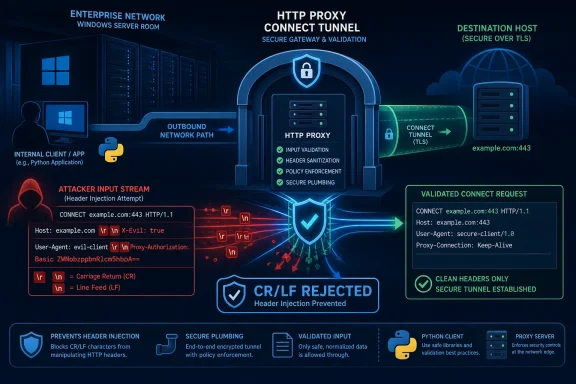
The shortest version of CVE-2026-1502 is almost comically old-fashioned: CR/LF characters were not being rejected where they should have been. In HTTP, carriage return and line feed are not decorative whitespace. They are delimiters that mark the end of a header line, and mishandling them is how one logical field can become two protocol-level fields.
That makes this a classic header injection problem. If an application builds a proxy tunnel request from data that an attacker can influence, and the HTTP client does not reject embedded line breaks, the attacker may be able to smuggle additional headers into the CONNECT request sent to the proxy. That is not the same thing as remote code execution, and it is not a universal break-glass compromise of Python. But it is also not harmless, because proxies are often enforcement points for authentication, routing, logging, egress policy, and access control.
The affected area is CPython’s standard library HTTP client behavior around proxy tunneling. The public issue described the failing plainly: HTTP proxy CONNECT tunneling did not sanitize CR/LF and should validate input passed through
The interesting part is not that Python had a missing validation check. Every mature platform still accumulates these. The interesting part is where the bug lives: not in a fashionable framework, not in an abandoned plugin, but in the language runtime’s batteries-included networking stack. That is why a “medium” CVE deserves more attention than its score might suggest.
That distinction matters for remediation. Windows Update is not necessarily going to fix every Python interpreter on a workstation or server, because Python may have arrived through the Microsoft Store, winget, Visual Studio Build Tools, an embedded application, a virtual environment, a container image, a vendor bundle, or a manually installed python.org package. On Windows fleets, Python is often less a single installed product than a small ecosystem of copies.
This is where many organizations get caught. They have rigorous patch accounting for Windows cumulative updates, Edge, Office, Defender, and .NET, but Python lives in developer directories, CI runners, appliance-like third-party software, security tools, and automation agents. A standard-library CVE cuts across those boundaries because the vulnerable code may be present wherever that interpreter was copied.
The Microsoft listing still has value. MSRC’s cataloging puts the CVE into the security-update bloodstream that many enterprise teams already monitor. But the operational answer is not “install this month’s Windows patches and move on.” The answer is to inventory Python runtimes and determine which ones are exposed through code paths that use HTTP proxy tunneling.
In ordinary HTTP header construction, accepting a raw newline from user-controlled input is dangerous because it lets data escape its intended field. The receiving component may treat what follows as a separate header, a separate request component, or a confusing hybrid that upstream and downstream systems interpret differently. These are the ingredients behind response splitting, cache poisoning, request smuggling, policy bypasses, and logging deception.
Proxy tunneling narrows the issue but does not neutralize it. A CONNECT request is the mechanism by which an HTTP client asks a proxy to open a tunnel to a target host, commonly for HTTPS. Before the encrypted tunnel exists, the client and proxy are still speaking a clear HTTP control exchange. That handshake is exactly where injected headers can matter.
The reason mature HTTP stacks reject CR and LF in header names, values, and authority-like fields is not aesthetic. It is a boundary defense. If the library guarantees that one application-level value cannot become multiple protocol-level lines, every application built on top gets a safety net. CVE-2026-1502 is a case where that net had a hole in a less-traveled corner.
CVSS is a useful sorting mechanism, not a substitute for architecture. A medium bug in a desktop utility that never touches attacker-controlled input is mostly theoretical. A medium bug in an enterprise automation service that builds proxy destinations from tenant-controlled configuration, webhook payloads, or user-supplied URLs can become a meaningful control-plane problem.
The likely exploit conditions are not “anyone on the internet can own your Windows box.” They are more constrained: an attacker needs a path to influence the tunnel host or tunnel headers passed into Python’s HTTP client. Many scripts will never expose such a path. Some internal services, test harnesses, crawlers, API gateways, compliance scanners, and integration tools might.
That is why the right response is targeted triage. Security teams should ask where Python code uses proxies, where proxy destinations are dynamic, and whether untrusted users can feed values into those destinations. Developers should ask whether they assumed
That sprawl changes patch management. A Windows server can have no obvious “Python” entry in Programs and Features while still running Python under a product directory. A developer workstation can have a Store Python, a python.org Python, a pyenv-win managed Python, a Conda environment, and several virtual environments, each pinned to a different minor version. A CI machine can rebuild vulnerable interpreters into artifacts long after the host is patched.
CVE-2026-1502 is therefore a test of software composition visibility. If an organization cannot answer which Python interpreters are present, which versions they are, and which applications own them, it cannot confidently answer whether this vulnerability matters. The fact that the bug is in the standard library makes the inventory problem more important, not less.
Windows administrators should resist the temptation to treat this as a developer-only concern. Plenty of Python code in Windows shops is operational glue: scheduled tasks, backup scripts, cloud provisioning helpers, vulnerability scanners, Active Directory reporting, certificate renewal, log shippers, and internal portals. Those tools frequently talk through enterprise proxies. That is exactly the neighborhood where this CVE lives.
For users of supported Python branches, the practical remediation is to move to a Python build that includes the backported fix. The public CPython issue and pull request show attention across active branches, including security-fix-only lines such as Python 3.10, 3.11, and 3.12, along with newer maintained branches. Organizations should verify the actual release or vendor package they deploy rather than assuming that a major/minor label alone is enough.
On Windows, “update Python” is not one operation. The path depends on provenance. Python from python.org has its own installers. Microsoft Store Python updates through the Store ecosystem. Conda environments need Conda package updates. Embedded runtimes depend on the application vendor. Containers and CI images need base-image refreshes. Virtual environments may continue to point at an old interpreter even after another interpreter on the same host is upgraded.
The most defensible approach is to treat Python like any other third-party runtime. Inventory it, map ownership, update supported installs, remove abandoned ones, and pressure vendors for patched embedded copies. Then retest the applications that use proxy tunneling, because networking code is notorious for hiding in error-handling paths, optional proxy configuration, and environment-variable-driven behavior.
That narrows the practical risk. A local script that fetches a fixed API endpoint through a fixed corporate proxy is unlikely to be exploitable just because the interpreter contains the vulnerable code. If the target host and proxy headers are hard-coded or controlled by trusted configuration, an attacker has no useful injection point.
But the narrowing should not lull teams into overlooking common dynamic patterns. Developer tools often accept arbitrary repository URLs. Security scanners accept target lists. Webhooks trigger outbound callbacks. Internal platforms let users configure integrations. Cloud automation accepts proxy settings from environment variables, templates, or tenant configuration. Each of those patterns can turn “the application chooses the host” into “the user influences the host.”
Proxy headers are even more subtle. Some applications add custom headers for proxy authentication, tenancy, tracing, routing, or policy enforcement. If any part of those values is derived from input that was not strictly validated, the vulnerable library behavior could preserve the dangerous boundary crossing all the way to the proxy.
That does not mean every proxy will be fooled. Many modern proxies perform their own strict parsing and reject malformed requests. Some will normalize headers. Some will ignore unknown fields. Others will log them but not act on them. Exploitability depends heavily on the proxy product, configuration, and surrounding trust model.
Still, relying on the proxy to rescue the client is backward. The client library should not emit malformed or attacker-shaped protocol lines in the first place. Defense in depth works best when both sides are strict: the client refuses to construct invalid requests, and the proxy refuses to accept them.
For Windows-heavy enterprises, this is especially relevant in hybrid environments. A Python tool running on a Windows host may talk through a corporate proxy into Azure, Microsoft 365, GitHub Enterprise, package repositories, partner APIs, or internal web services. The tunnel handshake may be a tiny prelude to the “real” encrypted connection, but it occurs at a policy choke point the enterprise often trusts.
Python’s appeal is partly that it disappears into the background. A sysadmin can write a script in an afternoon; a developer can add a dependency with a one-line command; a vendor can embed an interpreter and ship a cross-platform feature. That ease is why Python is everywhere. It is also why Python patching often lacks a single owner.
There is a cultural problem here as much as a technical one. Windows teams may assume Python belongs to developers. Developers may assume endpoint management owns installed runtimes. Security teams may see Python CVEs in scanners but lack application context. Vendors may bundle Python and expose no documented update path. CVE-2026-1502 is not severe enough to force a reckoning by itself, but it is a useful reminder of where the handoffs fail.
The best organizations will fold this into routine hygiene. They will add interpreter discovery to endpoint scans, track Python versions in software bills of materials, update golden images, and standardize how automation gets its runtime. They will also remove unused Python installs, because every forgotten interpreter is a future advisory waiting to become an incident ticket.
For CVE-2026-1502, the relevant safe practice is blunt. Do not allow control characters in hostnames, header names, or header values. Do not build proxy tunnel targets from raw user input. Do not assume URL parsing is validation. Do not let convenience features such as “custom proxy header” become an injection primitive.
The upstream fix should protect patched Python users from this particular library behavior, but applications should still validate their own trust boundaries. A patched runtime rejecting CR/LF is the last guardrail, not the design. The earlier an application rejects impossible hostnames and illegal header content, the easier it is to log, explain, and test.
There is also a testing lesson. Security unit tests should include protocol delimiter characters, not just SQL quotes and HTML angle brackets. For HTTP-facing code, CR and LF are among the most important characters in the threat model. If they are not in the test corpus for proxy configuration, URL handling, and header construction, the tests are incomplete.
This is where triage quality matters. Marking every finding as urgent wastes effort and trains teams to ignore medium CVEs. Dismissing every finding because “it is only Python” creates blind spots. The middle path is to enrich the finding with application context: who owns the runtime, what process uses it, whether it makes outbound HTTP connections through a proxy, and whether inputs to that proxy path can be influenced.
A good ticket for this CVE should not merely say “upgrade Python.” It should identify the interpreter path, the observed version, the owning application or team, the update mechanism, and the exposure hypothesis. If the runtime is embedded in a vendor product, the ticket should track the vendor advisory or support case. If the runtime is unused, removal is often better than patching.
For regulated environments, there is an audit dimension. Proxy logs and egress controls are part of the evidence chain for security monitoring. A vulnerability that could affect what the proxy sees or how headers are interpreted touches more than application correctness. It touches the reliability of controls that auditors and incident responders may later depend on.
Here is the concrete readout for WindowsForum readers:
 A Small Parser Bug Lands in a Very Large Trust Zone
The shortest version of CVE-2026-1502 is almost comically old-fashioned: CR/LF characters were not being rejected where they should have been. In HTTP, carriage return and line feed are not decorative whitespace. They are delimiters that mark the end of a header line, and mishandling them is how one logical field can become two protocol-level fields.That makes this a classic header injection problem. If an application builds a proxy tunnel request from data that an attacker can influence, and the HTTP client does not reject embedded line breaks, the attacker may be able to smuggle additional headers into the CONNECT request sent to the proxy. That is not the same thing as remote code execution, and it is not a universal break-glass compromise of Python. But it is also not harmless, because proxies are often enforcement points for authentication, routing, logging, egress policy, and access control.
The affected area is CPython’s standard library HTTP client behavior around proxy tunneling. The public issue described the failing plainly: HTTP proxy CONNECT tunneling did not sanitize CR/LF and should validate input passed through
set_tunnel(). The fix was likewise straightforward: reject CR or LF in HTTP tunnel request headers.The interesting part is not that Python had a missing validation check. Every mature platform still accumulates these. The interesting part is where the bug lives: not in a fashionable framework, not in an abandoned plugin, but in the language runtime’s batteries-included networking stack. That is why a “medium” CVE deserves more attention than its score might suggest.
The MSRC Page Is a Mirror, Not the Whole Story
The user-facing source here is Microsoft’s Security Update Guide entry, wrapped in the familiar Knowledge Base disclaimer language. That can make the vulnerability look, at first glance, like a Microsoft product flaw. In substance, however, CVE-2026-1502 is a CPython issue associated with the Python Software Foundation and the CPython codebase.That distinction matters for remediation. Windows Update is not necessarily going to fix every Python interpreter on a workstation or server, because Python may have arrived through the Microsoft Store, winget, Visual Studio Build Tools, an embedded application, a virtual environment, a container image, a vendor bundle, or a manually installed python.org package. On Windows fleets, Python is often less a single installed product than a small ecosystem of copies.
This is where many organizations get caught. They have rigorous patch accounting for Windows cumulative updates, Edge, Office, Defender, and .NET, but Python lives in developer directories, CI runners, appliance-like third-party software, security tools, and automation agents. A standard-library CVE cuts across those boundaries because the vulnerable code may be present wherever that interpreter was copied.
The Microsoft listing still has value. MSRC’s cataloging puts the CVE into the security-update bloodstream that many enterprise teams already monitor. But the operational answer is not “install this month’s Windows patches and move on.” The answer is to inventory Python runtimes and determine which ones are exposed through code paths that use HTTP proxy tunneling.
CR/LF Injection Is the Bug Class That Refuses to Retire
CR/LF injection is one of those vulnerabilities that feels like it should have disappeared with CGI scripts and hand-rolled web servers. It has not, because HTTP remains line-oriented at critical boundaries and modern infrastructure keeps adding more intermediaries. Every proxy, gateway, load balancer, agent, library, and compatibility shim is a place where parsing assumptions can diverge.In ordinary HTTP header construction, accepting a raw newline from user-controlled input is dangerous because it lets data escape its intended field. The receiving component may treat what follows as a separate header, a separate request component, or a confusing hybrid that upstream and downstream systems interpret differently. These are the ingredients behind response splitting, cache poisoning, request smuggling, policy bypasses, and logging deception.
Proxy tunneling narrows the issue but does not neutralize it. A CONNECT request is the mechanism by which an HTTP client asks a proxy to open a tunnel to a target host, commonly for HTTPS. Before the encrypted tunnel exists, the client and proxy are still speaking a clear HTTP control exchange. That handshake is exactly where injected headers can matter.
The reason mature HTTP stacks reject CR and LF in header names, values, and authority-like fields is not aesthetic. It is a boundary defense. If the library guarantees that one application-level value cannot become multiple protocol-level lines, every application built on top gets a safety net. CVE-2026-1502 is a case where that net had a hole in a less-traveled corner.
“Medium” Severity Is Not a Permission Slip
The published CVSS score reported by vulnerability trackers is 5.7, a medium rating. That will lead some patch dashboards to push this below anything with “critical” in the headline. In many environments, that prioritization is reasonable, but it should not become an excuse to ignore context.CVSS is a useful sorting mechanism, not a substitute for architecture. A medium bug in a desktop utility that never touches attacker-controlled input is mostly theoretical. A medium bug in an enterprise automation service that builds proxy destinations from tenant-controlled configuration, webhook payloads, or user-supplied URLs can become a meaningful control-plane problem.
The likely exploit conditions are not “anyone on the internet can own your Windows box.” They are more constrained: an attacker needs a path to influence the tunnel host or tunnel headers passed into Python’s HTTP client. Many scripts will never expose such a path. Some internal services, test harnesses, crawlers, API gateways, compliance scanners, and integration tools might.
That is why the right response is targeted triage. Security teams should ask where Python code uses proxies, where proxy destinations are dynamic, and whether untrusted users can feed values into those destinations. Developers should ask whether they assumed
http.client would normalize or reject bad input for them. Administrators should ask whether a vendor appliance or agent includes its own Python interpreter that will not be updated by normal OS patching.The Windows Angle Is the Python Sprawl Problem
On Linux, Python’s presence is often obvious because it is part of the operating system story. On Windows, Python is more opportunistic. It appears because a developer installed it, because an installer bundled it, because a security product needs it, because a build pipeline invokes it, or because a cross-platform tool decided embedding Python was easier than documenting prerequisites.That sprawl changes patch management. A Windows server can have no obvious “Python” entry in Programs and Features while still running Python under a product directory. A developer workstation can have a Store Python, a python.org Python, a pyenv-win managed Python, a Conda environment, and several virtual environments, each pinned to a different minor version. A CI machine can rebuild vulnerable interpreters into artifacts long after the host is patched.
CVE-2026-1502 is therefore a test of software composition visibility. If an organization cannot answer which Python interpreters are present, which versions they are, and which applications own them, it cannot confidently answer whether this vulnerability matters. The fact that the bug is in the standard library makes the inventory problem more important, not less.
Windows administrators should resist the temptation to treat this as a developer-only concern. Plenty of Python code in Windows shops is operational glue: scheduled tasks, backup scripts, cloud provisioning helpers, vulnerability scanners, Active Directory reporting, certificate renewal, log shippers, and internal portals. Those tools frequently talk through enterprise proxies. That is exactly the neighborhood where this CVE lives.
The Fix Is Simple; Proving You Have It Is Not
The upstream CPython fix rejected CR/LF in HTTP tunnel request headers. Conceptually, that is the cleanest possible remediation: fail early when a value contains characters that cannot safely appear inside the protocol field. This is preferable to trying to escape or reinterpret the data, because line delimiters should not be ambiguous in HTTP header construction.For users of supported Python branches, the practical remediation is to move to a Python build that includes the backported fix. The public CPython issue and pull request show attention across active branches, including security-fix-only lines such as Python 3.10, 3.11, and 3.12, along with newer maintained branches. Organizations should verify the actual release or vendor package they deploy rather than assuming that a major/minor label alone is enough.
On Windows, “update Python” is not one operation. The path depends on provenance. Python from python.org has its own installers. Microsoft Store Python updates through the Store ecosystem. Conda environments need Conda package updates. Embedded runtimes depend on the application vendor. Containers and CI images need base-image refreshes. Virtual environments may continue to point at an old interpreter even after another interpreter on the same host is upgraded.
The most defensible approach is to treat Python like any other third-party runtime. Inventory it, map ownership, update supported installs, remove abandoned ones, and pressure vendors for patched embedded copies. Then retest the applications that use proxy tunneling, because networking code is notorious for hiding in error-handling paths, optional proxy configuration, and environment-variable-driven behavior.
The Attack Surface Is Narrower Than the Headline, But Wider Than Most Asset Lists
A vulnerability description that mentions HTTP clients, proxies, tunnels, and CR/LF can sound like it affects every outbound HTTPS request made by Python. It does not. The key condition is proxy tunneling, particularly code paths that configure tunnel host or tunnel headers and allow maliciously crafted values into those fields.That narrows the practical risk. A local script that fetches a fixed API endpoint through a fixed corporate proxy is unlikely to be exploitable just because the interpreter contains the vulnerable code. If the target host and proxy headers are hard-coded or controlled by trusted configuration, an attacker has no useful injection point.
But the narrowing should not lull teams into overlooking common dynamic patterns. Developer tools often accept arbitrary repository URLs. Security scanners accept target lists. Webhooks trigger outbound callbacks. Internal platforms let users configure integrations. Cloud automation accepts proxy settings from environment variables, templates, or tenant configuration. Each of those patterns can turn “the application chooses the host” into “the user influences the host.”
Proxy headers are even more subtle. Some applications add custom headers for proxy authentication, tenancy, tracing, routing, or policy enforcement. If any part of those values is derived from input that was not strictly validated, the vulnerable library behavior could preserve the dangerous boundary crossing all the way to the proxy.
Proxies Are Policy Engines Wearing Network Clothing
The reason this class of bug punches above its apparent weight is that proxies are rarely mere transport devices in enterprise networks. They authenticate users, enforce acceptable-use policies, broker access to internal services, apply data-loss rules, generate audit trails, and sometimes carry the only reliable record of where automation connected. If a client can inject unintended headers into the proxy negotiation, the effect may be felt in policy rather than payload.That does not mean every proxy will be fooled. Many modern proxies perform their own strict parsing and reject malformed requests. Some will normalize headers. Some will ignore unknown fields. Others will log them but not act on them. Exploitability depends heavily on the proxy product, configuration, and surrounding trust model.
Still, relying on the proxy to rescue the client is backward. The client library should not emit malformed or attacker-shaped protocol lines in the first place. Defense in depth works best when both sides are strict: the client refuses to construct invalid requests, and the proxy refuses to accept them.
For Windows-heavy enterprises, this is especially relevant in hybrid environments. A Python tool running on a Windows host may talk through a corporate proxy into Azure, Microsoft 365, GitHub Enterprise, package repositories, partner APIs, or internal web services. The tunnel handshake may be a tiny prelude to the “real” encrypted connection, but it occurs at a policy choke point the enterprise often trusts.
Supply Chain Hygiene Beats Panic Patching
The wrong lesson from CVE-2026-1502 would be that Python’s standard library is uniquely unsafe. The better lesson is that standard libraries are supply-chain dependencies too. They deserve the same visibility and update discipline organizations now apply to npm packages, container base images, OpenSSL, curl, and .NET runtimes.Python’s appeal is partly that it disappears into the background. A sysadmin can write a script in an afternoon; a developer can add a dependency with a one-line command; a vendor can embed an interpreter and ship a cross-platform feature. That ease is why Python is everywhere. It is also why Python patching often lacks a single owner.
There is a cultural problem here as much as a technical one. Windows teams may assume Python belongs to developers. Developers may assume endpoint management owns installed runtimes. Security teams may see Python CVEs in scanners but lack application context. Vendors may bundle Python and expose no documented update path. CVE-2026-1502 is not severe enough to force a reckoning by itself, but it is a useful reminder of where the handoffs fail.
The best organizations will fold this into routine hygiene. They will add interpreter discovery to endpoint scans, track Python versions in software bills of materials, update golden images, and standardize how automation gets its runtime. They will also remove unused Python installs, because every forgotten interpreter is a future advisory waiting to become an incident ticket.
Developers Should Stop Treating “Internal Input” as Safe Input
The bug also exposes a developer habit that has outlived its usefulness: treating internal configuration as inherently trustworthy. In modern systems, configuration is often assembled from dashboards, environment variables, CI secrets, templates, service catalogs, tenant settings, and user-facing integration forms. By the time a value reaches networking code, it may have passed through so many layers that nobody remembers whether it was ever validated.For CVE-2026-1502, the relevant safe practice is blunt. Do not allow control characters in hostnames, header names, or header values. Do not build proxy tunnel targets from raw user input. Do not assume URL parsing is validation. Do not let convenience features such as “custom proxy header” become an injection primitive.
The upstream fix should protect patched Python users from this particular library behavior, but applications should still validate their own trust boundaries. A patched runtime rejecting CR/LF is the last guardrail, not the design. The earlier an application rejects impossible hostnames and illegal header content, the easier it is to log, explain, and test.
There is also a testing lesson. Security unit tests should include protocol delimiter characters, not just SQL quotes and HTML angle brackets. For HTTP-facing code, CR and LF are among the most important characters in the threat model. If they are not in the test corpus for proxy configuration, URL handling, and header construction, the tests are incomplete.
Security Teams Need to Ask Better Scanner Questions
Vulnerability scanners will find Python packages and flag CVE-2026-1502 where version metadata suggests exposure. That is useful, but the raw finding needs interpretation. A scanner can usually tell you that a vulnerable interpreter exists. It cannot always tell you whether that interpreter runs code using proxy tunnels with attacker-influenced values.This is where triage quality matters. Marking every finding as urgent wastes effort and trains teams to ignore medium CVEs. Dismissing every finding because “it is only Python” creates blind spots. The middle path is to enrich the finding with application context: who owns the runtime, what process uses it, whether it makes outbound HTTP connections through a proxy, and whether inputs to that proxy path can be influenced.
A good ticket for this CVE should not merely say “upgrade Python.” It should identify the interpreter path, the observed version, the owning application or team, the update mechanism, and the exposure hypothesis. If the runtime is embedded in a vendor product, the ticket should track the vendor advisory or support case. If the runtime is unused, removal is often better than patching.
For regulated environments, there is an audit dimension. Proxy logs and egress controls are part of the evidence chain for security monitoring. A vulnerability that could affect what the proxy sees or how headers are interpreted touches more than application correctness. It touches the reliability of controls that auditors and incident responders may later depend on.
The Real Patch Is Knowing Which Python You Run
CVE-2026-1502 is unlikely to become the defining security event of 2026. It is too conditional, too plumbing-specific, and too dependent on application architecture for that. But it is exactly the kind of vulnerability that separates mature Windows operations from inventory theater.Here is the concrete readout for WindowsForum readers:
- CVE-2026-1502 affects CPython HTTP client proxy tunneling behavior where CR/LF characters were not rejected in tunnel host or header values.
- The issue is most relevant when untrusted or semi-trusted input can influence proxy tunnel targets or proxy tunnel headers in Python applications.
- Updating Windows alone may not remediate the issue, because Python runtimes on Windows often come from python.org installers, Store packages, Conda, CI images, virtual environments, or embedded vendor software.
- The upstream fix rejects CR and LF in the affected tunnel request fields, so administrators should move supported Python branches to patched builds supplied by their runtime or OS vendor.
- Security teams should prioritize exposed automation, scanners, integration platforms, and services that build outbound proxy connections dynamically over scripts with fixed trusted destinations.
- Developers should still validate hostnames and header values at application boundaries, because runtime-level rejection is a safety net rather than a substitute for input validation.
References
- Primary source: MSRC
Published: 2026-05-26T01:41:55-07:00
Security Update Guide - Microsoft Security Response Center
 msrc.microsoft.com
- Related coverage: securityvulnerability.io
CVE-2026-1502 : HTTP Client Proxy Tunnel Header Vulnerability in Python Software Foundation's CPython
Learn about a critical vulnerability in CPython affecting HTTP client proxy tunnel headers, CVE-2026-1502. Stay secure.securityvulnerability.io - Related coverage: sentinelone.com
CVE-2026-1502: HTTP Client Proxy Header Injection Flaw
CVE-2026-1502 is a header injection vulnerability in HTTP client proxy tunnels. Learn about its impact, affected versions, and mitigation methods.www.sentinelone.com
- Related coverage: thewindowsupdate.com
- Related coverage: service.securitm.ru
CVE-2026-1502 - CVE уязвимости - SECURITM
HTTP client proxy tunnel headers not validated for CR/LFservice.securitm.ru
- Related coverage: vulert.com
CVE-2026-1502: Python Package HTTP Client Proxy Tunnel Headers Vulnerability
Learn about CVE-2026-1502, a vulnerability in the Python package affecting HTTP client proxy tunnel headers. Find out how to fix it and check your application with Vulert.vulert.com