

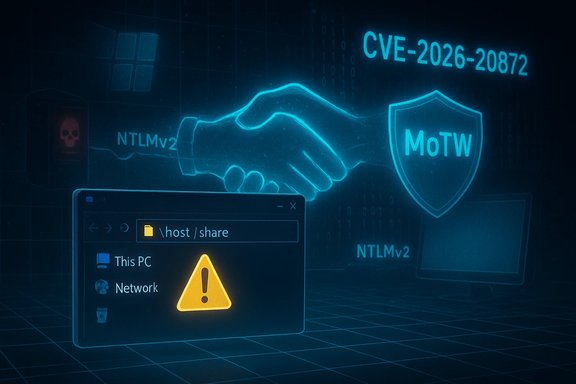
Microsoft’s security channels have logged CVE-2026-20872 as an NTLM hash disclosure / spoofing vulnerability tied to File Explorer and preview/metadata handling — a class of bug that repeatedly enables low‑interaction credential leakage by coaxing Windows clients to authenticate to attacker‑controlled SMB/UNC endpoints. The vendor entry confirms the identifier exists, but public technical details remain intentionally limited; defenders should treat the flaw as real and actionable while also recognizing that specific exploit mechanics published to date are probable reconstructions based on prior, closely related NTLM incidents.
NT LAN Manager (NTLM) is a legacy Windows authentication suite that still appears across millions of endpoints and servers for backward compatibility. Over the past two years a recurring attack pattern has emerged: specially crafted files or metadata cause File Explorer (or server-side preview/parsing services) to resolve external resources hosted on attacker-controlled servers, which in turn triggers NTLM/Samba authentication handshakes. Those handshakes leak negotiable NTLM artifacts — commonly an NTLMv2 response blob — that attackers can capture, relay, or attempt to crack offline. The operational consequence is credential theft, relay or impersonation and often fast lateral movement inside networks. Independent incident reporting and vendor advisories show this is not theoretical — the class has been weaponized multiple times. This article synthesizes the MSRC advisory posture for CVE‑2026‑20872 together with independent technical analysis, historical precedent, and practical mitigation steps for system administrators and security teams. Where Microsoft’s public entry is terse — a common staged‑disclosure approach designed to reduce immediate mass exploitation — the discussion draws on corroborated details from earlier NTLM CVEs and community reproductions to provide an evidence‑based operational playbook. Key claims are cross‑checked against multiple independent sources; where direct vendor patch identifiers or PoC details are missing, the text flags those items as unverified and prescribes conservative mitigations in the interim.
What is not yet publicly verified for CVE‑2026‑20872 (at time of writing):
Because vendor advisories for this family are often deliberately terse early in the disclosure timeline, assume the vulnerability is actionable and prepare to validate fixes thoroughly. Where specific exploit mechanics remain unverified, act conservatively: lock down preview surfaces, harden NTLM/SMB posture, and tune telemetry for explorer‑initiated outbound authentications. These steps close off the most reliable exploit paths and buy time until complete vendor patches and technical notes are available.
Source: MSRC Security Update Guide - Microsoft Security Response Center
 Background / Overview
NT LAN Manager (NTLM) is a legacy Windows authentication suite that still appears across millions of endpoints and servers for backward compatibility. Over the past two years a recurring attack pattern has emerged: specially crafted files or metadata cause File Explorer (or server-side preview/parsing services) to resolve external resources hosted on attacker-controlled servers, which in turn triggers NTLM/Samba authentication handshakes. Those handshakes leak negotiable NTLM artifacts — commonly an NTLMv2 response blob — that attackers can capture, relay, or attempt to crack offline. The operational consequence is credential theft, relay or impersonation and often fast lateral movement inside networks. Independent incident reporting and vendor advisories show this is not theoretical — the class has been weaponized multiple times. This article synthesizes the MSRC advisory posture for CVE‑2026‑20872 together with independent technical analysis, historical precedent, and practical mitigation steps for system administrators and security teams. Where Microsoft’s public entry is terse — a common staged‑disclosure approach designed to reduce immediate mass exploitation — the discussion draws on corroborated details from earlier NTLM CVEs and community reproductions to provide an evidence‑based operational playbook. Key claims are cross‑checked against multiple independent sources; where direct vendor patch identifiers or PoC details are missing, the text flags those items as unverified and prescribes conservative mitigations in the interim. What Microsoft’s advisory actually says — and what it omits
Microsoft’s Update Guide lists CVE‑2026‑20872 as a tracked vulnerability associated with File Explorer / Shell behavior and includes the vendor confidence metadata that helps triage urgency. The presence of an Update Guide entry is the primary vendor confirmation that the issue exists and is being tracked. What the initial entry commonly omits — and what administrators must confirm before declaring remediation complete — are the per‑SKU KB numbers, exact cumulative update packages and the full technical write‑up that maps exploit mechanics to code paths. Because MSRC pages are often rendered client‑side, their early entries tend to be brief while engineering teams finalize fixes and KB mapping. Treat the Update Guide entry as canonical for the identifier; use it to extract KB → SKU mappings once Microsoft publishes them.What is not yet publicly verified for CVE‑2026‑20872 (at time of writing):
- A public proof‑of‑concept (PoC) that specifically demonstrates CVE‑2026‑20872 exploitation.
- The exact file formats, preview handlers, or Shell parsing paths exploited (for example, whether .library‑ms, LNK, manifest resources, or another metadata construct is the trigger).
- The set of KB package identifiers and per‑build patch binaries mapped definitively to the CVE.
Technical anatomy: how NTLM leak/spoofing bugs typically work
The following is an evidence‑based technical primer drawn from prior incidents, public vulnerability analyses, and the defensive community. These steps describe the usual exploit primitive and why it is broadly effective:- Many file types and metadata containers may include external URIs, UNC paths (\host\share\resource), or icon/resource references. File Explorer, preview handlers, and in‑process parsers sometimes attempt to resolve these resources to render thumbnails, icons, or previews.
- When the client attempts to resolve a remote SMB/UNC target that requires authentication, the Windows client will initiate an NTLM (or negotiate) handshake under the interactive user’s security context.
- The authentication sequence transmits negotiable material (NTLMv2 response blobs and negotiation tokens) to the remote endpoint. Although not plaintext passwords, these blobs can be:
- Recorded and relayed to other services (NTLM relay) where the blob is accepted, or
- Cracked offline through brute force or dictionary attacks under favorable conditions, or
- Used in chained attacks when SMB signing is not enforced or relay defenses are missing.
- An attacker who controls the remote endpoint can therefore capture these blobs with minimal user interaction — sometimes merely selecting or previewing a file in Explorer — making the attack low friction and high value for lateral movement.
- Maliciously crafted .library‑ms files and LNK/shortcut files that specify UNC paths or remote icons.
- Documents or archives whose embedded metadata (icons, fonts, external images, webresource links) point to attacker SMB servers.
- Server‑side rendering engines and mail gateways that auto‑preview uploaded files without sandboxing, amplifying a single crafted file into a broad‑scale server compromise.
Why the vendor “confidence metric” matters (and how to read it)
Microsoft and many vendors use a simple staged confidence metric to indicate how much technical detail is public and how certain the advisory is. Practically, the stages are:- Identifier‑only (low confidence): CVE assigned, short description, no mapped KBs or technical details. The vulnerability’s existence is confirmed but exploit mechanics are not public. Treat as real but avoid overspecifying attack vectors.
- Corroborated (medium confidence): Independent researchers, vendors or community analyses publish reproductions, PoCs, or detailed write‑ups that substantiate the vendor summary.
- Vendor‑validated (high confidence): Microsoft publishes a KB, per‑SKU package identifiers and a detailed advisory or patch diff. This is the point where defenders can map updates to deployment pipelines with high certainty.
Evidence and corroboration: what independent sources show
This CVE belongs to a well‑documented class. Independent research and incident reports from 2024–2025 demonstrate active exploitation of similar NTLM hash disclosure issues, and they provide concrete examples of how weaponization looks in the wild.- Check Point Research documented active exploitation campaigns leveraging an NTLM hash disclosure bug via crafted .library‑ms files (CVE‑2025‑24054) and tracked real‑world campaigns using phishing and archived payloads. This demonstrates the plausibility of low‑interaction exploit chains targeting government and private institutions.
- SecurityWeek and other incident trackers reported similar campaigns and characterized the attack primitive: capturing NTLM negotiation material during Explorer or preview resolution, then using the artifacts to perform relay or brute‑force attacks. These independent analyses corroborate the attack class and show rapid weaponization once a simple trigger or PoC is available.
- Vendor/defensive analysis (Cymulate, 0patch, and others) has repeatedly shown Microsoft’s initial fixes for prior NTLM leaks were sometimes bypassed, creating a sequence of CVEs as researchers found alternative triggers — an operationally important precedent for defenders evaluating whether a single bulletin is sufficient.
Practical impact — who’s most at risk
The practical blast radius depends on environment and configuration, but typical high‑risk profiles include:- Administrative workstations, jump hosts and privileged operator consoles that frequently authenticate to network resources.
- Servers and services that process untrusted files at scale (mail gateways, document ingestion services, file servers that generate thumbnails).
- Environments that allow outbound SMB/NetBIOS traffic to the Internet or lack SMB signing and strict NTLM restrictions.
- Legacy estates that still permit widespread NTLM authentication because Kerberos or modern auth cannot be enforced.
Immediate, high‑priority mitigations (operational playbook)
Until Microsoft publishes patch KBs and teams can validate fixes in test rings, apply the following prioritized actions across endpoints, servers and infrastructure:- Confirm vendor status
- Check the Microsoft Update Guide entry for CVE‑2026‑20872 and extract KB → SKU mappings once they appear; do not rely on third‑party mappings.
- Short‑term, high‑impact behavior mitigations (apply immediately on critical hosts)
- Disable File Explorer Preview Pane and thumbnail generation on administrative and ingestion hosts to prevent in‑process parsers from resolving external resources.
- Enforce Mark‑of‑the‑Web (MoTW) handling: files sourced from Internet zones should not be rendered inline by in‑process preview handlers. Require explicit Unblock actions for trusted files.
- Block outbound SMB (TCP 445/139) to untrusted networks at the egress firewall; allow explicit exceptions only when necessary and logged.
- Harden authentication posture
- Disable or restrict NTLM where possible via Group Policy and accept only Kerberos for domain traffic.
- Enforce SMB signing and require secure SMB dialects between hosts.
- Patch management and staged rollout
- When Microsoft publishes KB identifiers, stage updates through pilot rings that include admin workstations, VDI hosts and mail gateways, verify compatibility, then roll out broadly.
- Detection and telemetry tuning
- Alert on explorer.exe (and preview host processes) initiating outbound SMB/UNC connections to unusual endpoints or geolocations.
- Hunt for anomalous NTLM negotiation attempts from endpoints to external IPs immediately after preview or extraction operations.
- Avoid risky operational shortcuts
- Do not mass‑unblock Internet‑zoned files as a convenience — this defeats MoTW protections.
- Do not rely on third‑party micro‑patches in enterprise production without compensating validation and vendor support plans; they may be useful in emergency scenarios but require risk acceptance.
Detection, hunting and forensic guidance
If you suspect exploitation or want to proactively hunt:- Network indicators: SMB session setup requests and NTLM negotiation attempts from client endpoints to previously unseen IP addresses or domains immediately following Explorer activity. Correlate with firewall logs and egress allow lists.
- Endpoint indicators: explorer.exe spawning network-aware child processes, preview handler loads, or unexpected handle duplications around the time of file extraction or preview. EDR telemetry that catches in‑process parsing anomalies is valuable.
- Authentication telemetry: unusual NTLM authentication attempts, anomalous session tickets, or relay attempts reported by SMB servers and domain controllers. Hunt for authentication events where the source is a workstation that normally does not contact the target host.
- Forensics: preserve volatile memory, EDR snapshots, and full network capture where possible before remediation steps that alter the endpoint state. Correlate with mail gateway logs if the initial vector may have been phishing.
Strengths and limitations of Microsoft’s likely response
Strengths:- Microsoft’s staged disclosure model lets engineers harden platform behavior (for example, blocking previews of Internet‑zoned files) to blunt whole classes of attacks quickly; platform‑level behavioral mitigations are high leverage and reduce the attack surface across many parsers.
- Behavioral mitigations are blunt and create operational friction for teams that rely on quick previews (legal, mailrooms, procurement). Misapplied exceptions (bulk unblocking) can nullify protections.
- Historical precedent shows initial patches for NTLM leak classes have sometimes been bypassed along unpatched parsing paths, prompting follow‑on CVEs and repeated remediation cycles. Defenders must therefore verify fixes end‑to‑end rather than assuming a single bulletin fully closes all vectors.
Risk rating and triage guidance
Use this heuristic to prioritize actions across your estate:- Critical: Domain controllers, administrative jump boxes, VDI hosts and servers that ingest untrusted documents. Apply behavioral mitigations immediately and schedule patches the moment KBs are published.
- High: Workstations used by privileged or compliance staff. Pilot fixes and roll out Group Policy hardenings (SMB signing, NTLM restrictions).
- Medium: Standard user endpoints with limited network privileges. Apply detection rules and scheduled patches as part of normal cycles.
- Low: Isolated systems with no egress or no interaction surface. Maintain vigilance but prioritize resources elsewhere.
What remains unverified — and how to treat unknowns
Because Microsoft’s published entry for CVE‑2026‑20872 is currently brief, defenders must treat several points as unverified until vendor KBs or independent technical write‑ups appear:- The precise file type(s) or preview handler(s) that trigger the leak for this specific CVE.
- Whether in‑the‑wild exploitation for CVE‑2026‑20872 has occurred prior to public PoC release.
- Exact patch package names and the per‑build KB identifiers that will be used to validate coverage across diverse Windows builds.
Executive summary and prioritized checklist
- CVE‑2026‑20872 is a File Explorer / NTLM hash disclosure / spoofing vulnerability confirmed by Microsoft’s Update Guide entry; public technical details are limited at the time of publication.
- The exploit class is well documented and has been weaponized in earlier CVEs (for example, CVE‑2025‑24054), so conservative mitigations are strongly recommended even before full KB mapping is available.
- Immediate actions (top priorities):
- Disable File Explorer Preview Pane and thumbnails on admin/jump hosts.
- Block outbound SMB/NetBIOS to untrusted networks at the egress layer.
- Enforce SMB signing and restrict/disable NTLM where possible.
- Monitor explorer.exe outbound SMB connections and NTLM negotiations and preserve forensic evidence if malicious activity is suspected.
- Extract KB→SKU mappings from the Microsoft Update Guide when Microsoft publishes them; stage patches through pilot rings before wide rollout.
Conclusion
CVE‑2026‑20872 joins a string of NTLM hash disclosure and spoofing vulnerabilities that have repeatedly proven operationally effective for attackers. Microsoft’s Update Guide confirmation is the essential signal that the issue is real; historical precedent and independent research confirm the attack primitive and the urgency of pragmatic mitigations. Administrators must balance operational needs against security: apply short‑term behavior mitigations (disable previews on critical hosts, block SMB egress, enforce MoTW) immediately, verify vendor KB mappings as soon as they are published, and treat this CVE as high priority for privileged endpoints and document‑ingesting services.Because vendor advisories for this family are often deliberately terse early in the disclosure timeline, assume the vulnerability is actionable and prepare to validate fixes thoroughly. Where specific exploit mechanics remain unverified, act conservatively: lock down preview surfaces, harden NTLM/SMB posture, and tune telemetry for explorer‑initiated outbound authentications. These steps close off the most reliable exploit paths and buy time until complete vendor patches and technical notes are available.
Source: MSRC Security Update Guide - Microsoft Security Response Center
