

Microsoft has assigned CVE‑2026‑20872 to a new NTLM hash disclosure / spoofing vulnerability that affects the Windows Shell and File Explorer family of components — a class of bugs that historically allows a crafted file or metadata to cause a client to resolve an attacker‑controlled UNC/SMB resource and leak NTLM negotiation material under the user’s account context.
NT LAN Manager (NTLM) is a long‑standing Windows authentication protocol. Although enterprise environments are encouraged to favor Kerberos and modern passwordless methods, NTLM (and NTLMv2 negotiation blobs) still exist in many networks and remain useful to attackers when disclosed. The leaked artifacts are not plaintext passwords but NTLM negotiation response blobs that can be cracked offline or abused via relays in legacy or misconfigured environments — giving attackers the ability to impersonate the user or pivot inside a network. Microsoft’s Update Guide lists CVE‑2026‑20872 as an identified vulnerability; the initial vendor entry is terse on exploit mechanics and per‑SKU KB mappings but confirms the issue and begins the staged remediation process. Where vendor entries are short, community and vendor analyses of past NTLM disclosure CVEs provide the operational template defenders should use while waiting for full patch artifacts.
Important caveat: until Microsoft publishes the KB diff or independent researchers produce reproducible PoCs, these technical models are defensive inferences — credible guides that match past incidents but not a verbatim description of the CVE’s exact exploit chain. Flag any definitive claims about precise file types or parsing paths as unverified until the vendor’s KB or trusted researcher reports confirm them.
Realistic scenarios include:
Key signals to hunt for:
Apply the following in priority order:
Source: MSRC Security Update Guide - Microsoft Security Response Center
 Background / Overview
NT LAN Manager (NTLM) is a long‑standing Windows authentication protocol. Although enterprise environments are encouraged to favor Kerberos and modern passwordless methods, NTLM (and NTLMv2 negotiation blobs) still exist in many networks and remain useful to attackers when disclosed. The leaked artifacts are not plaintext passwords but NTLM negotiation response blobs that can be cracked offline or abused via relays in legacy or misconfigured environments — giving attackers the ability to impersonate the user or pivot inside a network. Microsoft’s Update Guide lists CVE‑2026‑20872 as an identified vulnerability; the initial vendor entry is terse on exploit mechanics and per‑SKU KB mappings but confirms the issue and begins the staged remediation process. Where vendor entries are short, community and vendor analyses of past NTLM disclosure CVEs provide the operational template defenders should use while waiting for full patch artifacts. Why this class of bug matters now
- The exploitation bar is low: many real‑world NTLM disclosure incidents are triggered by minimal user interaction — viewing a folder, extracting an archive, or simply having a crafted file present in Explorer. That small interaction window is commonly reached via phishing, malicious downloads, or contaminated shared folders.
- Leaked NTLM negotiation blobs have outsized operational value: attackers can crack hashes offline or use them in relays to impersonate accounts, escalate privileges, or move laterally — especially when SMB signing is not enforced or NTLM is still accepted by internal services.
- The attack surface is broad: File Explorer, in‑process preview handlers, thumbnail generation and some server‑side renderers all parse untrusted file metadata and may automatically resolve external references; any of these can trigger outbound authentication.
Technical analysis — plausible exploit primitives
Microsoft’s initial advisory for CVE‑2026‑20872 confirms the vulnerability but omits low‑level exploit code and detailed PoC descriptions. That is normal during staged disclosures; however, the most plausible technical models are well understood from prior Explorer/preview‑handler CVEs:1. External resource resolution via metadata or icons
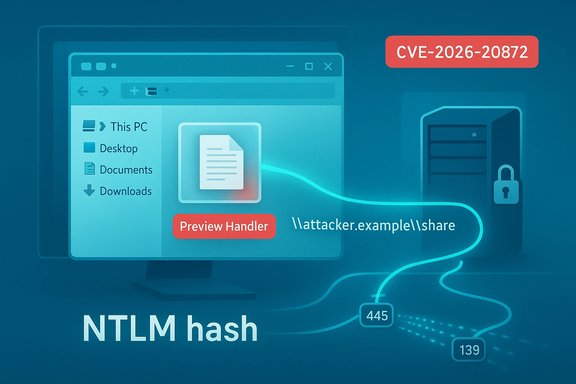
Many file formats and metadata fields permit embedded resource URIs (images, icons, stylesheet references, UNC/\ paths). When Explorer or a preview handler resolves these URIs to render thumbnails or previews, Windows may attempt to authenticate to the remote host, initiating NTLM negotiation that can be captured by an attacker‑controlled SMB endpoint. This is the canonical NTLM leak primitive.2. Preview handlers and in‑process parsers
Preview handlers run in the context of the host process (often explorer.exe). A vulnerable parser (PDF, Office, image container, or third‑party shell extension) can cause a network resolution unintentionally. Because the handler is in‑process, the runtime privileges and network stack used to render the preview can expose protocol artifacts and tokens.3. UI spoofing and provenance confusion
Some spoofing weaknesses let attacker‑controlled attributes appear as trusted UI (file origin, icon, labels), increasing the likelihood of user action and allowing attackers to obtain approvals or cause the OS to perform actions that disclose authentication material. While spoofing itself is often a separate CWE class, a spoof can be the enabling step in an NTLM disclosure chain.4. TOCTOU / handle substitution and memory‑safety issues
Time‑of‑check/time‑of‑use races or handle swapping can cause trusted code paths to operate on attacker‑controlled data. Memory corruption or use‑after‑free faults in shell components can further amplify a primitive into remote code execution; while CVE‑2026‑20872 is currently described as a hash disclosure/spoofing issue, defenders should not rule out chained exploitation.Important caveat: until Microsoft publishes the KB diff or independent researchers produce reproducible PoCs, these technical models are defensive inferences — credible guides that match past incidents but not a verbatim description of the CVE’s exact exploit chain. Flag any definitive claims about precise file types or parsing paths as unverified until the vendor’s KB or trusted researcher reports confirm them.
Impact and realistic attacker scenarios
The immediate impact of a successful exploit is information disclosure (NTLM negotiation blobs) that can be used for credential cracking or relay/impersonation in permissive network configurations. From that foothold, attackers commonly pursue lateral movement, privilege escalation and persistence.Realistic scenarios include:
- Remote UNC‑triggered credential leakage
- Attacker delivers a crafted file (LNK, .library‑ms, or a document with an embedded UNC) to the target.
- When the file is viewed, Explorer resolves the referenced resource, initiating an SMB negotiation and leaking NTLMv2 blobs to the attacker’s server.
- Preview‑pane exfiltration on document triage servers
- A mail gateway or VDI host that previews attachments could, when rendering an attacker‑crafted file, reach out to a remote host and expose many users’ negotiation material. This amplifies one crafted upload into mass exposure.
- Low‑interaction social engineering on admin devices
- Minimal user actions (open, select, extract) on highly‑privileged operator machines (jump hosts, admin workstations) yield NTLM material that is highly valuable in targeted intrusions or ransomware chains.
- Domain controllers, jump boxes, VDI and RDS hosts, mail gateways, ingestion servers and any endpoint that processes untrusted files. These hosts amplify the blast radius.
Detection, telemetry and forensic indicators
Because the attack commonly uses standard OS behavior (a client authenticating to a remote SMB resource), detection requires correlating Explorer activity, network connections and NTLM authentication events.Key signals to hunt for:
- explorer.exe initiating outbound SMB (TCP 445/139) or WebDAV/HTTP connections immediately after file extraction or preview events.
- NTLM authentication attempts to previously unseen IPs or hostnames, especially to external addresses or unusual geographies.
- Mass unblocking of Zone.Identifier (Mark‑of‑the‑Web) streams via PowerShell or scripts — this action removes the protective MoTW behavior and can be a sign of attacker preparation.
- Sudden creation of scheduled tasks, services, or privilege changes following Explorer preview activity — indicative of follow‑on compromise after credential capture.
Short‑term mitigations and compensating controls (operational checklist)
While the canonical fix is to deploy Microsoft’s security update(s) once the per‑SKU KB mappings are published, defenders can immediately apply high‑leverage mitigations that materially reduce risk.Apply the following in priority order:
- Confirm vendor mapping and staged rollout
- Check Microsoft’s Update Guide entry and extract per‑SKU KB numbers, then deploy through WSUS/Intune/ConfigMgr pilot rings. Apply to administrative workstations and servers that handle untrusted files first.
- Behavior hardening (immediate, low‑risk)
- Disable File Explorer Preview Pane and thumbnail generation on high‑risk hosts (admin jump boxes, mail gateways, VDI hosts). This removes in‑process parsing surfaces that commonly trigger leaks.
- Enforce Mark‑of‑the‑Web handling: do not allow Internet‑zoned files to be passed to in‑process previewers by default. Require explicit unblock action for trusted files.
- Network hardening
- Block outbound SMB (TCP 445/139) from endpoints to untrusted networks at egress firewalls or edge routers; allow exceptions only for approved infrastructure.
- Enforce SMB signing and require Kerberos where possible; disable NTLM authentication if legacy applications permit.
- Host hardening
- Temporarily disable or restrict third‑party shell extensions and preview handlers that run inside explorer.exe, especially on admin or triage hosts. Consider out‑of‑process rendering for server‑side previewing.
- Monitoring and detection
- Add telemetry to alert on explorer.exe network activity, anomalous NTLM authentication attempts, and sudden unblocking actions. Hunt for artifacts described above.
Patching guidance and deployment prioritization
- Treat admin and ingestion hosts as top priority — patch them as soon as Microsoft publishes KBs and tested updates.
- Use pilot rings: test updates on representative hosts to catch compatibility regressions that may affect printing, line‑of‑business software, or third‑party shell extensions.
- For environments with long patch windows, apply network and host mitigations to create layered defenses until the vendor patch is applied.
- Avoid bulk unblocking of MoTW on many files — that defeats the behavioral mitigation and increases exposure. Train mailroom/triage teams to explicitly verify files before unblocking.
Strengths and weaknesses of Microsoft’s likely response
Strengths:- Microsoft’s staged disclosure (assign CVE ID, publish Update Guide entry, then map KBs and push updates) reduces PoC‑driven mass exploitation and lets engineering produce correct fixes rather than rushed patches. This model has blocked many immediate mass‑exploitation waves in the past.
- Platform behavior hardenings — for example, preventing previewing of Internet‑zoned files — are high‑leverage mitigations that reduce many attack paths simultaneously. They were effective in prior waves of NTLM disclosure CVEs.
- Terse advisories increase defender workload: when MSRC entries lack KB mappings and detailed mitigations, operations teams must infer risk and apply blunt mitigations that may carry productivity costs.
- Partial mitigations (blocking previews for Internet‑zoned files) are effective but blunt; they slow day‑to‑day workflows for teams that rely on previews (legal, procurement, mailrooms) and can be bypassed by reckless mass unblocking.
- Environments with outbound SMB egress or permissive NTLM posture remain dangerous even after fixes are applied if network and authentication re‑architecture is not completed. Long‑term remediation requires reconfiguring authentication and hardening network egress.
What we can and cannot verify today
Verified:- Microsoft has created an Update Guide entry for CVE‑2026‑20872, confirming the vulnerability exists.
- The vulnerability class matches numerous prior, publicly documented NTLM hash disclosure incidents where Explorer/preview handlers resolved attacker UNC resources and leaked NTLM negotiation material. Multiple vendor write‑ups and community analyses corroborate the exploit pattern.
- Specific exploit primitives claimed on forums (exact file types like .library‑ms or a single preview handler) should be treated as probable but unconfirmed until Microsoft’s KB or independent researcher reports publish PoCs or reproductions. Do not assume a single file type is the only vector.
- Whether an in‑the‑wild active exploitation campaign is currently using CVE‑2026‑20872 specifically — published exploit evidence or attributions should be corroborated across multiple trusted outlets before being treated as confirmed.
Practical checklist for Windows administrators (action items)
- Immediate (hours)
- Disable Explorer Preview Pane and thumbnail generation on admin and triage hosts.
- Block outbound SMB (TCP 445/139) at the egress firewall for client subnets.
- Enforce Mark‑of‑the‑Web policy: do not allow Internet‑zoned files to be passed to in‑process previewers. Educate triage teams to explicitly unblock only after verification.
- Short term (days)
- Identify and isolate high‑value targets (jump hosts, domain controllers, VDI host pools). Apply the mitigations above and prioritize them for the vendor patch.
- Enable telemetry to alert on explorer.exe outbound connections and anomalous NTLM negotiations. Run hunts for evidence described earlier.
- Medium term (weeks)
- Apply Microsoft security updates mapped to the CVE once KB numbers are published and tested. Roll out patches in prioritized rings.
- Harden authentication posture: phase out NTLM where possible, require SMB signing and Kerberos for internal resources.
- Long term (1–3 months)
- Rework document ingestion and previewing pipelines to render untrusted files out‑of‑process or inside sandboxes. Remove dependence on in‑process parsers for server‑side rendering.
- Conduct adversary simulation exercises (purple team) that emulate the NTLM leak to validate detection and response plans.
Conclusion — the practical takeaway
CVE‑2026‑20872 belongs to a proven, high‑value class of vulnerabilities: NTLM hash disclosure and spoofing via Explorer/preview behavior. The vendor’s Update Guide entry confirms its existence and begins the remediation lifecycle, but initial advisories can be deliberately brief to avoid facilitating exploit automation. Until Microsoft publishes KB mappings and researchers release technical analyses, defenders must assume a high operational risk and act with layered mitigations: block SMB egress, disable in‑process previews on sensitive hosts, enforce Mark‑of‑the‑Web handling, and prioritize patch deployment once vendor updates are available. The class of attack is straightforward to understand but subtle to fully eliminate across a complex OS and heterogeneous enterprise environment. Practical, conservative mitigations dramatically reduce exposure and should be the immediate focus while awaiting vendor patches and detailed technical write‑ups from independent researchers.Source: MSRC Security Update Guide - Microsoft Security Response Center
