

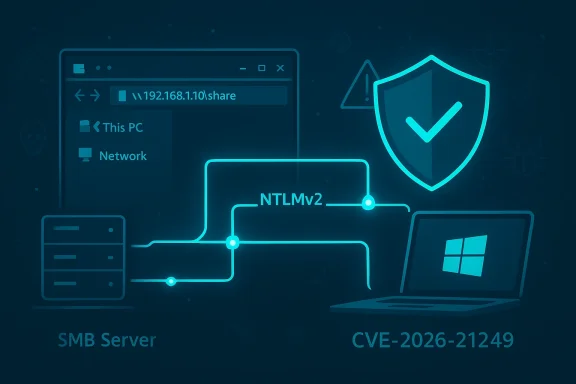
Microsoft’s advisory listing for CVE-2026-21249 confirms a new Windows NTLM spoofing vulnerability that has elevated operational urgency across enterprise environments: the vendor has assigned the identifier and published a terse entry in its Security Update Guide, but technical specifics and KB mappings remain limited in the public advisory. (msrc.microsoft.com)
NTLM (NT LAN Manager) is a legacy Microsoft authentication protocol still widely present in enterprise Active Directory environments for compatibility with older services. Over the past two years the security community has repeatedly observed low‑interaction NTLM disclosure and relay patterns that allow attackers to capture authentication blobs and then reuse them to impersonate users, move laterally, or escalate privileges. Those historical precedents make any new Ntn vendor advisories are sparse.
Microsoft’s own Security Update Guide shows CVE‑2026‑21249 as a validated entry; however, the public-facing page provides minimal technical detail beyond confirming the vulnerability’s existence and high-level impact category. That “identifier‑only” posture is normal during phased disclosures, but it forces defenders to plan conservatively: treat the issue as real, assume plausible exploitation primitives, and prioritize mitigations until per‑SKU KBs, package identifiers, or vendor technicalmicrosoft.com](Security Update Guide - Microsoft Security Response Center))
CERTs and national CSIRTs echo the same playbook: treat NTLM‑class disclosures with high urgency because the exploitation bar is low and the impact of successful impersonation is high (lateral movement, data exfiltration, ransomware staging). Several regional advisories published in the last 12 months have prioritized patching and recommended network behavior mitigations while KB linkages matured.
If you are responsible for high‑value assets in an Active Directory elock outbound SMB, disable previewing on admin hosts, and prepare to roll patches as soon as Microsoft publishes the per‑SKU KBs. These steps materially reduce risk while the vendor and research community complete technical analysis and remediation mapping.
Caveat and transparency note: this analysis uses Microsoft’s Security Update Guide entry for CVE‑2026‑21249 as the vendor‑validated anchor and supplements that with recen disclosure patterns documented by the defensive community; where vendor mapping and public PoCs are not yet available, I have flagged those specifics as unverified and recommended conservative mitigations accordingly. (msrc.microsoft.com)
Source: MSRC Security Update Guide - Microsoft Security Response Center
 Background / Overview
NTLM (NT LAN Manager) is a legacy Microsoft authentication protocol still widely present in enterprise Active Directory environments for compatibility with older services. Over the past two years the security community has repeatedly observed low‑interaction NTLM disclosure and relay patterns that allow attackers to capture authentication blobs and then reuse them to impersonate users, move laterally, or escalate privileges. Those historical precedents make any new Ntn vendor advisories are sparse.Microsoft’s own Security Update Guide shows CVE‑2026‑21249 as a validated entry; however, the public-facing page provides minimal technical detail beyond confirming the vulnerability’s existence and high-level impact category. That “identifier‑only” posture is normal during phased disclosures, but it forces defenders to plan conservatively: treat the issue as real, assume plausible exploitation primitives, and prioritize mitigations until per‑SKU KBs, package identifiers, or vendor technicalmicrosoft.com](Security Update Guide - Microsoft Security Response Center))
How NTLM leak and spoof primitives typically work
The canonical attack chain (evidence‑based primer)
From prior incidents and defensive write‑ups, the technical anatomy of NTLM disclosure and spoofing attacks follows a small set of reliable primitives:- Many file formats and shell metadata fields can contain external URIs, UNC paths (\host\share\resource), or resource references (icons, fonts, remote images).
- Windows Shell components, Explorer preview handlers, thumbnailers, and some in‑process parsers automatically attempt to resolve those external resources to render icons or previews.
- If the remote target requires authentication, the client initiates an NTLM (or Negotiate) handshake under the interactive user’s security context, producing NTLMv2 response blobs and negotiation tokens.
- An attacker controlling the remote endpoint (for example an SMB server) can record those blobs. While the blob is not a plaintext password, it is reusable: attackers can relay it to other services or craaabling impersonation or lateral movement.
Why these issues persist
NTLM remains enabled in many networks because legacy applications and appliances still depend on it. Kerberos is the recommended, stronger alternative, but migration is nontrivial. Additionally, some user-facing components (Explorer previews, shell extensions, mail gateway renderers) still resolve external resources in ways that can trigger network authentication without clear provenance controls. That combination — legacy protocol + automatic resolution paths — is the r
What Microsoft’s advisory (and the “confidence” metric) actually tells defenders
Microsoft’s Security Update Guide acts as the canonical source of record for CVEs affecting Windows. For CVE‑2026‑21249 the presence of an MSRC entry establishes the vulnerability’s existence and that Microsoft is tracking it in its update pipeline, but the lack of immediately visible KBs and package mappings leaves two critical questions open:- Exactly which file types, shell components, or preview handlers are exploited (if any)?
- Which Windows builds and SKUs carry the definitive patch binaries, and what are the KB identifiers defenders should deploy?
CERTs and national CSIRTs echo the same playbook: treat NTLM‑class disclosures with high urgency because the exploitation bar is low and the impact of successful impersonation is high (lateral movement, data exfiltration, ransomware staging). Several regional advisories published in the last 12 months have prioritized patching and recommended network behavior mitigations while KB linkages matured.
Exploitation scenarios defenders should prioritize
The following attack scenarios are not speculative; they are the practical patterns seen in recent NTLM campaigns and the plausible paths for CVE‑2026‑21249 until vendor technical details say otherwise:- Low‑interaction file exposure: a maliciously crafted archive, LNK, .library‑ms, or document that contains UNC/icon references is placed on a sharmail. When previewed in Explorer or in an email client with automatic previews, the system performs an outbound authentication handshake to an attacker SMB host. The attacker records the NTLM blob and relays it.
- Server‑side rendering amplification: a web application or mail gateway that renders uploaded content (thumbnails, previews) withg or blocking of external UNC references can be leveraged to reach many victims from a single crafted file. Server‑side previewing converts single‑file crafts into broad compromise vectors.
- Lateral movement chains: once a usable credential or relay path is obtained, attackers can impersonate service accounts, connect to internal services lacking strict SMB privileges or harvest additional secrets. Historically, such chains have been combined with Pass‑the‑Hash or credential theft tools to obtain domain‑privileged access.
Impact assessment — who is at risk and why it matters
High‑risk targets- Administrative workstations, jump boxes, and machines used by helpdesk and domain admins. These hosts regularly authenticate to many services and are therefore high‑value for impersonation.
- Document processing servers, mail gateways, and cloud file ingestion endpoints that automatically render attachments or previews on behalf of users.
- Neound SMB (TCP 445) to the Internet or other untrusted segments, or that accept NTLM in‑band without SMB signing enforcement.
- The attacker’s required interaction can be one click (or no click at all if auto‑preview is enabled), making user education alone insufficient.
- Leaked NTLM blobs are reusable in relay scenarios or potentially crackable offline in some configurations — both of which can permit lateral movement and privilege escalation.
- Because NTLM remains supported fory, complete removal is rarely practical in the short term; defenders must therefore layer mitigations.
- Past NTLM spoofing CVEs have carried CVSS vectors that reflect network attackability with low complexity but requiring user interaction; operational scoring must therefore weigh exploitability probability (how easy is it to trigger an outbound authentication?) and impact (can an attacker reach privileged resources after impersonation?). Independent vulnerability trackers and commercial vendors typically place NTLM disclosure CVEs in the Important / High operational urgency band even when CVSS scores are moderate, because the real‑world consequences (ransomware, domain compromise) are severe.
Immediate mitigations — a prioritized checklist for defenders
Until Microsoft publishes per‑SKU KBs and patch binaries that map to CVE‑2026‑21249, follow this conservative, defense‑in‑depth checklist. Each step reduces the available exploit surface for NTLM leakage and relay attacks.- Apply vendor updates immediately when Microsoft releases the patch and KB mappings.
- Confirm the KB identifiers and use WSUS/ConfigMgr/patch automation to enforce coverage. Microsoft’s Security Update Guide is the authoritative release point; monitor the CVE entry for KB links as they appear. (msrc.microsoft.com)
- Block or log outbound SMB (TCP 445 / 139) at network egrwalls.
- Egress blocking of SMB prevents attacker‑controlled SMB endpoints on the Internet from receiving NTLM handshakes. For hosted environments with legitimate outbound SMB needs, apply allow‑lists and strict inspection.
- Disable or restrict automatic preview/thumbnail resolution for Internet‑zoned files and untrusted locations.
- Configure Group Policy or local settrer from auto‑resolving external resources for files downloaded from the Internet or originating outside the local intranet. Where possible, disable the “preview pane” on machines with elevated privileges.
- Enforce SMB signing and reject NTLM where Kerberos is available.
- Require SMB si clients and use Group Policy to disable NTLM authentication for accounts and servers that can use Kerberos. Gradually move legacy services to Kerberos or modern authentication stacks.
- Harden endpoints: restrict WebClient, disable WebDAV and unnecessary shell extensions, and remove third‑party preview handlers on privileged hosts.
s run in‑process inside explorer.exe; removing untrusted handlers and the WebClient service reduces untrusted code paths that can trigger external authentication. - Implement multifactor authentication (MFA) and least‑privilege service accounts.
- MFA reduces the captured negotiation blobs for remote interactive login. Likewise, avoid using highly privileged interactive accounts for routine processes.
- Monitor and detect anomalous NTLM traffic.
- Instrument logging: enable Sysmon, collect Windows Security logs and account authentication events, and monitor for unusual outbound NTLM handshakes (connec hosts). Network IDS rules can detect suspicious SMB traffic patterns and outbound connections to known malicious hosts.
- Isolate high‑value assets and apply network segmentation.
- Place jump hosts and admin workstations on hardened segments with egress rted update pipelines. Limit lateral access paths to domain controllers and sensitive file servers.
- For high‑risk ingestion servers: sandbox document/attachment rendering or disable on‑the‑fly previewing entirely.
- Document triage/preview servers should not perform network resolurces. If they must, implement strict sandboxing and network egress controls.
- Prepare an incident response playbook specific to NTLM leakage.
- Include steps to rotate credentials (service account passwords, key material), identify potential relay victims, and thentication events following any suspected disclosure.
Detection recipes and practical checks
- Search Security Event logs and SIEM for outbound authentication attempts to unusual SMB hosts (TCP 445) originating from Explorer or preview processes.
- On endpoints, query for installed shell extensions and preview handlers; on high‑privilege machines remove any non‑essential third‑party handlers.
- Use packet captures to inspect NTLM negotiate/authenticate exchanges; record hashes for correlation and threat hunting (handle these artifacts as sensitive).
- Validate patch deployment by matching installed KB numbers to Microsoft’s Security Update Guide once Microsoft publishes the KB mapping for CVE‑2026‑21249. Until that mapping appears, assume vulnerable build conservative network mitigations. (msrc.microsoft.com)
Vendor response expectations and what to watch for next
Microsoft’s staged disclosure process means defenders should watch for:- The appearance of explicit KB mappings and per‑build package identifiers on the MSRC CVE page (authoritative confirmation that a patch exists for an SKU). (msrc.microsoft.com)
- A security blog post, advisory, or KB article from Microsoft explaining the affected code path (Explorer, a preview handler, or a specific file parser).
- Independent researcher analyses, PoCs, or ap the CVE to concrete triggers or sample files; these typically follow vendor confirmation by days or weeks and raise the urgency for defenders to patch quickly.
Strengths and limitations of current public information
Strengths- Vendor acknowledgement via the MSRC entry confirms the vulnerability’s existence and ensures a channel for authoritative KBs and patches; this reduces ambiguity about whether the issue is real. (msrc.microsoft.com)
- The ready has a rich operational template for NTLM leakage issues from prior CVEs: plausible exploit primitives, detection heuristics, and mitigations are well understood and can be rapidly applied.
- The MSRC entry for CVE‑2026‑21249 is terse and (at publication) may not yet include KB mappings, per‑build binaries, or a full technical write‑up; this absence limits defenders’ ability to do precise vulnerability scanning and patch verification. (msrc.microsoft.com)
- There is a risk of over‑attribution: the same class of NTLM bug mle file formats or handlers. Publicly declaring a single file type as the vector without vendor or independent confirmation risks misdirecting defensive effort. Treat specific trigger attributions as probable but unverified until corroborated.
Practical operational recommendations for the next 30 days
- Treat CVE‑2026‑21249 as a high‑urgency item for privileged hosts and document‑processing servers.
- Immediately implement egress blocking for SMB from endpoints that don’t require it.
- Harden and isolate admin workstations; remove automatic previews and unnecessary shell extensions from these hosts.
- Prepare rapid deployment plans: when Microsoft publishes KBs, push the patch through youion channels with priority scheduling.
- Build or update SIEM detections for outbound NTLM handshakes tied to explorer.exe, searchindexer.exe, or preview host processes, and triage any matches for lateral movement indicators.
Final assessment: confidence and recommended posture
CVE‑2026‑21249 is a confirmed NTLM‑class vulnerability as shown by Microsoft’s advisory listing. The immediate operational posture must therefore be conservative: assume plausible exploit vectors exist across Shell/preview/metadata resolution pathways, prioritize mitigations that reduce external SMB exposure and automatic previewing, and accelerate patch deployment the moment Microsoft publishes KB mappings and updates. Theidence status (entry present, limited public technical detail) implies defenders need to combine vendor monitoring with established community mitigations drawn from prior NTLM incidents. (msrc.microsoft.com)If you are responsible for high‑value assets in an Active Directory elock outbound SMB, disable previewing on admin hosts, and prepare to roll patches as soon as Microsoft publishes the per‑SKU KBs. These steps materially reduce risk while the vendor and research community complete technical analysis and remediation mapping.
Caveat and transparency note: this analysis uses Microsoft’s Security Update Guide entry for CVE‑2026‑21249 as the vendor‑validated anchor and supplements that with recen disclosure patterns documented by the defensive community; where vendor mapping and public PoCs are not yet available, I have flagged those specifics as unverified and recommended conservative mitigations accordingly. (msrc.microsoft.com)
Source: MSRC Security Update Guide - Microsoft Security Response Center
