

 Overview
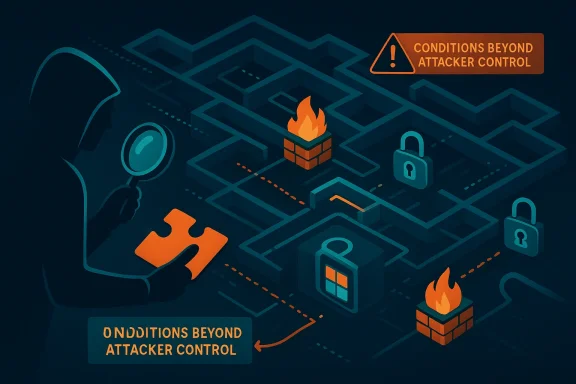
Microsoft’s description for CVE-2026-21713 points to an important nuance in vulnerability scoring: the flaw is not reliably exploitable “at will,” but instead depends on conditions outside the attacker’s direct control. In practical terms, that usually means exploitation may require environmental knowledge, a specific network position, or some kind of preparation before the attack can succeed. The language strongly suggests a threat model where the bug is real, but the path to weaponization is more constrained than a straightforward remote-code-execution headline would imply. tters because defenders often underestimate vulnerabilities that sound conditional. A bug that requires pre-positioning, manipulation of trust relationships, or knowledge of the victim’s environment can still be dangerous, especially if it sits in a widely deployed Microsoft component or a common enterprise workflow. At the same time, the “conditions beyond the attacker’s control” phrasing typically lowers the odds of mass opportunistic exploitation compared with a bug that can be triggered by a single unauthenticated request from the public internet.Even with limited pisory language is enough to frame the operational question for security teams: can an attacker turn this into a repeatable chain against your environment, and what assumptions in your network or application design would make that easier? That is where this CVE becomes interesting—not just as a line item in a patch list, but as a reminder that exploitability is often shaped as much by architecture and exposure as by the underlying code flaw itself.
Background
Microsoft’s update guide g-standing theme in vulnerability management: not every CVE has the same real-world risk, even if the formal classification looks severe. Some bugs are trivially reachable. Others demand reconnaissance, timing, trust abuse, or an attacker’s ability to place themselves somewhere in the victim’s path. Microsoft’s wording for CVE-2026-21713 places this issue firmly in the second category, which usually means security teams should think in terms of attack chains rather than a single exploit primitive.In Microsoft’s ecosystem, that often translates into a need tmponent is deployed rather than merely whether it is installed. An issue may affect one product family in a directly exploitable way, while another deployment is only vulnerable under certain network, authentication, or state conditions. That is why Microsoft’s advisory language can be so valuable: it hints at the practical attack surface without necessarily revealing enough for attackers to shortcut the work.
The phrasing in the CVE description is especially reminiscent of vulnerabilities tntal grooming or positioning. Microsoft explicitly notes examples such as gathering knowledge about the environment, preparing the target to improve exploit reliability, or inserting oneself into the logical network path to observe or alter communications. Those examples are not incidental; they are classic indicators that the flaw may depend on protocol state, trust assumptions, or a man-in-the-middle style precondition.
That matters because the security impact of such flaws can be very different across consumer, SMB, and ts. A home user may never encounter the attack conditions. A large enterprise with segmented networks, internal proxies, complex identity flows, or legacy trust relationships may expose exactly the kind of intermediate states an attacker wants. In other words, the same CVE can be low-friction in one environment and stubbornly difficult in another.
Historically, Microsoft security advisories have repeatedly shown that exploitability and blast radius are rarely identical.be technically significant but practically narrow, or modest on paper but devastating in a particular deployment. That is why reading the advisory text carefully is so important: Microsoft is often signaling not just “patch this,” but also “understand the prerequisites before you underestimate it.”
What Microsoft’s wording really implies
The phrase “successful attack depends on conditions beyond the attacker’s control” is more than usually means the attacker cannot simply send a request and expect a reliable outcome; instead, they must influence the target environment in some measurable way first. That could mean knowing details about the target’s topology, a particular version or configuration, or an intermediate system that can be used to amplify the exploit.Why that matters operationally
For defenders, conditional exploitability changes incident prioritization. A vulnerability with high theoretical impact but narrowserve immediate patching in exposed, sensitive, or complex environments, while still being less urgent than a simpler flaw that is actively weaponized at scale. The key is not to confuse “harder to exploit” with “safe.” It just means the attacker needs more runway.A practical consequence is that defenders should ask what extra assumptions the attack depends on. If those assumptions are already true in your environment—say, shared internal trust, werotocol exposure—then the vulnerability may be far more dangerous than the wording initially suggests. Conversely, if the preconditions are absent, compensating controls may already be doing meaningful work.
Common prerequisite patterns
- The attacker must first learn environment-specific details.
- The attacker must shape traffic or state before the vulnerable code path becomes reachable.
- The attacker mposition that lets them observe or alter communications.
- The attacker may need to stage the tarns more reliably.
- The vulnerable behavior may only appear under certain deployment conditiond enterprise, those requirements can be meaningful barriers. In a poorly segmented or overly trey can become mere inconveniences for a determined adversary. That is why risket this language as a prompt to review topology, trust boundaries, and packet flatus.
Reading the attack model
Microsoft’s examples point toward a threat model where the attacker may need to operate over time rather than in a single shot. That has implications for both detection and prevention. If exploitation requires setup, then the attack likely leaves more traces: reconnaissance, probing, aborted attempthavior, or anomalous communication patterns before the final trigger.Reconnaissance before exploitation
An attacker who must gather knowledge about the environment is usually doing more than just testing a port. They may be identifying protocol behaviors, internal service relationships, version-specific responses, or configuration differences that affect exploit reliability. That turns vulnerability hunting into a cick event.This also means defenders should think about visibility. Log retention, network telemetry, and authentication telemetry may all matter if the attacker needs to map the environment first. A vulnerability that depends on observation can often be detected earlier than a vulnerability that is triggered instantly and silently.
Manipulating the target state
Microsoft’s woreparing the target environment to improve exploit reliability. That is a red flag for bugs where timing, order of operations, or state transitions matter. Attackers often prefer these flaws because once they find the right sequence, the exploit can become very reliable even if it initially looks finicky.In practice, statelude coerced traffic, repeated requests, controlled interruptions, or inducing the target to enter a specific mode. The challenge for defenders is that this kind of abuse can look like normal operational churn unless the monitoring is tuned to identify suspicious repetition or unusual sequencing.
Network-path dependence
Microsoft’s man-in-the-middle example is particulatack requires the adversary to inject themselves into the logical network path, then trust in internal communications, certificate handling, and routing assumptions becomes part of the risk surface. That elevates the role of segmentation, encryption, and endpoint validation far beyond “best practice” language.- Encrypt internal traffiReduce reliance on implicit trust between components.
- Monitor for route or proxy anomalies.
- Treat strange packet paths as security signals, not just performance issues.
- Assume internal networks can be hostile if trust boundaries are too broad.
Enterprise impact
For enterprises, the danger lies lVE and more in the environment it lands ing suggests that exploitation may depend on architecture, and enterprises are fuomplexity: proxies, VPNs, remote access layers, identity brokers, hybrid cloud east-west traffic. Each of those layers can create opportunities for an attacker to influence state or position.Why big environments can be more exposed
Large organizations often have the very traits that make conditional exploitatiosubnets, shared services, legacy authentication flows, and internal trust relationships that were never designed with modern adversaries in mind. If the exploit requires reconnaissance or path control, enterprises may inadvertently provide both through scale alone.That does not mean enterprises are doomed; it means patching alone is only part of the response. Security teams need to ask whether the specific preconditions described by Microsoft already exdesign. If they do, then compensating controls become as important as the patch itself.
The role of segmentation and identity
Where the attack depends on being in the communication path, segmentation and strong identity validation matter greatly. The fewer places an attacker can bridge internal traffic, the fewer opportunities they have to observe or tamper with the exchange. In that sense, CVE-2026-21713etwork design is still a security control, not just an operations concern.- Review where implicit trust still exists between internal components.
- Identify systems that can proxy or alter traffic unexpectedly.
- Check whether the vulnerable component is reachable from untrusted segments.
- Tightled or repeated attempts tied to the vulnerable path.
- Prioritize remediation in high-value administrative or identity-heavy workflows.
Consumer and small-business ismaller organizations may be less likely to face the complex condiibes, but that does not make the CVE irrelevant. It simply means the attack pathndent. Smaller environments often have fewer layers, fewer internal trust relationsd infrastructure, which can reduce the likelihood of certain attack preconditions beakes the risk lower, and when it is not
If the flaw requires an intermediary network position or knowledge of the victim’s environment, a home user is less likely to be targeted successfully by casual attackers. But targeted attacks are a different story. Remote workers, small businesses, and managed service customers often sit inside lartrust relationships, remote access tools, and cloud integration can unintentionally recreate enterprise-style attack conditions.That is why “unlikely” is not the same as “ignore it.” A consumer or small-business device that sits on a managed network, uses a corporate VPN, or participates in cross-device sync may be more exposed than its owner realizes. Conditional vulnerabilities thrive on hidden complexity.
Patch behavior still matets, the main defense is often simple but effective: keep Microsoft updates current, especially on systems that handle identity, communications, or privileged administrative workflows. If the vulnerability does require special conditions, patching can completely remove the need to reason about whether those conditions are present. That is one of the strongest arguments for timely updates: they eliminate uncertainty.
- Patch Windows and Microsoft-managed components promptly.
- Treat remote-accessiority.
- Keep an eye on home-office devices used for business tasks.
- Don’t assume “harder to exploit” means “no urgency.”
Why conditional vulnerabilities still attract attackers
Attackers care about return on investment. A bug that requires more effort may still be worth pursuing if it offers access to valuable systems, repeated leverage, or a reliable foothold in a difficult environment. Microsoft’s description acknowledges that reality: the flawion, but once the conditions are right, a successful attack c The economics of effortThis is one reason conditderestimated. Defenders often equate “not trivially exploitableile attackers see a more useful equation: extra work up a meaningful payoff. If the vulnerable component protects sensitive data or sits in a critical workflow, the effort can be justified.
That dynamic is especially true in enterprise-targeted operations. Advanced attackers frequently invest time in mapping networks, positioning relays, and learning operationality that depends on environmental knowledge may actually favor such actors because reconnaissance is one of their core competencies.
Practical attacker behaviors
In real-world terms, attackers may:- Scan for the vulnerable component and determine how it behaves under different conditions.
- Enumerate trust relationships, routing paths, or proxy layers.
- Manipulate the target environment to make the exploit more reliabbug when the preconditions are satisfied.
- Use the resulting access to pivot deeper into the environment.
How defenders shoution
The right response to a conditional vulnerability is usually layered. Patching remains the first priority, but patching is only the start of the conversation. If the attack depends on trust, routing, or environmental knowledge, then defenders should look for ways to remove those assumptions altogether.Immediate respstall Microsoft’s fix as soon as it is available.
- Inventory where the affected component is deployed.
- Determine whether the vulnerable path is internet-facing or internally reachable.
- Review proxy, VPN, and trust-chain dependencies.
- Search logs for probing or abnormal sequencing tied to the component.
Compensating controls
Compensating controls should focus on breaking the assumptions the attacker needs. Strong se path manipulation opportunities. Mutual authentication and strict certificate validation can limit man-in-the-middle style abuse. Better telemetry can expose the reconnaissance phase that often precedes exploitation.This is also whdening pays off. If the exploit depends on specific environmental traits, then reducing complexity and eliminating unnecessary trust relationships may lower risk even before the patch lands. In mature environments, that can be the difference between a theoretical issue and a practical emergency.
Strengths and Opportunities
Microsoft’s advisory larief form, gives defenders a useful head start by telegraphing the likely attack shape. Thaopportunity to shift from reactive patching to more delgement, especially in environments where trust relationships and internal routing are more carefully teams map their attack surface, the has to satisfy the preconditions this CVE appears to demand.- The advivial exploit prerequisites*, which can buy defenders time to assess exposure.
- Security teams can focus on the specific conditions the attacker needs, not just the CVE label.
- Network segmentation and identity validation become high-value controls.
- Logs and telemetry may reveal the preparation phase before exploitation.
- Enterprises can use this CVst dependencies.
- Smaller organizations can simplify their risk picture by reducing unnecessary network complexity.
The main risk is that teams will misread “requires effort” as “not urgent.” That is a dangerous conclusion, because many serious intrusions begin with exactly this kind of preparatory work. If an attacker is willing to invest the time, a vulnerability with environmental prerequisites can still become a powerful foothold.
Another concern is that the prerequisites themselves may be invisible to the people responsible for patching. A component can look harmless in isolation while sitting inside a netwain that makes exploitation viable. In that sense, the CVE is not just about code; it is about *deployment realay underestimate the issue because it is not a simple one-shot exploit.
- The vulnerable condition complex enterprise networks.
- Attackers may use the preparatory phase to iance on implicit trust can make the attack path easier than expected.
- Inobscure the reconnaissance or setup phase.
- Delayed patching incretever environmental conditions the attacker needs.
public wording for CVE-2026-21713 suggests this is the kind of issue that security teams should treat as a situationally high-risk vulnerability rather than a universally explosive one. That distinction will matter a great deal as more details emerge, because the real danger may be concentrated in specific deployments, topologies, or trust modpublishes fuller technical guidance, the best assumption is that the vulnerability rewards attackers who can understand and shape the target environment.
Over the next patch cycle, the key question will not simply be whether the fix exists, but what assumptions the fix invalidates. If the patch removes a state depend boundary, or closes a network-path abuse opportunity, defenders should translate that ardening work elsewhere in their estate. Good vulnerability management is raree; it is about eliminating the pattern that made it possible.the vulnerable component exists anywhere in your estate.
- Check whether thee already present in your network design.
- Prioritize exposed, ideng-sensitive systems first.
- Watch for reconnaissance, repeated probing, or unusual traffic sequtch to revisit segmentation and trust assumptions.
Source: MSRC Security Update Guide - Microsoft Security Response Center
Last edited:
