

CVE-2026-2291 is a May 2026 dnsmasq vulnerability in the
The first trap with CVE-2026-2291 is the domain name on the advisory. When a vulnerability appears in the Microsoft Security Update Guide, many Windows administrators instinctively ask which cumulative update, Defender platform build, Edge release, or Office channel needs attention. In this case, the answer is more awkward: the affected component is dnsmasq, a small but widely deployed DNS forwarder and DHCP/TFTP server most often associated with Linux, routers, appliances, containers, and network utilities.
That does not make the CVE irrelevant to WindowsForum readers. It makes it exactly the sort of vulnerability that slips between teams. Desktop administrators may assume it belongs to the network group. Network engineers may assume the Linux team patched the package. The Linux team may know the distro fixed dnsmasq but not know whether the same code is embedded in a firewall, Pi-hole instance, lab router, hypervisor appliance, IoT gateway, or test image that nobody treats as production until it breaks production.
Microsoft’s presence here is best read as ecosystem plumbing. The company’s security guide increasingly functions as a risk-management surface for vulnerabilities that affect customers’ environments, not merely binaries with a Microsoft logo. That is sensible in a cloud-and-hybrid world, but it also raises the risk of misreading the operational action. A Windows admin who searches for “KB for CVE-2026-2291” may be solving the wrong problem.
The primary issue described by public Linux vendor advisories is a heap buffer overflow in dnsmasq’s
The phrase supplied in the advisory material — “performance is reduced or there are interruptions in resource availability” — is the CVSS way of saying the availability impact is limited rather than catastrophic. It is not a promise that users will not notice. DNS failures rarely feel partial to the person whose browser, VPN, package manager, authentication flow, or line-of-business application suddenly cannot find the service it needs.
The danger is that infrastructure like this becomes invisible. Nobody opens a change-control meeting by saying, “Today we are relying on a tiny DNS forwarder to keep the business functioning.” Yet when dnsmasq sits between clients and authoritative answers, it becomes part of the authentication path, the software-update path, the browsing path, and often the troubleshooting path. If it serves the wrong answer, users do not blame dnsmasq; they blame Windows, Teams, Outlook, the VPN, the domain controller, or “the network.”
CVE-2026-2291 is therefore less interesting as a single memory-safety bug than as a map of hidden dependency. A vulnerable resolver can be buried in a system that Windows clients depend on every day. That system may not appear in endpoint inventory, may not be covered by Windows Update compliance dashboards, and may not be watched by the same EDR tooling that covers laptops and servers.
The modern Windows estate is no longer a neat rectangle of domain-joined PCs and Windows Server roles. It is a mesh of Windows 11 endpoints, Entra ID, MDM, Linux appliances, WSL experiments, containers, cloud workloads, NAS boxes, branch routers, developer boards, and “temporary” DNS helpers that have been in production since 2019. CVE-2026-2291 is exactly the kind of issue that exposes that mesh.
DNS is one of the least forgiving places for intermittent failure. A file server that is down tends to stay visibly down. A resolver that sometimes answers, sometimes crashes, and sometimes returns poisoned data creates a fog. Applications cache results differently. Clients retry at different intervals. Administrators test from one machine and see success, while users elsewhere continue to fail. Incident channels fill with reports that appear contradictory because, at the protocol level, they are.
The cache-poisoning angle is even more uncomfortable. A denial of service is noisy; a bad DNS answer can be quiet. If a resolver caches attacker-controlled records, users may be sent to infrastructure they did not intend to visit. In tightly managed environments, TLS validation, HSTS, certificate pinning, and modern browser behavior can reduce the likelihood of seamless impersonation. But not every internal service is a hardened public website, and not every application fails safely.
That is why the “availability: low” label should not lull administrators into treating this as a minor nuisance. The direct impact on the component may be partial. The downstream impact on trust can be larger. DNS sits at the point where human intent becomes network destination; if that translation layer is unreliable, every dependent control inherits some uncertainty.
That distribution-by-distribution pattern is normal, but it is also why Windows-centric patch management can miss the issue. There is no single “install this Windows update” answer. The correct action depends on where dnsmasq exists: an Ubuntu VM, a Debian container base image, a Pi-hole deployment, a router firmware tree, a vendor appliance, a lab image, or a custom embedded build. Each has its own update channel, maintenance window, and owner — if it has an owner at all.
The most exposed systems are not necessarily the ones with the scariest labels. An Internet-facing dnsmasq listener is obviously risky, but many internal resolvers are attractive targets because they sit in trusted zones. A compromised workstation, rogue Wi-Fi client, malicious container, or attacker-controlled upstream response path can be enough to turn “internal only” into “reachable enough.”
This is where enterprise patch rhetoric breaks down. We talk about “applying the patch” as if every affected component is registered in a console and waiting for approval. In reality, dnsmasq may be part of a Docker image that gets rebuilt only when an application changes, or an appliance image whose vendor has not yet published firmware, or a home-office device outside formal IT but inside the daily workflow.
Microsoft’s advisory page can alert a Windows admin that the CVE exists, but it cannot tell that admin where dnsmasq is hiding. That discovery step is the work.
This is not a criticism. It is the practical shape of modern IT. The problem is that responsibility often remains organized around old boundaries. The endpoint team owns Windows Update. The server team owns domain controllers. The cloud team owns Kubernetes. The network team owns appliances. The security team owns vulnerability scanning. Dnsmasq can appear in all of those worlds and be fully owned by none of them.
CVE-2026-2291 should push Windows-heavy organizations to ask a basic inventory question: which systems answer DNS for our users, devices, containers, labs, and branch networks? The answer should include more than Active Directory-integrated DNS. It should include forwarders, conditional resolvers, local caches, DNS filters, DHCP appliances, VPN-provided resolvers, and little “temporary” boxes that developers or admins set up to solve a routing problem years ago.
The Windows angle is especially sharp for small businesses and enthusiasts. A Windows 11 desktop may be perfectly patched while relying on a Pi-hole running on a Raspberry Pi, a Linux VM, or a NAS package for DNS. If that resolver is vulnerable and unpatched, the user’s effective security posture is weaker than Windows Update history suggests. The endpoint can be current and still be led astray by the resolver it trusts.
This is why vulnerability management has to follow trust paths, not vendor logos. If Windows clients depend on a Linux resolver, then a Linux resolver vulnerability is a Windows operational issue.
Cache poisoning is more subtle. A caching resolver exists to remember answers so clients do not have to repeat the same lookups. If an attacker can inject false entries into that cache, the resolver’s efficiency becomes a weapon. One bad answer can be served repeatedly to downstream clients until it expires or is flushed.
Modern DNS and transport security reduce some of the classic catastrophe scenarios, but they do not erase the risk. Internal services may still use private certificates, split-horizon names, legacy protocols, hard-coded trust assumptions, or application-layer behavior that is less robust than a modern browser. Even when TLS blocks full impersonation, poisoned DNS can still cause outages, misrouting, confusing certificate errors, failed updates, failed logins, or traffic diversion attempts worth investigating.
For administrators, the key point is that DNS cache integrity is not just a network hygiene issue. It is part of the security boundary in practice, even when architecture diagrams pretend otherwise. If a resolver is authoritative for the user’s first step toward a service, then poisoning that resolver can influence everything that follows.
That also means detection is difficult. The absence of a crash does not prove safety. The absence of user complaints does not prove cache integrity. Administrators need to think in terms of resolver logs, unexpected process restarts, strange answer divergence, unusual upstream traffic, and whether critical clients are receiving answers from the resolvers they are supposed to use.
The same pattern exists in small offices, only with less visibility. A consultant installs a DNS-filtering appliance. A branch router handles DHCP and DNS forwarding. A developer adds a local resolver for test domains. A NAS package provides lightweight network services. Years later, users experience “Windows networking problems,” and nobody remembers that the first DNS hop is a tiny service running inside a box that has not been updated since the last office move.
This is why CVE-2026-2291 deserves attention even if the exploitability conversation remains more nuanced than a remote-code-execution headline. Infrastructure debt often announces itself through small components. Dnsmasq is not glamorous, but it is close to the ground. When it fails, the symptoms appear everywhere else.
Home users running Pi-hole or similar DNS-filtering setups should be especially careful not to assume that appliance-style software updates happen automatically. Some deployments update containers; others update host packages; still others require explicit image pulls, package upgrades, or full appliance firmware updates. “It still resolves names” is not evidence that it is patched.
For IT pros, the lesson is broader: if a system provides DNS or DHCP to anything you care about, it belongs in inventory. The fact that it is small, free, open source, embedded, or sitting under a desk does not make it optional.
Both statements can be true. A vulnerability can be technically serious because it is easy to reach and affects a trusted service, while still having an availability impact that is not total by CVSS definitions. That is why mature vulnerability management does not sort only by base score. It asks where the component sits, who can reach it, what it serves, whether exploit code is available, whether the system is exposed to untrusted traffic, and whether compensating controls exist.
For dnsmasq, placement matters enormously. A vulnerable instance serving an isolated lab VLAN is not the same as one forwarding DNS for a branch office, a guest network, or production containers. A resolver that can receive responses from attacker-controlled authoritative servers is not the same as one tightly constrained behind trusted upstreams and egress controls. A package in a dormant VM is not the same as a package in the path of every laptop authentication request.
The danger of advisory fatigue is that admins stop making these distinctions. Every week brings another CVE, another score, another vendor page, another scanner finding. CVE-2026-2291 is a useful reminder that the interesting question is not “Is this Microsoft?” or “Is this critical?” The interesting question is “Does this component mediate trust for systems I care about?”
If the answer is yes, patching should move quickly. If the answer is no, the finding still belongs in the cleanup queue — but it should not displace genuinely exposed infrastructure. That is judgment, not complacency.
Once the systems are known, patching is straightforward in principle and messy in practice. Distribution packages should be updated to vendor-fixed builds. Container images should be rebuilt from patched bases rather than merely restarted. Embedded devices and appliances should receive vendor firmware or configuration guidance. Where no update exists, exposure should be reduced by restricting who can query the resolver, limiting upstream paths, or replacing the component.
Admins should also clear caches after patching where poisoning is a plausible concern. A patched resolver with a stale malicious answer is still serving a bad answer until that record expires or is flushed. In many environments, cache flushing is a low-cost step that closes an uncomfortable gap between “the binary is fixed” and “the service state is trustworthy.”
Monitoring should focus on symptoms that fit the bug rather than generic “DNS is down” alerts alone. Unexpected dnsmasq restarts, segmentation faults, memory allocator errors, repeated service crashes, strange domain-to-IP mappings, spikes in malformed DNS traffic, and divergence between local cache answers and trusted upstream answers all deserve attention. For Windows teams, help-desk reports of intermittent certificate warnings or destination mismatches should not be dismissed as browser weirdness until DNS has been ruled out.
The best mitigation, however, is architectural humility. Do not expose lightweight resolvers to networks that do not need them. Do not let every VLAN talk to every DNS helper by default. Do not let a forgotten lab service become the resolver of record for production clients simply because it was convenient during a migration.
That oddness is the point. The Windows world is now deeply hybrid, even when the user interface remains familiar. A Windows 11 machine may authenticate against cloud identity, route through a VPN appliance, resolve through dnsmasq, run Linux tooling under WSL, deploy containers to Kubernetes, and consume SaaS services whose availability depends on a chain of DNS answers. Calling that a “Windows environment” is not wrong, but it is incomplete.
Security programs that remain organized around operating-system tribes will keep missing these seams. The attacker does not care whether the vulnerable resolver is on the Windows team’s patch calendar. The user does not care whether the broken DNS answer came from an appliance, a Linux VM, or a container sidecar. The business only sees that work stopped or trust failed.
CVE-2026-2291 is therefore a small test of operational maturity. The immature response is to say, “Not our platform.” The mature response is to say, “Does anything we rely on run this code?” That shift is the difference between patch compliance and actual resilience.
CVE-2026-2291 will not be remembered like the great Windows worms or the emergency Exchange bugs, and that is probably appropriate. But it is the kind of vulnerability that reveals how real networks are built: out of small components, old assumptions, mixed platforms, and trust paths nobody fully documents until they fail. The organizations that handle it well will not be the ones that merely read Microsoft’s advisory; they will be the ones that use it as a prompt to find the hidden resolvers their Windows estate has been trusting all along.
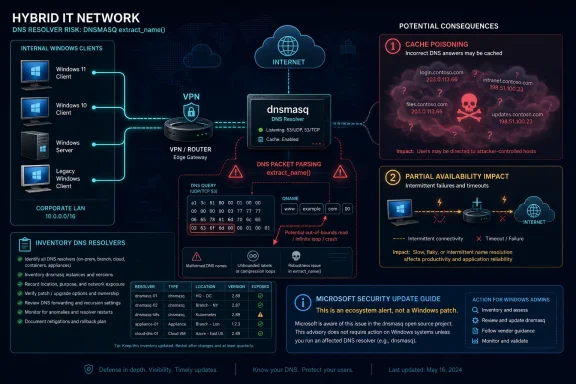
extract_name() DNS parsing code that can enable cache poisoning or denial of service in affected Linux and embedded resolver deployments, with Microsoft’s Security Update Guide carrying the record rather than shipping a Windows patch. That distinction matters, because the advisory can look like another item in the Microsoft patch stack when it is really a reminder that modern Windows estates depend on much more than Windows. The risk is not a Hollywood-style “Internet down” event, but something more operationally familiar: name resolution that becomes intermittently unreliable or subtly wrong. For IT teams, that can be worse than a clean outage.
 Microsoft’s Advisory Is a Signpost, Not the Center of Gravity
The first trap with CVE-2026-2291 is the domain name on the advisory. When a vulnerability appears in the Microsoft Security Update Guide, many Windows administrators instinctively ask which cumulative update, Defender platform build, Edge release, or Office channel needs attention. In this case, the answer is more awkward: the affected component is dnsmasq, a small but widely deployed DNS forwarder and DHCP/TFTP server most often associated with Linux, routers, appliances, containers, and network utilities.That does not make the CVE irrelevant to WindowsForum readers. It makes it exactly the sort of vulnerability that slips between teams. Desktop administrators may assume it belongs to the network group. Network engineers may assume the Linux team patched the package. The Linux team may know the distro fixed dnsmasq but not know whether the same code is embedded in a firewall, Pi-hole instance, lab router, hypervisor appliance, IoT gateway, or test image that nobody treats as production until it breaks production.
Microsoft’s presence here is best read as ecosystem plumbing. The company’s security guide increasingly functions as a risk-management surface for vulnerabilities that affect customers’ environments, not merely binaries with a Microsoft logo. That is sensible in a cloud-and-hybrid world, but it also raises the risk of misreading the operational action. A Windows admin who searches for “KB for CVE-2026-2291” may be solving the wrong problem.
The primary issue described by public Linux vendor advisories is a heap buffer overflow in dnsmasq’s
extract_name() function. In plain English, the resolver can mishandle crafted DNS name data while parsing packets. Depending on the path and build, that can open the door to poisoned DNS cache entries, process crashes, service interruption, and, according to some vendor wording, possible arbitrary code execution.The phrase supplied in the advisory material — “performance is reduced or there are interruptions in resource availability” — is the CVSS way of saying the availability impact is limited rather than catastrophic. It is not a promise that users will not notice. DNS failures rarely feel partial to the person whose browser, VPN, package manager, authentication flow, or line-of-business application suddenly cannot find the service it needs.
The Small Resolver With a Large Blast Radius
Dnsmasq is popular precisely because it is small, flexible, and easy to embed. It can provide DNS caching, DHCP, PXE-related services, and lightweight name-resolution glue without the ceremony of a large enterprise DNS stack. That makes it attractive for home labs, branch offices, appliances, developer networks, virtualization hosts, routers, and ad-blocking setups.The danger is that infrastructure like this becomes invisible. Nobody opens a change-control meeting by saying, “Today we are relying on a tiny DNS forwarder to keep the business functioning.” Yet when dnsmasq sits between clients and authoritative answers, it becomes part of the authentication path, the software-update path, the browsing path, and often the troubleshooting path. If it serves the wrong answer, users do not blame dnsmasq; they blame Windows, Teams, Outlook, the VPN, the domain controller, or “the network.”
CVE-2026-2291 is therefore less interesting as a single memory-safety bug than as a map of hidden dependency. A vulnerable resolver can be buried in a system that Windows clients depend on every day. That system may not appear in endpoint inventory, may not be covered by Windows Update compliance dashboards, and may not be watched by the same EDR tooling that covers laptops and servers.
The modern Windows estate is no longer a neat rectangle of domain-joined PCs and Windows Server roles. It is a mesh of Windows 11 endpoints, Entra ID, MDM, Linux appliances, WSL experiments, containers, cloud workloads, NAS boxes, branch routers, developer boards, and “temporary” DNS helpers that have been in production since 2019. CVE-2026-2291 is exactly the kind of issue that exposes that mesh.
“Low Availability Impact” Does Not Mean Low Business Impact
The advisory language around availability is easy to underweight. The CVSS framing says performance may be reduced or resources may be only intermittently available, but the attacker cannot completely deny service to legitimate users. That is a technical severity judgment, not a business continuity plan.DNS is one of the least forgiving places for intermittent failure. A file server that is down tends to stay visibly down. A resolver that sometimes answers, sometimes crashes, and sometimes returns poisoned data creates a fog. Applications cache results differently. Clients retry at different intervals. Administrators test from one machine and see success, while users elsewhere continue to fail. Incident channels fill with reports that appear contradictory because, at the protocol level, they are.
The cache-poisoning angle is even more uncomfortable. A denial of service is noisy; a bad DNS answer can be quiet. If a resolver caches attacker-controlled records, users may be sent to infrastructure they did not intend to visit. In tightly managed environments, TLS validation, HSTS, certificate pinning, and modern browser behavior can reduce the likelihood of seamless impersonation. But not every internal service is a hardened public website, and not every application fails safely.
That is why the “availability: low” label should not lull administrators into treating this as a minor nuisance. The direct impact on the component may be partial. The downstream impact on trust can be larger. DNS sits at the point where human intent becomes network destination; if that translation layer is unreliable, every dependent control inherits some uncertainty.
The Patch Story Is Fragmented by Design
Linux distributions moved quickly with patched packages in mid-May 2026, and Ubuntu, Debian, SUSE, and other ecosystems published advisories or tracker updates for affected dnsmasq builds. Ubuntu’s notice grouped CVE-2026-2291 with several other dnsmasq issues, which is typical for a package-level security update. Debian listed fixed versions for newer supported releases while older branches required separate attention.That distribution-by-distribution pattern is normal, but it is also why Windows-centric patch management can miss the issue. There is no single “install this Windows update” answer. The correct action depends on where dnsmasq exists: an Ubuntu VM, a Debian container base image, a Pi-hole deployment, a router firmware tree, a vendor appliance, a lab image, or a custom embedded build. Each has its own update channel, maintenance window, and owner — if it has an owner at all.
The most exposed systems are not necessarily the ones with the scariest labels. An Internet-facing dnsmasq listener is obviously risky, but many internal resolvers are attractive targets because they sit in trusted zones. A compromised workstation, rogue Wi-Fi client, malicious container, or attacker-controlled upstream response path can be enough to turn “internal only” into “reachable enough.”
This is where enterprise patch rhetoric breaks down. We talk about “applying the patch” as if every affected component is registered in a console and waiting for approval. In reality, dnsmasq may be part of a Docker image that gets rebuilt only when an application changes, or an appliance image whose vendor has not yet published firmware, or a home-office device outside formal IT but inside the daily workflow.
Microsoft’s advisory page can alert a Windows admin that the CVE exists, but it cannot tell that admin where dnsmasq is hiding. That discovery step is the work.
Windows Shops Have More Linux Than Their Dashboards Admit
For many Windows administrators, Linux has moved from “the other platform” to background infrastructure. WSL makes Linux tools local to developer workstations. Containers routinely use Linux base images even when the application team works on Windows laptops. Network security products, monitoring stacks, DNS filters, and home-lab tools often run on Ubuntu or Debian because that is where the documentation starts.This is not a criticism. It is the practical shape of modern IT. The problem is that responsibility often remains organized around old boundaries. The endpoint team owns Windows Update. The server team owns domain controllers. The cloud team owns Kubernetes. The network team owns appliances. The security team owns vulnerability scanning. Dnsmasq can appear in all of those worlds and be fully owned by none of them.
CVE-2026-2291 should push Windows-heavy organizations to ask a basic inventory question: which systems answer DNS for our users, devices, containers, labs, and branch networks? The answer should include more than Active Directory-integrated DNS. It should include forwarders, conditional resolvers, local caches, DNS filters, DHCP appliances, VPN-provided resolvers, and little “temporary” boxes that developers or admins set up to solve a routing problem years ago.
The Windows angle is especially sharp for small businesses and enthusiasts. A Windows 11 desktop may be perfectly patched while relying on a Pi-hole running on a Raspberry Pi, a Linux VM, or a NAS package for DNS. If that resolver is vulnerable and unpatched, the user’s effective security posture is weaker than Windows Update history suggests. The endpoint can be current and still be led astray by the resolver it trusts.
This is why vulnerability management has to follow trust paths, not vendor logos. If Windows clients depend on a Linux resolver, then a Linux resolver vulnerability is a Windows operational issue.
Cache Poisoning Turns DNS Into a Trust Problem
The denial-of-service portion of CVE-2026-2291 is the easiest to grasp. A crafted packet triggers bad behavior, the resolver crashes or loops, and users lose name resolution until the service restarts or the condition clears. That is unpleasant, but it is familiar.Cache poisoning is more subtle. A caching resolver exists to remember answers so clients do not have to repeat the same lookups. If an attacker can inject false entries into that cache, the resolver’s efficiency becomes a weapon. One bad answer can be served repeatedly to downstream clients until it expires or is flushed.
Modern DNS and transport security reduce some of the classic catastrophe scenarios, but they do not erase the risk. Internal services may still use private certificates, split-horizon names, legacy protocols, hard-coded trust assumptions, or application-layer behavior that is less robust than a modern browser. Even when TLS blocks full impersonation, poisoned DNS can still cause outages, misrouting, confusing certificate errors, failed updates, failed logins, or traffic diversion attempts worth investigating.
For administrators, the key point is that DNS cache integrity is not just a network hygiene issue. It is part of the security boundary in practice, even when architecture diagrams pretend otherwise. If a resolver is authoritative for the user’s first step toward a service, then poisoning that resolver can influence everything that follows.
That also means detection is difficult. The absence of a crash does not prove safety. The absence of user complaints does not prove cache integrity. Administrators need to think in terms of resolver logs, unexpected process restarts, strange answer divergence, unusual upstream traffic, and whether critical clients are receiving answers from the resolvers they are supposed to use.
The Home Lab Is Now a Production Dependency
Windows enthusiasts are unusually exposed to this class of bug because enthusiasts build rich local infrastructure. A typical home lab might include Windows 11 desktops, a Windows Server evaluation VM, Hyper-V, Proxmox, Docker, Pi-hole, pfSense or OpenWrt, a NAS, a few Linux VMs, and an experimental Kubernetes cluster. Dnsmasq may be present in more than one of those places.The same pattern exists in small offices, only with less visibility. A consultant installs a DNS-filtering appliance. A branch router handles DHCP and DNS forwarding. A developer adds a local resolver for test domains. A NAS package provides lightweight network services. Years later, users experience “Windows networking problems,” and nobody remembers that the first DNS hop is a tiny service running inside a box that has not been updated since the last office move.
This is why CVE-2026-2291 deserves attention even if the exploitability conversation remains more nuanced than a remote-code-execution headline. Infrastructure debt often announces itself through small components. Dnsmasq is not glamorous, but it is close to the ground. When it fails, the symptoms appear everywhere else.
Home users running Pi-hole or similar DNS-filtering setups should be especially careful not to assume that appliance-style software updates happen automatically. Some deployments update containers; others update host packages; still others require explicit image pulls, package upgrades, or full appliance firmware updates. “It still resolves names” is not evidence that it is patched.
For IT pros, the lesson is broader: if a system provides DNS or DHCP to anything you care about, it belongs in inventory. The fact that it is small, free, open source, embedded, or sitting under a desk does not make it optional.
Severity Scores Are Useful Until They Replace Judgment
CVE scoring is designed to normalize technical risk, not to decide your weekend. CVE-2026-2291’s public scoring has generally landed in high-severity territory because the attack can be network-reachable, requires no privileges, and needs no user interaction. At the same time, the availability language stresses limited rather than total service loss.Both statements can be true. A vulnerability can be technically serious because it is easy to reach and affects a trusted service, while still having an availability impact that is not total by CVSS definitions. That is why mature vulnerability management does not sort only by base score. It asks where the component sits, who can reach it, what it serves, whether exploit code is available, whether the system is exposed to untrusted traffic, and whether compensating controls exist.
For dnsmasq, placement matters enormously. A vulnerable instance serving an isolated lab VLAN is not the same as one forwarding DNS for a branch office, a guest network, or production containers. A resolver that can receive responses from attacker-controlled authoritative servers is not the same as one tightly constrained behind trusted upstreams and egress controls. A package in a dormant VM is not the same as a package in the path of every laptop authentication request.
The danger of advisory fatigue is that admins stop making these distinctions. Every week brings another CVE, another score, another vendor page, another scanner finding. CVE-2026-2291 is a useful reminder that the interesting question is not “Is this Microsoft?” or “Is this critical?” The interesting question is “Does this component mediate trust for systems I care about?”
If the answer is yes, patching should move quickly. If the answer is no, the finding still belongs in the cleanup queue — but it should not displace genuinely exposed infrastructure. That is judgment, not complacency.
The Practical Response Starts With Finding the Resolvers
The right first move is inventory. Administrators should identify dnsmasq packages on Linux servers and appliances, but they should also map functional DNS paths. Which resolvers do Windows clients receive from DHCP? Which DNS servers do VPN profiles push? Which resolvers do containers use? Which branch devices forward DNS? Which home-office or small-site deployments rely on Pi-hole or router firmware?Once the systems are known, patching is straightforward in principle and messy in practice. Distribution packages should be updated to vendor-fixed builds. Container images should be rebuilt from patched bases rather than merely restarted. Embedded devices and appliances should receive vendor firmware or configuration guidance. Where no update exists, exposure should be reduced by restricting who can query the resolver, limiting upstream paths, or replacing the component.
Admins should also clear caches after patching where poisoning is a plausible concern. A patched resolver with a stale malicious answer is still serving a bad answer until that record expires or is flushed. In many environments, cache flushing is a low-cost step that closes an uncomfortable gap between “the binary is fixed” and “the service state is trustworthy.”
Monitoring should focus on symptoms that fit the bug rather than generic “DNS is down” alerts alone. Unexpected dnsmasq restarts, segmentation faults, memory allocator errors, repeated service crashes, strange domain-to-IP mappings, spikes in malformed DNS traffic, and divergence between local cache answers and trusted upstream answers all deserve attention. For Windows teams, help-desk reports of intermittent certificate warnings or destination mismatches should not be dismissed as browser weirdness until DNS has been ruled out.
The best mitigation, however, is architectural humility. Do not expose lightweight resolvers to networks that do not need them. Do not let every VLAN talk to every DNS helper by default. Do not let a forgotten lab service become the resolver of record for production clients simply because it was convenient during a migration.
The Lesson Hidden in Microsoft’s Listing
There is a reason this CVE feels slightly odd in a Microsoft context. It is not a Windows kernel flaw. It is not an Exchange emergency. It is not an Edge zero-day. It is a vulnerability in an open-source resolver that Microsoft’s advisory ecosystem surfaces because Microsoft customers live in mixed environments.That oddness is the point. The Windows world is now deeply hybrid, even when the user interface remains familiar. A Windows 11 machine may authenticate against cloud identity, route through a VPN appliance, resolve through dnsmasq, run Linux tooling under WSL, deploy containers to Kubernetes, and consume SaaS services whose availability depends on a chain of DNS answers. Calling that a “Windows environment” is not wrong, but it is incomplete.
Security programs that remain organized around operating-system tribes will keep missing these seams. The attacker does not care whether the vulnerable resolver is on the Windows team’s patch calendar. The user does not care whether the broken DNS answer came from an appliance, a Linux VM, or a container sidecar. The business only sees that work stopped or trust failed.
CVE-2026-2291 is therefore a small test of operational maturity. The immature response is to say, “Not our platform.” The mature response is to say, “Does anything we rely on run this code?” That shift is the difference between patch compliance and actual resilience.
The Resolver Bug That Should Change Your Patch Meeting
CVE-2026-2291 should leave administrators with a short, concrete action list rather than a vague sense of DNS dread. The goal is not panic; it is to close the gap between what the advisory says and what your environment actually depends on.- Treat the Microsoft Security Update Guide entry as an ecosystem alert, not evidence that a Windows cumulative update remediates the affected component.
- Find every dnsmasq instance that provides DNS, DHCP, forwarding, filtering, or lab name-resolution services to Windows clients or production-adjacent systems.
- Apply fixed distribution packages, appliance firmware, container rebuilds, or upstream project updates rather than assuming a service restart changes the vulnerable code.
- Flush resolver caches after patching if the instance may have been exposed to malicious or untrusted DNS responses.
- Restrict resolver access so only intended clients and networks can query dnsmasq, especially in branch, guest, lab, and home-office deployments.
- Investigate intermittent DNS failures, resolver crashes, certificate warnings, and suspicious answer divergence as possible security signals rather than ordinary network noise.
CVE-2026-2291 will not be remembered like the great Windows worms or the emergency Exchange bugs, and that is probably appropriate. But it is the kind of vulnerability that reveals how real networks are built: out of small components, old assumptions, mixed platforms, and trust paths nobody fully documents until they fail. The organizations that handle it well will not be the ones that merely read Microsoft’s advisory; they will be the ones that use it as a prompt to find the hidden resolvers their Windows estate has been trusting all along.
References
- Primary source: MSRC
Published: 2026-05-27T01:40:02-07:00
Security Update Guide - Microsoft Security Response Center
 msrc.microsoft.com
- Related coverage: techradar.com
Microsoft confirms two major Defender security issues — so update now or face possible attack
CISA confirms two bugs being actively exploited in the wild, as Microsoft releases patches.www.techradar.com
- Related coverage: sentinelone.com
CVE-2026-2291: dnsmasq Buffer Overflow Vulnerability
CVE-2026-2291 is a buffer overflow vulnerability in dnsmasq. Learn about its impact, affected versions, and mitigation methods to protect your systems.www.sentinelone.com
- Official source: microsoft.com
MSRC - Microsoft Security Response Center
The Microsoft Security Response Center is part of the defender community and on the front line of security response evolution. For over twenty years, we have been engaged with security researchers working to protect customers and the broader ecosystem.www.microsoft.com - Official source: learn.microsoft.com
Security Advisories and Bulletins | Microsoft Learn
learn.microsoft.com
