

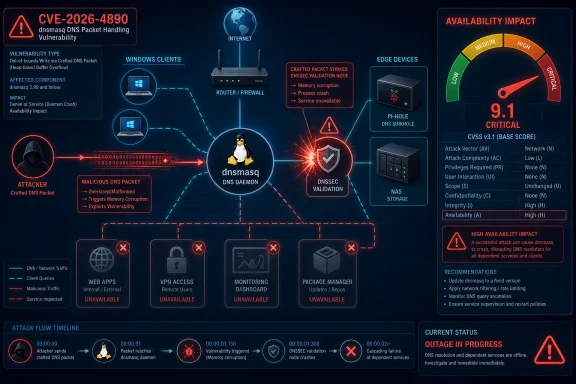
This Is a Linux-Flavored Bug With Windows-Sized Blast Radius
The affected component is dnsmasq, the compact open-source service widely used for DNS forwarding, DHCP, router-style name resolution, and small-network infrastructure. It is popular precisely because it is lightweight, boring, and embedded in places administrators do not always think to inventory. That makes CVE-2026-4890 the kind of vulnerability that rarely produces dramatic screenshots but can still take down practical access to applications.
The vulnerability sits in DNSSEC validation, the part of DNS resolution intended to verify that DNS answers have not been tampered with. According to coordinated vulnerability notes and Linux vendor advisories, a crafted DNS packet can trigger an infinite-loop condition or denial-of-service state in vulnerable dnsmasq builds. The result is availability loss, not stolen files or arbitrary code execution.
That matters because availability is not a second-class security property. A resolver that stops answering can make domain controllers look unreachable, SaaS applications appear offline, package managers fail, VPN clients hang, and monitoring dashboards light up with symptoms that all point somewhere else. DNS failures have a habit of masquerading as every other outage at once.
For WindowsForum readers, the key point is not whether Windows itself includes dnsmasq by default. It does not. The point is that Windows networks increasingly depend on Linux-shaped infrastructure in places where the help desk, endpoint team, and server team may not have clear ownership.
The CVSS Score Gets the Shape Right, but Not the Whole Story
CVE-2026-4890 carries a CVSS 3.1 base score of 7.5, with network attack vector, low attack complexity, no privileges required, no user interaction, no confidentiality impact, no integrity impact, and high availability impact. That vector is almost a textbook example of a pure denial-of-service vulnerability. It does not promise data theft. It does not require a user to open a file. It attacks a service exposed to network traffic.
The phrase “total loss of availability” can sound melodramatic until you remember what DNS does. In a small office, the vulnerable component may be a router, a Pi-hole instance, a NAS appliance, or a lightweight Linux VM providing DHCP and name forwarding. In a larger environment, it may be part of a lab network, container host, development cluster, virtualization bridge, or embedded product that nobody has patched since the last time it visibly broke.
The score also does not fully express where the vulnerable resolver sits. A lab-only dnsmasq instance is a nuisance. A branch-office DNS forwarder used by point-of-sale systems is a business incident. A resolver sitting inside a product or appliance that cannot be quickly updated is a change-management problem with a security label.
This is where vulnerability management becomes more art than spreadsheet. Two assets can report the same CVE and deserve very different treatment. The asset that answers DNS for humans, endpoints, or revenue systems moves to the front of the queue.
DNSSEC Turns a Security Feature Into an Attack Surface
DNSSEC is supposed to reduce trust in unsigned or forged answers by adding cryptographic validation to DNS. In principle, that is the right direction. In practice, validation code has to parse complicated inputs, handle malformed records, and fail safely under hostile conditions.
CVE-2026-4890 is a reminder that security features are still software. The fact that DNSSEC validation exists to harden DNS does not exempt it from parser bugs, loop conditions, memory safety issues, or state-machine mistakes. When validation goes wrong, the resolver may not merely reject a bad response; it may stop doing useful work.
This is especially awkward for administrators because DNSSEC enablement varies by product, distribution, and local configuration. Some devices compile dnsmasq without DNSSEC support. Some ship it enabled. Some expose a toggle in a web interface. Others bury the detail so deeply that the only realistic answer is to check the vendor advisory or package build flags.
That ambiguity should shape the response. The right question is not simply “Do we use dnsmasq?” It is “Do we use a vulnerable dnsmasq build in a role where DNSSEC validation can be reached by untrusted or semi-trusted traffic?” That narrower question is harder to answer, but it is the one that determines exposure.
The Coordinated Disclosure Was Bigger Than One CVE
CVE-2026-4890 arrived as part of a broader cluster of dnsmasq issues disclosed in May 2026. The same coordinated notes described vulnerabilities involving cache poisoning, information disclosure, DHCPv6 handling, heap behavior, and denial of service. That context matters because defenders often triage one CVE at a time while attackers and researchers look at a component as a whole.
The upstream dnsmasq project released fixes in the 2.92rel2 line, while Linux vendors began publishing distribution-specific packages. Ubuntu marked affected supported releases fixed through updated dnsmasq packages, including fixes for Ubuntu 24.04 LTS, 22.04 LTS, and newer releases. Debian listed fixed versions for bookworm security, trixie security, and unstable, while also showing older or pending release states that require careful reading.
Amazon Linux also published fixed dnsmasq packages for affected channels, and third-party security trackers rapidly added detection content. That patch spread is normal for open-source infrastructure, but it creates a timing problem. A vulnerability can be “fixed” upstream while remaining unfixed in a device firmware image, container base image, or long-lived appliance.
This is why the phrase “just update dnsmasq” is both correct and insufficient. On a managed Ubuntu server, it may be one package update and a service restart. On a consumer router, storage appliance, firewall, or vendor-managed virtual appliance, the administrator may be waiting for firmware, a hotfix, or a statement that never arrives.
Microsoft’s Presence in the Advisory Is a Signal, Not a Windows Indictment
The user-submitted source points to Microsoft’s Security Update Guide entry for CVE-2026-4890, which can make the issue look like a Microsoft vulnerability at first glance. That interpretation would be too simple. Microsoft’s security ecosystem tracks vulnerabilities that may affect Microsoft products, dependencies, services, container images, Linux offerings, cloud workloads, or downstream assets, even when the vulnerable code did not originate in Windows.
That distinction is important for Windows administrators who have learned to treat MSRC pages as Patch Tuesday territory. CVE-2026-4890 does not mean a Windows desktop suddenly ships dnsmasq. It means Microsoft’s orbit now includes enough Linux, cloud, container, and appliance-adjacent infrastructure that a dnsmasq flaw can be relevant to Microsoft customers.
Azure workloads, Linux VMs, container registries, developer environments, and hybrid networks all blur the old platform boundary. A Windows shop can be exposed through a Linux DNS forwarder supporting a Windows fleet. An Intune-managed laptop can be perfectly patched while the local network’s DNS resolver is brittle. A domain-joined device can look broken because the network service it depends on is not part of the Windows patch cadence at all.
That is the operational lesson. The Windows update button is necessary, but it is no longer a complete security program for a Windows-centered organization.
The Most Likely Failure Mode Is Boring, Which Makes It Dangerous
Denial-of-service vulnerabilities often receive less attention than remote code execution bugs because they do not immediately imply compromise. That is rational up to a point. If the choice is between patching an unauthenticated RCE and a resolver crash, the RCE usually wins.
But DNS denial of service has leverage. Attackers do not need to own a server if they can repeatedly knock out the name resolution that lets users, applications, and devices find everything. In environments with weak redundancy, a single vulnerable resolver can become the soft underbelly of otherwise well-patched systems.
The practical risk also depends on exposure. A dnsmasq instance listening only on a protected LAN faces a different threat model than one reachable from hostile networks. But “only on the LAN” is not the same as safe. Guest Wi-Fi, compromised endpoints, malware on a developer machine, misconfigured firewall rules, and container bridge networks can all turn internal services into reachable targets.
The deeper problem is that DNS is trusted by habit. Administrators may firewall databases, segment management ports, harden RDP, and still leave DNS infrastructure treated as plumbing. CVE-2026-4890 rewards that complacency by attacking the thing nobody wants to think about until it stops working.
Home Labs and Small Offices Are the Quietly Exposed Audience
Enterprise security teams have scanners, asset inventories, emergency change windows, and vendor account managers. They may still miss dnsmasq, but at least they have machinery designed to find it. Home labs, small businesses, and prosumer networks often do not.
That is where dnsmasq is everywhere. Pi-hole deployments, OpenWrt routers, NAS devices, hypervisor hosts, development VMs, and small Linux boxes commonly use dnsmasq or dnsmasq-derived functionality. A Windows-heavy household or office can still rely on it every time a laptop resolves a name, leases an address, or reaches a local service by hostname.
The patch path in these environments is uneven. A Pi-hole user may receive a fix through the project’s update mechanism. An Ubuntu box may receive fixed packages through apt. A router may depend on firmware. A forgotten VM may need manual attention from someone who built it two years ago and has not logged in since.
For enthusiasts, the advice is less glamorous than exploit analysis: find the boxes doing DNS and DHCP. Check the package version. Check whether DNSSEC is enabled. Patch or disable the vulnerable feature if the vendor’s guidance supports that mitigation. Then make sure there is a second resolver path if the first one fails.
Containers Make the Inventory Problem Worse
Containers create an additional wrinkle because dnsmasq may appear inside images, sidecars, test networks, and service meshes that are not part of the traditional server inventory. A vulnerability scanner might see the package in an image that is not actually used for DNS resolution. Or worse, it may miss a container that is actively forwarding DNS for a development or CI environment because nobody considered it infrastructure.
This is where security teams need to separate package presence from reachable behavior. The mere existence of a vulnerable dnsmasq binary inside a dormant image is lower priority than a running dnsmasq process listening on a network interface. But the only way to make that distinction is to combine image scanning, runtime inventory, and network observation.
Developers also need to pay attention to base images. If a project inherits dnsmasq through a distro layer, rebuilding against updated repositories may be enough. If the image pins packages, uses stale snapshots, or vendors binaries, the fix may require more deliberate intervention.
The container lesson mirrors the broader one: modern Windows environments are full of Linux dependencies because modern software delivery is full of Linux dependencies. Ignoring them because the endpoint fleet says Windows 11 is a category error.
Availability Bugs Belong in Incident Planning, Not Just Patch Queues
CVE-2026-4890 should push teams to think beyond patch compliance. If a crafted DNS packet can render a resolver unavailable, the first question is patch status. The second question is resilience. Can clients fail over to another resolver? Are the backup resolvers actually independent? Do DHCP scopes hand out multiple working DNS servers? Does monitoring detect resolver failure directly, or only the application errors caused by it?
Many environments have nominal redundancy that collapses under real failure. Two DNS servers may forward to the same vulnerable upstream appliance. Branch routers may advertise themselves as DNS forwarders but depend on a single local process. Endpoint configurations may list a backup resolver that is unreachable from the current VLAN. These design flaws are invisible until the outage.
Administrators should also be careful with mitigation language. Disabling DNSSEC may reduce exposure in some deployments if the vulnerable code path is tied to validation, but doing so trades one kind of security property for another. The better answer is to apply fixed packages or firmware. Temporary mitigations should be documented, time-limited, and revisited after vendor fixes land.
The incident playbook should include a fast path for DNS replacement. If the resolver is an appliance, know how to bypass it. If it is a Linux VM, know how to update and restart it. If it is a router feature, know whether clients can be pointed at another resolver through DHCP without touching every endpoint.
The Vendor Patch Maze Is the Real Operational Tax
The open-source ecosystem responded quickly, but “quickly” does not mean uniformly. Ubuntu, Debian, Amazon Linux, and other distributions publish fixes according to their own package versions and support windows. Security vendors create detections. Appliance vendors investigate whether their builds include the affected feature. Some products are not affected because DNSSEC was not compiled in or enabled. Others are affected but require firmware release cycles.
This is the part of vulnerability response that frustrates IT pros because it is mostly paperwork. You need to map a CVE to a package name, a distribution release, an appliance model, a firmware branch, and a feature setting. Then you need to prove to yourself that the update actually landed.
Version numbers can also mislead. A distro may backport a security fix into an older-looking package version rather than shipping the latest upstream dnsmasq release. Conversely, an embedded device may report an old upstream version with local patches. The only reliable answer is the vendor’s advisory or package changelog, not a simplistic “greater than” comparison copied from a scanner.
That does not mean scanners are useless. They are starting points. But CVE-2026-4890 is exactly the kind of issue where scanner output needs administrator judgment, especially in mixed Windows and Linux environments where the exposed service may sit outside the team that owns the endpoints.
The Windows Admin’s Job Is to Follow the Dependency, Not the Logo
A Windows administrator looking at CVE-2026-4890 should resist two bad instincts. The first is dismissing it because dnsmasq is not Windows. The second is panicking because it appeared in a Microsoft security feed. The correct response is dependency mapping.
Start with DNS and DHCP roles. Identify routers, Linux servers, hypervisors, NAS appliances, Pi-hole instances, container hosts, lab boxes, and cloud VMs that provide local name resolution or forwarding. Then determine whether they use dnsmasq, whether DNSSEC validation is enabled or compiled in, and whether a fixed vendor package is available.
For organizations with Microsoft-heavy tooling, this may require reaching outside the usual consoles. Defender, Intune, WSUS, and Windows Update will not necessarily tell you whether the branch router’s embedded dnsmasq build is vulnerable. Asset management and network discovery become the bridge between Windows operations and non-Windows dependencies.
The same logic applies to developers using WSL or Linux VMs on Windows workstations. A local dnsmasq instance used for testing may not be internet-facing, but it can still disrupt development workflows or expose a reachable service on a shared network. Treat developer infrastructure as infrastructure, not as harmless clutter.
The Concrete Work Starts at the Resolver
The practical response to CVE-2026-4890 is not complicated, but it does require discipline. Patch where vendors have shipped fixes, isolate where they have not, and make sure DNS failure does not become a mystery outage. The vulnerability is narrow; the dependency graph around it is not.
- Inventory systems and appliances that provide DNS forwarding, DHCP, local name resolution, Pi-hole-style filtering, router services, or lab-network DNS, even if they are not managed by the Windows team.
- Prioritize dnsmasq instances that are reachable from untrusted networks, guest networks, developer networks, container bridges, or broad internal client segments.
- Apply fixed packages or firmware from the relevant vendor rather than relying only on upstream version comparisons, because distributions often backport security fixes.
- Verify whether DNSSEC validation is enabled or compiled into the affected deployment, but treat feature disablement as a temporary mitigation rather than a substitute for patching.
- Test resolver failover so that a single dnsmasq process cannot make Windows sign-ins, SaaS access, package installation, VPN connectivity, or monitoring appear broken across an entire site.
- Re-run vulnerability scans after patching and confirm service restarts, because updating a package without restarting the active resolver may leave the old process in memory.
The Small Resolver Has Become Critical Infrastructure
CVE-2026-4890 is easy to underrate because it lacks the cinematic qualities of a remote-code-execution crisis. It is a denial-of-service flaw in a small utility, triggered through crafted DNS traffic, in a code path many users will never knowingly configure. Yet that is exactly why it deserves attention from Windows-heavy organizations: the small utility is often the thing holding the larger network together.
The larger lesson is not that dnsmasq is uniquely unsafe. It is that infrastructure has become layered, borrowed, and embedded. A Windows endpoint depends on a Linux resolver, which depends on a router firmware branch, which depends on an open-source package, which depends on a validation routine that can be reached by hostile input. The user only sees that Teams will not connect.
Security teams have spent years improving endpoint patching, identity controls, and cloud posture. The next gains are often in the unglamorous dependencies: resolvers, forwarders, local appliances, and embedded services that sit between patched clients and the internet they expect to reach. CVE-2026-4890 will fade into the usual churn of advisories, but the dependency it exposes will remain, and the organizations that treat DNS as critical infrastructure rather than invisible plumbing will be the ones that spend less time explaining why “the network is down” when only one small daemon stopped answering.
References
- CVE-2026-4890 CVE-2026-4890 MSRC · 2026-05-27T01:40:17-07:00