

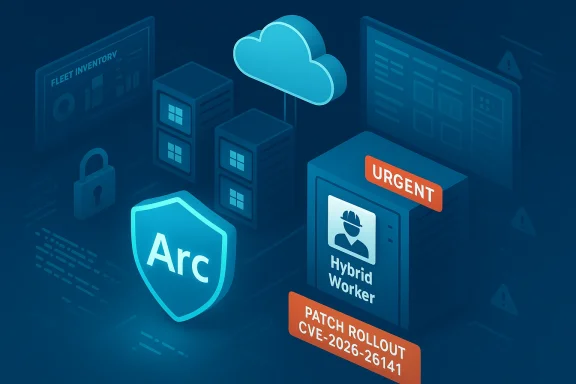
Microsoft has assigned CVE‑2026‑26141 to a newly disclosed Elevation‑of‑Privilege (EoP) defect in the Hybrid Worker Extension used on Arc‑enabled Windows VMs, and administrators must treat the entry as an urgent inventory, patching, and hunt priority while the vendor’s public technical detail set remains limited. (msrc.microsoft.com)
Microsoft’s Security Update Guide lists CVE‑2026‑26141 as an Elevation‑of‑Privilege vulnerability that affects the Hybrid Worker Extension deployed to Arc‑enabled Windows virtual machines. The public record classifies this as a local EoP issue in a cloud‑connected extension component; official text and tracking metadata emphasize the vendor’s confidence metric for the advisory (how sure Microsoft is that the vulnerability exists and how much detail is being released). (msrc.microsoft.com)
Independent CVE trackers and security briefings corroborate the vendor entry and show the advisory surfaced as part of Microsoft’s March 2026 updates, alongside several other Azure/Arc‑related privilege escalation fixes. These third‑party trackers list the same CVE identifier and mirror the vendor’s high‑urgency posture.
Action priorities for organizations should be:
Appendix — verification trail (selected authoritative references used in this article)
Source: MSRC Security Update Guide - Microsoft Security Response Center
 Overview
Microsoft’s Security Update Guide lists CVE‑2026‑26141 as an Elevation‑of‑Privilege vulnerability that affects the Hybrid Worker Extension deployed to Arc‑enabled Windows virtual machines. The public record classifies this as a local EoP issue in a cloud‑connected extension component; official text and tracking metadata emphasize the vendor’s confidence metric for the advisory (how sure Microsoft is that the vulnerability exists and how much detail is being released). (msrc.microsoft.com)Independent CVE trackers and security briefings corroborate the vendor entry and show the advisory surfaced as part of Microsoft’s March 2026 updates, alongside several other Azure/Arc‑related privilege escalation fixes. These third‑party trackers list the same CVE identifier and mirror the vendor’s high‑urgency posture.
Background: Hybrid Worker extension and Azure Arc context
What the Hybrid Worker extension does
The Hybrid Worker extension is the on‑VM component used when organizations deploy Azure Automation Hybrid Runbook Workers on machines that are managed by Azure Arc. It lets customers run automation jobs (PowerShell, scripts, runbooks) locally on servers that are not native Azure VMs while retaining central management and telemetry. Because it integrates with the Azure management plane and runs on hosts that may also house privileged services, the extension occupies a sensitive position in the hybrid management stack.Why Arc and extensions matter for security
Azure Arc and the Azure Connected Machine agent (commonly called azcmagent) act as a bridge between on‑prem or other‑cloud servers and Azure’s control plane. Extensions and agent services often:- Run with elevated service privileges on the host (to perform management tasks).
- Expose management channels and machine identity capabilities to the cloud.
- Have code paths that process metadata, tokens, or extension payloads — making them attractive targets for privilege escalation and identity abuse.
What Microsoft and trackers say about CVE‑2026‑26141
Vendor statement and confidence metric
Microsoft’s entry for CVE‑2026‑26141 in the Security Update Guide confirms the vulnerability’s classification (Elevation of Privilege) and maps it to the Hybrid Worker Extension (Arc‑enabled Windows VMs). The vendor’s guidance includes a confidence/credibility metric concept — a way to indicate whether the vulnerability is merely suspected, corroborated by outside research, or fully acknowledged and patched by the vendor. In this case Microsoft’s public record confirms the CVE and associates it with the March 2026 security rollup. (msrc.microsoft.com)Independent confirmation and timeline
Multiple independent CVE aggregators and security outlets registered the item contemporaneously with Microsoft’s March 10, 2026 updates, noting CVE‑2026‑26141 as part of a cluster of cloud‑management and Arc‑related fixes. Those trackers reproduce the vendor classification (EoP) and mark the entry as needing immediate attention in Arc‑enabled fleets.Technical scope and impact — what we can verify
Because Microsoft’s publicly published advisory is terse on low‑level exploit details (a common practice when rolling out fixes), several key points are straightforward to verify while others remain undercontrolled by the vendor’s disclosure policy.- Affected component: Hybrid Worker Extension on Arc‑enabled Windows VMs (the extension that enables Hybrid Runbook Workers for Windows under Arc management). (msrc.microsoft.com)
- Impact: Elevation of Privilege — if exploited successfully a local actor could obtain higher privileges on the host, potentially up to SYSTEM. Multiple third‑party trackers characterize the flaw as enabling local privilege escalation in practice.
- Attack vector: publicly described as a local issue; exploitation likely requires local access (authenticated low‑privileged user or process) to the host or an ability to influence extension behaviors. Public records do not assert a remote, unauthenticated attack path at this time. (msrc.microsoft.com)
- Patch status: Microsoft released security updates in the March 10, 2026 security roll‑up that include fixes for this CVE; administrators should assume a patch is available and apply it according to vendor guidance.
Why this matters to enterprise defenders
Elevated privileges in a management agent is a high‑impact failure mode
Extensions and management agents typically run with broad local privileges to perform tasks such as patching, configuration, and running automation. A local EoP in such a component lets an attacker:- Move from a low‑privilege user account to SYSTEM on an Arc‑connected host.
- Abuse the host’s machine‑identity (managed identity) to request access to resources in the tenant if extra controls are absent.
- Tamper with extension lifecycle (install/uninstall/repair), creating persistence or further attack surface for lateral movement.
Operational risk: inventory and patching complexity
Arc adopters often have hybrid fleets with diverse OS versions and patch cadences. Tracking which VMs have the Hybrid Worker extension installed — and which extension versions are present — is essential because the CVE maps to an extension rather than a core OS binary. This elevates the need for per‑host extension inventory and for testing patch deployments in staged runs before widescale rollout. Multiple community advisories published alongside Microsoft’s update guidance called this patch cluster a high‑priority item for Arc customers in March 2026.Practical remediation and mitigation steps (for operators)
Below is a prioritized checklist for security and ops teams. Apply the numbered actions in order if possible; the goal is to reduce immediate risk and then ensure long‑term resilience.- Inventory first
- Enumerate Arc‑enabled Windows VMs and record which have the Hybrid Worker extension installed.
- Map extension versions against vendor KBs and the March 10, 2026 patch metadata. Use your configuration management system or Arc inventory APIs to produce a definitive list. (msrc.microsoft.com)
- Patch quickly (but safely)
- Apply Microsoft’s released updates that address CVE‑2026‑26141 to affected extension packages and to the host OS if Microsoft maps the CVE to any OS KB.
- Where possible, perform rolling updates: patch a test cohort first, validate functionality (runbooks, extension tasks), then scale the rollout. Third‑party trackers and press reports confirm the fix was shipped in the March 10, 2026 update bundle.
- Harden local access and reduce attack surface
- Restrict local logon and service start privileges to the minimum necessary.
- Harden service permissions for Arc agents and extension installers so ordinary users cannot trigger repair/installer operations. Prior advisories for other Arc/azcmagent issues noted installer repair and service restart sequences as abuse avenues.
- Temporary compensating controls (if patching is delayed)
- If you cannot patch immediately, consider removing the Hybrid Worker extension from non‑critical machines, or disabling Hybrid Runbook Worker capability on machines that do not require it.
- Increase monitoring and host EDR watchlists for suspicious restarts of Arc/extension services, unusual child processes spawned by extension services, or tampering with extension folders. (These are pragmatic, actionable mitigations based on the operational role of extensions.)
- Audit and rotate credentials where applicable
- If you suspect a compromise or have evidence of suspicious activity on affected hosts, rotate any service principals or managed identity credentials that might be at risk and re‑provision agent/server identities after remediation. Compromised machine identities are a particularly hazardous post‑exploit consequence.
- Post‑patch validation
- Verify that the Hybrid Worker extension functions correctly after patching by running representative runbooks and monitoring telemetry.
- Confirm extension version and patch level across your Arc fleet, then document the change window and any exceptions.
Detection and threat hunting guidance
Because the public advisory does not publish exploit code or full technical details, detection requires a combination of vendor guidance, baseline comparisons, and hunting for suspicious behaviors that align with EoP and extension abuse.- Indicators to start with:
- Unexpected restarts or crashes of the Hybrid Worker extension service or azcmagent around the time of local user activity.
- Creation or modification of extension executables, scripts, or configuration files in extension directories on Arc hosts.
- Execution of unexpected processes from extension service accounts or the Hybrid Worker process context.
- Abnormal authentication attempts by machine‑identities in tenant logs shortly after suspicious local activity (a potential sign of identity compromise).
- Queries and signals:
- Host EDR: search for process trees where a low‑privileged user process spawns cmd/PowerShell under the extension’s service account context.
- SIEM: correlation rules for service restart events plus local user account changes or scheduled task creation.
- Azure audit logs: attempts to use machine‑assigned identities to request resource access that were not previously observed.
Assessment: strengths and risks in Microsoft’s disclosure and vendor response
Strengths
- Microsoft acted with timely patching during a coordinated Patch Tuesday cycle (March 10, 2026), which is the correct operational model for high‑impact enterprise products. Third‑party coverage confirms the CVE appeared in the March updates.
- The vendor’s use of a confidence metric in the Security Update Guide helps defenders understand whether a CVE is preliminary, corroborated, or fully acknowledged — which improves triage decisions when many interdependent advisories land at once. (msrc.microsoft.com)
Risks and shortcomings
- Microsoft’s public advisory for CVE‑2026‑26141, like many modern vendor advisories, omits deep technical detail about the root cause and proof‑of‑concept attack steps. That reduces defenders’ ability to write highly targeted detection rules immediately. For high‑risk management‑plane components, this is a real operational gap: defenders need both the patch and contextual telemetry to confirm whether exploitation occurred. (msrc.microsoft.com)
- The extension‑centric nature of the flaw increases operational complexity: patched OS images do not fully mitigate extension vulnerabilities if extension payloads are not inventoried and updated. Organizations with large Arc fleets face nontrivial inventory and orchestration work to reach full coverage. Community advisories noted this complexity across other Arc‑related CVEs.
Readiness checklist for security teams (concise)
- Immediately inventory Arc‑enabled Windows VMs for installed Hybrid Worker extension and azcmagent versions. (msrc.microsoft.com)
- Prioritize patch deployment for production and internet‑facing Arc hosts; stage and validate before mass rollout.
- Harden host local accounts and restrict who can run installer/repair actions.
- Implement detection rules for service restarts, extension file tampering, and anomalous use of machine identities.
- Where immediate patching is impossible, consider removing or disabling the Hybrid Worker extension on nonessential hosts as a temporary control.
What we still do not know (and why that matters)
- Precise exploit mechanics: Microsoft’s advisory confirms the existence and impact class (EoP) but does not publish a low‑level root cause or exploit proof‑of‑concept at the time of the update. That means defenders must rely on behavior‑based detection and on vendor hotfix verification rather than artifact signatures. (msrc.microsoft.com)
- CVSS and exploitability scores: public trackers are updating entries, but an authoritative CVSS vector and exploitability assessment from NVD/MITRE may lag. Until those scores are published and stabilized, security teams should assume high impact and prioritize accordingly.
- Whether any in‑the‑wild exploitation preceded the patch: Microsoft has not, in the public advisory, indicated active exploitation for this CVE. Absence of that statement is not confirmation of absence; teams with high risk exposure should hunt proactively. (msrc.microsoft.com)
Final analysis and recommended posture
CVE‑2026‑26141 is, by vendor designation and independent confirmation, a credible Elevation‑of‑Privilege vulnerability in a management extension that sits at the intersection of host privilege and cloud identity. That combination makes the vulnerability materially more dangerous than a similar EoP confined to a single, isolated application.Action priorities for organizations should be:
- Patch and validate Arc extension versions across the estate with urgency.
- Reduce surface area by disabling Hybrid Worker capabilities on hosts that do not require runbook execution.
- Hunt for indicators of local exploitation, focusing on extension service behavior, file tampering, and abnormal machine‑identity usage.
- Treat Arc agent/extension security as an ongoing program: inventory, automated patching pipelines, and hardening of installer/service permissions will reduce future exposure.
Appendix — verification trail (selected authoritative references used in this article)
- Microsoft Security Update Guide entry for CVE‑2026‑26141 (vendor advisory, confidence metric). (msrc.microsoft.com)
- Third‑party CVE aggregators and trackers listing CVE‑2026‑26141 and summarizing the Patch Tuesday inclusion.
- Community and technical write‑ups on Azure Arc / azcmagent extension weaknesses and prior EoP patterns (used as operational context for detection/hardening recommendations).
Source: MSRC Security Update Guide - Microsoft Security Response Center
